









A small smear of melted chocolate ground into the seat of a pair of grey church slacks starts the ritual of embarrassment. The stain captures Greg Heffley with cruel precision, a boy who longs for social approval and moves through life marked by mishaps that often flirt with the scatological.
This opening image ushers viewers into the Disney+ animated feature Diary of a Wimpy Kid: The Last Straw, which draws its story from the third entry in Jeff Kinney’s book series. Kinney’s screenplay compresses that volume into a winter of domestic unrest.
Greg’s endless hunt for shortcuts, embodied in a fiasco involving an improvised snow-clearing machine, wears down his father, Frank. Spag Union, a strict military academy, rises in Frank’s imagination as a possible cure for his son’s wayward habits.
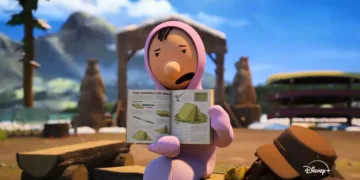
Susan, Greg’s mother, intervenes with a softer proposal: enlistment in the Wood Chippers, a scouting outfit that promises structure and values. Frank reluctantly takes on the role of guide within this group, and the film shapes itself into an examination of forced father-son closeness unfolding inside a swirl of animated mayhem.
The Architecture of Failure
Greg’s temperament shapes every scene he occupies. The film presents him as a selfish middle-schooler who hunts for the path of least effort. The script treats him as a tactician of avoidance; chores and friendships become puzzles that reward minimal labor and exaggerated payoff.
His fixation on his own status, sharpened by the anxiety of a middle child who fears invisibility, feeds his worst choices. He reaches for a rake as if it could serve as a shovel and launches a brawny-sounding snow business called Beefcake Snow Removal on a crude hand-drawn flier. Each miscalculation exposes the gulf between his inflated self-image and his limited abilities.
The friction between Greg and Frank gives the story its pressure. Frank’s irritation extends beyond annoyance at broken objects or fresh chaos in the yard. He reads Greg’s failures as a mirror held up to his own efforts as a parent, a reminder of lessons that never seem to land. When Lenwood Heath arrives, rebranded from bully to advocate for the stern discipline of Spag Union, the visit strikes Frank with particular force. The military school represents an outside authority that might correct the patterns he believes he cannot break at home.
The Wood Chippers scheme, resisted by father and son alike, forces them into close quarters. The film arranges their reluctant participation as a chain of shared tasks and mishaps that lean toward the absurd. Greg’s attempts to fake achievements collapse with regularity, and each failure opens space for Susan to steer the family’s emotional course. Her view anchors the film’s moral argument.
She stresses the simple fact of Frank showing up, staying present at Wood Chippers meetings and trips, as a value that exceeds any badge on a sash. The script revisits established series material, including the Safety Patrol fiasco, and reshapes it into a point of conflict between Greg and Frank. Through repeated embarrassments and clumsy efforts, the pair reach a small, hard-won version of success, discovering a fragile pleasure in the crooked shape of their cooperation.
The Comedy of Repetition
The film’s humor relies on a familiar ladder of escalation. Set pieces lean on slapstick, with exaggerated accidents and constant physical risk taking precedence over sharp dialogue. An early lawnmower episode establishes the pattern. A machine lurches out of control, yards suffer fresh damage, and animals scatter in panic while the sequence piles mishap upon mishap in quick succession.
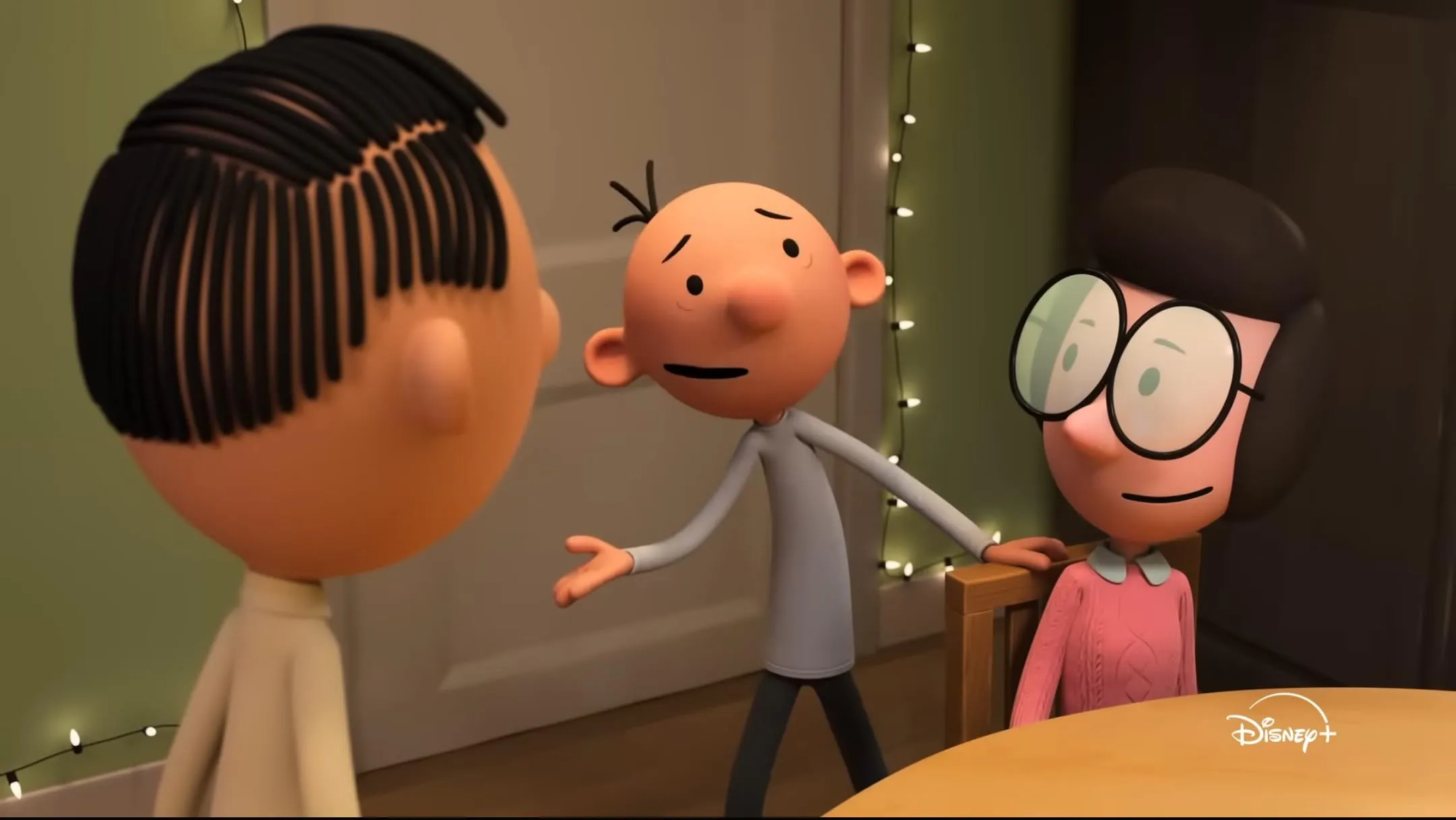
These Rube Goldberg-esque chains of cause and effect define Greg’s environment and reflect his taste for shortcuts that collapse under their own weight. The style suits the Wimpy Kid universe, yet the constant repetition of the formula with limited change in rhythm or invention turns many gags into predictable outcomes for viewers who hope for more intricate comedy.
The script also leans into unabashedly juvenile humor. Repeated gross-out bits, especially the misread chocolate smear on Greg’s church clothes, satisfy an expectation that family animation will traffic in bodily embarrassment. Younger viewers receive easy laughs, while the series signals a kind of creative stasis. The visual gag of Greg’s self-advertised “Beefcake” persona belongs to the same register of blunt, physical comedy and underlines how the film courts a very young sense of amusement.
Kinney’s screenplay performs its basic duties yet reveals the strain of adapting episodic material into a single arc. The story stretches to cover what feels like a full season of mishaps that build toward Frank’s ultimatum. Certain developments, especially the speed and intensity of Frank’s willingness to send Greg to military school, carry an air of exaggeration designed to keep the stakes high.
The film pulls strands from several books, brings in figures such as Patty Farrell, and borrows plot turns that lie outside the original volume. This approach seeks a kind of narrative consolidation and creates an on-and-off rhythm that can weaken emotional momentum. The thinner presence of Rowley and Rodrick, two of the series’ liveliest counterweights, registers sharply. Their easy, offbeat humor recedes so the film can concentrate on the father-son dynamic, and that choice leaves a perceptible gap.
Visual Style and Execution
The Last Straw adopts a deliberately low-tech visual style consistent with the recent animated entries. The images echo the rough charm of Greg’s journal sketches and treat his drawings as the template for the entire world. That decision ties the film’s look directly to the protagonist’s imagination and preserves the hand-drawn identity that has marked the books. The aesthetic operates as both framing device and brand marker for the franchise.
This stylistic commitment comes with visible trade-offs. Character motion often appears stiff, and that rigidity mutes the emotional nuance that fluid animation can suggest. The imagery retains coherence yet rarely introduces invention that might surprise viewers who watch a wide range of family animation.
Directors Matt Danner and Gino Nichele stage several action passages with verve, especially the Wood Chippers camping excursion and the frantic indoor soccer match. Certain details, particularly the handling of water effects, display extra polish and signal a technical step forward from earlier animated installments.
The voice work supplies much of the film’s texture. Aaron Harris delivers Greg’s self-serving adolescent whine with precision, and Chris Diamantopoulos shapes Frank’s dialogue into a portrait of weary parental strain. Their performances give the family friction a recognizable, lived-in sound that strengthens the drama even when the animation feels limited. The consistency of the casting helps the film hold together and allows the vocal performances to carry weight that the visuals do not always provide.
Diary of a Wimpy Kid: The Last Straw premiered on Disney+ on December 5, 2025. This computer-animated film is the fourth feature adaptation in the series for the platform and is based on the third book by Jeff Kinney. It follows Greg Heffley as his father, Frank, reaches his limit with Greg’s chronic mischief, leading to a tense winter where Greg must join a scouting troop to avoid being sent to a military academy. The movie is available to stream exclusively on Disney+.
Full Credits
Title: Diary of a Wimpy Kid: The Last Straw
Distributor: Disney+
Release date: December 5, 2025
Rating: PG
Running time: 1 hour 17 minutes (or 77 minutes)
Director: Matt Danner, Gino Nichele
Writers: Jeff Kinney
Producers and Executive Producers: Jeff Kinney, Tina Chow, Richard Grieve
Cast: Aaron D. Harris, Chris Diamantopoulos, Erica Cerra, Hunter Dillon, Jude Zarzaur, Gracen Newton, William Stanford Davis, Bashir Salahuddin, Jill Basey, Jabari Banks
Editors: Joe Wiesen
Composer: John Paesano, Adam Hochstatter
The Review
Diary of a Wimpy Kid: The Last Straw
The animated adaptation succeeds when focusing on the core father-son relationship, offering tender, recognizable moments beneath the chaos. While the visual style is deliberately rudimentary and the humor frequently relies on simple, repeated slapstick, the film maintains the franchise's accessible charm. It lacks true creative ambition, yet it functions as satisfying, if familiar, family entertainment.
PROS
- The emotional dynamic between the father and son is developed and heartfelt.
- The narrative efficiently blends various book elements to sustain the plot.
- Features valuable messages about growth through failure and the importance of parental presence.
- Aaron Harris and Chris Diamantopoulos deliver effective, recognizable performances.
CONS
- Heavy reliance on predictable, Rube Goldberg-style slapstick.
- The visual style, while accurate to the source, is technically limited and unexpressive.
- Key secondary characters like Rowley and Rodrick have noticeably less screen time.
- The film avoids pushing the creative limits of the franchise or the medium.