
























![Kingdom Hearts Collection [I-III] Review](https://gazettely.com/wp-content/uploads/2026/10/Kingdom-Hearts-Collection-I-III-1-360x180.webp "Kingdom Hearts Collection [I-III] Review: KHII Holds Steady as Newer Entries Fluctuate 37")



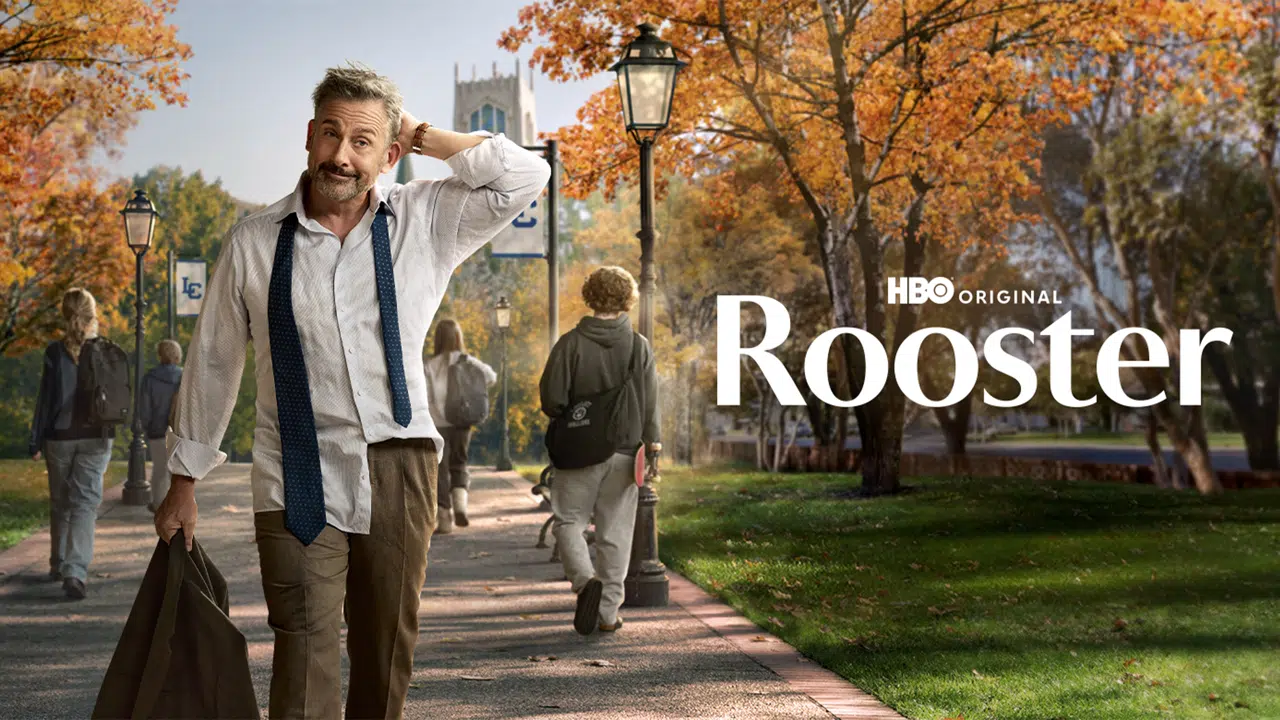

Steve Carell returns to television comedy with Rooster, a half-hour HBO series from creator Bill Lawrence and co-creator Matt Tarses, and the timing feels philosophically apt. Carell arrives on screen as Greg Russo, a bestselling author of pulpy “beach read” novels whose fictional hero goes by the Rooster, a swaggering alter ego Greg himself could never quite become. Divorced, emotionally stalled, and wearing his charm like a man who has forgotten why he put it on, Greg drives onto the autumn campus of the fictional Ludlow College in the Northeast, telling himself he has come to support his adult daughter, Katie (Charly Clive), a professor whose marriage has just collapsed after her husband Archie (Phil Dunster) left her for a graduate student named Sunny (Lauren Tsai). He stays because Ludlow’s mercurial president Walter Mann (John C. McGinley) maneuvers him into a writer-in-residence position.
Lawrence, whose creative fingerprints are across Scrubs, Ted Lasso, Shrinking, and Bad Monkey, makes his HBO Max debut here after years at Apple TV+. The shift in platform does not fundamentally alter his instincts. Rooster carries his signature warmth and ensemble intelligence, and yet something in the writing has not fully arrived. The cast is exceptional. The show, across its first six episodes of a ten-part season, is still finding the courage to match them.
The Campus as Comfortable Cage
Ludlow College, dressed in fallen leaves and faculty intrigue, functions less as a setting than as a sealed world. The small-campus atmosphere gives the show its coziest quality: everyone knows everyone, every corridor carries gossip, and the social geometry is tight enough that Greg’s arrival ripples through the ensemble immediately. Lawrence has always understood that a contained environment creates the conditions for a particular kind of comedy, one where escape is theoretically possible but nobody leaves.
The rhythm of the show is distinctly Lawrence. Humor accumulates through character behavior rather than set pieces: Greg’s dad jokes, physical mishaps, and chronic social misreads. The second episode deliberately pulls the camera away from Greg to let the ensemble breathe independently, a structural choice that pays quiet dividends. Watching Walter and Dylan negotiate a budget decision, or Archie and Sunny exist together without Greg’s projections crowding the scene, the show earns its world-building the slow way.
The wobble arrives in the show’s treatment of campus politics and generational friction. Rooster gestures toward satire of academic political correctness but retreats before committing to any actual point of view. The student characters, particularly those meant to embody a hypersensitive Gen Z culture, are drawn with a flatness that reads less as critique and more as caricature. The show’s warmth, which is its greatest asset, becomes a kind of avoidance here. Being likable is the safest possible posture, and Rooster wears it like armor.
Plot in a Holding Pattern
The narrative machinery of Rooster is simple by design. Katie’s marriage has exploded in the particular, humiliating way that leaves no dignified exit: her husband left her for a younger woman on the same campus where she works. Greg arrives to help, stays to teach, and the question becomes what either of them will do with this unwanted second act. The father-daughter dynamic, in its best moments, carries the bruised tenderness of decades of imperfect love. Greg’s advice to Katie, to “be kind” before speaking to Archie, lands as something earned rather than prescribed, a man passing on hard wisdom gathered from his own wreckage.
The structural problem is that the Katie-Archie story loses momentum almost before it gains it. By the end of the second episode, the situation feels provisionally resolved, and the subsequent four episodes struggle to identify a new engine. Archie circles back, Sunny remains peripheral, and Greg’s own emotional arc, the quiet grief beneath his awkward surface about his own divorce, is handled with such restraint that it barely registers as movement. A philosophical question lurks inside this narrative: can people genuinely change, or do they merely reposition themselves? The show declines to press on it.
The female characters present the sharpest irony in the writing. Greg’s novels are criticized, within the show itself, for writing women poorly. The campus scenes are peppered with challenges to his blind spots. And yet Sunny and Cristie (Annie Mumolo) are given glimpses of full personhood before being folded back into the supporting architecture of Greg’s story. The self-awareness is right there in the text; the follow-through is absent. It is the kind of gap that is difficult to overlook precisely because the show opened the door to it.
The physical comedy sequences, Greg’s classroom fall, the accidental arson, a name misspelled on a whiteboard that earns him an unwanted nickname, are the moments where Rooster finds its loosest, most confident register. The slapstick works because it is unguarded.
A Cast Operating Above Their Material
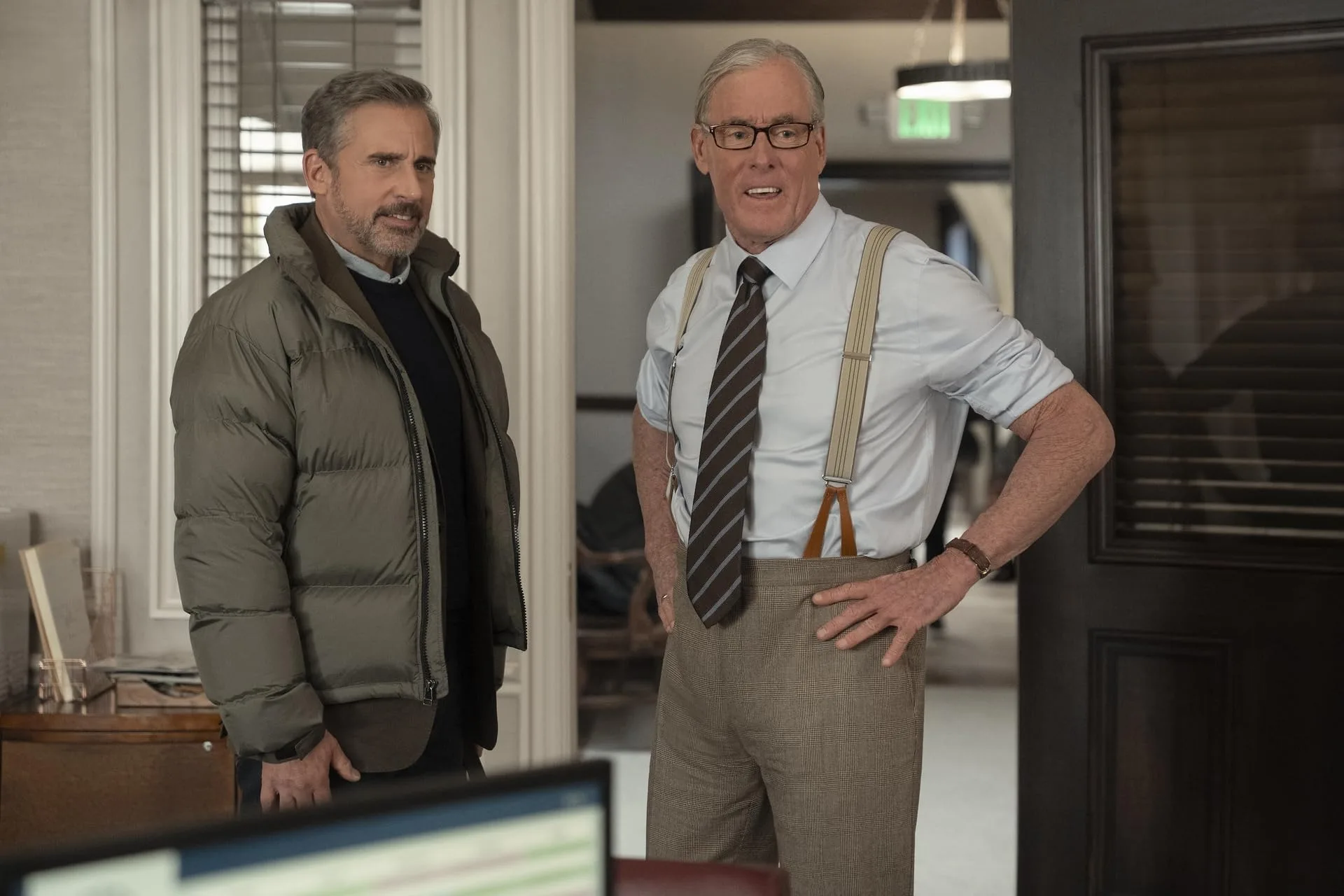
Steve Carell is doing precise, considered work as Greg Russo. This is a man who has social intelligence but consistently applies it a beat too late, who knows when he has said the wrong thing and apologizes in the same breath, who has written a swaggering fictional hero and now lives in the shadow of that creation. Carell neither retreats into earlier comedic territory nor performs a clean dramatic reinvention. Greg occupies a specific middle ground: functional, self-aware, perpetually miscalibrating. The dad jokes work because Carell does not wink at them. His physical comedy remains sharp. In quieter moments, particularly in scenes with Dylan, his face does something subtle and true, registering a man aware of his own loneliness without knowing what to do with that awareness.
Charly Clive, as Katie, is the series’ most welcome revelation. Katie carries grief, anger, and dry humor in a combination that feels genuinely inhabited rather than scripted. Her chemistry with Carell is immediate; they read as a real father and daughter, carrying the invisible weight of shared history. Katie has the widest emotional range of any character in the show, and Clive handles all of it.
Danielle Deadwyler, primarily known for dramatic roles, discovers a comic register here that is both relaxed and precise. Dylan is professionally accomplished, personally isolated, and she opens up to Greg with a directness that the writing respects. The dynamic between Greg and Dylan, tentative, genuinely awkward, charged without being manufactured, is the show’s most patient and rewarding throughline. A scene on Dylan’s doorstep after their first evening together achieves something rare: real social agony played for both comedy and feeling simultaneously.
Phil Dunster as Archie performs a carefully calibrated act of subversion. Archie is pompous, intellectually vain, and periodically disarming in exactly the way that makes him difficult to dismiss cleanly. The audience is positioned to dislike him while the writing keeps slipping him back into sympathy. Dunster holds both registers at once without visible strain.
John C. McGinley’s Walter Mann is the ensemble’s most reliable source of pleasure. Walter operates by his own internal logic, nakedly ambitious, genuinely warm, constitutionally unable to read a room he has already decided he owns. McGinley’s delivery, cataloguing sauna rules or offering unsolicited life advice half-dressed in his office, is consistently funnier than the script requires. He is the show’s secret engine.
The Weight of Starting Over
The philosophical preoccupation running through Rooster, rarely stated aloud, is the question of what it costs to begin again once you are old enough to know what beginning costs. Greg and Katie are both midway through their lives and midway through their grief, and the campus, with its enforced cycles of arrival and departure, places them in an environment built around fresh starts while they are still trying to survive an ending.
The father-daughter dynamic carries the show’s most honest emotional weight. Parenting an adult child is a peculiar existential condition: the authority has expired, the instinct to protect has not. Greg gives Katie advice she will ignore, stays close when she tells him to leave, and absorbs the frustration that comes with being both needed and resented. Their exchanges pack decades of history into brief scenes, and the writing earns those compressions.
Both Greg and Katie are in parallel crisis, each watching the other and seeing a reflection they would rather not acknowledge. Greg coaches his daughter through a marital collapse while his own divorce, five years old and still unprocessed, sits beneath every scene. The campus offers both of them a provisional version of second chances, and the show is most alive when it sits with the uncertainty of that.
Rooster reaches for something real about identity and work in Greg’s relationship to his own fiction. The Rooster character is Greg’s idealized self, bolder and freer, and teaching writing forces Greg to stand before an audience and speak with authority he does not quite feel. This thread is underdeveloped across the first six episodes, but the outline of something sharp is visible.
Greg and Dylan’s connection traces the loneliness that competent, functional people carry without advertising it. Both are skilled at their work and uncertain in their private lives, and the show, at its quietest, understands that being a capable adult is no guarantee of knowing what you actually want.
Rooster is an American comedy series that premiered on HBO and the Max streaming platform on March 8, 2026. Created by the powerhouse duo behind hits like Ted Lasso and Scrubs, Bill Lawrence and Matt Tarses, the show stars Steve Carell as Greg Russo, a middle-aged author of popular mystery novels. Set against the backdrop of a college campus, the narrative explores Greg’s efforts to navigate a complicated relationship with his daughter, played by Charly Clive, while interacting with a quirky cast of faculty and students. Following a successful debut and critical praise for its heart and humor, the series was quickly renewed for a second season in April 2026.
Where to Watch Rooster Online





Full Credits
Title: Rooster
Distributor: HBO, Max
Release date: March 8, 2026
Rating: TV-MA
Running time: 30–34 minutes
Director: Bill Lawrence, Matt Tarses, Jonathan Krisel
Writers: Bill Lawrence, Matt Tarses, Barbie Adler, Annie Mebane, David Stassen, Anthony King
Producers and Executive Producers: Steve Carell, Bill Lawrence, Matt Tarses, Jeff Ingold, Liza Katzer, Jonathan Krisel, Barbie Adler, Annie Mebane, David Stassen, Anthony King, David Hyman
Cast: Steve Carell, Danielle Deadwyler, Phil Dunster, Charly Clive, Lauren Tsai, John C. McGinley, Annie Mumolo, Rory Scovel, Robby Hoffman, Maximo Salas, Brenda Strong, Connie Britton, Alan Ruck
Director of Photography (Cinematographer): Blake McClure
Composer: Andrew Watt
The Review
Rooster
Rooster is a show of genuine warmth and exceptional performances constrained by writing that too often settles for comfort over courage. Carell, Clive, Deadwyler, and McGinley operate at a level the scripts do not always meet. The father-daughter dynamic is tender and true; the structural wobbles and underwritten female characters are real costs. Lawrence's instincts remain sound, and the final four episodes may reshape the whole. For now, Rooster is a pleasant, occasionally moving comedy that keeps promising something braver than it delivers.
PROS
- Exceptional ensemble cast across the board
- Genuine emotional warmth in the father-daughter dynamic
- Greg and Dylan's slow-burn connection is the show's most rewarding thread
- Physical comedy sequences land with confidence
- McGinley steals every scene he occupies
CONS
- Female characters are underwritten despite the show's own self-referential awareness of this
- Campus political commentary lacks conviction
- The central Katie-Archie plot loses momentum quickly
- Greg's personal growth arc is too muted to register
- Overall writing falls short of the cast's capabilities







