























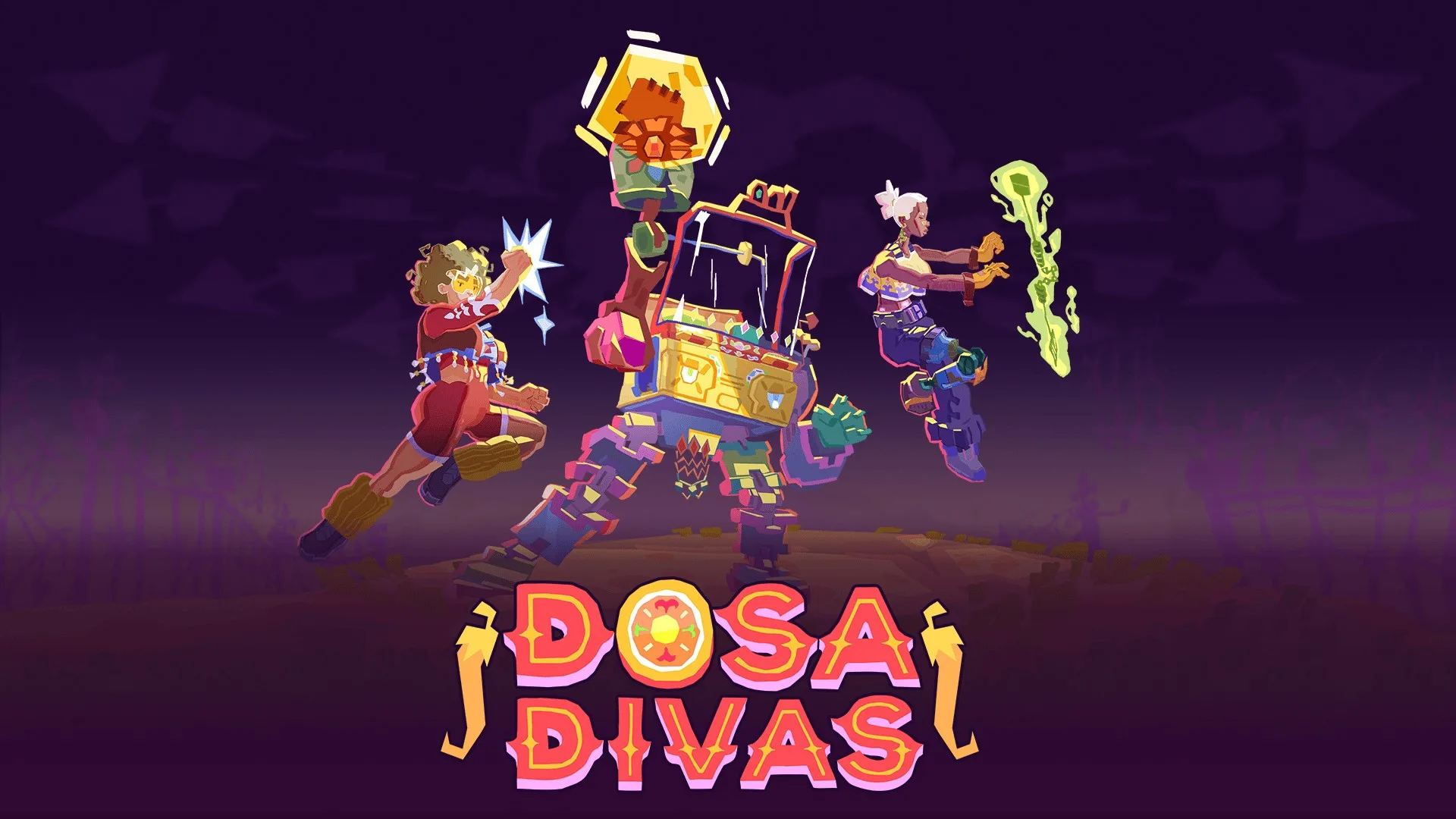

Food is one of the few things that genuinely crosses every boundary humans construct. A shared meal can rebuild a fractured relationship, a single dish can collapse decades and return you to a childhood kitchen, and the act of cooking carries meaning far beyond nutrition. Dosa Divas, from Outerloop Games, understands this with unusual clarity.
Set in the world of Meyndish, this turn-based RPG follows half-sisters Amani and Samara as they travel home to visit their parents after a decade apart. Their companion and vehicle is Goddess, a sentient bipedal food van with as much personality as either sister. Standing in their way is Lina, their youngest sibling, who has built LinaMeals, a corporate empire that replaced home cooking with processed tube food and made preparing a real meal a punishable offense.
Colorful, funny, and emotionally grounded, Dosa Divas completes in 9 to 13 hours, making it one of the most accessible RPG commitments in recent memory. Food functions as both its mechanical foundation and its emotional language, and the result is a game that lands considerably harder than its premise might suggest.
Family, Grief, and a Corporation Built on Slop
Amani and Samara’s road trip through Meyndish is structured as a series of village rescues. Buroth, a fishing settlement, has staged its own resistance against LinaMeals. Canopea, an underground village, was pushed below ground to gather resources for the corporation. Port Zest, a resort town, is the final destination. Each stop adds to the picture of what Lina has done to the land and to the people living on it.
What lifts Dosa Divas above a straightforward corporate-dystopia setup is the texture of Lina’s motivation. She is an antagonist, but her logic has roots in genuine emotional pain. Regular flashbacks reveal the family’s shared history: their parents’ restaurant, the accident that broke everyone apart, and the specific ways each sibling carried that fracture differently. Lina’s conclusion, that eliminating cooking will eliminate future suffering, is the kind of wounded logic that makes complete sense once you understand where it came from. Giving a villain that kind of interior coherence is a meaningful creative choice, and it pays off.
The game’s thematic concerns are handled with real care. Perfectionism, people-pleasing, resentment, and abandonment each receive proper attention, and the writing resists easy resolution. Past mistakes are not erased; forgiveness, where it arrives, is slow and earned. Food carries much of this thematic weight, framed consistently as an act of love, memory, and cultural identity. The contrast between Lina’s tube meals and the home-cooked food the sisters restore to the villages runs deeper than sustenance. A quiet critique of convenience culture threads through the whole game, the idea that meaningful rituals erode without people noticing until they are already gone. The anticapitalism angle is pointed, if not especially fresh. The specificity of the writing keeps it from feeling generic.
Amani and Samara’s relationship is the emotional engine of the experience. Back after a decade away, Amani slips easily into old habits of authority. Samara, who has done real growing up in that time, meets her with unexpected resistance. Their friction is convincing because it is rooted in love that has been stretched rather than broken, and their dialogue captures that tension with economy and precision. There are also well-placed dialogue choices that let players inhabit Samara’s perspective at key moments, which deepens investment without overcomplicating the structure.
Goddess earns her place as the third member of the family. She is present in nearly every moment that matters, and her dual role as mobile kitchen and battle companion gives her a practical logic that reinforces her emotional one. Kabi, the merchant the sisters rely on for supplies, provides much of the game’s comedy. His relentlessness could easily have read as uncomfortable; the fact that it plays as roguish charm is a genuine piece of tonal skill from the writers.
The Divas, the broader class of mechs whose involvement grows in the second half, are where the character work falters. Their designs are excellent, but they do not receive the narrative attention needed to make their role feel earned. The family drama that drives the first half is considerably more affecting than the mythology that grows around it, and the second act suffers for leaning away from its strongest material. After the confrontation with Lina, players return to the same three areas collecting key items, facing familiar enemies in familiar spaces. The closing moments land with genuine emotional weight, and the final message carries the kind of quiet resonance that may prompt real personal reflection. Getting there, though, requires a stretch the writing cannot fully sustain.
Flavor Over Force
The turn-based combat system places Amani, Samara, and Goddess into a party of three, each contributing basic attacks, skill attacks, and a shared Ultimate ability. The most distinctive design decision is the replacement of traditional elemental typing with a flavor-based system: sweet, sour, spicy, salty, and savory. Enemies carry flavor weaknesses, and landing enough hits of the right type drives them into a “Stuffed” state, leaving them vulnerable to significantly increased damage. It is a clever recontextualization of a familiar mechanic, and one that fits the game’s identity exactly.
Timed inputs thread through every layer of combat. Pressing a button at the right moment during an attack extends combos or increases damage; doing the same during an incoming hit reduces or negates it entirely. A perfect block absorbs the hit completely. Different skills use different input types, some requiring precise timing windows, others demanding button mashing, and some functioning as charge holds. The variety keeps combat physically engaged in a way that pure menu-based turn systems do not.
Boss fights are where the system earns its best moments. Timing, flavor targeting, and the Stuffed mechanic pull together under pressure in ways that feel genuinely satisfying. Landing a crippling hit on a boss carefully weakened to the right flavor threshold carries a specific kind of payoff that the regular encounter design never quite matches.
Regular encounters tell a different story. Each character unlocks additional skills as the game progresses, but the later unlocks largely replicate existing animations across different party members: what Samara does with a wok, Amani eventually does with a spatula. The sense of expanding possibility flattens. Compounding this, skill point costs are low and SP replenishes fully after every battle, which strips the back half of combat of any resource management weight. By the later stages, skilled players will find themselves cycling through attacks without meaningful consequence, and the combat loop begins to feel like an obstacle to the next story beat. The system is accessible and reliable throughout, but stops short of demanding anything substantial from players who arrive with genre experience.
Into the Kitchen, Across the Map
Cooking is handled inside Goddess and involves selecting a known recipe or experimenting with available ingredients to discover something new. Each dish is prepared through a short series of mini-games: spreading batter by rotating an analogue stick, pouring liquid to a fill line, chopping on a cue, keeping a dot centred in a circle, and seasoning with a rhythm-based input. The tasks are brief and the difficulty is low. Failing a step does not produce inedible food; the margin for error is generous. Later stages introduce new variables, including obscured vision and interference elements, that raise the ceiling slightly without ever making cooking genuinely demanding.
What keeps the cooking system from feeling purely decorative is the recipe flexibility. Rather than demanding exact ingredients, dishes call for specific flavor profiles: sour, savory, sweet. A player who lacks lemon can substitute pickled red onion if it carries the right flavor tag. That substitution logic gives cooking a light creative dimension and prevents it from collapsing into a rigid lookup table. There is also the pleasure of discovery, finding new dish combinations by experimenting with unfamiliar ingredient pairings.
Cooked food serves as the primary item system. Healing, stat buffs, and debuff removal all come from the kitchen rather than from conventional potion drops. Food is also the social currency of the game: villagers request specific meals, and satisfying those requests advances quests and builds relationships with each community. This design choice reinforces the game’s central argument consistently, that food requires intention, effort, and attention, as a direct counterpoint to Lina’s ready-made tubes.
The repetition problem surfaces in the later game. Once the cooking mini-games have been seen a handful of times, they offer little that is new, and villagers continue requesting food at a rate that the reward structure struggles to justify. The reputation gauge that fills with each successful feeding starts to feel like busywork once the early skill unlocks are banked.
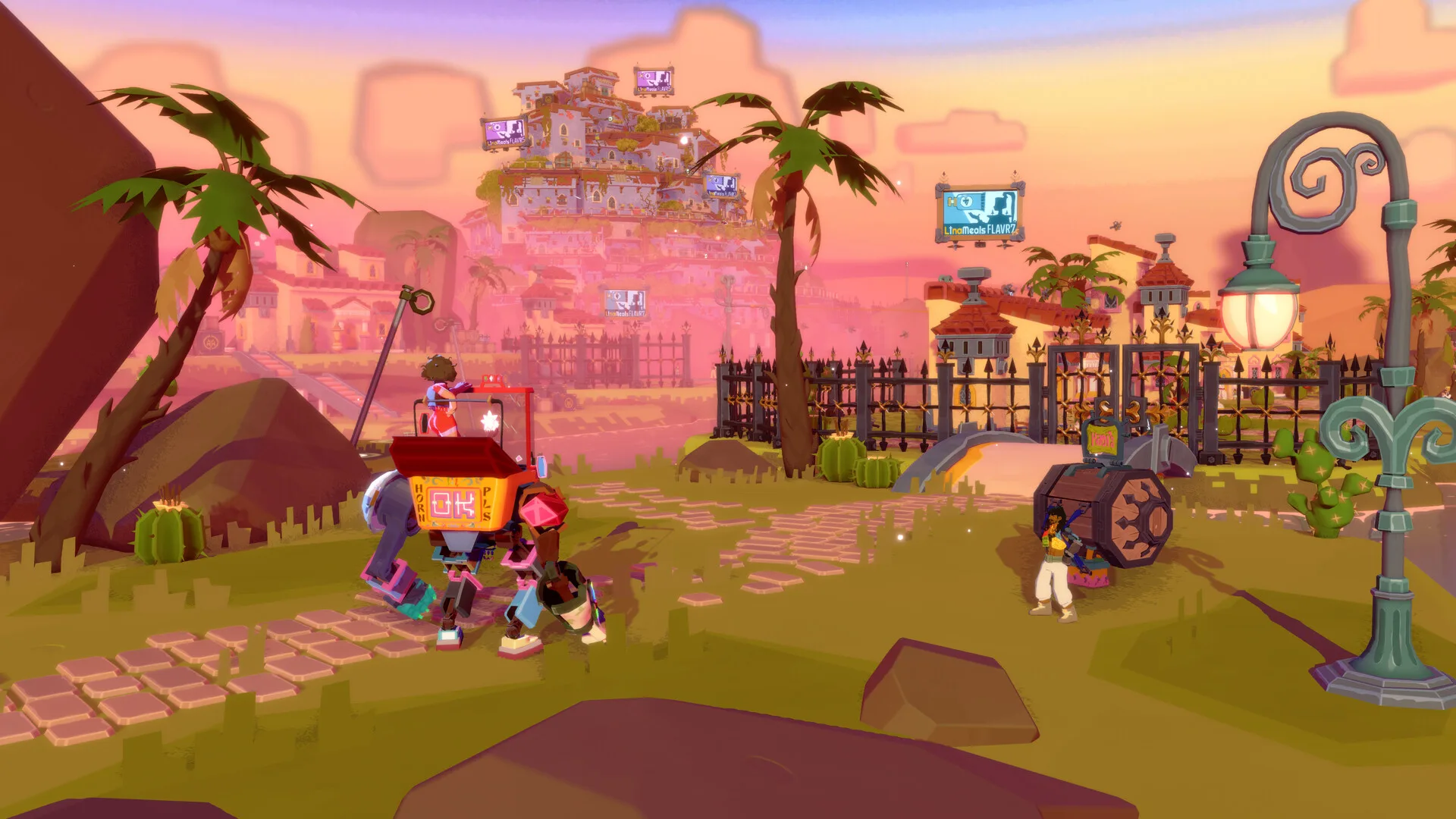
Ingredients are region-specific, which encourages thorough exploration of each area before moving on. Harvesting from the environment, fishing, collecting battle rewards, and buying from Kabi cover the supply side. Movement upgrades, specifically a grappling hook and a drill, open new parts of the map and add a light sense of physical progression. The areas are tiered and layered, giving them a side-scrolling sensibility that suits the art style. They can feel sparse once main quests are cleared, with exploration motivated primarily by ingredient hunting rather than environmental storytelling.
Color, Culture, and Sound
Dosa Divas has a visual identity that is immediately legible and consistently pleasing. The art direction leans into bold color and angular character design, with expressive character portraits that do real emotional work in dialogue scenes. Environments are built in tiers rather than flat open spaces, creating a 2D-in-3D effect that gives the world a side-scrolling sensibility and feels like a deliberate structural nod to the landscapes the game draws on culturally. The HUD and menus are clean and readable throughout.

The mech designs, including Goddess and the broader class of Divas, are a consistent highlight. They carry personality in their silhouettes and details in a way that makes the gap between their visual quality and their narrative depth particularly apparent.
The soundtrack is well-matched to the game’s range. Battle music leans into funk-inflected energy that fits the pace of combat, while the overworld theme draws on traditional South Asian musical rhythms. The choice feels considered rather than decorative, grounded in something specific, and players familiar with that musical tradition will likely feel its authenticity in a way that broadens the game’s emotional register. Voice acting is strong across the main cast, with one notable exception: the father character, whose performance sits a level below the standard set by everyone around him.
The cultural specificity of Dosa Divas is one of its genuine strengths. The dosa, a South Indian savory crepe, anchors the game’s central metaphor, and the broader food culture surrounding it is treated with evident care. Meyndish feels like a world built from the inside out around these influences.
Time Well Spent, Mostly
The main story completes in roughly 9 to 13 hours depending on side content engagement. This is a deliberate and effective choice. Turn-based RPGs that run to 40 or 60 hours ask players to schedule their lives around them; Dosa Divas asks for a long weekend. It delivers a structurally complete emotional arc within that window, which is its own kind of achievement and one that should not be understated.
Side quests extend the playtime but are unevenly supported by the writing. The strongest add texture to the village characters and reinforce the game’s themes. The weaker ones reduce to ingredient gathering without enough story to frame the effort.
The combat and cooking systems are both accessible to players new to the genre. The timed block and attack mechanics add a physical dimension that keeps things active, and the flavor-based system is intuitive once the logic settles in. Players seeking tactical depth will find it concentrated in boss fights, but may feel the regular encounter design grows thin before the credits roll.
The structural weak point is the second half’s loop through previously explored areas. Players who engaged thoroughly with each village the first time will find little genuinely new in the revisit. The game is at its strongest when story momentum and active exploration run together, which describes most of the experience, and most is enough.
Dosa Divas is a vibrant, “spicy” narrative turn-based RPG that blends heartfelt storytelling with tactical combat and culinary exploration. Developed by Outerloop Games (the creators of Thirsty Suitors), the game follows sisters Amani and Samara as they journey across a colorful world in their ancient spirit-mech, “Goddess,” to dismantle a corrupt fast-food empire. Players engage in rhythmic, flavor-based combat, forage for local ingredients, and use an expressive cooking system to restore community bonds and cultural traditions. Released on April 14, 2026, the game is available on PC (via Steam), Nintendo Switch 1 and 2, Xbox Series X|S, and PlayStation 5.
Full Credits
Director (Creative/Game Director): Chandana Ekanayake
Writers (Lead Writer/Narrative Designer): Meghana Jayanth
Producers/Studio Leadership (Producers, Executive Producers, and Key Studio Heads): Chandana Ekanayake, Victoria Tran (Outersloth)
Lead Voice Cast: Avanti Nagral, Maya Saroya
Art Director/Lead Artist: Chandana Ekanayake
Key Engineering/Technical Leads: Moiz Mohammed
Composer/Sound Director: Ramani Krishna
Developer, Publisher: Outerloop Games, Outersloth
Release Date: April 14, 2026
The Review
Dosa Divas
Dosa Divas is a heartfelt, accessible RPG that beautifully intertwines food, family, and cultural identity. Its flavor-based combat and cooking mechanics are charming and engaging, though they lose steam and become repetitive in the game's back half. While the emotional core of the sisters' journey shines brightly, the late-game backtracking and underdeveloped mech lore slightly dull the experience. Despite these flaws, its striking art direction, excellent soundtrack, and digestible runtime make it a road trip worth taking.
PROS
- Strong, emotionally grounded narrative exploring family, grief, and cultural identity.
- Clever flavor-based combat system with engaging timed physical inputs.
- Flexible cooking mechanics that encourage creative ingredient substitution.
- Striking, colorful art direction and highly expressive character/mech designs.
- Authentic soundtrack and stellar voice acting for the primary cast.
- Accessible 9 to 13-hour runtime that respects the player's time.
CONS
- Combat and cooking loops become repetitive and lack depth in the late game.
- Narrative focus shifts away from its strongest emotional elements in the second half.
- Tedious backtracking through previously explored areas and familiar enemies.
- Underdeveloped mythology surrounding the broader class of Divas.
- Noticeably weaker voice acting performance for the father character.