









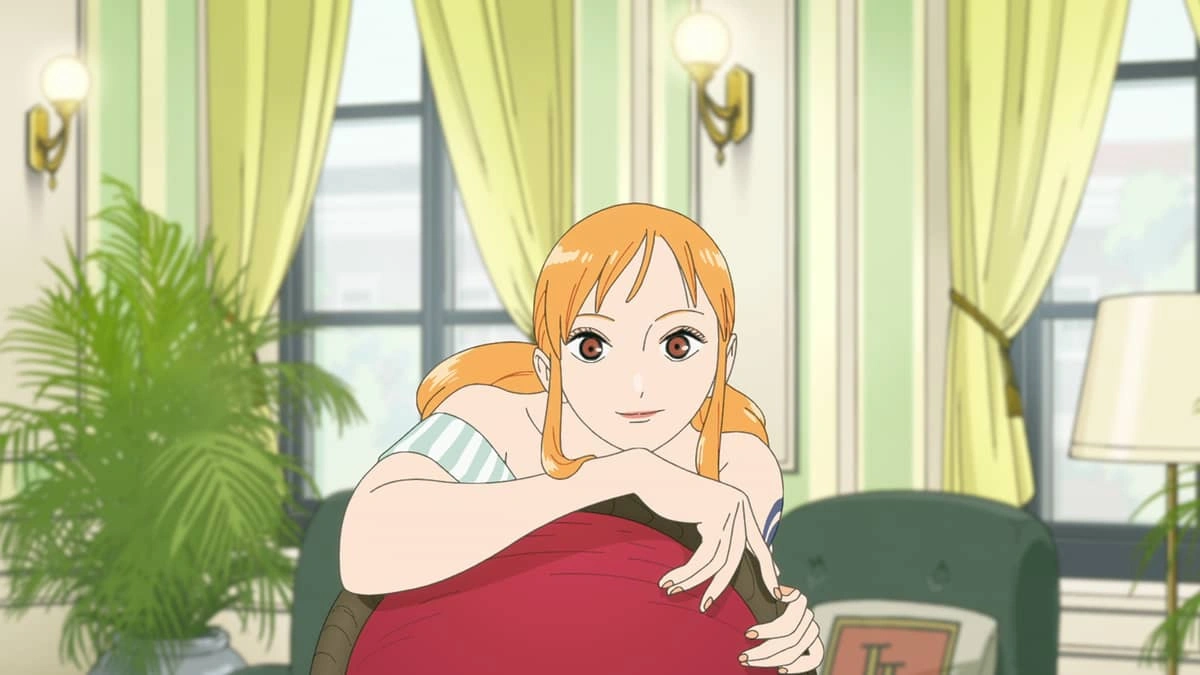

A woman loses a fight because her shoes were designed to be admired rather than worn. It is a suitably blunt premise for One Piece: Heroines, a 22-minute special that turns fashion into a dispute over who gets to decide what women’s bodies are for.
Adapted from Jun Esaka and Sayaka Suwa’s light novel collection, the episode places Nami and Robin inside a jewel-heist caper far removed from the wars, tyrants, and historical conspiracies of the main anime. Nami injures her foot during a pirate raid after slipping in a pair of ill-fitting sandals. Three thieves escape with her treasure, sending her to the boutique of celebrated designer Lebno Listaque, where a refund request develops into an invitation to model at his fashion show.
The scale is intentionally small. No island requires liberation, and the World Government has no interest in the footwear crisis. Yet the episode uses this modest conflict to expose a familiar contradiction: industries that praise women’s beauty while creating products indifferent to their comfort, mobility, or agency.
Lebno offers to make Nami a custom pair, provided she lends her image to his runway. His interest in her is commercial from the first exchange. Nami becomes valuable because her appearance can sell his work. She accepts after spotting one of her stolen bracelets in his jewel collection, recognizing that his glamorous designs are decorated with treasure stolen by pirates. The fashion show becomes a crime scene wearing perfume.
A Heist Built on Competence
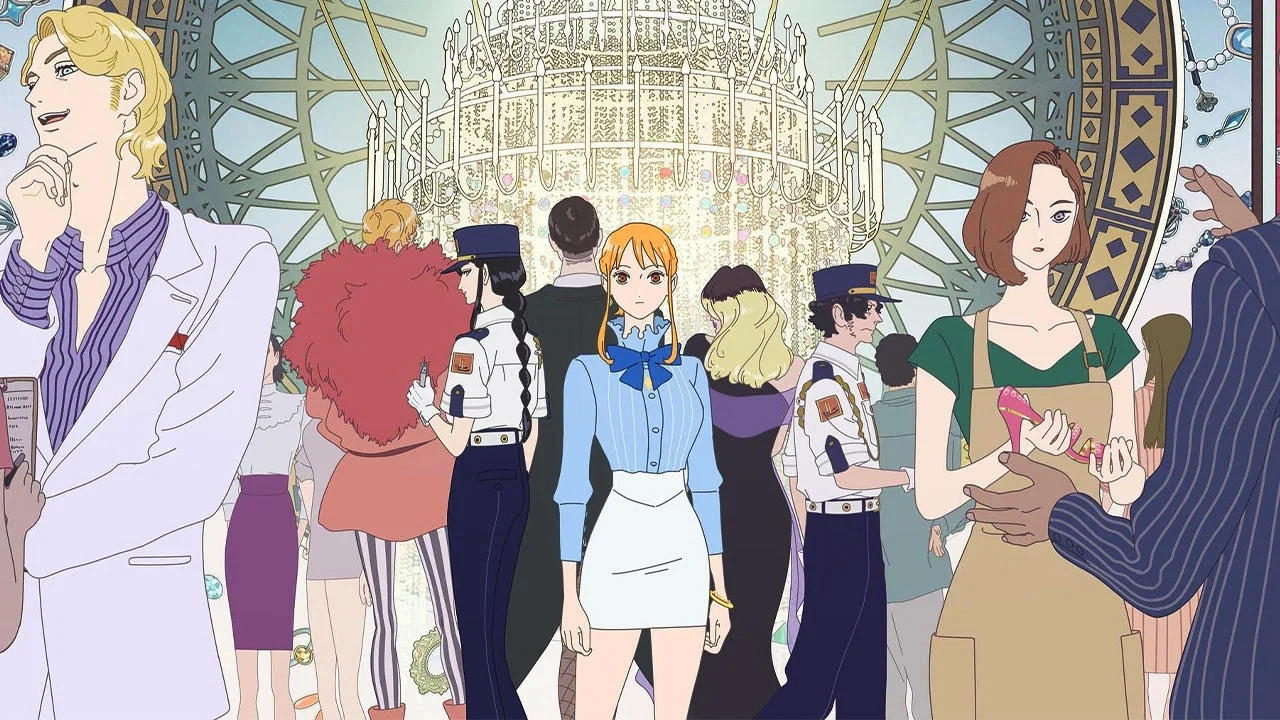
Nami and Robin approach Lebno’s operation with the ease of women accustomed to being underestimated. Robin infiltrates the venue in a guard’s uniform, communicating through a small Den Den Mushi while Nami draws attention on the runway. Their roles reflect their established abilities without requiring a speech about how capable they are.
Nami studies the room, identifies the jewel-covered chandelier, and turns performance into misdirection. She uses her Clima-Tact to fill the runway with bubbles and steam, allowing Robin to remove the chandelier above the crowd. Robin’s powers are applied with quiet precision during the infiltration and the fight that follows, closer to espionage tools than battlefield artillery.
Keeping the male Straw Hats offscreen is a simple production decision with significant meaning. Their absence does not need explanation. Nami and Robin are allowed to plan, fail, adjust, and escape without a male crewmate arriving to validate their competence. Television and anime have spent decades treating such autonomy as a special event, then congratulating themselves for scheduling it. Here, the choice feels refreshingly casual.
Robin still receives too little material. Her presence strengthens the adaptation by transforming Nami’s solo scheme into a partnership built on trust, yet she remains largely functional. She infiltrates, steals, and fights with characteristic composure, while the episode reserves its emotional development for Nami and Miucha. Their chemistry is enjoyable precisely because it seems to contain a richer story than the episode has time to tell.
The weakest element is the footwear itself. Nami has fought through injuries, unstable terrain, and physical exhaustion across the franchise, so a sandal disabling her twice requires convenient forgetfulness. The device works thematically, but the character must briefly become less resilient for the plot to begin.
The Name on the Shoe
Miucha, Lebno’s assistant, measures Nami’s feet and immediately identifies the boutique’s failure: the sandals were the wrong size. She then creates a pair designed around Nami’s actual life, capable of surviving a runway and a fight.
That distinction separates Miucha from Lebno. She begins with the person who will wear the shoe. He begins with the status the shoe might confer upon its creator.
Nami recognizes Miucha’s talent before Miucha can claim it herself. She praises the initial design and insists that Miucha complete the decoration. Lebno responds by rejecting the shoes as too plain, throwing them aside and substituting his own ornate pair. His idea of beauty requires discomfort, exclusivity, and submission to his signature.
The fight completes the argument with cheerful obviousness. Lebno’s shoes cause Nami to slip again. She calls for Miucha, changes into the practical sandals, and immediately regains control. Function becomes a form of liberation, expressed through grip, balance, and the ability to kick an unpleasant man without falling over.
Miucha’s arc carries the episode’s strongest cultural observation. Nami does not hand her independence to her. She treats her work as worthy of being named. The final newspaper advertisement, bearing Miucha’s name, confirms that she has opened her own business and stepped beyond Lebno’s shadow.
The transition happens too quickly. Miucha’s loyalty to Lebno rests on their abandoned dream of making shoes anyone could use, yet the emotional cost of leaving him receives little attention. The episode prefers the clean image of independence to the untidy process required to reach it.
Bodies in the Frame
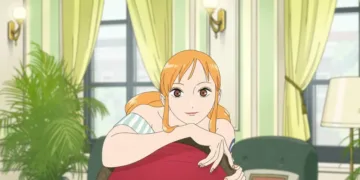
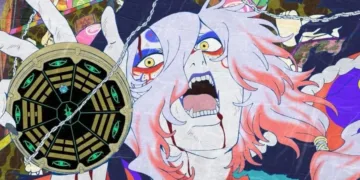
The special’s fashion-illustration style gives Nami and Robin elongated silhouettes, angular faces, and fluid movement distinct from the weekly anime. Lebno’s theatrical introduction, surrounded by roses and posed with calculated elegance, establishes his vanity before his criminal dealings become clear. His body performs sincerity while every decorative flourish suggests fraud.
Miucha is handled with greater visual care. When Lebno dismisses her work, shadow isolates her within the boutique, turning the glamorous space into a place of confinement. The lighting expresses what the dialogue rushes past: professional humiliation has become personal captivity.
The redesign also creates an unresolved tension. The episode criticizes a culture that turns women into display objects while repeatedly emphasizing legs, feet, and model-like proportions. Its gaze is softer than the main anime’s frequent sexualization, yet it remains fascinated by the bodies being discussed. Robin’s sharper features adapt comfortably to the style. Nami sometimes appears less expressive, as though elegance has been purchased by sanding away part of her familiar warmth.
That contradiction gives the special greater interest than its tidy empowerment narrative might suggest. Beauty can be pleasure, labor, commerce, control, and self-authorship in the same scene. One Piece: Heroines touches each idea, then moves quickly toward its next joke or burst of action.
The experiment deserves continuation because the franchise contains many women whose lives are usually framed through wars, royal duties, rivalries, or their relationships with male protagonists. A series built around Vivi’s political identity, Perona’s strange solitude, or Boa Hancock’s command of spectacle could make these side stories feel less like rare permissions and closer to ordinary practice.
The vibrant animated television film One Piece: Heroines made its official global debut on July 5, 2026, premiering on Fuji TV in Japan and dropping simultaneously for international streaming. Fans can watch the female-centric special presentation directly on Crunchyroll and Netflix across most major global regions. Adapted from the popular light novel series, the story focuses on a standalone, stylish side adventure where Nami must agree to model in a high-stakes runway fashion show to convince an eccentric designer to replace a shoddy pair of shoes that hurt her feet.
Where to Watch One Piece: Heroines Online


Full Credits
Title: One Piece: Heroines (originally titled Wan Pîsu Hiroinzu)
Distributor: Fuji TV, Crunchyroll, Netflix
Release date: July 5, 2026
Rating: TV-PG
Running time: 24 minutes
Director: Haruka Kamatani
Writers: Momoka Toyoda, Jun Esaka, Eiichiro Oda
Producers and Executive Producers: Miki Kobayashi, Marin Sakagami, Ryūta Koike, Tetsushi Akahori, Hayato Tokita
Cast: Akemi Okamura, Yuriko Yamaguchi, Maaya Sakamoto, Takehito Koyasu, Kumiko Nishihara, Mayumi Tanaka, Hiroaki Hirata, Yū Mizushima
Director of Photography (Cinematographer): Hideki Chiba
Editors: Kiminori Yoshida
Composer: Taisei Iwasaki
The Review
One Piece: Heroines
One Piece: Heroines gives Nami, Robin, and Miucha space to define competence outside the franchise’s usual spectacle. Its jewel heist, fashion-show setting, and expressive redesign create a lively side story with a clear interest in female autonomy. The episode’s politics remain tidier than its subject deserves, especially when Lebno receives comic humiliation instead of meaningful consequence. Still, Miucha’s decision to place her own name on her work gives the special its sharpest image: recognition becoming independence.
PROS
- Distinct fashion-inspired art style
- Clever Nami and Robin teamwork
- Strong focus on female agency
- Miucha’s satisfying personal arc
- Playful heist structure
CONS
- Robin remains underused
- Lebno lacks depth
- Convenient footwear premise
- Conflict resolves too easily
- Themes receive limited development