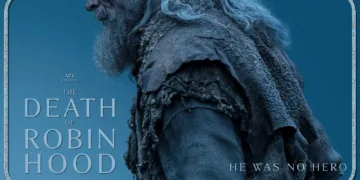










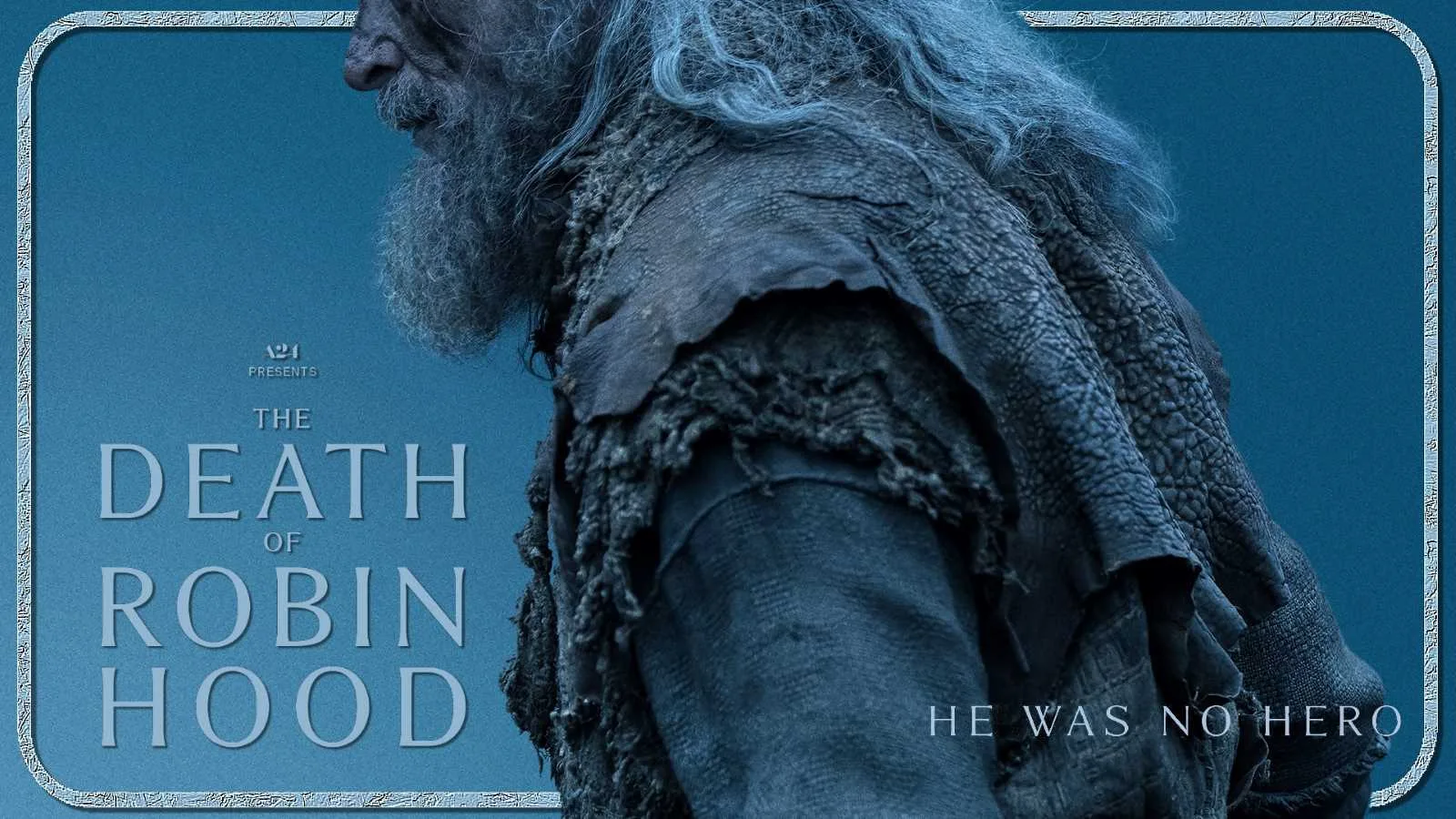

The Death of Robin Hood wants to be about truth. It is actually about the impossibility of escaping a story once the story has decided to eat you (stay with me here).
Michael Sarnoski’s third feature takes its cue from A Gest of Robyn Hode, a 17th-century ballad whose final section deposits the aging outlaw at a priory for treatment, where he dies. Sarnoski inverts the betrayal (here the prioress heals) and keeps the death and the intellectual problem beneath it: what does a legend do with itself when it knows the legend is false?
The film is set in 1247. Shot on 35mm in Northern Ireland, with cinematography by Pat Scola that makes the Celtic fringe feel like a wound that will not scar, it stars Hugh Jackman as a Robin Hood who freely confesses that Maid Marian was “an old wives’ tale,” that he robbed rich and poor alike, that the merry men are gone and probably deserved to be. A24 distributes. The audience comes for Jackman. They will not get what they came for, which is part of the point, and which may or may not be enough.
What the Violence Is For
Sarnoski opens by stabbing a teenage girl in the head. This is not an accident.
Before Robin Hood has said a single word about who he is or was, before Jackman has had time to establish any rapport with the audience, the film commits an act of preemptive myth-murder. Call it hagiographic severance: the clean cut of every heroic association before the viewer can form one. The green tights are not subverted here. They are not granted the dignity of existing long enough to be subverted.
What follows in the first act is a sustained argument in the form of carnage. Little John (Bill Skarsgård, submerged into the role so completely you half expect to find him on the IMDB page listed as “a different person”) arrives near-feral, living under an assumed name, to recruit Robin for one final act of vengeance. The battle that follows is specific in its brutality: flaming torches pressed to faces, a red-hot blade seared into flesh, a boy stumbling home with an arrow through his skull. Sarnoski refuses the kinetic pleasure that most period action buys wholesale. No choreography. No clean exchange of skill. Mud, proximity, and the sound of people dying badly.
I initially read this as aesthetic posturing. The Northman did something similar, and the grimness there served a kind of mythic grandiosity rather than a deflationary one. I think I was wrong. The violence here is load-bearing: it establishes the distance Robin must cover to reach whatever the film grants him. If the first act costs the viewer nothing, the priory sequences cost nothing.
Jim Ghedi’s score, elsewhere beautifully textured, overreaches in the battle sequences, adding vocals to scenes that should stay wordless. The one moment where the film tells you how to feel before the image has had the chance.
The Island of Slow Ideas
Robin arrives at Sister Brigid’s priory unconscious and barely alive. Pat Scola shifts both the palette and the aspect ratio. Cold grey widescreen becomes warm narrow gold. The suffering-in-cold, healing-in-warmth binary is schematic enough that the film almost earns a raised eyebrow, and yet the priory’s world does something the hinterlands cannot: it introduces people who have already made their peace with what they cannot change.
The leper (Murray Bartlett, whose face remains nearly invisible under prosthetics and rags for the film’s entirety) is the priory’s resident philosopher. The sanguine acceptance he models for Robin, carrying his suffering as fact rather than grievance, is what passes for moral instruction here. Bartlett accomplishes something quietly remarkable: without a face, without dialogue of any particular memorability, he makes this character feel like the most fully inhabited soul on screen.
Margaret (Faith Delaney, a newcomer who should be working steadily after this) attaches herself to Robin with a vulnerable need that unlocks the film’s emotional register more than any conversation manages to. The bow-making, in which Robin teaches her the craft that has defined his violence, is the film’s central image doubled back on itself: the cycle does not end; it transfers.
Arthur (Noah Jupe) arrives wanting revenge for the battle that cost him an eye. Sarnoski does not resolve this with a fight. Robin, given the chance to kill, tells the boy not to repeat his mistakes. No heroism in it. No catharsis. A man trying to interrupt a pattern he cannot undo, knowing the interruption is probably temporary.
The priory sequences extend into territory where stillness and stagnation start to look like each other. The crutch-walking, the philosophical dialogue about the utility of stories, the bow-making montage: these ask a lot from a viewer whose connection to Robin’s interiority has been kept deliberately at a remove. Sarnoski is making an argument for opacity. The argument is valid. The scene count is the film’s honest problem.
What Jackman Does With the Silence
Jackman gives a performance so calibrated to interior suffering that the exterior frequently appears to have stopped working. This is not a criticism. It might not be a compliment.
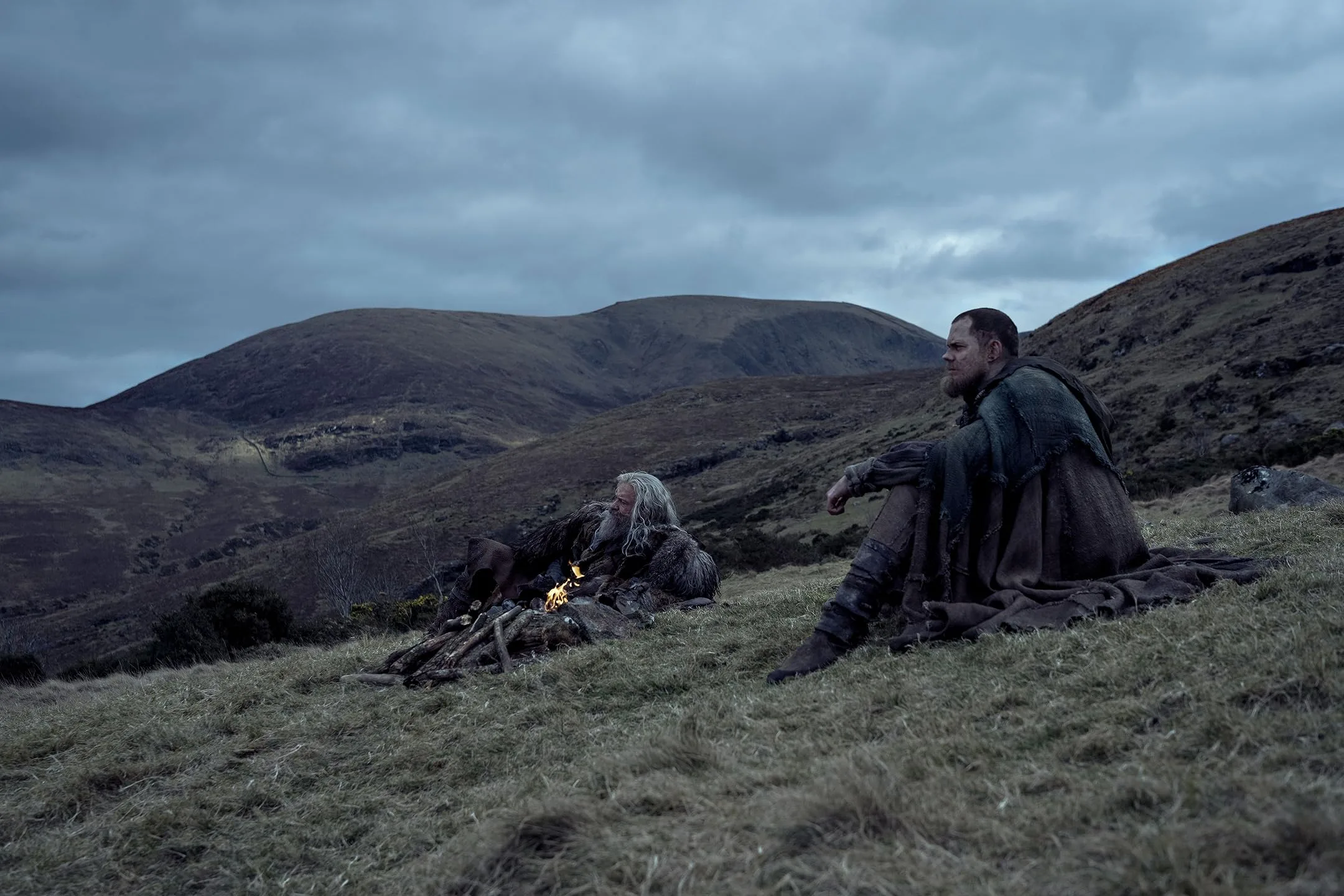
The ferocity in the first act is unimpeachable: the prologue killing, the battle sequences, the economy with which Jackman conveys that violence has become something close to grammar for this man. The priory work asks the opposite, to hold everything still and let it rot in public. He does it without apology.
The Logan comparison is unavoidable and the film knows it. Ageing Jackman, grey and violent, surrogate child, cycle of harm, Jim Mangold’s shadow hanging over the whole enterprise. The honest distinction: Logan allowed feeling to breach the surface. This film holds it further down and does not always let it come up. I keep calling that moral seriousness. It might be emotional withholding. The distinction matters and Sarnoski never resolves it.
Jodie Comer is underwritten in a way her restraint cannot fully disguise. Sister Brigid exists entirely as witness to Robin’s arc, no competing interiority, no friction. Comer is too good at her job for this to read as a failure of acting. It reads as a failure of imagination in the writing.
Skarsgård’s Little John exits the film before the priory. His function is catalytic: he does the work and leaves. That is correct. It is also a mild disappointment.
Print the Truth, Lose the Story
The film’s central proposition inverts The Man Who Shot Liberty Valance: where Ford concluded “print the legend,” Sarnoski argues that the legend is a form of violence, and that acknowledging the truth, however costly, is the only honest act available.
This is a serious argument. It is also, at the level of character, where the film gets into trouble.
Once hagiographic severance has run its course (around the forty-minute mark, give or take), what remains is a recognizable figure in a recognizable arc. The grizzled killer seeking late-life moral coherence has a distinguished lineage: William Munny in Unforgiven, John Bernard Books in The Shootist, Logan in Logan. Sarnoski’s innovation is the medieval specificity and the source ballad. The moral architecture is not new. Robin is rebuilt from cultural lie into something truer, but that something truer turns out to be a type we already know.
I want to be fair to what this costs the film and what it does not. The craft is genuine: Scola’s 35mm textures, Ghedi’s folk palette, the Northern Ireland locations doing serious atmospheric labor. A24 distributing a Robin Hood film with no action spectacle represents a real bet on adult counter-programming, and the bet deserves credit on principle.
There is a lineage worth placing. Richard Lester made his own A Gest-derived film in 1976, Robin and Marian, conflating the prioress with Maid Marian into a bittersweet late-life love story. Sarnoski strips even that consolation. His Robin gets no romance, no comfortable legend reframed. He gets the truth of what he was, and the company of people damaged enough to receive it.
The final image: Margaret sends an arrow into the air, from a bow Robin made. The cycle passes forward. Sarnoski does not tell you how to feel about this, which is either his most honest decision or his most convenient exit.
Both readings hold. I have been going back and forth since the credits rolled, which is probably the response the film is designed to produce.
I will reluctantly count that in its favor.
The Death of Robin Hood premiered at the Sydney Film Festival on June 12, 2026, and is scheduled to be released theatrically in the United States by A24 on June 19, 2026. Grappling with a dark past after a lifetime of crime and combat, a gravely injured Robin Hood finds himself in the hands of a mysterious woman who offers him a final chance at salvation. Once its theatrical run concludes, the film will be available to stream on platforms that carry A24’s distribution lineup.
Where to Watch The Death of Robin Hood (2026) Online








Full Credits
Title: The Death of Robin Hood
Distributor: A24
Release date: June 19, 2026
Rating: R
Running time: 122 minutes
Director: Michael Sarnoski
Writers: Michael Sarnoski
Producers and Executive Producers: Aaron Ryder, Andrew Swett, Alexander Black, Hugh Jackman, Rama Gottumukkala, Mark Huffam, Arlen Konopaki, Charles Miller, Janine Modder, Jon Rosenberg, Michael Sarnoski, Stefan Sonnenfeld, Paul Barry, Hannah Shipley
Cast: Hugh Jackman, Jodie Comer, Bill Skarsgård, Jade Croot, Katie Breen, Fintan Shevlin, Michael Hanna, Andrew McCracken, Alfie Lawless, Faith Delaney, Noah Jupe, Clive Russell, Amy McElhatton, Maeve Connelly, Maggie Hayes, Richie Wilson, Elijah Ungvary, Murray Bartlett, Tabitha Smyth, Beau Thompson, Asher De Silva
Director of Photography (Cinematographer): Pat Scola
Editors: Andrew Mondshein
Composer: Jim Ghedi
The Review
The Death of Robin Hood
The Death of Robin Hood is a revisionist film that means what it argues: the legend was a lie, the truth is uglier, and confronting it costs something. Sarnoski makes good on that first half. The brutality is purposeful, the craft genuine, Jackman unsparing. The priory, where the film spends most of its time, tests that goodwill: a familiar antihero in slow purgatory, with an underwritten Comer beside him and a scene count that mistakes duration for depth. The film knows what it wants to say. It takes its time saying it (perhaps too much time).
PROS
- First act violence earns its grimness; every death is load-bearing
- Jackman's performance of interior suffering, unvarnished and unsparing
- Bartlett's fully inhabited turn under full prosthetics, almost no face
- Pat Scola's 35mm cinematography, from battlefield cold to priory warmth
- A serious intellectual project, sincerely pursued
CONS
- The priory sequences where stillness shades into stagnation
- Comer given no interiority; the writing fails the casting
- A familiar antihero arc once the mythological scaffolding comes down
- Ghedi's score overreaches with vocals in the battle sequences