

























![Kingdom Hearts Collection [I-III] Review](https://gazettely.com/wp-content/uploads/2026/10/Kingdom-Hearts-Collection-I-III-1-360x180.webp "Kingdom Hearts Collection [I-III] Review: KHII Holds Steady as Newer Entries Fluctuate 37")



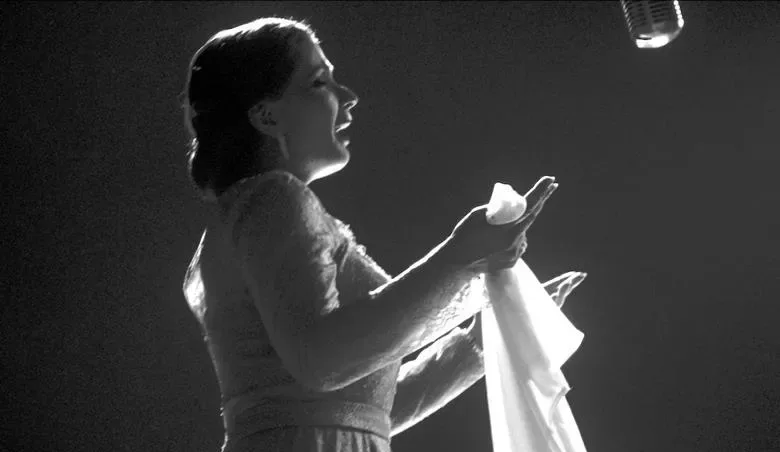

El Sett, titled after the honorific “The Lady,” tries to carve a coherent human figure from the monument of Umm Kulthum, a singer whose legend stretches beyond biography. She stands as a foundational force in Arabic music, hailed as the “Star of the Orient” and “the Fourth Pyramid,” a presence whose voice merged with the imagined soul of a nation. The film takes on an ambition that feels almost metaphysical, asking director Marwan Hamed to shape a vast, reverent production around a history that resists clarity.
It offers the promise of looking past the idol, of tracing the contours of a life that seemed to define an era. Beneath that promise lies a persistent question about existence: can someone so consumed by cultural devotion appear as a fallible person, or does she remain fixed as a distant deity for her audience? The challenge does not rest in recounting her chronology. The harder task lies in approaching the quiet space where the woman existed beneath the sound that consumed her.
Gilded Cage of History
Hamed builds a visual experience of imposing scale, a luxury production that moves with calm assurance through its long runtime. His direction often carries the confident grace of someone who knows how to compose an image, bathing the screen in a carefully controlled visual atmosphere.

The production design assembles grand, textured historical spaces that recreate a version of the past with meticulous care. The film stages the splendor of Egypt: restless Cairo streets, the winding sheet of the Nile, the theatrical halls where music and politics once intertwined. Cinematography, lighting, and costume design work together to assemble a dense and persuasive world.
That density carries a psychological weight. The detailed period reconstruction starts to feel like an accumulation of surfaces, a visual richness that presses down and narrows the route to the singer’s interior life. History surrounds her like ornament that hardens into armor.
The setting feels less like a neutral stage and more like an ornate, enclosing cage, shaped from nostalgia and national memory. Sequences such as the Queen Nazli passage, the Bosphorus club episode, and her dramatic entrance into Cairo appear as self-contained set pieces, impressive in their scale and control. They testify to Hamed’s command of spectacle, while they also highlight the distance between public ritual and private feeling.
The Isolation of Autonomy
The film’s narrative structure fractures into a disquieting pattern, moving back and forth across time as if memory itself had been splintered. It opens on the grandeur of the 1967 Paris concert, where Umm Kulthum stood as a representative of a struggling nation, then plunges suddenly into the uncertain textures of her youth. The viewer returns to her poor childhood in the Nile Delta, to scenes of her singing beside her father, Sheikh Beltagi, and to the early resistance she met in Cairo while performing devotional songs dressed in male clothing.
From that early defiance, a transformation begins with a spontaneous makeover that redirects her toward the regal, composed image of El Sett. Her life gradually aligns with a single principle: control. She emerges as an autonomous, imperious presence, setting terms in music and in business, collecting the devotion of political leaders such as Nasser.
The philosophical shadow that hangs over this rise is the cost of such control. The film traces it in fleeting, almost furtive glimpses: private anxiety that trembles beneath public certainty, vulnerability that slips through the poise, a loneliness that deepens as her legend expands. Power here feels less like freedom and more like a narrowing corridor. Mona Zaki’s performance reaches toward this contradiction.
Her work feels sincere and often arresting, as she searches for an emotional truth inside the icon. Yet the performance struggles against the visible construction around it. Makeup that calls attention to itself and a rigid, ceremonial presentation interfere with the warmth and fragility the actor tries to reveal. The figure on screen remains fixed in iconography, held at a remove from the younger person the film evokes.
Silence at the Core
Umm Kulthum’s fame rested on an unmatched voice and a performance practice that stretched across hours, built on extended mawwals that turned singing into a kind of temporal trance. The film identifies this legacy, yet its structure avoids a sustained gaze at her artistic process or her creative consciousness. For a narrative that positions itself around creation, the absence of a clear inner artistic life feels like a collapse of meaning. The legendary voice receives limited and uncertain treatment. Performances appear as fragments, often covered by heavy orchestral accompaniment that crowds the sonic space.
The film circles what should feel like a transcendent encounter and withholds it. Her voice rarely arrives with the intimate clarity the material demands. The camera and sound design hesitate to grant that pure, concentrated moment where everything else falls away and only the timbre of her singing remains. Even central musical choices such as “Ana Fi Intizarak” and “Al Atlal” carry a muted force, shaped more by framing devices than by the sound itself.
The decision to treat her creative relationship to sound as a secondary concern leaves a deep hollow in the film’s center. The work manages to project the scale of the myth, yet turns away from the most immediate trace of the woman’s existence: the living sound that once filled rooms, streets, and radios, and that still haunts the silence the film cannot quite reach.
The film, El Sett (The Lady), is a major biographical drama centered on the life of the legendary Egyptian singer Umm Kulthum. The film, which has a reported running time of 155 minutes, is directed by Marwan Hamed, known for large-scale productions. After premiering at the Marrakech International Film Festival, it is slated for wider international release and festival play. While specific details on the general theatrical release date in the Arab world are still forthcoming, the film is expected to hit cinemas sometime in 2025. As of today, December 6, 2025, you would look for it playing at international film festivals or await its domestic release in Egypt and the Middle East.
Full Credits
Title: El Sett (The Lady)
Distributor: Film Square, Synergy Films, Film Clinic, Big Time Fund, Luxor Studios, Oscar Picture (Production Companies)
Release date: World Premiere: December 4, 2025 (Marrakech International Film Festival); Scheduled for 2025
Running time: 155 minutes
Director: Marwan Hamed
Writers: Ahmed Mourad
Producers and Executive Producers: Ahmed Badawy, Tamer Morsi, Mohammed Hefzy, Marwan Hamed, Fadi Rahim, Wael Abdallah
Cast: Mona Zaki, Mohamed Farag, Sayed Ragab, Tamer Nabil, Ahmed Khaled Saleh, Nelly Karim, Amr Saad, Ahmed Dawood, Ahmed Helmy, Amina Khalil (Partial Listing)
Director of Photography (Cinematographer): Abdelsalam Moussa
Editors: Ahmed Hafez
Composer: Hesham Nazih
The Review
El Sett
El Sett is a visually spectacular, ambitious biographical attempt that successfully reconstructs the gilded environment and historical weight of its subject. Director Marwan Hamed captures the external grandeur of Umm Kulthum's life and her fierce autonomy. However, the film struggles under the burden of its own reverence. It fails to penetrate the iconic image, leaving the essential human spirit obscured. The most critical failure is the film's neglect of the singer's artistry; the legendary voice, the core of her myth, is rarely heard clearly. It is a visually rich but emotionally and creatively distant portrait of an incomparable artist.
PROS
- Masterful direction and high production value create a captivating and historically rich aesthetic.
- The film ambitiously covers major biographical episodes and historical shifts in Egypt.
- Superb production design and costumes bring the splendor of ancient Egypt and Cairo to life.
- Successfully depicts Umm Kulthum as an imperious, autonomous figure controlling her career.
- Contains powerfully executed set pieces (e.g., Queen Nazli segment, Cairo arrival).
CONS
- Fails to provide insight into the personality, vulnerability, or private life beneath the public image.
- Insufficient focus on her creative process and the profound power of her voice.
- The legendary voice is often fragmented or obscured by heavy orchestral accompaniment.
- The detailed period recreation can become cluttered, and the choice of makeup for the lead actress is often distracting.
- The film remains largely reverential and distant, avoiding emotional depth in favor of historical coverage.







