

























![Kingdom Hearts Collection [I-III] Review](https://gazettely.com/wp-content/uploads/2026/10/Kingdom-Hearts-Collection-I-III-1-360x180.webp "Kingdom Hearts Collection [I-III] Review: KHII Holds Steady as Newer Entries Fluctuate 37")




The American Western, treated as serious work, behaves like a rolling philosophical seminar on property and sanctioned violence. The Abandons plants itself in the 19th-century Washington Territory and turns the invented towns of Angel’s Ridge and Jasper Hollow into a debating chamber. A familiar land dispute becomes a corporate acquisition project, filtered through family loyalty and the question of who has the right to claim soil soaked in blood.
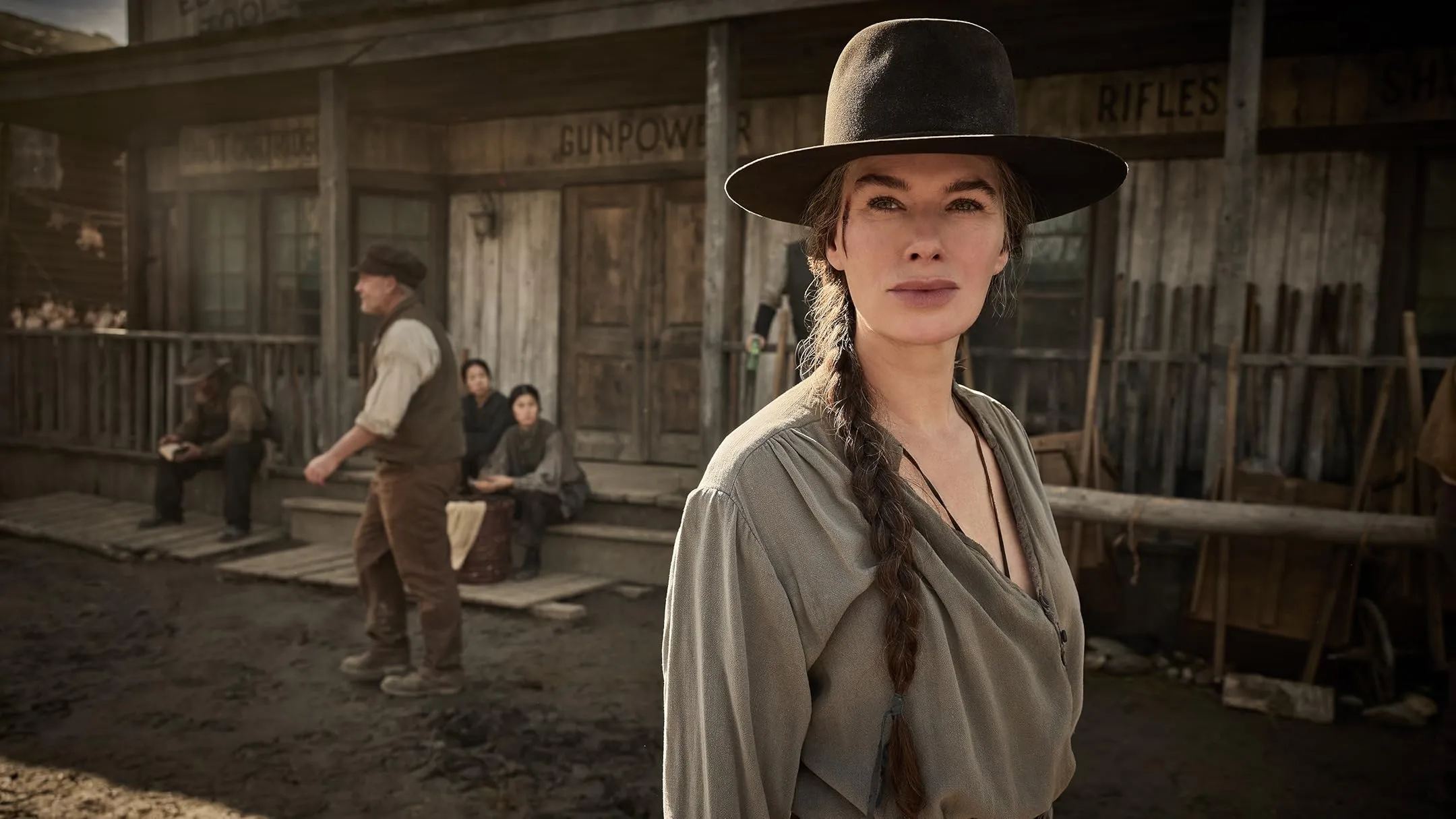
This arena of ethics and economics leans on two figures of very different power. Constance Van Ness (Gillian Anderson) embodies industrial ambition, while Fiona Nolan (Lena Headey) stands as the fierce, strong-willed guardian of the settlement she commands. From creator Kurt Sutter, the series quickly sketches a dramatic design grounded in blood feuds, the murk of frontier politics, and a frantic hunt for security. Across seven episodes, the show trades in murder, betrayal, and consequence, hinting at a narrative density that the finished work only intermittently carries.
The Doctrine of Conquest: Manifest Destiny as Mining Venture
The opening movement of The Abandons stages a clash between competing American doctrines. The battle over Fiona Nolan’s land in Jasper Hollow, with its potential silver wealth, sets a self-defining settler against an apparently inevitable corporation. Constance Van Ness, the mining magnate, operates as a local avatar of industrial capital. She wields social power and draws on distant large-scale investors such as Cornelius Vanderbilt, who remains physically absent yet financially decisive. Constance’s hunt for silver turns manifest destiny into something closer to a quarterly earnings statement.
Constance’s construction as a character depends on contradiction. She appears as a polished widow whose femininity fits the expectations of polite society, yet she moves through the territory with the calculating and methodical ruthlessness required to survive, or prosper, inside an extractive economy. Behind the carefully tailored gowns and the public composure sits the spirit of a gangster, fixated on control of a volatile market and a chaotic region.
Fiona Nolan embodies an older, more intimate style of power. She is Irish Catholic, marked by a difficult history that has forged a primal instinct to defend what she has carved out of the landscape. Her strength is physical and tied to labor; her trousers operate as a quiet refusal of conventional femininity. Fiona acts from fierce attachment to her found family and to her faith, yet she abandons these moral codes with startling speed when land or loved ones face danger. She reacts on impulse where Constance calculates, and she trusts passion where Constance relies on finance.
A shared, almost theological, stubbornness binds these two women. Neither yields, so a land negotiation mutates into a blood feud. Each refusal to compromise escalates the conflict and generates further risk, passing the advantage back and forth with each fresh act of aggression. The series studies frontier politics as an inherently violent system and shows how moral lines erode once property claims become sacred.
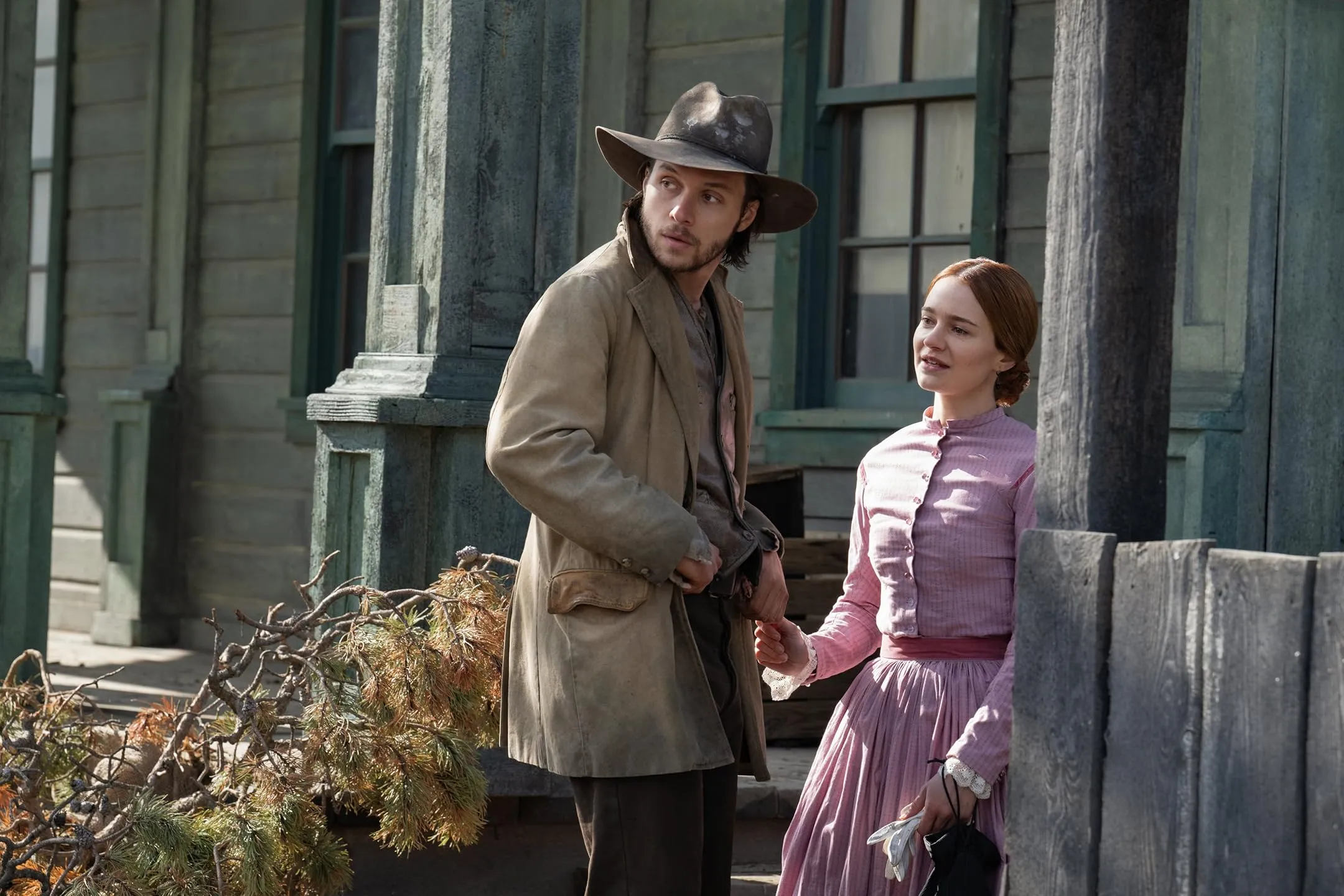
The script uses family ties to compress the conflict into something intimate and inescapable. The romance between Fiona’s son Elias (Nick Robinson) and Constance’s daughter Trisha (Aisling Franciosi) plays like a classic star-crossed mechanism, engineered to amplify the tragic potential of the feud. A still sharper accelerant appears in the traumatic incident that binds Fiona’s de facto daughter Dahlia (Diana Silvers) to Constance’s son Willem (Toby Hemingway), a man raised in entitlement and prone to violence. This event pushes the struggle past economics into steady vendetta, a cycle of reprisal that speaks directly to the Western’s emotional core.
The Specter of Potential: Character and the Failure of Ensemble
The strongest gravitational pull in The Abandons comes from Gillian Anderson and Lena Headey. Their shared history of playing figures of unyielding authority allows them to rise above the script’s structural weaknesses. Anderson channels a precise, steely menace, while Headey leans into volatility; together they create a charged atmosphere whenever they share the frame. Their work functions as a stabilizing center, absorbing shock from a production that rarely feels steady. This dependence on the leads to fill narrative gaps produces what might be called “actorly overburn,” a mode where performance energy attempts to patch inconsistencies in the writing.

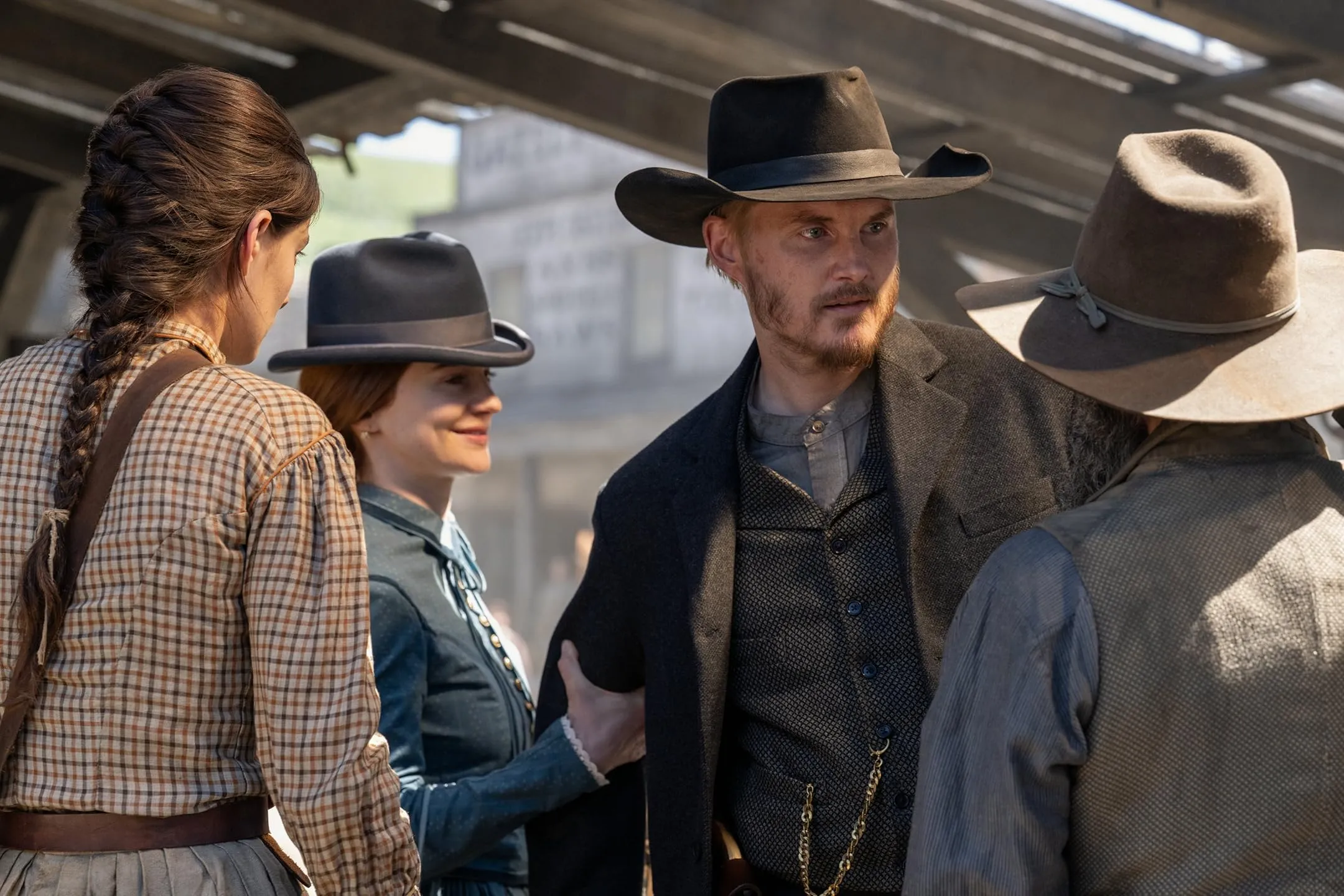
The Van Ness household appears as a sterile hierarchy built on Constance’s approval. Her children serve as extensions of her empire: Garret (Lucas Till), the glowering heir committed to duty; Willem, the reckless and toxic spare; and Trisha, the resistant daughter whose aspirations surface through her piano playing. These siblings receive limited dramatic nourishment. Garret and Willem stay locked in one note as antagonists or approval-seekers and never emerge as complex figures outside the gravitational field of their mother’s ambition.
Fiona’s found family, which gives the series its title, arrives with far richer conceptual promise. This group, composed of Elias, Dahlia, Albert (Lamar Johnson), who is Black, and Lilla Belle (Natalia del Riego), who is Native American, could signal a revisionist approach to the diversity and complexity of the Old West. The execution falters. The show leans on the conventional Romeo and Juliet structure around Elias and Trisha.
Dahlia’s trajectory begins, and remains largely framed, through trauma, which reduces her to a plot device and strips away the sense of an independent subject. Albert receives sporadic focus in isolated passages, such as his brief period as a schoolteacher, while Lilla Belle becomes a near-ghost, frequently absent from key sequences in the edit. The series leaves the potential for meaningful cultural commentary inside this diverse family unrealized and leaves the very foundation of their bond underexplained.
That sense of missed opportunity extends to the margins. The supporting ensemble, including Ryan Hurst, Brian F. O’Byrne, Katey Sagal in a fleeting appearance, and Patton Oswalt in a short turn as the Mayor, appears only in slivers, so their work feels closer to a procession of guests than to a living community. These seasoned performers must conjure depth out of fragments of dialogue, which suggests a severe narrowing of originally planned arcs.
The Crisis of Brevity: Production Scars and Sub-Arc Syndrome
The production of The Abandons carries visible scars of scale and duration. The series shrank from an initial 10-episode order to only seven episodes, many of which run closer to 30 minutes than to a full hour. That compression produces a story that plays rushed, thinned out, and squeezed into too little space. The show struggles to match the sweep of its Alberta landscapes with the limits of its running time.
Reports of creator Kurt Sutter leaving before the end of filming, followed by reshoots and deep re-editing, reshape the final series into something akin to a gutted drama. The fallout from that process appears in jagged storytelling, uneven characterization, and a surplus of subplots that arrive with fanfare and then simply evaporate. The piece names this pattern “sub-arc syndrome,” a tendency to introduce secondary stories as a hint of complexity and then abandon them through lack of room or editorial triage.
One of the central writing problems lies in the reliance on explanatory dialogue. Characters repeatedly restate their motives or current situation for an unseen listener. This habit feels like a product of present-day production anxiety, a preference for overt clarity aimed at viewers imagined as half distracted. The trade-off is severe. The drama carries high stakes and rarely allows its people to appear as layered human beings. They explain themselves so frequently that silence, gesture, and subtext rarely have a chance to work.
The series also stumbles in its pursuit of genre spectacle. The visual rhyme of Constance’s refined gowns and Fiona’s practical trousers communicates their conflict with simplicity, yet the action set pieces often disappoint. The much-discussed CGI cattle stampede in the pilot looks distractingly artificial. Several night scenes appear dim and hard to read, muffling the violence they should render vivid. Direction feels constrained by production turmoil and never attains the brutal, visceral competence associated with the creator’s earlier work. The show lacks a distinct visual signature and leans instead on generic Western atmosphere.
The Unpaid Dividend of a Core Premise
The remaining value of The Abandons rests in its intellectual and performative core. The casting of Gillian Anderson and Lena Headey functions as a clear asset, creating an immediate, high-voltage dynamic. Their presence and the intense chemistry between them provide the strongest reason to watch the series.
The central premise, a Western feud built around two powerful women who stand for opposing currents of historical change, has genuine pull and supplies a fresh angle on a genre usually tied to male rivalry. Aisling Franciosi’s work as Trisha marks another bright spot, bringing emotional nuance to a family structure that often feels constrained.
The weaknesses that run through the series steadily erode these strengths. The finished show resembles a sketch for a more finished work, a promising blueprint left half assembled. The absence of polish appears in abrupt transitions and fragments of ideas. The most damaging flaw lies in the thin development of the ensemble, especially the younger members of Fiona’s diverse found family, which undercuts the series’ claim to meaningful revisionist Western status.
The season stops on an unresolved cliffhanger, a final move that reads less like earned suspense and more like narrative surrender. The emotional payoff expected from a drama with this level of intensity never arrives, and viewers are left with the sense that their investment went into a story already truncated at the production level.
The Abandons is a Western action drama created by Kurt Sutter, known for Sons of Anarchy. The series premiered on December 4, 2025, and is available for streaming on Netflix. Set in the 1850s in the Washington Territory, the show follows the intense, escalating conflict between two powerful matriarchs: one, a wealthy mining mogul, and the other, the leader of a found family of orphans and outcasts, as they battle over a silver-rich piece of frontier land.
Full Credits
Title: The Abandons
Distributor: Netflix
Release Date: December 4, 2025
Rating: TV-MA
Running Time: 35–52 minutes (per episode, 7 episodes in Season 1)
Directors: Otto Bathurst, Gwyneth Horder-Payton, Guy Ferland, Stephen Surjik
Writers: Kurt Sutter, Emmy Grinwis, Robert Askins, Sarah McCarron, Mary Kathryn Nagle, Ron Carlivati, Ryan Quan, Leon Hendrix III, Denise Harkavy
Producers and Executive Producers: Kurt Sutter, Christopher Keyser, Jon Paré, Otto Bathurst, Stephen Surjik, Robert Askins, Emmy Grinwis
Cast: Lena Headey, Gillian Anderson, Nick Robinson, Diana Silvers, Aisling Franciosi, Lucas Till, Lamar Johnson, Natalia del Riego, Toby Hemingway, Michiel Huisman, Ryan Hurst, Brían F. O’Byrne, Michael Greyeyes, Patton Oswalt, Katey Sagal
Composer: Jeff Danna
The Review
The Abandons
The Abandons possesses an immensely appealing core premise and features two magnetic lead performances from Gillian Anderson and Lena Headey, who generate genuine dramatic tension. However, the series is ultimately compromised by severe production chaos. The resulting structure is rushed, thin, and plagued by underdeveloped subplots and an uneven ensemble. It is a compelling idea executed as an incomplete narrative, one that concludes on an unsatisfying, unearned cliffhanger.
PROS
- Exceptional lead performances that anchor the central feud.
- A compelling, female-led Western drama focusing on corporate power vs. settler independence.
- The interactions between the two matriarchs are consistently electric.
- A standout effort among the younger cast members.
CONS
- The series is visibly rushed, shortened, and ends abruptly on a cliffhanger.
- Most supporting characters, especially the diverse found family, are thinly sketched or sidelined.
- Plot points are often dropped, and key scenes rely on simplistic, explanatory dialogue.
- Some visual elements, like the CGI and staging of violence, are disappointing.







