





























Odysseus returns to Ithaca carrying the authority to punish a broken law and the guilt of having broken it first. Christopher Nolan builds The Odyssey around this moral recursion, where each victory produces the conditions for another violation, and every road home leads through damage the hero helped create.
The law in question is xenia, the sacred obligation to protect and respect a guest. Ithaca still observes its procedures, which is precisely how the suitors have managed to hollow out the kingdom. They eat Odysseus’s food, drink his wine, abuse his servants, pressure Penelope into marriage, and provoke Telemachus while sheltering beneath the custom they are destroying. Civilization has become a hostage to its own manners. The joke would be funny if the people living inside it were not so frightened.
Nolan makes this corruption visible before explaining much of the journey. Demodocus stands amid the palace revelry recounting Odysseus’s triumphs to men who have converted those triumphs into entertainment. The king is a legend in the room and an absence everywhere else. Penelope sits behind her loom, using patience as political resistance. Telemachus, old enough to understand his humiliation and too inexperienced to survive acting on it, absorbs insult after insult from men eager for him to strike first. The suitors need his anger because it would give their violence a pretext.
Tom Holland plays that predicament through restless movement and badly concealed fury. Telemachus wants to perform the courage associated with his father, though the palace offers no version of courage that will keep him alive. Anne Hathaway’s Penelope understands the trap earlier and more completely. Her restraint is strategic, visible in the way she measures stories about Odysseus for inconsistencies and redirects conversations before Antinous can turn them into public surrender. She is preserving a kingdom through delay, an exhausting form of rule that history rarely bothers to call heroic.
Robert Pattinson’s Antinous knows the advantage this gives him. He rarely needs to announce his intentions. His treatment of Eumaeus, played by John Leguizamo with bruised dignity, establishes his politics through physical contempt. Antinous behaves as though possession has already transferred to him. Penelope, the palace, the servants, and Telemachus are details awaiting correction. Pattinson gives his politeness the texture of a threat. Every smile carries an eviction notice.
This arrangement initially appears to place Odysseus on the side of moral order. The journey complicates that comfort almost immediately. His greatest military achievement, the Trojan Horse, depends on converting trust into a weapon. The structure is dragged from the water as an object worthy of reverence, while Greek soldiers wait inside it among exhaustion, fear, and death. Sinon becomes the human proof required to complete the deception, disposable evidence in a victory built from sacrilege.
The fall of Troy therefore does more than explain why Odysseus is famous. It reveals the first version of the crime he will later punish at home. Hospitality permits an enemy to cross a boundary. A guest becomes an invader. Sacred obligation becomes tactical weakness. The suitors have committed the same conceptual offense with fewer ships and better table manners.
Nolan’s nonlinear construction gives this parallel its force. Jennifer Lame’s editing moves among Troy, Calypso’s island, the voyage, and Ithaca as though chronology has lost the right to keep cause separate from consequence. A decision made during the war can cut directly into Penelope’s waiting or Telemachus’s anger. Memory does not interrupt the present. It occupies it.
This suits Odysseus because his problem is no longer distance alone. Matt Damon plays him as a man whose intelligence remains sharp after his moral confidence has begun to decay. His face on Calypso’s beach belongs to someone who has survived long enough to become suspicious of survival. The lotus offers oblivion, yet the island also permits him to postpone the judgment waiting at home. Divine captivity and self-imposed exile gradually become difficult to separate.
His code of honor contains the same instability. Before firing an arrow at a living target, Odysseus plucks the bowstring as a warning. The ritual suggests fairness, limits, perhaps even respect. He abandons such limits whenever expediency or pride demands it, then reacts badly when his men notice. The principle matters to him. So does winning. One of them will always be asked to wait.
The Cyclops sequence makes this conflict unusually clear. Polyphemus is terrifying in scale, and the dark cave reduces Odysseus and his soldiers to intruders scrambling through another creature’s home. Their escape displays his tactical brilliance. His conduct after survival exposes the vanity attached to it. Odysseus needs the victory to have his name on it. Recognition becomes more valuable than safety, and his men inherit the consequence.
Himesh Patel’s Eurylochus gives that erosion of faith a human center. The crew’s doubt does not emerge from cowardice or treachery. It accumulates as Odysseus repeatedly asks them to treat his judgment as a substitute for evidence. Every escape confirms his genius, while every death raises the price of trusting it again. Leadership survives danger more easily than arithmetic.
The supernatural episodes work best when they intensify this moral pressure. Samantha Morton’s Circe possesses a disturbing physicality that gives transformation the quality of punishment rather than spectacle. The underworld, populated by shrouded figures hunched close to the earth, refuses the comforting grandeur usually associated with communion with the dead. These spirits seem trapped near the living, close enough to accuse them. Ludwig Göransson’s score moves between plucked strings and heavy percussion, allowing memory to gather quietly before violence crashes through it.
Some creatures fare worse under Nolan’s preference for tangible weight. Charybdis becomes an indistinct vortex, and the armored Laestrygonians lack the strangeness the film finds in Circe or the dead. Grounding mythology gives the journey mud, blood, exhaustion, and physical consequence. It can also make fantasy appear like military hardware with a mythology label attached. The film’s imagination is richest around damaged people and weakest when scale is expected to supply wonder by itself.
Even Troy carries this imbalance. The burning architecture and fleeing bodies have enormous physical force, yet the attack itself cannot fully bear the guilt later placed upon it. The moral aftermath cuts deeper than the conquest. Nolan can collapse a structure with frightening weight, though Odysseus’s haunted recollections reveal more about the war than the spectacle of the city falling.
That gap may be deliberate. Songs preserve the clever horse and the victorious king. Memory preserves Sinon, slaughtered civilians, abandoned principles, and the moment a fight became a hunt. Damon’s performance lives between those accounts. Odysseus remains capable of tenderness, grief, vanity, cruelty, and tactical calculation, sometimes within the same decision. His legend has simplified him for Ithaca. His voyage has made simplification impossible.
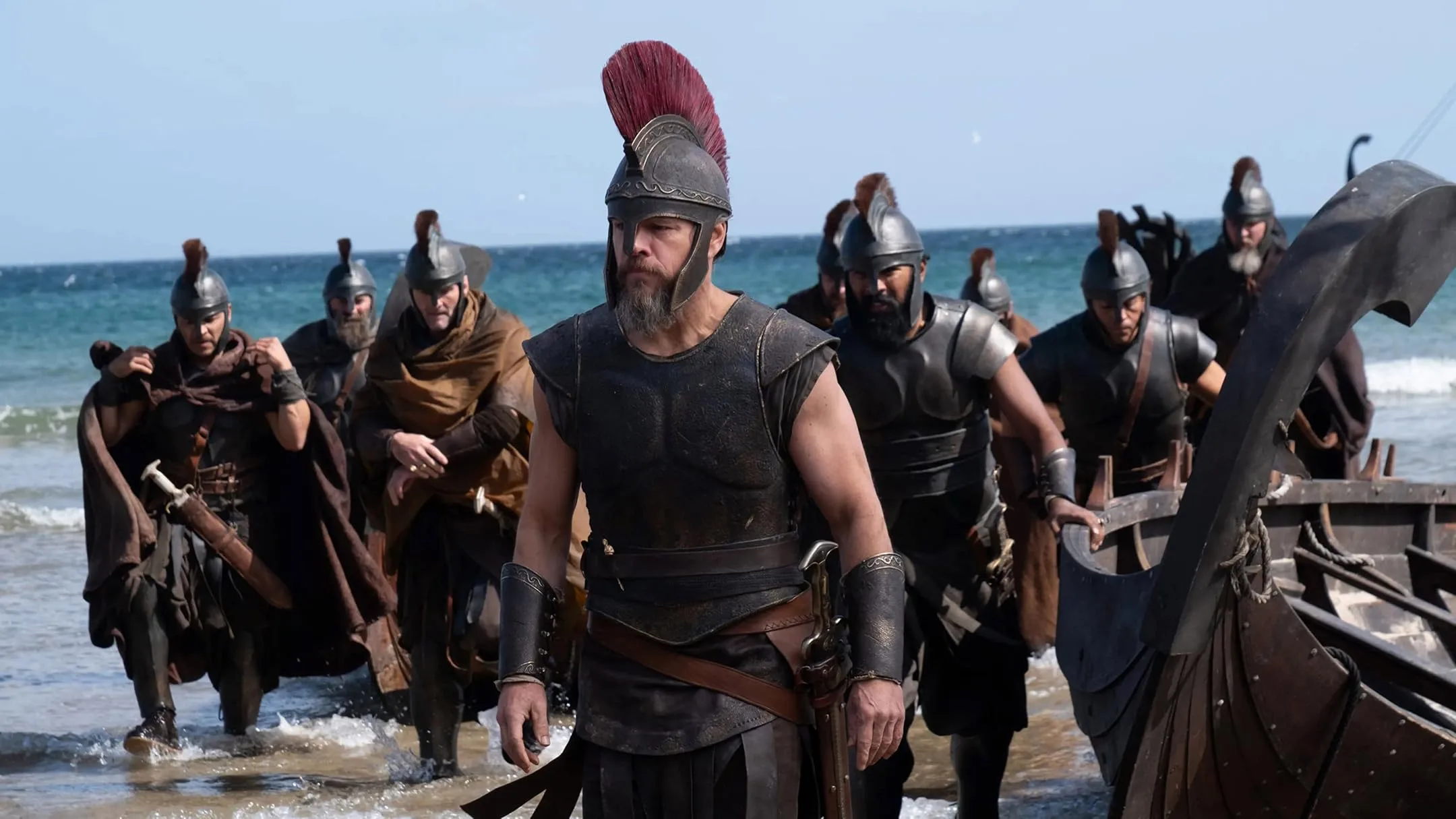
Penelope and Telemachus have spent years living inside that simplified version. Their loyalty is directed toward a husband and father who has been frozen at the moment of departure, before war rewrote him. His return cannot merely fill an empty chair. It introduces a stranger carrying the face of the person they lost.
The beggar disguise brings the xenia argument back to its beginning. Odysseus enters his own home as a vulnerable guest and discovers what remains of its moral order through the treatment he receives. The suitors fail the test they never realized they were taking. Their punishment arrives with a ferocity that Nolan stages as catharsis, horror, and political restoration at once.
The violence is exhilarating. That exhilaration creates the film’s hardest problem. Troy taught Odysseus what happens when force declares itself morally necessary, yet Ithaca can only be reclaimed through another room filled with bodies. The targets have earned judgment through cruelty, conspiracy, and abuse. The method still belongs to the world Odysseus claims he has learned to regret.
His return restores authority. It protects Penelope and Telemachus. It ends the occupation of the palace. None of those outcomes returns innocence to the man producing them. Odysseus can reclaim Ithaca. He cannot recover the life that existed before Troy.
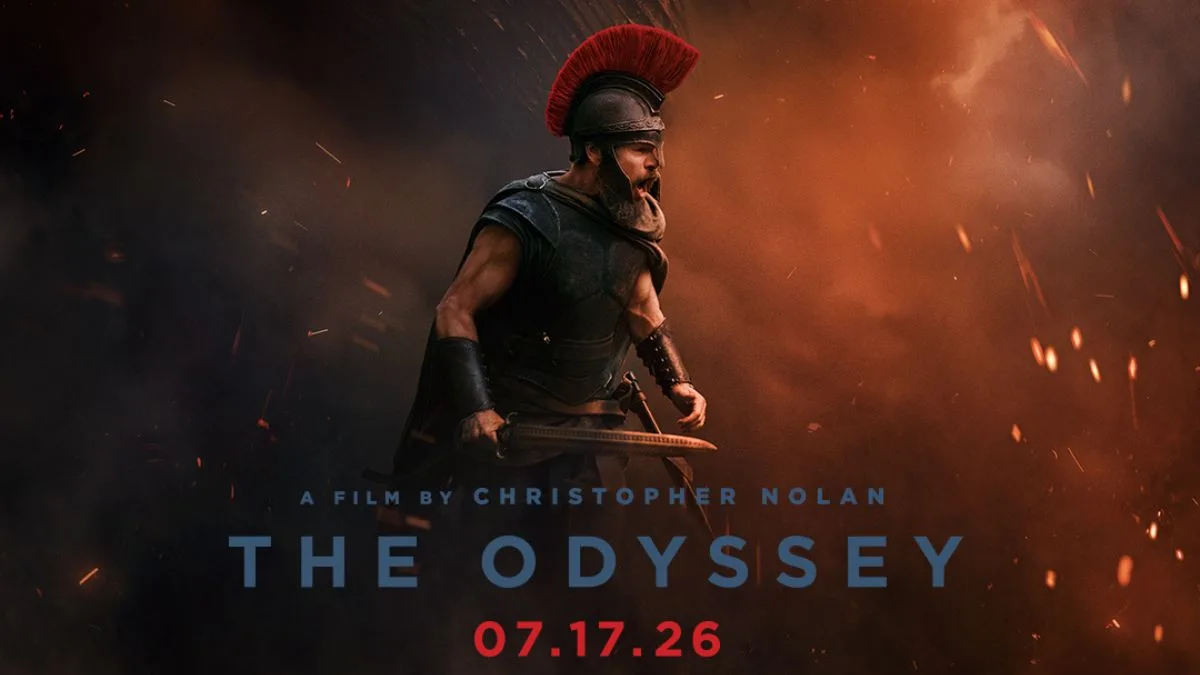
The Odyssey celebrated its world premiere on July 6, 2026, at the Empire Leicester Square in London, leading into its theatrical release on July 17, 2026. The epic action film chronicles the Greek king Odysseus as he embarks on a long and perilous voyage home following the Trojan War, facing mythical beings and dangerous elements while his wife Penelope fends off aggressive suitors. Audiences can watch the film exclusively in cinemas, with premium viewing experiences available on IMAX and large-format screens.
Where to Watch The Odyssey (2026) Online
Full Credits
Title: The Odyssey
Distributor: Universal Pictures
Release date: July 17, 2026
Rating: R
Running time: 172 minutes
Director: Christopher Nolan
Writers: Christopher Nolan, Homer
Producers and Executive Producers: Christopher Nolan, Emma Thomas, Thomas Hayslip
Cast: Matt Damon, Tom Holland, Anne Hathaway, Robert Pattinson, Lupita Nyong’o, Samantha Morton, Zendaya, Charlize Theron, Benny Safdie, Jon Bernthal, John Leguizamo, Bill Irwin, Himesh Patel, Elliot Page, Mia Goth
Director of Photography (Cinematographer): Hoyte van Hoytema
Editors: Jennifer Lame
Composer: Ludwig Göransson
The Review
The Odyssey
Christopher Nolan’s The Odyssey locates its most compelling conflict inside the moral authority of its hero. Its nonlinear structure, forceful performances, and tactile mythology turn homecoming into an argument about whether violence can repair the world violence ruined. A few creatures and the fall of Troy lack the film’s full imaginative force. The central contradictions still deepen the journey, leaving Odysseus triumphant, chastened, and permanently unable to recover the man who left Ithaca.
PROS
- Xenia as moral architecture
- Damon and Hathaway’s performances
- Nonlinear cause-and-consequence editing
- Tactile mythological sequences
- A genuinely conflicted homecoming
CONS
- Uneven creature design
- Troy lacks emotional force
- Grounded fantasy sometimes feels ordinary
- Retribution muddies the anti-war argument