



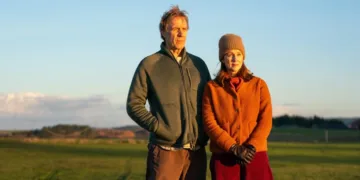










Ada Horn buries her father in soil that seems unwilling to receive him. The winter has hardened the earth, weakened the livestock, and left wolves pacing beyond the fences of a remote Union outpost. Death has already claimed the place before armed men arrive to formalize its rule.
Set in 1865, John Suits’ The Isolate Thief treats the closing days of the Civil War as an exhausted pause rather than a grand historical threshold. Ada, played by Mackenzie Foy, writes a final entry in the outpost log and prepares to leave for San Francisco. Her plans change when Perry, a frantic wanderer played by Joe Pantoliano, enters her cabin, ties her up, steals clothing, and directs her attention toward something buried in the woods. What she finds is gold.
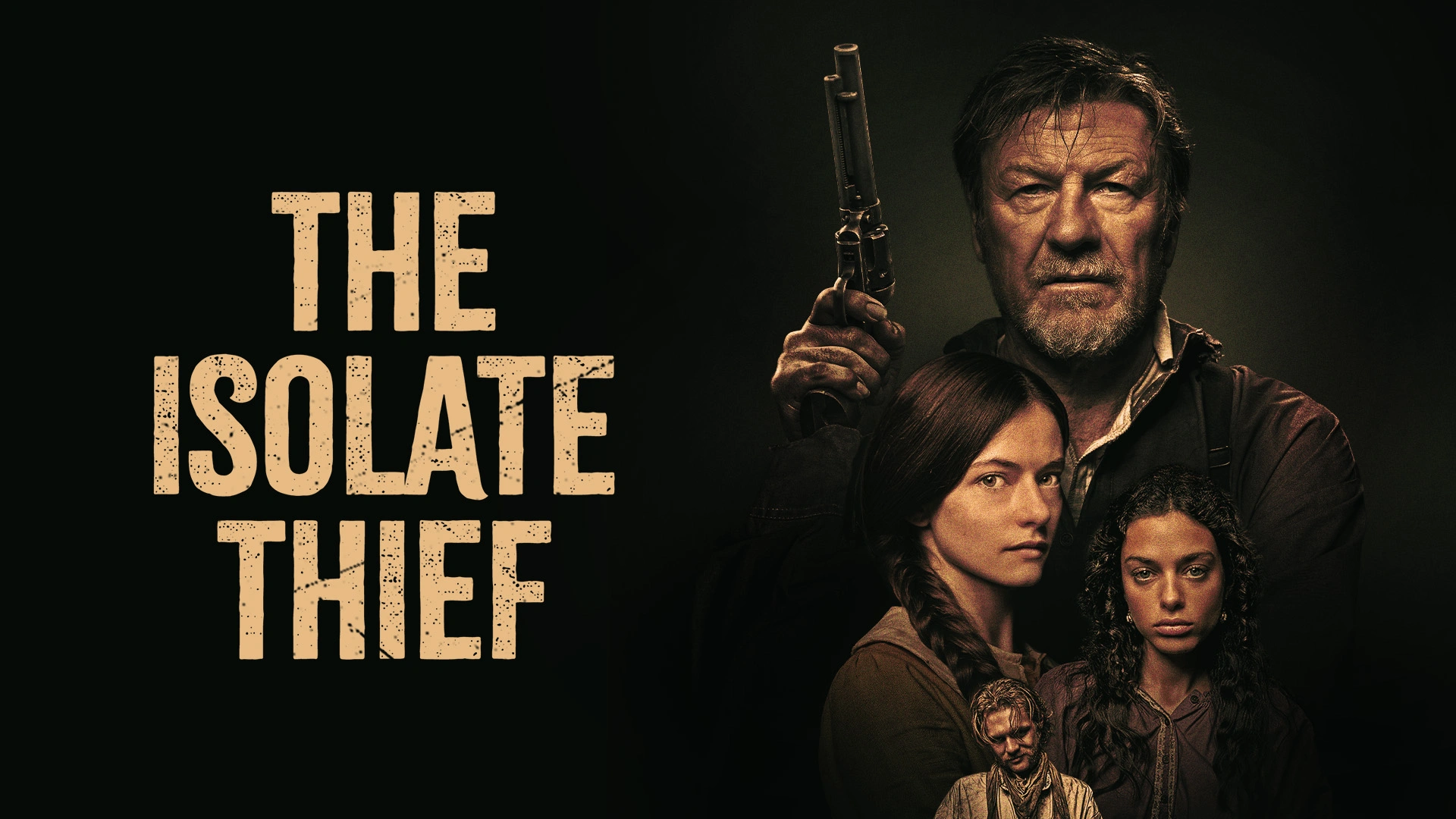
Then Colonel John “Fiddler” Good appears with three supposed Union soldiers. Sean Bean carries himself with the measured calm of a man who expects violence to remain unnecessary because his presence should be enough. The uniforms offer legal authority. The men wearing them offer something colder.
A House of Withheld Truths
Kevin Lefler’s screenplay builds tension from partial knowledge. Ada knows where the gold is hidden. Perry knows she found it. Fiddler suspects both of them. Red, Calvin, and Charley understand their leader’s purpose, yet their impatience repeatedly threatens the controlled performance of military legitimacy.
The film lets these facts emerge through behavior. Fiddler’s men show little interest in provisions or shelter. They seize Perry, accuse him of theft, and hang him while forcing Ada to watch. Their enjoyment of his suffering reveals what their uniforms cannot conceal. A strange harmonica tune and the deaths of actual soldiers in the woods further loosen their disguise. Ada survives by pretending not to notice.
Foy makes that pretense readable without turning it into theatrical cleverness. Ada lowers her gaze, answers carefully, and allows the men to mistake composure for obedience. Fiddler responds with his own performance, offering praise and suggesting she may grow into a formidable outlaw. Bean gives the compliment the warmth of a hand placed gently around a throat.
The cabin becomes a room where every pause carries calculation. Suits often holds on faces after dialogue has ended, waiting for a lie to settle. The approach creates a quiet strain, though several conversations circle the same suspicion without shifting control. Silence can tighten a scene. Repetition merely makes the cold feel longer.
Women the Men Cannot Read
Ada possesses practical knowledge shaped by isolation. She can tend animals, treat injuries, handle a rifle, and read the terrain surrounding the outpost. Her competence has limits. Life with her father has left her unprepared for the particular cruelty Fiddler’s gang directs toward women. Emily brings that knowledge into the cabin.
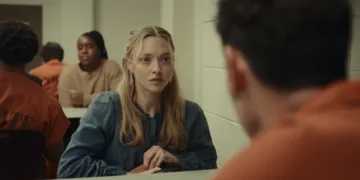
Odeya Rush plays her as someone who has survived by understanding how violent men distribute attention. Ada discovers her injured on the road and offers shelter, unaware of her connection to the gang. Emily soon recognizes the danger around them and the secret Ada is protecting. She teaches Ada about menstruation, warns her about the men’s intentions, and studies the shifting moods inside the room.
Their alliance develops through glances and small acts of care. The script avoids granting them speeches about solidarity. They bandage wounds, exchange information, and perform submission while searching for an opening. Their captors keep reading these actions as weakness.
The men’s failure is partly moral and partly perceptual. They see Ada as a sheltered girl and Emily as property. Neither category allows for patience, planning, or retaliation. Fiddler senses Ada’s intelligence, yet his admiration remains another form of possession. He wants to define her before she can define the terms of their conflict.
A knife driven through Ada’s hand turns that conflict physical. Foy plays the pain without surrendering the character’s alertness. Ada immediately protects what remains useful, including her shooting hand. Survival here has little romance. It is the discipline of deciding which part of the body can still function.
Wolves in Blue Light
Cinematographer Will Stone covers the landscape in cold blue-grey tones. Snow, smoke, and pale daylight seem cut from the same dead material. The visual scheme gives the outpost a suffocating stillness, as if warmth itself has abandoned the territory.
The limited setting serves the film well. Frozen graves, starving animals, rough timber walls, and the distant tree line create a world where every resource is close to depletion. Even before Fiddler arrives, Ada is living inside a slow collapse.
Suits loses some control once the restrained contest erupts into gunfire. The nighttime climax is frequently obscured by shadow, making positions and movements difficult to follow. Characters absorb bullets, blades, and blunt trauma far beyond what the film’s earlier physical realism can support. Pain stops carrying meaning when the body becomes an endlessly reusable target.
The wolf circling Ada’s pigs supplies the film with its clearest symbol. Fiddler is another predator waiting beyond the threshold, testing fences and searching for weakness. The comparison requires little interpretation, and the animal’s eventual intervention pushes the image toward blunt literalism.
Yet there is something fitting in the beast entering the human violence. Fiddler believes savagery is a language he controls. The wilderness answers without recognizing his authority. In the snow, a uniform is only cloth, gold is only weight, and blood cools at the same speed in every body.
The film premiered in theaters on July 10, 2026. Set during a brutal winter in the Civil War era, the story follows a young woman serving as the sole caretaker of a remote Union Army outpost who must defend herself and a hidden stash of gold against a ruthless gang of outlaws.
Where to Watch The Isolate Thief (2026) Online






Full Credits
Title: The Isolate Thief
Distributor: Radial Entertainment (Shout! Studios)
Release date: July 10, 2026
Running time: 1 hour 35 minutes
Director: John Suits
Writers: Kevin Lefler
Producers and Executive Producers: Vince Jolivette, Shannon Houchins, Margaret Miller, Travis Mann, Potsy Ponciroli, Trevor O’Neil, Noor Ahmed, Dave Roberts
Cast: Mackenzie Foy, Odeya Rush, Sean Bean, Joe Pantoliano, Jack Kesy, Ty Simpkins, Martin Sensmeier
The Review
The Isolate Thief
The frozen outpost becomes a grave before anyone finishes digging. Mackenzie Foy gives Ada a quiet, stubborn intelligence, while Sean Bean turns courtesy into a weapon with frightening ease. Their contest of concealed knowledge sustains the film through its slower passages, aided by blue-grey photography that makes every breath feel painful. Once conversation gives way to carnage, repeated wounds and murky nighttime staging weaken the physical danger. The Isolate Thief understands isolation as a form of violence, then nearly buries that insight beneath gunpowder.
PROS
- Mackenzie Foy’s restrained performance
- Sean Bean’s controlled menace
- Oppressive winter cinematography
- Effective cabin-bound tension
- Ada and Emily’s quiet alliance
CONS
- Sluggish middle passages
- Thinly drawn supporting outlaws
- Excessive physical punishment
- Dark, unclear climactic action
- Heavy-handed wolf symbolism