





















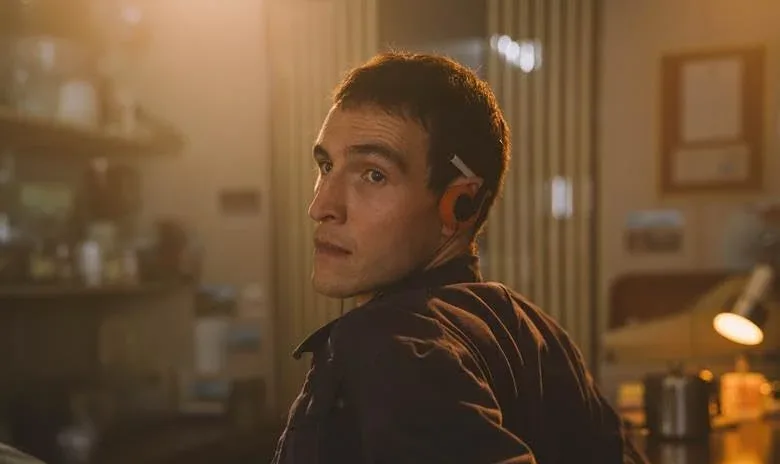

Beau has crossed the Irish Sea, but the change of country has not made intimacy easy. In 1988 London, the Irishman works at Maurice’s café, spends time with his friend Shell, and cruises bars and parks. Ireland, where homosexuality remains illegal, is behind him. So is any familiar idea of home. David Turpin’s Ancestors finds Beau living among people who have made a place for one another, while remaining guarded about how much of himself he will give them.
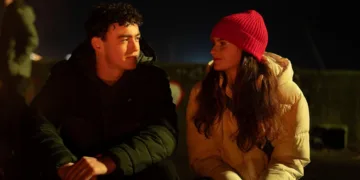
Maurice (Rupert Everett) welcomes younger men into the café and talks to them about the Hollywood stars whose pictures cover its walls. Those faces from another country have become part of his way of making a room feel hospitable. Beau (Éanna Hardwicke) has benefited from that hospitality, though he is less practiced at offering it. When Tiny (Jack Wolfe) needs somewhere to stay, Beau lets him in for a few nights. As Tiny remains, the offer becomes an attachment Beau cannot manage through kindness alone.
That progression gives the film its sharpest account of queer kinship. Maurice gathers people; Beau cares for Tiny in the smaller, less graceful ways available to him, including helping him keep track of medication. As Tiny’s health worsens, Beau pulls away from the person he wants to protect. His fear is understandable, and his withdrawal still hurts Tiny. Turpin allows both truths to stand. The relationship gains force from the gap between taking someone in and staying beside him when care becomes frightening.
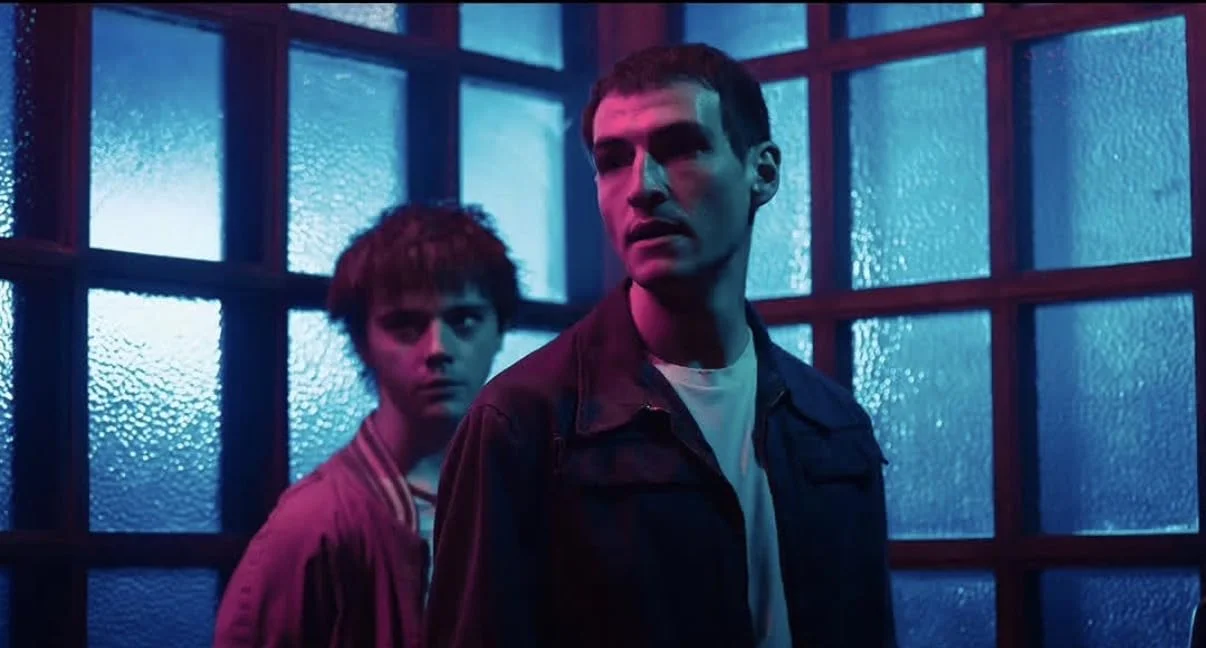
Hardwicke makes that gap visible without turning Beau’s reserve into a puzzle for the audience to solve. As the search wears on, his rangy posture seems to fold under the strain. Wolfe gives Tiny an appeal that explains Beau’s attachment, but the character also has wishes and anxieties of his own. When Tiny sings “My Love My Brother” at a gay bar, Beau watches him hold a room that is not organized around his illness. The scene matters because the film’s account of Tiny would be poorer if we knew him only through Beau’s fear of losing him.
Tiny’s disappearance sends Beau searching through the bars, clubs, and cruising grounds he knows. Editor Stephanie McCutcheon moves between that search and memories of their time together, gradually bringing Beau toward something he has avoided recalling. The shifts in time rarely make the basic action difficult to follow. They change the meaning of places Beau once used for pleasure and company: he returns to them looking for one person, increasingly aware of how easily someone can vanish from his life.
Patrick Jordan’s grainy, neon-touched images of London hold that uncertainty alongside more direct evidence of the AIDS crisis. Medication and declining health are part of Beau and Tiny’s daily experience; a crowded photo wall registers losses beyond them. The wall also guards against treating their bond as a complete portrait of the period. Turpin stays close to these characters while allowing the scale of what surrounds them to remain visible.
The film takes a greater risk with Gloria (Christina Hendricks), a Hollywood-style figure who appears in Beau’s dreams. Her polished monochrome world is far removed from Jordan’s hazier London. The choice has a logic of its own: Maurice’s beloved screen goddesses, imported and cherished, become images through which Beau might approach thoughts he cannot bear in waking life. Yet Gloria sometimes guides him so plainly that the fantasy narrows the uncertainty the editing and Hardwicke’s performance have worked to sustain. Where a look or a return to a familiar street leaves room for Beau’s resistance, her scenes can seem to supply the interpretation for him.
Ancestors shares some of the dreamlike visual language familiar from recent films of queer memory, including All of Us Strangers. Its own strongest material is less dependent on that resemblance. Beau’s passage from Ireland to London gives displacement a specific history; Maurice’s café shows how people make a culture from whatever they can carry and share; Tiny tests the limits of Beau’s willingness to belong to it.
The ending lingers after Beau’s emotional recognition has become clear, and the closing-credit message about descendants states what the crowded photo wall and Maurice’s café have already shown. Still, the difficult question remains with the ordinary acts that preceded it: Maurice opening his door, Beau opening his, and what each man is able to do once someone walks through.
Ancestors world-premiered at the Toronto International Film Festival on September 12, 2026. Set in 1980s London during the shadow of the AIDS crisis, the mystery drama follows a young man searching for his missing friend as dreams, memories, and history converge.
Full Credits
Title: Ancestors
Distributor: Samson Films / Mister Smith Entertainment
Release date: September 12, 2026 (Toronto International Film Festival)
Running time: 1 hour 46 minutes (106 minutes)
Director: David Turpin
Writers: David Turpin
Producers and Executive Producers: David Collins, Eamon Hughes, Miranda Ballesteros
Cast: Éanna Hardwicke, Jack Wolfe, Jessica Reynolds, Rupert Everett, Christina Hendricks, Margi Clarke, Tony Flynn, Patrick Martins
Director of Photography (Cinematographer): Patrick Jordan
Composer: Jack Wolfe, David Turpin
The Review
Ancestors
Ancestors gives Beau’s move from Ireland to London a history that matters to his relationships. Éanna Hardwicke and Jack Wolfe make care feel tender, difficult, and sometimes inadequate, while Maurice’s café and the crowded photo wall give private loss a communal scale. Gloria’s dream sequences explain too much, and the ending lingers after its emotional point is clear. Turpin’s strongest scenes trust what these people do for one another, and where they falter.
PROS
- Hardwicke and Wolfe’s layered performances
- A specific Irish and London cultural perspective
- Nonlinear editing that follows Beau’s uncertainty
- Concrete details of communal care and loss
CONS
- Gloria’s guidance can feel too explicit
- The ending outlasts its emotional resolution