






















![Kingdom Hearts Collection [I-III] Review](https://gazettely.com/wp-content/uploads/2026/10/Kingdom-Hearts-Collection-I-III-1-360x180.webp "Kingdom Hearts Collection [I-III] Review: KHII Holds Steady as Newer Entries Fluctuate 37")



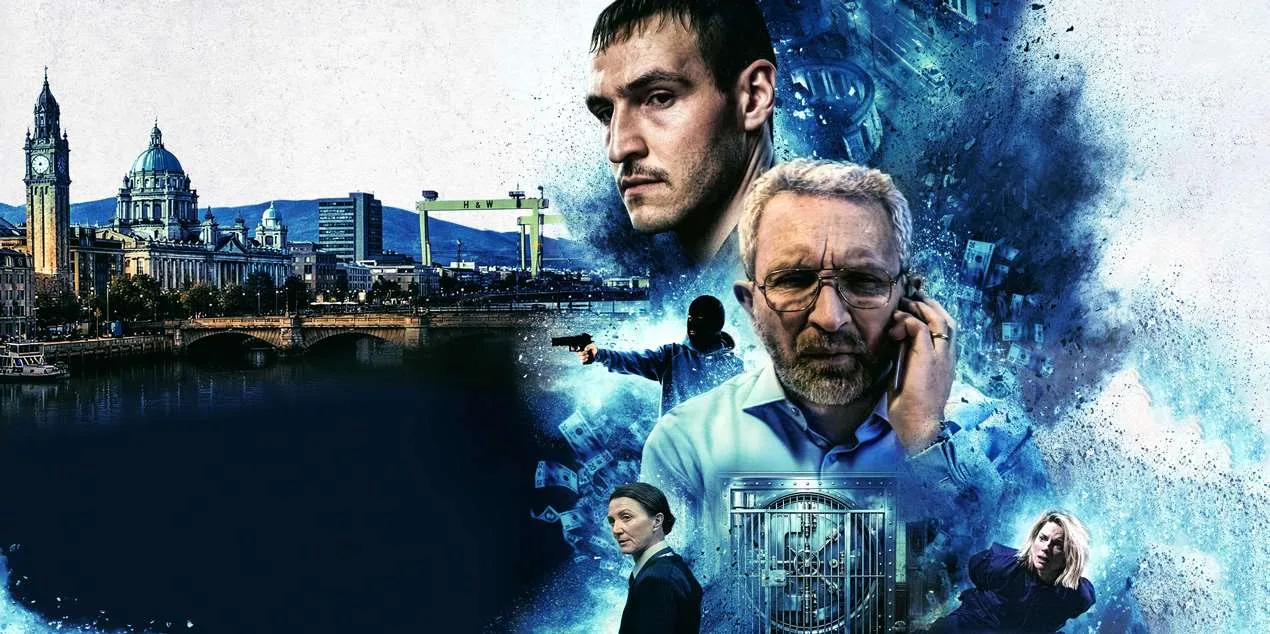

The 2004 Northern Bank robbery sits in Irish criminal history like a splinter that never quite worked its way out. Colin McIvor and co-writer Aisling Corristine have taken that event and built a fictionalised thriller around it, changing names and compressing timelines to serve dramatic purpose rather than historical record. The result is No Ordinary Heist, a Belfast-set crime film that arrives with a clear-eyed sense of what it wants to be: grounded, human, and tense without the artifice of big-budget heist spectacle.
At its centre are two men with very little in common. Richard Murray (Eddie Marsan), an emotionally buttoned-up bank manager already fraying at the seams, and Barry McKenna (Éanna Hardwicke), a younger, looser, vault-key-holding security worker who treats professional responsibility as something of a suggestion. A tiger kidnapping scheme, in which Richard’s wife and Barry’s mother are seized by an armed gang, forces these two into a working partnership neither would have chosen.
The timing is specifically cruel. It is the week before Christmas. Redundancies are coming. The bank is already a pressure cooker, and the lid has just been welded shut.
The Quietest Kind of Thriller
The gang’s plan has an almost elegant simplicity. Richard and Barry go to work as normal, pack millions in used notes, and move the cash to a side door. The criminals never need to set foot inside the building. It is a heist conducted entirely by proxy, and therein lies the film’s most original tension: the real crime scene is psychological, not physical.
McIvor builds pressure the way a good short story accumulates detail. A glance held a second too long. The vibration of a mobile phone at the wrong moment. The exhausting effort of appearing ordinary when everything is quietly collapsing. There is no car chase, no shootout. The film understands that fear, properly rendered, requires no percussion.
Mags Fulton (Michelle Fairley), the bank’s head of security, functions as the film’s silent detonator. She knows every camera angle and reads the room with unnerving precision. Every time Richard or Barry drifts into her orbit, the temperature drops. The cuts to the hostages, Richard’s wife and Barry’s mother held by people who do not broadcast their intentions, remind the audience at regular intervals that the danger is entirely real.
A subplot about impending staff redundancies adds a specific, quietly devastating irony: Richard is being asked to ruin Christmas for his colleagues while someone else is ruining it for him. This thread runs through Mags in particular. It is, frustratingly, abandoned before it can pay off. Some of the film’s editing choices, with time-jumps and deliberately withheld information, generate productive unease. Occasionally they feel like sleight of hand around a story that is, stripped back, fairly straightforward.
Two Men, Wrong Room, Right Film
The relationship between Richard and Barry is where the film earns its keep. Class difference, professional hierarchy, personal history, mutual contempt. These are the raw materials. What the kidnapping does is strip those materials down to something more essential: two men who would never have chosen each other, now entirely dependent on each other.
Marsan plays Richard as a man who has spent years compressing himself into professional usefulness. The Belfast accent is convincing; the performance beneath it is careful and precise. Marsan has spoken about reading this script as a story about prejudice, about two men who have calcified opinions of each other and must crack those open to save something precious. That reading is correct, and it gives the film a moral undertow that lifts it clear of simple thriller mechanics.
Hardwicke is the more immediately arresting presence. Barry is bravado stretched thin over anxiety, a young man whose casualness has accidentally made him the most important person in a very dangerous room. Hardwicke makes Barry’s recklessness feel earned rather than lazy, so that the audience roots for him even when they arguably shouldn’t.
Fairley, sharp and watchful as Mags, deserves more than the script gives her. The redundancy subplot tied to her character is dropped without resolution, which is a poor return on a performance of this quality.
The film’s minor villain, a gang member left to guard Barry’s mother, is quietly unforgettable. His compulsive cleaning of his hostage’s kitchen sink radiates a specific menace found in real behavioural detail rather than genre shorthand. That is good writing. Marsan and Hardwicke together carry moments of dark comedy that cut the tension without deflating it. The film is funnier than its premise suggests it has any right to be.
A Small Film with Large Source Material
McIvor’s visual instincts are restrained and deliberate. The colour palette is drained of warmth, the cinematography unshowy. Belfast is presented as a city of ordinary streets and fluorescent-lit offices. This is exactly right. The green-tinted vault and security camera footage do specific work: they make money look cold, institutional, barely worth the fear. There is a quiet argument here about what people risk, and why.

The film’s pacing is measured. Pressure accumulates in small units, which suits the material, though it occasionally makes No Ordinary Heist feel like it is operating below its source material’s natural register.
The script gestures at a richer picture: the suggestion that the gang may have IRA connections, the post-Troubles social backdrop, the class tensions running through every exchange between Richard and Barry. These are live wires. McIvor and Corristine identify them clearly and then step around them. The Northern Ireland that produced this crime, a place still recalibrating its sense of self in 2004, is present in the film’s atmosphere but largely absent from its argument. That gap is the most honest thing to say about No Ordinary Heist: it is a good film that keeps flinching from the chance to be a great one.
Released theatrically in Ireland and the UK on March 27, 2026, No Ordinary Heist is a claustrophobic crime thriller based on the real-life 2004 Northern Bank robbery in Belfast. The story follows two feuding bank employees who must work together to rob their own workplace after their families are taken hostage. As of today, April 28, 2026, the film is officially available to watch on VOD platforms such as Apple TV and Fandango at Home, and it is also scheduled to arrive on Sky Cinema as a “Sky Original” later this year.
Where to Watch No Ordinary Heist Online









Full Credits
Title: No Ordinary Heist
Distributor: Wildcard Distribution (Theatrical), Epic Pictures Group (North America), Apple TV, Fandango at Home
Release date: March 27, 2026 (Theatrical), April 28, 2026 (VOD)
Rating: 15 / 15A
Running time: 99 minutes
Director: Colin McIvor
Writers: Aisling Corristine, Colin McIvor
Producers and Executive Producers: Ruth Carter, Johanna Hogan, Damon Lane, John Gleeson, Oisín O’Neill
Cast: Eddie Marsan, Éanna Hardwicke, Eva Birthistle, Michelle Fairley, Andrea Irvine, Desmond Eastwood, Patrick O’Kane, JB Moore
Director of Photography (Cinematographer): Damien Elliott
Editors: Brian Philip Davis
Composer: Andrew Simon McAllister
The Review
No Ordinary Heist
No Ordinary Heist is a lean, character-driven thriller that finds genuine tension in human psychology rather than genre spectacle. Hardwicke is revelatory, Marsan is precise, and McIvor's restrained hand keeps things grounded and believable. The film earns its suspense honestly. What holds it back is a script that identifies rich thematic territory — class, prejudice, post-Troubles Belfast — and repeatedly declines to fully inhabit it. Promising threads are left loose. A good film, then, that carries the faint weight of a better one it could have been.
PROS
- Hardwicke's standout, live-wire performance
- Tension built through restraint and psychological realism
- Sharp dark comedy woven into a serious premise
- Grounded, authentic Belfast setting
- Strong central dynamic between the two leads
CONS
- Several subplots abandoned without resolution
- Fairley underserved by the script
- Post-Troubles backdrop underdeveloped
- Some editing choices obscure rather than enrich