

























Eleni does not need Douglas to touch her; she needs him to need her. That distinction gives Night Nurse its peculiar charge. Georgia Bernstein’s feature debut takes place inside an upscale retirement community, yet its real setting is the unstable border between care and appetite. A nurse may help someone bathe, swallow medication, remember a name, or make it safely across a room. Each task requires trust. Each task can also become a little theatre of dependence.
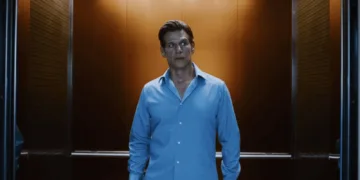
Cemre Paksoy plays Eleni as a young woman whose stillness is difficult to classify. She arrives at the facility watchful and eager to help, then studies its strange routines from behind glass: young nurses guide elderly men through a therapy pool, bodies separated by decades and united by institutional intimacy. Douglas Callum, played by Bruce McKenzie, sits nearby in sunglasses, smoking where nobody should be smoking. He looks less like a patient than a retired despot enjoying loose enforcement.
The film’s vague period setting sharpens that unreality. Landlines dominate the rooms, cigarettes appear indoors, and mobile phones seem absent. Bernstein is not reconstructing a precise decade. She is removing the modern world until the facility becomes an island where Douglas can preserve an older model of male authority. He has failing checks, possible dementia, and no visible reason to remain powerful. Power remains his chief vital sign.
A Confidence Trick for Two
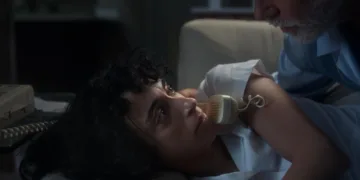
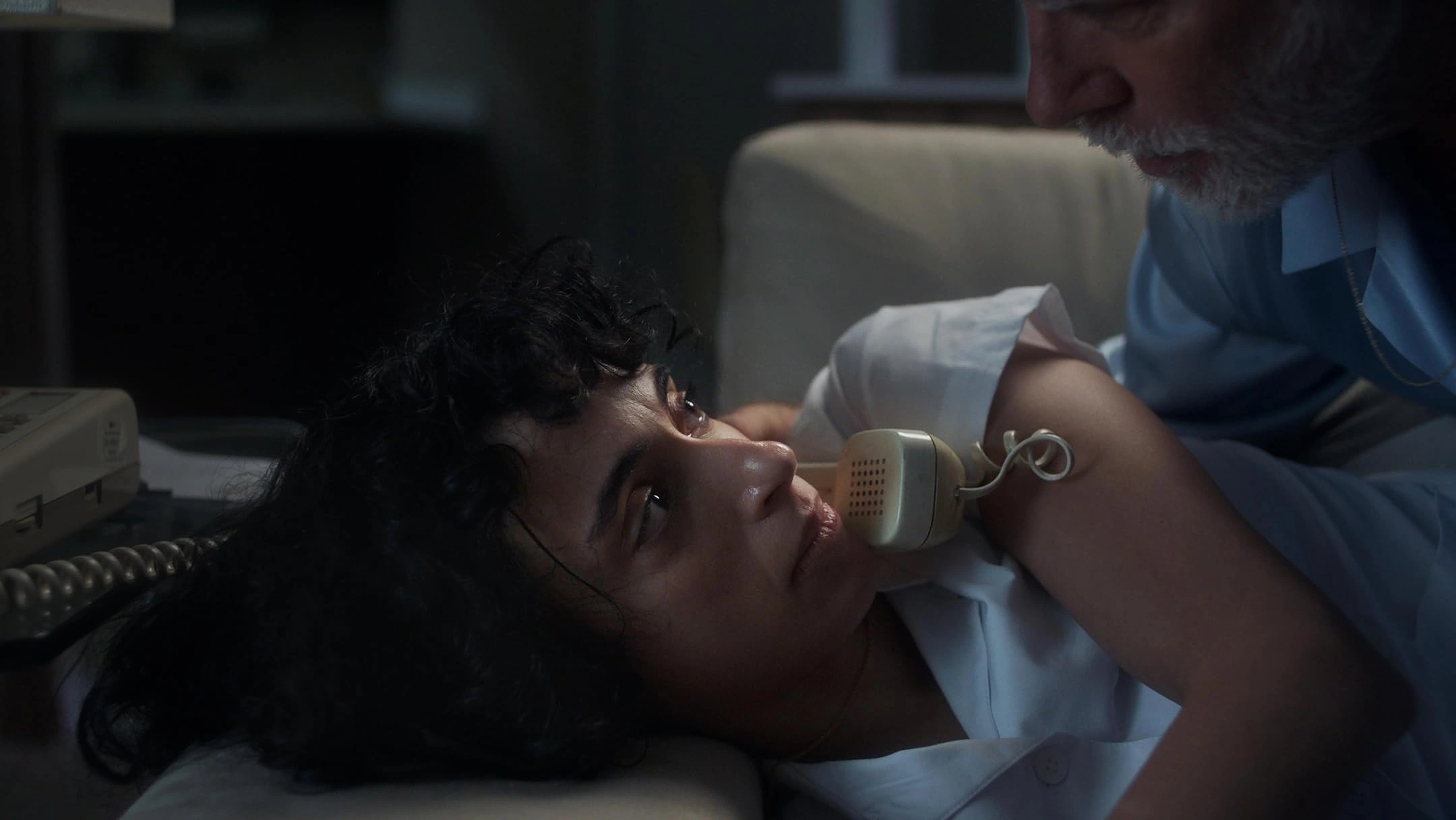
The first scam call turns voice into touch. Douglas feeds Eleni lines while a coiled telephone cord winds around her body. She pretends to be a granddaughter in legal trouble, frightened enough to make an elderly stranger send cash for a fictional bail payment. Douglas then takes over as the calm authority figure. Panic opens the door. His voice walks through it.
Bernstein’s smartest idea is the moral kinship she finds between caregiving and fraud. Both practices begin with attention. The nurse watches for weakness because she intends to help; the scammer watches for weakness because he intends to exploit it. The difference sounds enormous, until Eleni starts enjoying the performance. Call it usefulness erotics: the pleasure of becoming indispensable to someone at the precise moment they become helpless.
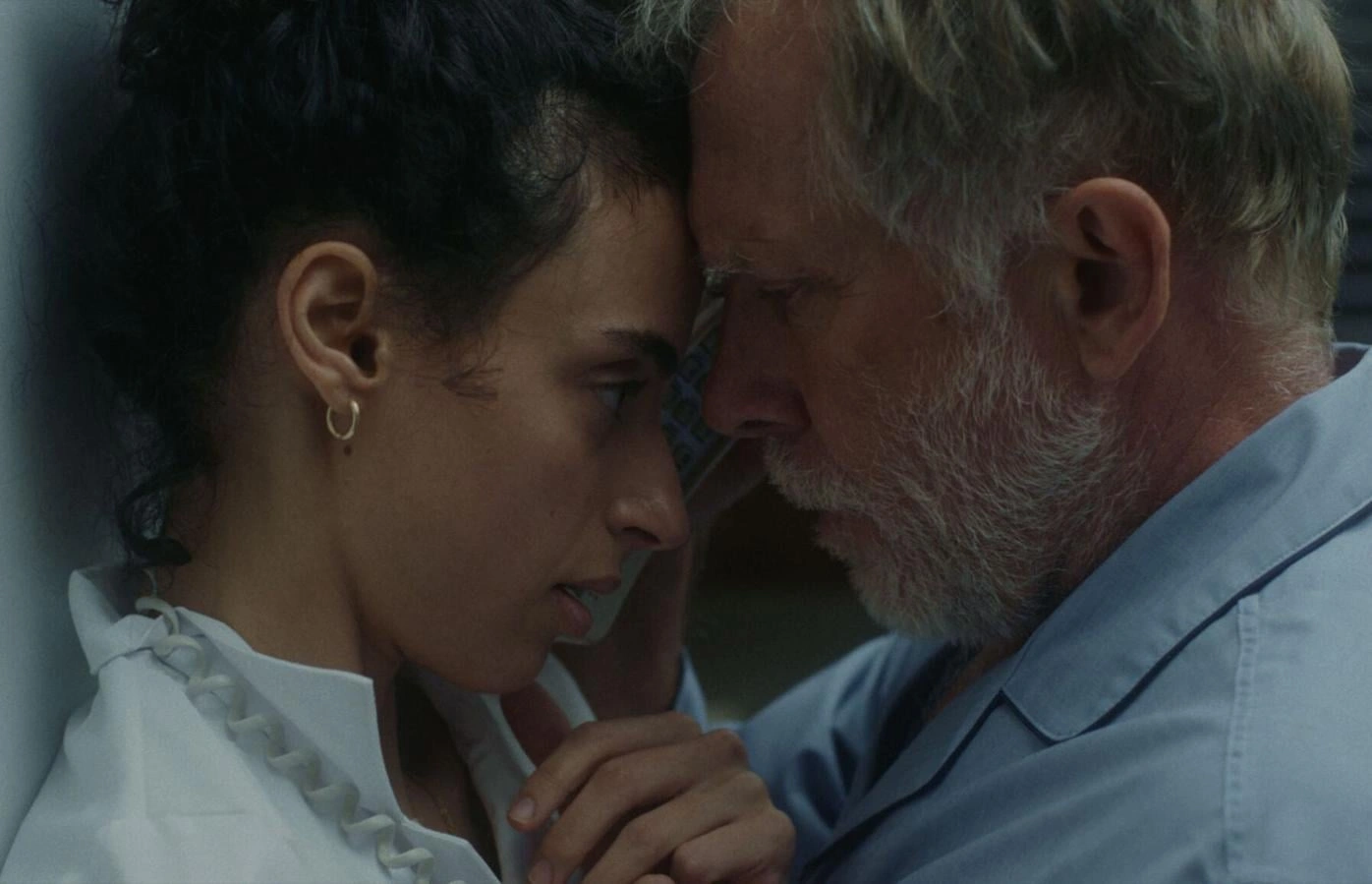
Douglas understands this appetite instantly. During a late-night kitchen encounter, he presses Eleni against a wall and speaks to her as though patient and caregiver were roles they had agreed to play. She does not retreat. Her excitement comes from the taboo, yet the taboo is not simply age. He depends on her for ordinary physical care, while she depends on his dependence for emotional permission. Their power moves in both directions, which is why neither can own it for long.
Also Read




His warning that he is no “pogo stick” punctures the obvious reading. Eleni is not chasing conventional sex. She wants proximity to need, perhaps because need is easier to manage than affection. I initially read her as another person drawn into Douglas’s orbit. The scam calls make that reading less comfortable. She learns the rhythm too quickly, and her voice gains confidence each time another stranger believes her lie.
The victims remain offscreen or distant, a choice that protects the film’s dream logic while weakening its moral pressure. We hear trust being converted into cash, yet rarely face the person being robbed. The arrangement keeps Eleni’s fantasy intact. It also makes the crime feel cleaner than it is, which may be the point. Fraud works best when harm can be imagined as paperwork.
The Little Kingdom
Mona, Douglas’s day nurse, recognizes the arrangement before Eleni does. Eléonore Hendricks gives her a possessive calm, especially when she watches Douglas notice the new hire. Her advice, “It’s easier to play along,” could describe nursing, seduction, fraud, or employment under a difficult man. “He’s all yours” sounds generous for half a second. Then the territorial sting arrives.
Mona later asks, “Isn’t it amazing to feel needed?” The line carries the film’s argument without settling it. Care work asks people to place another person’s body ahead of their own comfort. That sacrifice can produce tenderness. It can also feed vanity. The caregiver becomes morally virtuous, emotionally central, and difficult to replace. There is a kind of narcissism available through selflessness (human beings have found loopholes in every virtue).
Eleni, Mona, and Douglas gradually form a sealed unit. They ride through the community in his convertible, scanning for possible victims with the casual intimacy of a family outing. The scene is funny until its predatory logic registers. Two nurses and an aging resident appear to be enjoying the afternoon. They are prospecting.
Douglas expands this unit into a miniature court. At a gathering in his bungalow, nurses drift through the room under the influence of prescription medication stolen from residents. He presides in blue satin pajamas, less a sexual conqueror than a patriarch who has learned that attention can replace potency. His charisma is transactional. He offers permission to misbehave, and the nurses return the favor by treating his authority as real.
McKenzie keeps Douglas’s cognition uncertain. He can pass much of a memory test, manipulate several women, and close a scam call with professional precision. He also slips into confusion that feels less controllable as the film proceeds. At first, dementia appears to be another mask. Later, the mask may be wearing him. Bernstein refuses to mark the exact moment of change, leaving Eleni in a relationship whose consent cannot remain fixed.
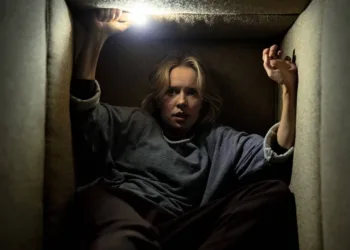
Paksoy responds by making Eleni more unsettling as Douglas grows weaker. She watches from corners. In the therapy pool, her mouth stays beneath the surface while her eyes remain exposed, giving her the patience of an animal waiting for movement. Violence never arrives to make her menace easy. Her danger lies in the possibility that care itself has become her method of possession.
Rooms That Watch Back
Lidia Nikonova’s cinematography gives the facility the texture of a place remembered incorrectly. Shallow focus separates Eleni from her surroundings even when she stands among colleagues. Faces are withheld while the camera studies the age difference between residents and nurses. Hallways, kitchens, bathrooms, and bungalows become intimate without feeling safe. Privacy exists only as a temporary failure of surveillance.
A sunlit room filled with plants briefly softens that pressure. Eleni and Mona sit within the foliage like figures arranged for a painting, their bodies calm while their relationship with Douglas grows increasingly unstable. The composition makes care look serene. The surrounding film has already taught us to distrust serenity.
Bernstein’s limited budget becomes a formal advantage. Her grandmother’s house reportedly supplies much of the facility, and the film rarely offers wide establishing views that might expose its scale. A hospital room is created through a bed, equipment, and a green wall. A police car is suggested through fragments of metal and flashing light. Space is built from implication, the same method used for psychology. We see enough to form a whole, then discover the whole may be false.
Steven Jackson and Sam Clapp’s piano-led jazz score performs a similar trick. Its elegance gives Douglas’s crimes the atmosphere of old noir, while its loose tempo keeps Eleni’s motives suspended. Telephone static, close breathing, and whispered instructions make the scam calls feel private even when they reach into strangers’ homes. The sound design turns distance into intimacy, which is exactly what the scam requires.
A harsh fade to black later in the film breaks that sensual continuity. For a moment, Eleni’s desire ceases to be dreamy and becomes bluntly dangerous. Bernstein does not explain the shift. She cuts the light.
When the Dream Needs a Plot
The film’s patience is both its confidence and its alibi. Bernstein allows Douglas to smoke while Eleni and Mona arrange themselves around him, lets wind move through Eleni’s hair in the convertible, and watches the nurses drift through the drug party in a medicated haze. These images reveal the group’s emotional structure. They also repeat it.
Once the scam, the triangle, and Douglas’s influence are established, the middle section has limited room to move. Police interest produces a staff meeting, Dr. Mann begins to look through Douglas’s performance, and his mental decline complicates Eleni’s attachment. Yet each pressure arrives softly, as though the film fears that a clear dramatic turn would wake it from its own atmosphere.
Mimi Rogers gives Dr. Mann a dry suspicion that suggests she understands much of what is happening and says little. The character remains peripheral when she might have forced Eleni to defend her conduct or Douglas to confront the institution sheltering him. The victims receive even less presence. Bernstein seems committed to Eleni’s sealed perspective, but the seal becomes a limitation once consequences arrive.
The final act speeds through complications the earlier passages took great care preparing. Douglas’s decline, institutional scrutiny, and Eleni’s predatory investment collide quickly, producing an ending that feels emotionally sharp and structurally hurried. I wanted the film to stay with the collapse longer. Then again, Eleni’s fantasy depends on postponing recognition, and the film has been sharing that fantasy with her from the start. That may explain the drift. It does not fully excuse it.
The provocative psychological indie thriller Night Nurse celebrated its cinematic debut at the Sundance Film Festival on January 26, 2026, before launching into select independent picture houses across the United States yesterday, July 10, 2026, via IFC Films. Moviegoers following its rollout can catch the theatrical production in limited regional arthouse locations like the IFC Center or watch for upcoming home streaming dates on digital on-demand services. The dreamlike narrative follows a young, newly hired nurse at a high-end retirement community who becomes deeply entangled with a charming, manipulative patient involved in a series of perverse telephone scam calls targeting the elderly residents.
Where to Watch Night Nurse (2026) Online






Full Credits
Title: Night Nurse
Distributor: Independent Film Company, IFC Films
Release date: January 26, 2026 (Sundance Film Festival), July 10, 2026 (United States Limited Theater Release)
Running time: 95 minutes
Director: Georgia Bernstein
Writers: Georgia Bernstein
Producers and Executive Producers: Georgia Bernstein, Edwin Linker, Lucy Rogers, Liane Cunje, Veronica Barbosa
Cast: Cemre Paksoy, Bruce McKenzie, Eleonore Hendricks, Colleen Rose Trundy, Mimi Rogers, Keith Kupferer, Frank V. Ross, Medina Kincy, Vincent Teninty, Karin Anglin, Sandy Gulliver
Director of Photography (Cinematographer): Lidia Nikonova
Editors: Alex Jacobs
Composer: Sam Clapp, Steven Jackson
The Review
Night Nurse
Night Nurse finds a disturbing kinship between care and fraud: both depend on making another person believe they are needed. Georgia Bernstein turns that idea into a woozy study of desire, dependency, and moral role-play. I kept resisting the film’s thin plot, then wondering if thinness was part of the trap (the answer is partly). Cemre Paksoy and Bruce McKenzie keep the power balance unstable, while the final act rushes consequences the earlier scenes patiently earned.
PROS
- Paksoy’s unnerving restraint
- McKenzie’s slippery ambiguity
- Seductive visual design
- Sharp caregiver-scam parallel
- Eerie jazz score
CONS
- Underdeveloped victims
- Repetitive middle stretch
- Peripheral supporting roles
- Hurried final act