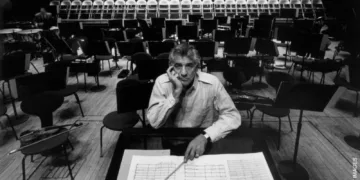























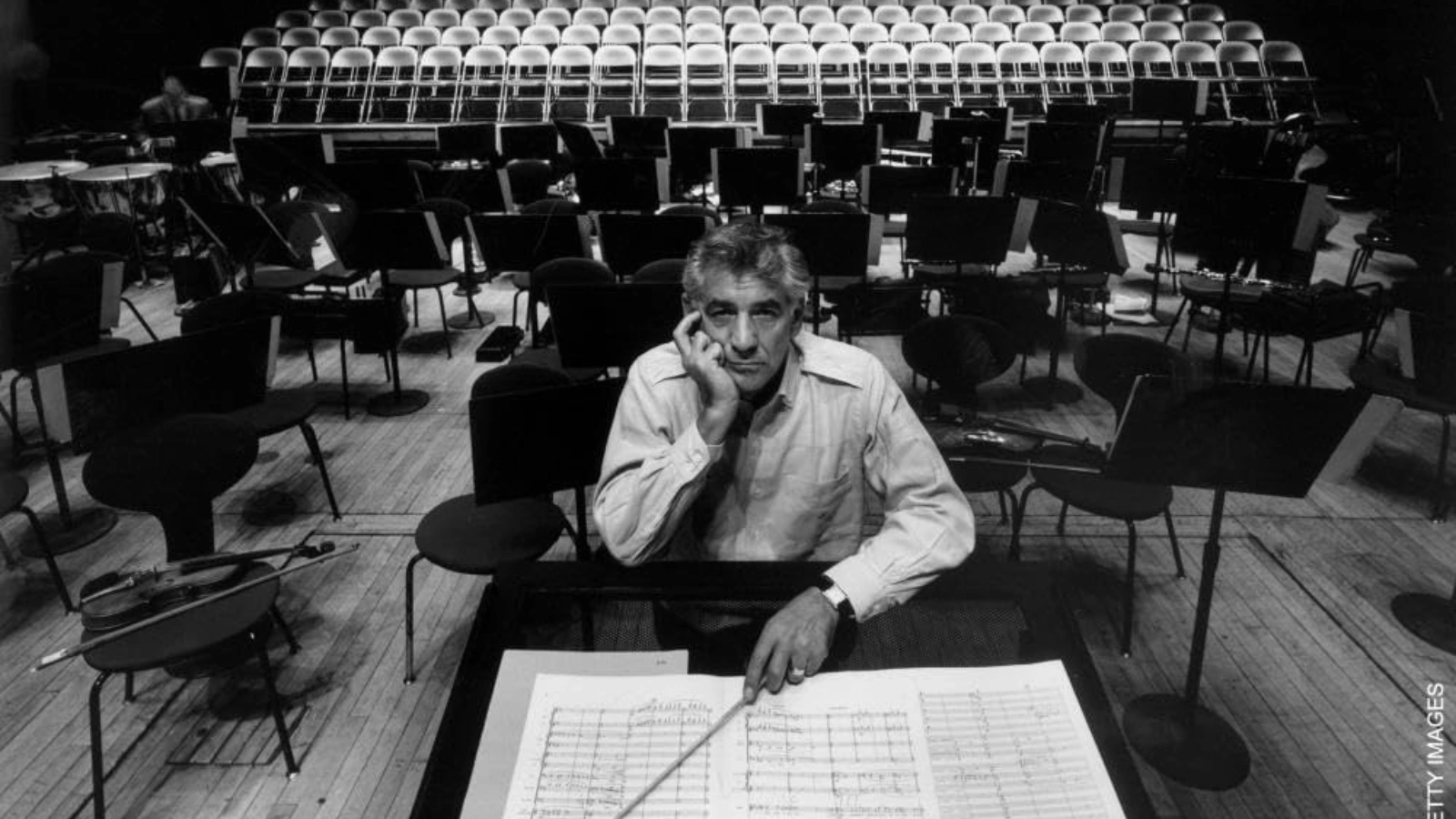

Leonard Bernstein’s cigarette-rough voice carries Douglas Tirola’s film before any orchestra has time to swell. It comes through archival interviews, television appearances, private letters, home movies, photographs, concert footage, and old audio recordings, forming a self-portrait that feels intimate in the way a room can feel intimate after someone has left it.
Bernstein’s Wall avoids the usual parade of experts explaining genius from a safe distance. Tirola lets Bernstein speak, and that choice gives the documentary its warmth, its seduction, and some of its danger. The man was a magnificent talker.
He could turn music into weather, politics into melody, guilt into charm. The film trusts that voice so deeply that it sometimes inherits his evasions. Still, the texture is powerful: the gravel, the wit, the hunger to be understood. The result is not a complete life. It is a haunted arrangement.
Music as a Public Fire
Tirola’s strongest idea is that Bernstein treated music as a civic force. The old clips from Omnibus and the Young People’s Concerts matter here because they show him refusing to treat classical music as a sealed room for the initiated. He stands before cameras and audiences with the confidence of a preacher who has misplaced his pulpit and found a piano instead.
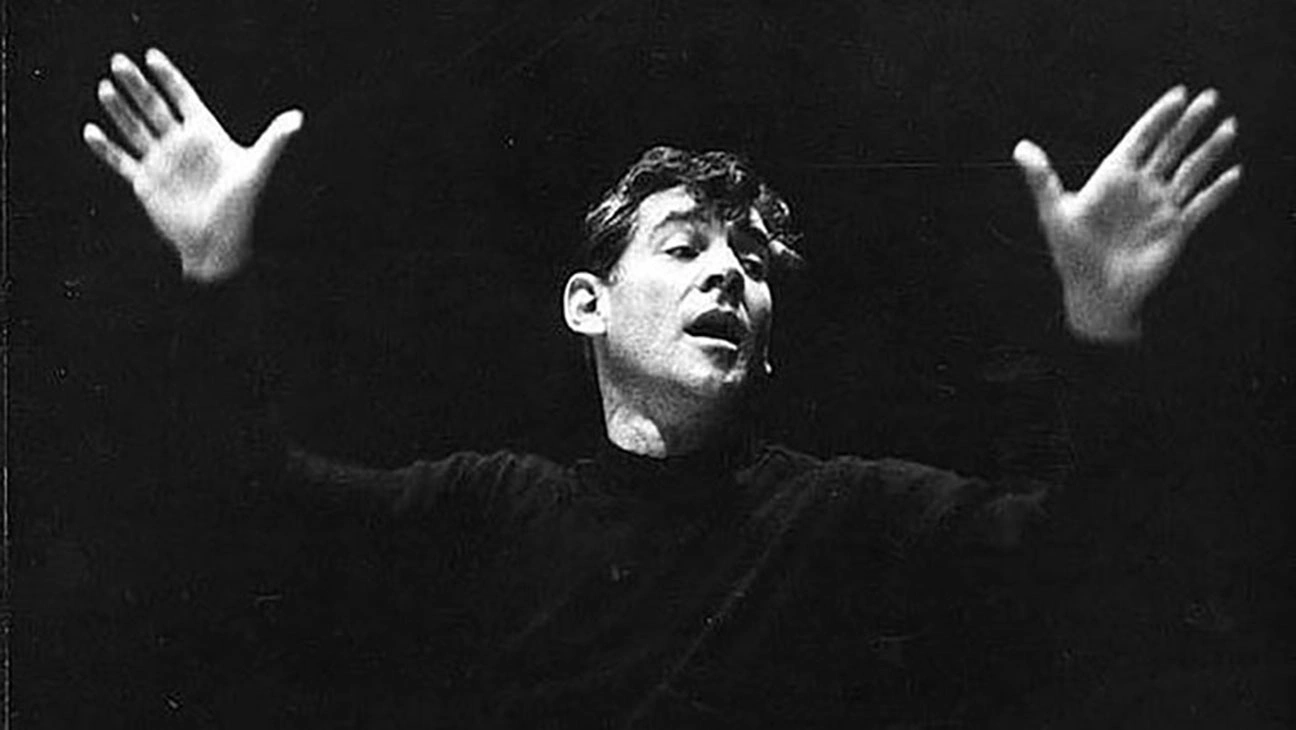
He explains jazz, opera, musical theater, symphonic structure, and emotional rhythm without lowering the ceiling. That is the beautiful thing. He assumes the young can listen. He assumes the public can think. In the CBS footage, his gestures have the grandeur of performance, but his speech keeps returning to access, curiosity, and freedom. He does not merely conduct music. He conducts attention.
The film draws a clean line from this public teacher to the 25-year-old assistant conductor who replaced Bruno Walter at Carnegie Hall in 1943 with no rehearsal after a night out. Fame arrives almost violently: a standing ovation, a front-page notice in The New York Times, and the sudden birth of an American maestro. Serge Koussevitzky had once told him to change his surname to “Burns” because Bernstein sounded too Jewish. Bernstein slept on it and refused. That refusal echoes through the film like a struck note left to decay.
The Politics of Being Seen
Bernstein’s politics were not decoration. The film returns again and again to his belief that artists need freedom, and that freedom has enemies with names, offices, uniforms, newspapers, and sometimes very good manners. His civil rights work, antiwar activism, human rights advocacy, and Kennedy-era idealism are presented as extensions of his music rather than extracurricular virtue.
The House Un-American Activities Committee passes through the documentary too quickly, which is frustrating. Passport trouble and McCarthy-era suspicion should leave a deeper bruise than the film has time to examine. The same compression affects Mass, the 1971 theater piece written for the Kennedy Center at Jacqueline Kennedy’s request. Bernstein calls it a statement on the temporary nature of power, and the Nixon White House tapes give that claim a grimly comic afterlife, with H.R. Haldeman warning Richard Nixon about the work’s political charge.
Then comes the Black Panther benefit at Bernstein’s apartment in 1970, the wound the film touches and pulls back from. Tom Wolfe’s “radical chic” attack turned the gathering into a public spectacle of elite guilt, privilege, and performative compassion.
Archival Bernstein reacts with exhausted pain, calling the account false, almost folding into himself under the memory. Tirola clearly sides with Bernstein’s sincerity. The harder truth is that sincerity does not dissolve contradiction. Bernstein’s compassion was real. So was the apartment.
Love, Desire, and the Rooms Left Dark
The private material gives Bernstein’s Wall its ache. Letters to Aaron Copland suggest desire, intimacy, perhaps a relationship, certainly a longing that Bernstein could not safely place in public. Copland’s warning that he should burn such letters lands with the cold practicality of a world built for concealment.
The film acknowledges male lovers throughout Bernstein’s life, including during his marriage to Felicia Montealegre, yet these relationships remain partial, glimpsed through fragments and transcripts. The restraint can feel respectful. It can also feel like another locked door.
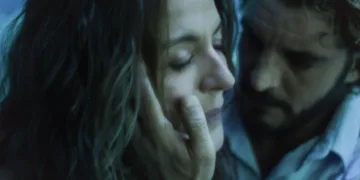
Felicia is the figure who most needs stillness around her, and the film gives her some. Vintage footage catches the liveliness between husband and wife, their wit, their musical play, their easy intelligence at the piano. Then the letters cut through the surface.
Felicia names the pain of his divided life with devastating grace, granting him freedom from guilt and confession. It is one of the film’s most painful moments because kindness becomes a form of loneliness. Her death in 1978 leaves guilt hanging over Bernstein like smoke that will not clear. The documentary lets him remain charming, brilliant, wounded, and evasive. It does not fully weigh the cost paid by those near him.
The Missing Music, the Final Wall
For a film about Bernstein, the Broadway work receives strangely narrow space. West Side Story gets the richest treatment, especially the Beverly Hills Hotel poolside conversation with Arthur Laurents, where the Romeo-and-Juliet gang-war idea returns to life through news of ethnic violence in Los Angeles.
On the Town barely breathes. Candide and Wonderful Town drift past the frame. The film is less interested in the composer of American musical theater than in the public intellectual at the podium. The loss is real, since Bernstein’s theatrical music might have deepened the portrait of a man always performing and always searching for release.
Tirola’s final movement earns its force through Beethoven. In East Berlin in 1989, after the fall of the Berlin Wall, Bernstein conducts the Ninth Symphony and changes “joy” to “freedom” in the choral text. The gesture could have been sentimental. Instead, it feels almost unbearably fragile: an old man standing before history, lifting his arms as if music could hold the broken century together for one last bar.
Douglas Tirola’s documentary film premiered at the Tribeca Film Festival in June 2021 and received its limited theatrical release on April 24, 2026, where it can be seen in select arthouse theaters and streamed via Topic Studios platforms. The film chronicles the professional, personal, and political life of the legendary composer and conductor Leonard Bernstein, exploring how he leveraged the power of classical music to advocate for civil rights, antiwar efforts, and global social change.
Full Credits
Title: Bernstein’s Wall
Distributor: Topic Studios
Release date: June 2021 (Tribeca Film Festival Premiere), April 24, 2026 (Theatrical Release)
Running time: 100 minutes
Director: Douglas Tirola
Writers: Douglas Tirola
Producers and Executive Producers: Susan Bedusa, John Boccardo, David J. Cornfield
Cast: Leonard Bernstein, Felicia Montealegre
Editors: Zachary Obid
Composer: Peter Golub
The Review
Bernstein's Wall
Bernstein’s Wall listens to Leonard Bernstein as if his voice were both confession and orchestra: gravel, charm, hunger, guilt, and civic faith moving through the same body. Douglas Tirola’s archival structure gives the film intimacy, especially in the letters to Aaron Copland, the wounded exchanges with Felicia Montealegre, and the 1989 Berlin performance where “joy” becomes “freedom.” Its omissions around Broadway and private responsibility leave shadows, but shadows suit this portrait.
PROS
- Rich archival self-portrait
- Powerful political throughline
- Moving Felicia letters
- Electric conducting footage
- Strong Berlin finale
CONS
- Broadway work feels underfed
- Male relationships stay partial
- Some political defense feels guarded
- Felicia’s pain needs sharper weight