
















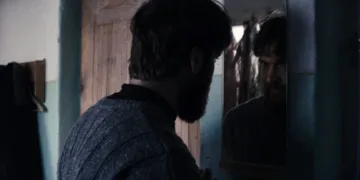














Carroll’s body does not betray him when he steps on a rusty nail. It simply catches up. Oliver Bernsen’s Bagworm understands its protagonist as a man whose physical infection arrives after years of quieter contamination. Carroll, played by Peter Falls, lives inside a wrecked house that seems half-burned and half-abandoned, even if everyone around him treats it as normal. He eats convenience food, steals internet access, scrolls through dating apps with mechanical impatience, and disappears into online discussions about ecological collapse and the planet’s magnetic field.
There is something almost comforting about his certainty that civilization is doomed. If the whole system is collapsing, then Carroll never has to consider the possibility that Carroll is the problem. His dates expose that logic quickly. He alters photographs to make himself appear traveled, lies casually about his life, then scolds one woman over what she orders at dinner.
These are small acts compared with the bodily horrors Bernsen later introduces, yet they establish the film’s nastiest infection. Carroll wants intimacy while treating other people as objects arranged around his insecurity. Then he goes outside. The rusty nail feels less like an inciting incident than a punchline delivered by the universe.
Small Tyrannies
Carroll’s moral philosophy becomes clearest when he watches a driver toss garbage into the street. He retrieves the bag, follows the man home, waits until night, and deposits the trash back onto the property. There is a version of Carroll’s story where this qualifies as civic responsibility. Bernsen refuses him that flattering interpretation. Carroll does not clean the street because he values communal life. He wants the offender to know that someone has beaten him at his own game.
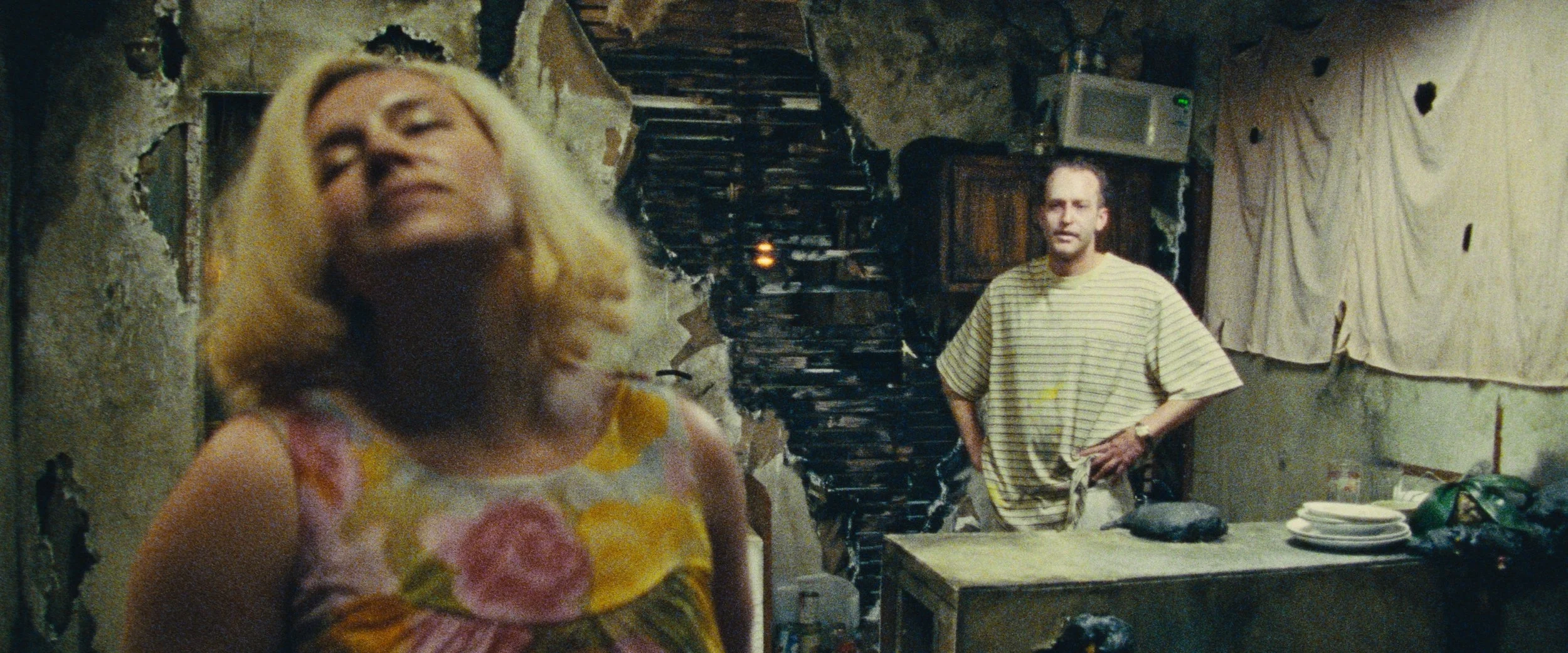
His obsession with dominance runs through nearly every interaction. Even his ridiculous employment selling a portable hammer called the “Handmer” has a strange thematic neatness to it. Carroll spends his days selling a tool built to strike things, then returns home convinced that the world keeps striking him.
After losing the job, he begins driving for Uber. A minor road incident leads to one of the film’s strangest encounters, with an older man played by Corbin Bernsen forcing Carroll through a humiliating ritual of submission. Carroll repeats promises that he will improve, surrendering his clothes as the older man asserts control. The film then follows this stranger home.
His beachside property is clean, expensive, and tasteful, yet emotionally it resembles Carroll’s ruin. One man lives inside visible decay. The other has enough money to decorate his emptiness. Dominance has better interior design at higher incomes.
Flesh and Film Stock
Peter Falls never asks the audience to rehabilitate Carroll simply because he becomes sick. That decision protects the performance from easy sentimentality. As the infection worsens, Falls grows sweatier and more swollen. His eyes redden. His hair sticks against his head. His face appears to expand under the pressure of whatever is happening inside him. Carroll treats severe illness with dark blue cough syrup, turning self-neglect into something approaching ritual.
Bernsen pushes these changes into body horror without separating them from Carroll’s emotional condition. His resentment has always behaved like an infection. The film eventually gives it fluid, discoloration, swelling, pus.
The 16mm photography makes that ugliness unexpectedly seductive. Carroll’s collapsing home carries grain, shadow, and sickly texture, while strange fragments of organic material appear almost beautiful under the camera. Inside the walls, a bagworm undergoes metamorphosis. The symbolism is loud enough to hear from the next room.
Yet the obviousness works because Carroll’s transformation is fundamentally ironic. Metamorphosis usually implies becoming something new. He deteriorates while remaining astonishingly committed to the same grievances.
Bernsen’s use of the Snorricam reinforces the trap. With the camera fixed to Falls’ upper body, Carroll stays visually centered while the world jerks and slides behind him. It captures his entire worldview in mechanical form. Everything moves. Carroll does not.
Vegas, Pupa, Hell
Las Vegas arrives like the logical destination for someone already experiencing reality as sensory overload. Carroll reluctantly joins his friends for a drug-fueled celebration connected to the coming birth of a child. By now, his body appears wrecked. His infection has become difficult to separate from hallucination, metaphor, or psychological collapse, particularly because the people around him rarely respond with the alarm his appearance should provoke.
Vegas turns that uncertainty into atmosphere. Neon, intoxication, masculine posturing, and grotesque physical decline fuse into something resembling an artificial afterlife. Carroll spends much of the film wearing a Paradise Lost shirt, a visual joke with the subtlety of a hammer to the forehead. Given his profession, perhaps that is appropriate.
The film’s black comedy keeps interrupting the horror at precisely the wrong moments. Carroll buys a revolting secondhand chair. He conducts surreal video calls with employers. His dating lies collapse under minor scrutiny. Each humiliation is funny because his self-image remains completely intact.
The early stretch can move slowly, particularly while Bernsen accumulates these episodes before the nail’s consequences dominate the narrative. Vegas carries another problem: the mounting pressure loses some force once Carroll’s collapse reaches its most extreme phase. The film has spent so long tightening the screw that any release feels suspiciously gentle.
What remains fascinating is Bernsen’s refusal to turn agony into wisdom. Carroll suffers tremendously. Suffering does not automatically make him perceptive, decent, or transformed. Sometimes the worm enters the cocoon and comes out worse.
Bagworm premiered at the SXSW Film Festival on March 13, 2026. The body-horror comedy follows a frustrated hammer salesman whose life spirals into surreal chaos after he steps on a rusty nail and begins to suspect that his physical infection is mirroring the rotting world around him.
Full Credits
Title: Bagworm
Release date: March 13, 2026
Running time: 96 minutes
Director: Oliver Bernsen
Writers: Henry Bernsen
Producers and Executive Producers: Henry Bernsen, Zoe Rosenberg, Jessica Dube, Kyra Rogers, Todd Remis, A.J. Calabrese, Ashley
Cast: Peter Falls, Michelle Ortiz, Robbie Arnett, Corbin Bernsen, Stephen Borrello, Jessy Morner-Ritt, Sydney Winbush, Francesca Galassi
Director of Photography (Cinematographer): Adriel Gonzalez
Editors: Nicholas Nazmi
Composer: Ari Balouzian
The Review
Bagworm
Bagworm turns a rusty nail into a diagnosis of a man already infected by resentment. Oliver Bernsen’s body horror works best when Carroll’s physical decay mirrors the social rot he keeps blaming on everyone else, from disastrous dates to petty acts of vigilante justice. Peter Falls never begs for sympathy, which makes his swollen, sweating collapse far harder to dismiss. The early pacing drags, and Vegas loses some accumulated pressure, but the film’s refusal to treat suffering as moral purification gives its ugliness real bite.
PROS
- Peter Falls’ fearless performance
- Potent body-horror imagery
- Beautifully grimy 16mm photography
- Sharp toxic-masculinity critique
- Effective pitch-black comedy
CONS
- Slow first act
- Final stretch loses tension
- Deliberately abrasive protagonist