










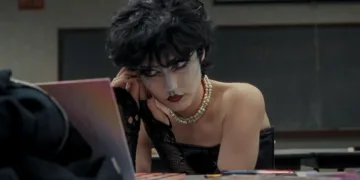


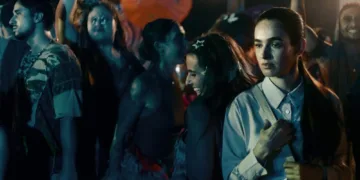












Tadeo Pestaña Caro begins his directorial career by stripping Buenos Aires of postcard romance and bathing it in the cool blue glare of a smartphone. His debut feature, A Few Feet Away, turns the city into a map of bodies close by and feelings held at arm’s length.
Santiago, a twenty-year-old architecture student from a quiet provincial home, has come to the capital searching for some clearer version of himself. The grand buildings he studies barely hold his attention. His gaze keeps falling to a Grindr-style dating app, where every profile promises access, validation, and the tiny thrill of possibility.
Caro shapes the film around a very current contradiction. Santiago’s phone offers hundreds of possible partners, creating the sensation of endless choice, then leaves him stranded inside a sharper loneliness. Across one frantic day and night, A Few Feet Away studies a culture built around availability, where intimacy starts to feel like clerical work. Anyone who has watched a room disappear behind a screen will recognize the sting here. Caro turns that familiar gesture into a full urban condition.
The Shield of a Poker-Faced Avatar
Santiago makes for a sharply drawn portrait of modern alienation, moving through his life like a spectator watching himself from across the street. Online, he becomes Seth, a digital persona that gives him a shield against the risk of direct contact. The split between Santiago and Seth creates a clean, painful dissonance. Around acquaintances, he brags about sexual adventures, inventing stories that cover his romantic inexperience and fear of rejection.
His habits reveal a steady pattern of self-sabotage. He spends hours swiping for dates, then freezes when physical intimacy begins to take shape. During an awkward encounter with J, a bisexual man, the possibility of sex in a crowded bar restroom sends Santiago into a quiet panic attack. He runs into the street, rattled by the very closeness he has been chasing. He wants the charge of being desired, yet real touch arrives with confusion, pressure, and danger. The screen gives him an exit door he understands.
Max Suen plays Santiago with remarkable control. His stoic, poker-faced presence mirrors the blank surfaces of internet exchange, where desire can be performed without much visible feeling. His flat, faintly sardonic delivery catches the dry comedy of young metropolitan life, the kind of humor that treats anxiety like an inside joke. The minimalism sometimes softens the dramatic force of Santiago’s private crisis, yet it feels true to a generation trained to hide panic behind irony.
Karen, played with warmth by Jazmín Carballo, gives the film its needed human ballast. As Santiago’s pragmatic workplace confidante, she behaves like a protective older sister, watching his digital fixation with clear concern. Her advice gives the film its clearest moral pressure. Fulfillment, she suggests, grows through personal development, beyond the brief confirmation strangers offer through a profile grid.
The Geography of the Digital Hunt
Caro organizes the narrative through the mechanics of app design, showing how software begins to choreograph the body. Santiago experiences Buenos Aires as a localized field of distance markers, thumbnails, and possible encounters. Casual scrolling becomes ritual. The constant inbox refresh carries the small chemical promise of a dopamine spark, then demands another refresh.
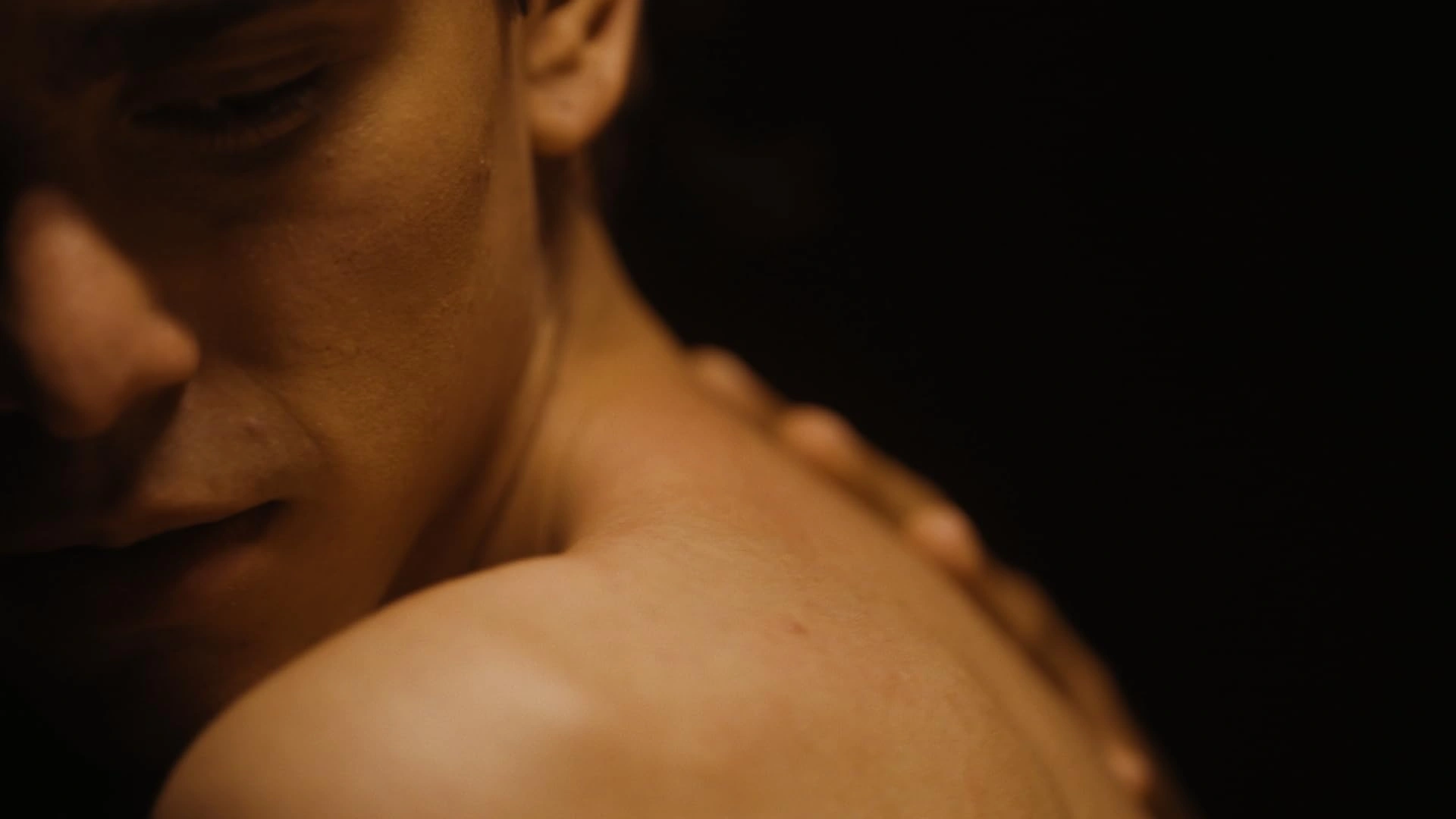
That structure gives A Few Feet Away a distinct place within independent queer cinema. Earlier films in the tradition often drew energy from glances, chance meetings, and hidden gatherings. Caro’s film belongs to a world ruled by geolocation, surveillance, and curated self-display. Santiago uses the app to locate specific users in physical spaces, shifting his own position to get closer to desirable profiles. His pursuit gradually gains a predatory edge, which the film observes with calm precision.
The subject receives careful treatment. Digital networks serve as vital infrastructure for LGBTQ+ life, giving people ways to express identity and desire across social barriers that remain active in physical spaces. The film also shows the emotional drought produced by treating people as disposable choices on a menu. Caro keeps both truths alive without turning the material into a lecture.
During the midnight stretch, the story widens into the hierarchies of Buenos Aires nightlife. Fleeting encounters with supporting figures map the social rules of the scene. Lucas, a relaxed partygoer, treats casual sex with ease. Guido, an older man, keeps sending messages that Santiago ignores. Their presence points to rigid age politics and the transactional habits of a community where value gets assigned through surface criteria. Caro watches these dynamics with a steady eye, letting the audience feel the fatigue of the hunt.
Synths, Pings, and Neon Overload
The film’s technical choices stay closely tied to Santiago’s mental state. Caro moves away from the bright polish of mainstream city imagery and adopts a gritty, low-key visual style suited to the darker corners of Buenos Aires nightlife. The cinematographer and lighting directors lean into deep color fields, saturated blues, and neon reds, placing Santiago as an isolated figure amid packed dance floors.
Digital communication becomes part of the frame itself. Messages appear across the screen as stylized subtitles, making the phone’s presence feel spatial, almost architectural. The device pulls Santiago’s attention from the room around him, and the image design lets us feel that theft in real time.
Sound carries equal weight. Composer Baltazar Oliver supplies a moody, 1980s-style electronic synth score filled with retro melancholy. Caro’s integration of technology is exact. App-alert pings slip directly into the music, turning notifications into rhythmic hooks. The effect creates a Pavlovian tension, since every sound cue seems capable of dragging Santiago back to his phone. I am a sucker for synth textures that make a city feel haunted, and here that texture gives the film a nervous pulse.
The pacing accelerates sharply in the final act, entering explicit territory as Santiago moves into a maze-like nightclub backroom. The editing becomes fast and fractured, with strobe lighting mirroring the sensory overload of the space. The camera follows him through anonymous bodies as he searches for an online match and loses contact with the physical reality pressing against him.
Dawn breaks the intensity. The film shifts into a quiet, introspective passage as sunlight rises over the city. The near-silent final sequence grounds the story with elegant restraint, leaving Santiago alone with his thoughts after the music stops.
A Few Feet Away (originally titled A metros de distancia) had its official world premiere at the 39th BFI Flare London LGBTIQ+ Film Festival on March 20, 2025, and went on to screen at notable regional events including Mix Brasil. This Argentinian drama is currently available to watch globally on specialized digital streaming platforms such as MUBI as well as various video-on-demand services.
Where to Watch A Few Feet Away (2025) Online






Full Credits
Title: A Few Feet Away (A metros de distancia)
Distributor: Mesa Chica Cine, Digital Platforms
Release date: March 20, 2025
Running time: 1 hour 29 minutes
Director: Tadeo Pestaña Caro
Writers: Tadeo Pestaña Caro
Producers and Executive Producers: Malena Suárez, Eugenia Gonzalía, Tadeo Pestaña Caro
Cast: Max Suen, Jazmín Carballo, Martín Shanly, Esteban Kukuriczka, Luciano Mortarotti, Felipe Romeo, Manuel Figuerero, Nicolás Rodriguez, Matías Méndez
Director of Photography (Cinematographer): Joaquín Castro, Andy González
Editors: Lucas Casolo
Composer: Baltazar Oliver
The Review
A Few Feet Away
A Few Feet Away functions as a striking portrait of modern digital isolation, successfully capturing how intimacy is commodified by contemporary screen culture. Tadeo Pestaña Caro establishes an authentic urban atmosphere, though the narrative occasionally struggles under the passivity of its lead character. The clever integration of application audio into the electronic score creates an immersive sensory experience that reflects the exhaustion of the online chase. It remains an insightful independent effort that effectively maps the coordinates of modern connection.
PROS
- Atmospheric and moody cinematography that effectively captures Buenos Aires nightlife.
- Inventive sound design that integrates digital notifications directly into the synth score.
- A grounded, balancing supporting performance by Jazmín Carballo.
- An objective, non-judgmental exploration of modern LGBTQ+ hookup spaces.
CONS
- A passive, emotionally aloof protagonist that limits the narrative's dramatic weight.
- The flat delivery from the lead actor occasionally diminishes the impact of vital scenes.
- A third-act resolution that introduces a heavy-handed moral lesson.