























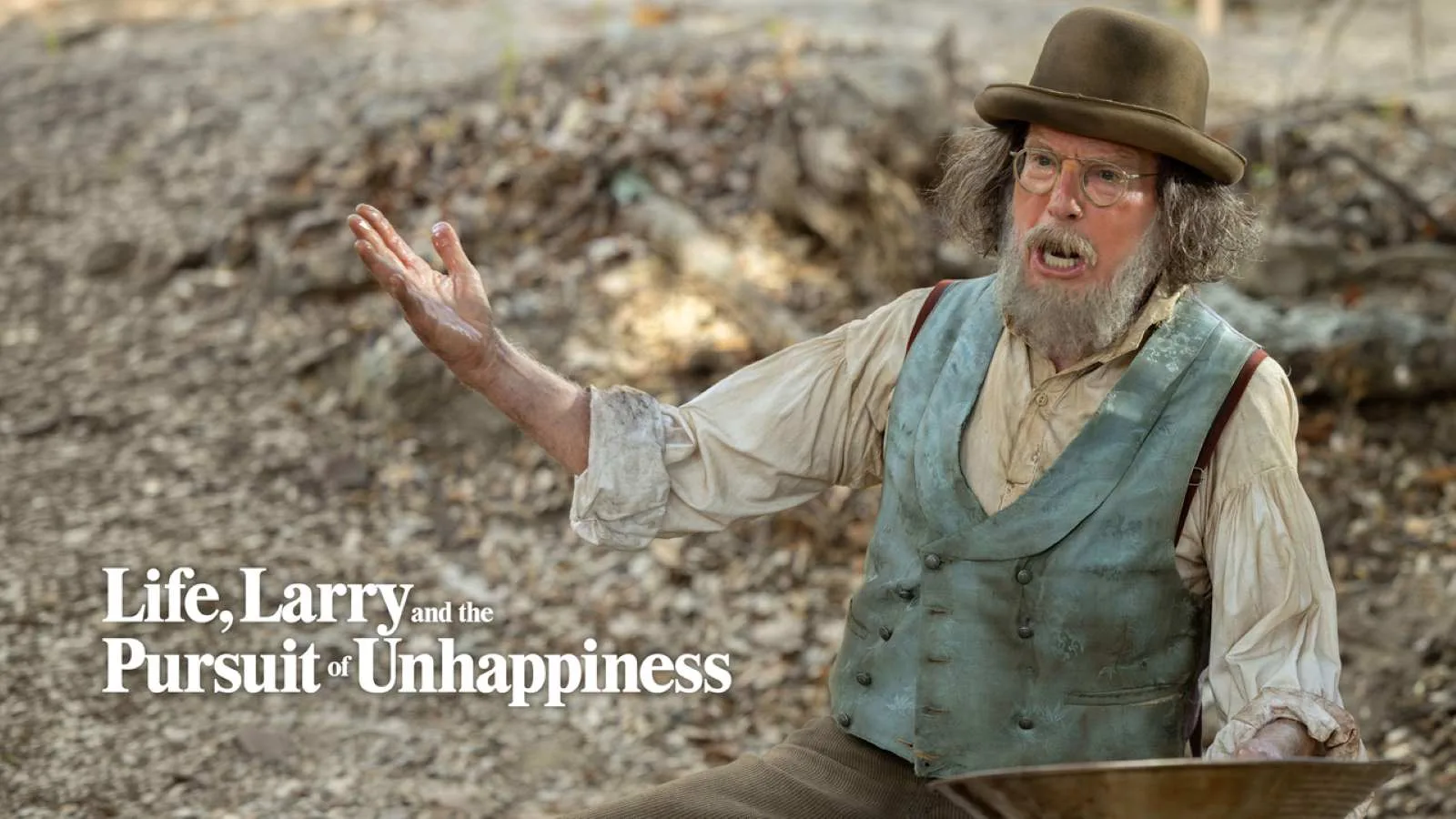

Larry David looks strangely natural in American history because the past, at least in HBO’s Life, Larry, and the Pursuit of Unhappiness, is already a crowded room full of social violations. Someone has chosen the wrong fork. Someone has cut in line. Someone has issued a holiday greeting past its expiration date. Somewhere near the birth of the republic, one man is preparing to turn public grievance into private complaint.
That man is Larry, or Lawrence, or Robert Livingston, or Meriwether Lewis, or whoever history needs him to be for a sketch. The name changes. The posture does not. David moves through the seven-episode limited series with the same bent impatience he carried through Curb Your Enthusiasm: the eyes narrowed by suspicion, the voice rising toward moral certainty, the body already halfway out of the room before duty can find him. The joke is that America has always contained this man. The darker joke is that the show may be right.
Created by David and Jeff Schaffer, who also directs, the series arrives as an “almost history” of America tied loosely to the country’s 250th anniversary. Barack and Michelle Obama are among the executive producers, and Barack Obama appears to frame the project with civic optimism, the sort that can still find progress under a mountain of unpleasant human behavior. The sketches take that optimism and feed it to a grouch in a powdered wig.
The show’s best instinct is simple: do not make Larry David adapt to history. Make history adapt to him.
Old Complaints in New Wigs
The opening Declaration of Independence sketch gives the series its purest equation. David plays Robert Livingston, one of the men drafting the founding document, and he wants the grievances against King George III expanded to include his own private code of conduct. If you pick a line, you stay in that line. “Happy New Year” expires after January 7. A nation waits to be born while one man drags petty etiquette into the language of revolution.
It is funny because the scale is obscene. It is also the show’s trap.
Also Read






Again and again, Life, Larry, and the Pursuit of Unhappiness places familiar Davidian arguments inside historical dioramas: the Boston Tea Party becomes a social exclusion wound, the Wright Brothers’ first flight becomes cramped airline seating, the Army-McCarthy hearings become a venue for “respect wood.” A soup kitchen line during the Great Depression gives the “chat ’n’ cut” a new costume. A horse becomes the old-world version of a pig parker’s vehicle. The past is treated like a warehouse where old Curb bits can be stored until someone remembers to dust them off.
Recognition has its own warmth. There is pleasure in hearing David’s grievances resurface because they belong to a comic worldview built with obsessive care across decades. His rules are absurd, yet they have an internal theology. The world is fallen. The sinner is the person who violates invisible etiquette. The prophet is Larry, naturally, and every prophet is unbearable at dinner.
Still, repetition changes the air in the room. The first time a familiar complaint appears under candlelight or inside a congressional hearing, it feels like self-mockery. The third or fourth time, it feels like preservation. The series begins to resemble a museum of irritations, each one arranged behind glass, each one labeled with the same small note: Larry was already angry about this.
The stronger sketches push past that display-case quality. James Buchanan worrying about passed appetizers while secession gathers force has a sharper comic wound because it lets the personal and political rot touch. The joke is not only that Buchanan is distracted. The joke is that catastrophe often shares space with trivial self-management. People can stand beside history and still ask about snacks.
Sketches That Stop Too Soon
The sketch format gives the series speed, then quietly denies it depth. Most episodes move through several vignettes, each dropped into a different period, each resetting the board before any single scenario can decay into full madness. The structure keeps weak premises from dying in public for too long. It also prevents stronger ones from becoming stranger.
That absence matters because David’s comedy has long depended on accumulation. In Curb Your Enthusiasm, a small offense could wander through a half-hour, collect misunderstandings, change hands, return in grotesque form, then detonate at the exact moment Larry believed himself safe. The pleasure was architectural. The trap had been visible all along, but David kept walking toward it with the confidence of a man who thinks doors open for logic.
Here, the sketches often have one engine. Larry enters history. Larry complains. History recoils. The premise announces itself early, then circles its own footprint. The Wright Brothers sketch has the quick clarity of a blackout gag stretched into routine: the first flight, recast as airline annoyance, gives David plenty of room to complain, but little room to discover. The Boston Tea Party sketch has the same problem. Once the rebellion becomes an invitation slight, the sketch has already spent its best currency.
The longer Lincoln and Ford Theatre segment fares better because it has room to breathe badly. Badly, in this case, is praise. David’s discomfort can gather, sour, change texture. The joke acquires pressure through duration rather than repetition. A gritty All the President’s Men riff also works because Schaffer changes the visual weather. The segment shifts into 1970s paranoia, and Larry as a Deep Throat figure becomes funnier because the sketch does not move exactly where the premise seems to point.
The show needs that kind of misdirection. History alone is not enough. Costumes alone are not enough. A joke cannot survive forever on the sight of Larry David standing near a famous event like a man about to ask for separate checks.
The Living Need Collision
David remains an astonishingly durable comic presence. His voice can turn a minor objection into a legal brief. His pauses are little moral voids. His face, when someone explains a social custom to him, looks genuinely wounded by civilization itself.
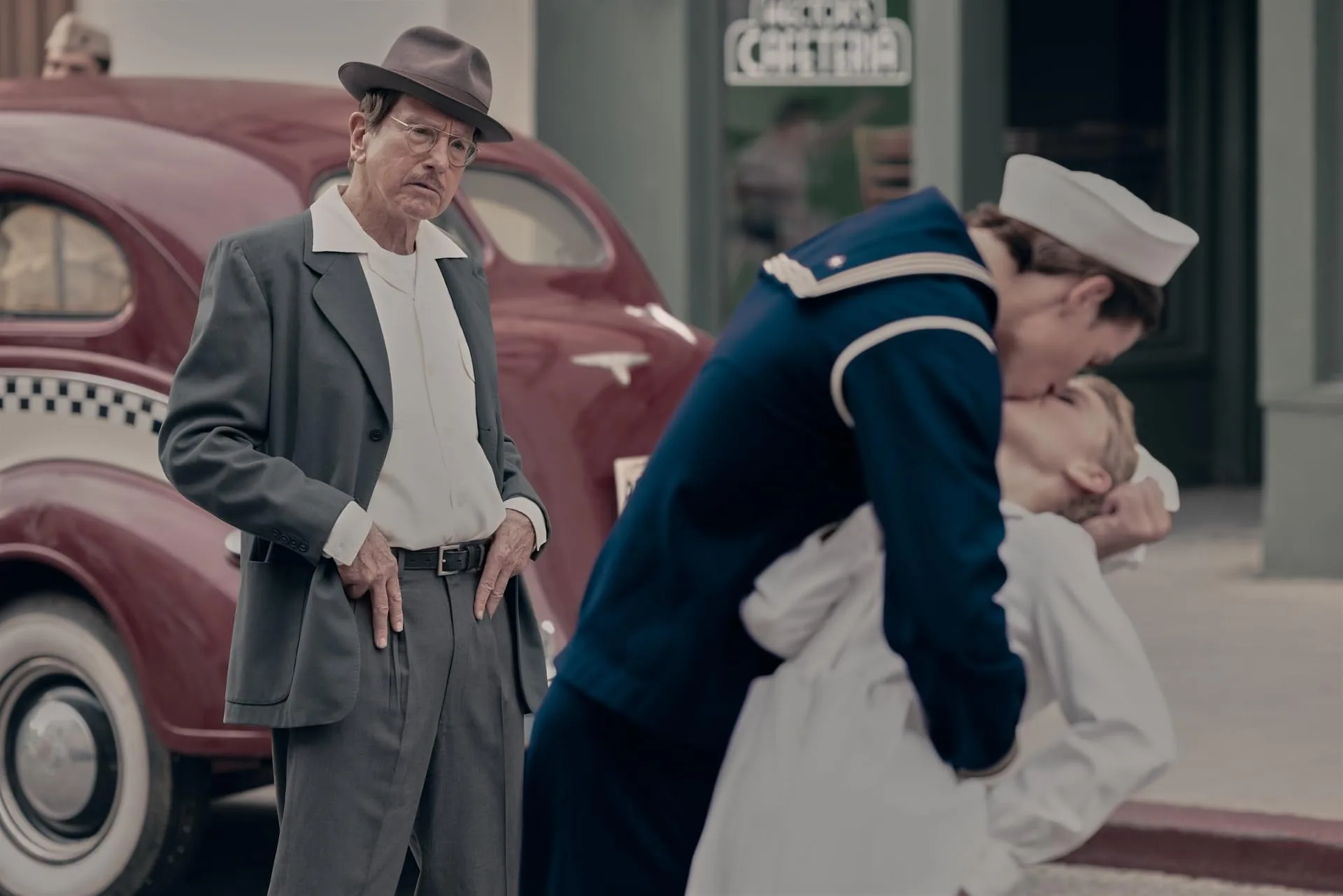
Yet Life, Larry, and the Pursuit of Unhappiness proves again that his persona needs resistance. Without a proper opponent, Larry becomes a weather pattern: recognizable, noisy, and predictable. With the right person across from him, he becomes dangerous.
J.B. Smoove gives the series one of its sharpest charges. Their sketch carries the old Larry and Leon voltage into an Underground Railroad frame, a setup that could easily collapse into bad taste. What saves it is the precision of their friction. Smoove does not simply bounce off David. He invades his rhythm, interrupts his moral bookkeeping, and forces the scene to move faster than Larry’s complaints can organize. The sketch also draws a line that cannot be crossed, letting history retain some gravity under the banter.
Jerry Seinfeld’s appearance in the Lewis and Clark material works in a quieter key. David’s Meriwether Lewis tries to present the expedition as serious national business, while Seinfeld’s Clark brings the energy of a friend turning responsibility into an outing. Rita Wilson, playing Lewis’s skeptical wife, gives the scene a domestic ache under the joke. She knows exactly what the men are doing: dressing escape as purpose. There is a whole marriage in her suspicion.
Susie Essman’s Susan B. Anthony dinner-party sketch finds another useful form of collision. Larry calling her “Susie” is a cheap joke until it becomes a perfect one, because the mistake erases the historical figure and summons the old combatant at the same time. The sketch works through misnaming, irritation, and the strange immortality of a shared comic wound.
Bill Hader and Kathryn Hahn bring a livelier elasticity to their material, the kind of performance energy that suggests whole scenes might have unfolded between cuts. Jon Hamm, Vince Vaughn, Jane Krakowski, Isla Fisher, Lin-Manuel Miranda, and others help give the series the polished air of a prestige comedy event. At times, though, the casting becomes the punchline’s substitute. A famous face appears, the audience recognizes the game, and the sketch has little left to confess.
Obama’s presence is stranger and more revealing. His opening frames Larry as one of America’s unpleasant survivals, a petty obstruction inside a larger faith in progress. His later sketch appearance shows crisp comic timing, but it also exposes the show’s tension. This is a series backed by civic optimism and powered by a man whose genius is suspicion. The fit is funny. It is also uneasy.
America, Reduced to Bad Manners
The series wants to laugh at America’s founding myths without burning the bunting. That tension gives it some of its most interesting friction and some of its weakest speeches. Racism, antisemitism, misogyny, public cowardice, political vanity, and democratic erosion all pass through the sketches. Samuel L. Jackson’s narration gives the historical setups a pointed charge, guiding the viewer toward the moral ugliness beneath the wigs and waistcoats.
The show is sharper when that ugliness enters through behavior. Henry Ford’s antisemitism gives David and Schaffer a direct target with real historical venom. Jonas Salk’s vaccine story opens space for jokes about anti-vaxx paranoia and public memory, with the Robert F. Kennedy Jr. material carrying an extra sting because of David’s own Curb orbit. Rosa Parks, the Donner Party, Susan B. Anthony, James Buchanan, and the Boston Tea Party all offer versions of the same grim comic proposition: history is full of people who meet a moral crisis and start thinking about themselves.
That is where the series finds its bleakest truth. Nations are built through documents, wars, protests, inventions, and ideals, but they are also built in rooms where someone wants the best seat, the largest portion, the cleanest exit, the last word. The civic life of a country is never free from appetite. Larry David’s character becomes a parasite on American history because he is also one of its native species.
The weakest sketches turn that idea into direct topical scolding. Anger at the Trump era appears, and the anger is understandable, but the comedy grows blunt when the show starts announcing what it already knows. David is far more lethal when he sweats the small rule until the large moral shape appears by accident. Give him a line, a fork, a chair, a greeting, a parking space, and the abyss opens. Give him a lecture, and the abyss checks its watch.
Life, Larry, and the Pursuit of Unhappiness is minor Larry David, which is still a strange and occasionally valuable thing. It does not discover a new continent. It maps the old one with a shaking finger, muttering about the person ahead in line. Its funniest sketches understand that pettiness is not the opposite of history. Sometimes it is the mold growing on history’s walls.
This limited sketch comedy series premieres today, June 26, 2026, and is available to stream on HBO and Max. The show offers an improvised, irreverent take on pivotal events throughout American history in celebration of the nation’s 250th anniversary.
Where to Watch Life, Larry, and the Pursuit of Unhappiness Online

Full Credits
Title: Life, Larry and the Pursuit of Unhappiness: An Almost History of America
Distributor: HBO, HBO Max
Release date: June 26, 2026
Rating: TV-MA
Running time: 30 minutes (average)
Director: Jeff Schaffer
Writers: Larry David, Jeff Schaffer
Producers and Executive Producers: Larry David, Jeff Schaffer, Barack Obama, Michelle Obama, Ethan Lewis, Vinnie Malhotra
Cast: Larry David, Bill Hader, Kathryn Hahn, Jon Hamm, Sean Hayes, Jerry Seinfeld, Chris Parnell, Barack Obama
Director of Photography (Cinematographer): Patrick Capone
Editors: Various
Composer: Christian Lundberg
The Review
Life, Larry, and the Pursuit of Unhappiness
Life, Larry, and the Pursuit of Unhappiness places Larry David inside American history and finds, with grim little pleasure, that pettiness travels well. Its strongest sketches turn civic mythology into social discomfort, especially when David has J.B. Smoove, Jerry Seinfeld, or Susie Essman to collide with. Yet the series often mistakes recognition for renewal, dragging old grievances through powdered wigs and period rooms until the joke begins to fossilize. Funny, uneven, minor, still alive in flashes.
PROS
- Sharp historical comic setup
- Strong guest pairings
- J.B. Smoove chemistry
- Occasional political bite
- Period craft has polish
CONS
- Recycled Curb bits
- Sketches run long
- Repetitive comic structure
- Blunt topical satire
- Persona sometimes does all the work