




















Arinzo’s survival should destabilize every room before she enters it. Instead, The Return of Arinzo spends much of its running time hiding her behind political maneuvering, family quarrels, kidnapping, church sermons, and a warning left at a graveyard. Iyabo Ojo’s sequel to the 2013 film expands its story across Nigeria, Ghana, and Tanzania, yet the scale works against the simple pressure promised by its title.
Aisha Williams has built a life upon silence. Her husband, Marcus, is pursuing his party’s presidential nomination, placing their family beneath cameras, crowds, and public scrutiny. Years earlier, Aisha belonged to a violent gang led by Arinzo, who was presumed dead after a betrayal. A campaign built upon image meets a past built upon blood. That is fertile noir territory. The film sees the visual possibilities. It has less control over the dramatic ones.
A Household Under Interrogation
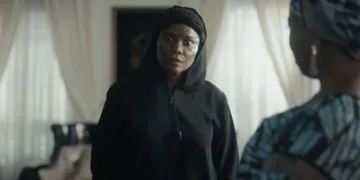
Aisha first appears as a domestic tyrant, screaming at her sister-in-law Bolanle while the rest of the household watches with the stillness of witnesses awaiting cross-examination. Mercy Aigbe gives the confrontation a clipped aggression. Her shoulders remain firm, her gaze rarely breaks, and the scene establishes authority as performance. Aisha does not need to be calm. She needs everyone else to retreat.
Her behavior changes when her son Mandla introduces his fiancée, Simisola. The warmth Aisha offers Simi is smooth enough to pass for affection until Pastor Bridget arrives. Recognition hardens Aisha’s face before the screenplay explains why. Bridget knows Arinzo, and Simi is Arinzo’s daughter. The engagement has joined two families already connected by violence.
This revelation should allow suspicion to move through the household like a shadow crossing a wall. Instead, Aisha’s rejection of the marriage arrives with limited emotional preparation. Her hostility serves the plot first and the character second. The screenplay keeps its secrets so tightly that it deprives Aisha of the behavior needed to make those secrets legible.
The same problem shapes the political material. Details of Aisha’s criminal past leak during Marcus’s campaign, yet public scandal feels detached from private guilt. Marcus’s ambitions raise the stakes in theory, but the film rarely shows the couple recalculating trust behind closed doors. Politics becomes noise outside the house rather than pressure inside it.
Simi’s kidnapping supplies another engine, first suggesting electoral violence before revealing a revenge scheme. A mole within Aisha’s public-relations team is later exposed as a killer, a twist delivered with the blunt force of a trapdoor. Surprise is achieved. Suspense is not.
Women Framed by Different Forms of Power
The film’s male presidential candidate may organize the public plot, but its moral struggle belongs to Aisha, Arinzo, Bolanle, Bridget, and Simi. Each woman occupies a distinct relationship with power. Aisha controls through intimidation. Bolanle resists through family opposition. Bridget appeals to faith. Simi inherits consequences she did not create. Arinzo returns carrying punishment, vengeance, and the possibility of remorse.
Aigbe gives Aisha the film’s most coherent behavioral line. Her rage toward Bolanle, measured courtesy toward Simi, and frozen recognition of Bridget reveal a woman changing masks without ever lowering her guard. Funke Akindele brings weight to the family confrontations, especially when Bolanle’s objections threaten the respectable image Marcus’s campaign needs to preserve.
Bimbo Akintola plays Bridget with welcome restraint. She avoids turning the preacher into a delivery system for moral lessons, grounding her calls for forgiveness in steady eye contact and controlled speech. The performance gives spiritual conviction a physical calm missing from the surrounding drama.
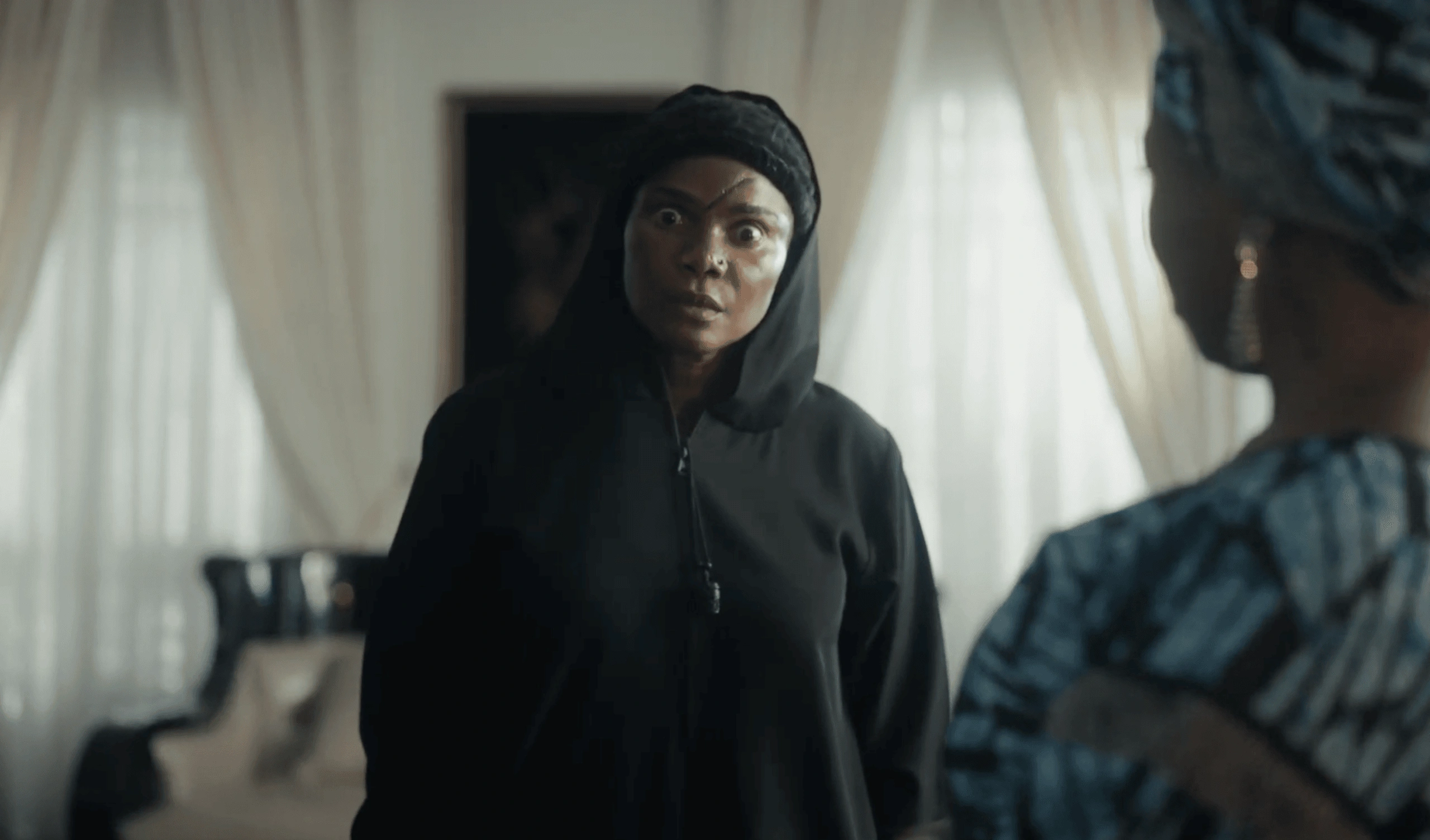
Arinzo presents the greatest difficulty. Her reappearance arrives so late that the film has little time to register its effect. A woman believed dead should alter how Aisha breathes, how Bridget speaks, and how Simi understands her own family. The characters absorb the revelation with less disturbance than the premise warrants.
Her movement toward repentance is similarly compressed. Revenge has guided her actions from concealment, yet the transition toward forgiveness is communicated through declarations rather than accumulated choices. The prison outcome restores accountability, but it cannot supply the psychological steps omitted before it.
Lagos in Shadow and Campaign Light
Visually, Ojo and her cinematography team grasp the attraction of divided spaces. Interiors frequently use backlighting and deep shadow, placing faces between visibility and concealment. Aisha often appears surrounded by polished surfaces and controlled illumination, yet darkness gathers behind her. The visual argument is plain: respectability has not erased the room where the crime occurred.
The campaign rally is the film’s strongest meeting of image and subject. Marcus addresses a busy market from a customized bus, transforming electoral politics into mobile theatre. The crowd supplies scale, movement, and social texture. Here, public ambition occupies a real environment rather than an abstract campaign subplot.
Street scenes, church gatherings, and aerial views of Lagos give the story a wider civic life. The drone photography can be overly declarative, yet it establishes the density surrounding the Williams family. Their secrets exist inside a city crowded with observers, worshippers, voters, and potential judges.
The cross-border production adds geographic range, though Ghana and Tanzania often function as display rather than dramatic necessity. Movement between countries enlarges the map without clarifying the emotional route. The film travels farther than its characters do.
Editing deepens this imbalance. Interrogations continue after their tension has dissolved, conversations repeat information, and studio sequences involving musicians interrupt the revenge plot without changing it. The shifts among political thriller, family melodrama, crime story, romance, and spiritual parable lack a governing rhythm. Scenes sit beside one another where they should tighten around the same threat.
The cinematography keeps offering moral geometry: faces divided by light, crowds arranged around power, interiors holding pockets of darkness. The screenplay keeps adding rooms.
The massive pan-African Nollywood blockbuster The Return of Arinzo celebrated its star-studded red carpet premiere in Lagos on March 29, 2026, before expanding into commercial cinema screens nationwide on April 3, 2026, via FilmOne Entertainment. Audiences tracking its current theoretical run can look for regional listings across English-speaking West Africa or wait for upcoming international video-on-demand platform rights agreements. Acting as a long-awaited sequel to the 2013 hit, the crime-thriller narrative picks up years after the notorious criminal Arinola was presumed dead, chronicling her sudden resurfacing as she enters a dangerous web of familial betrayal and political scandals across Nigeria, Ghana, and Tanzania to extract lethal revenge on those who crossed her path.
Full Credits
Title: The Return of Arinzo
Distributor: FilmOne Entertainment
Release date: March 29, 2026 (Lagos Premiere), April 3, 2026 (West Africa Theatrical Release)
Rating: Not Rated
Running time: 135 minutes
Director: Iyabo Ojo
Writers: Moshood Yakubu Olawale
Producers and Executive Producers: Iyabo Ojo, Soso Soberekon, Abazee Productions, Fespris Production, Layole Oyatogun
Cast: Iyabo Ojo, Funke Akindele, Mercy Aigbe, Bimbo Akintola, Yinka Quadri, Uzor Arukwe, Scarlet Gomez, Priscilla Ojo, Enioluwa Adeoluwa, Adjetey Anang, Juma Jux, Prisca Lyimo, Zuhura Othman
The Review
The Return of Arinzo
The Return of Arinzo finds its clearest morality in shadow: Aisha’s polished public life sits against the darkness of the past she buried, while Arinzo’s return should make every frame feel contaminated by guilt. The cinematography understands this pressure. The screenplay rarely does. Political spectacle, family warfare, kidnapping, and spiritual redemption crowd the image until suspense loses its shape. Mercy Aigbe and Bimbo Akintola give the conflict weight, yet uneven editing and delayed revelations blunt the reckoning. The prison ending restores a measure of consequence. By then, the light has exposed too little.
PROS
- Noir-inflected lighting
- Mercy Aigbe’s controlled intensity
- Lively campaign rally sequence
- Strong Lagos atmosphere
- Unforgiving final turn
CONS
- Overcrowded plot
- Sluggish editing
- Arinzo appears too late
- Uneven supporting performances
- Rushed redemption arc