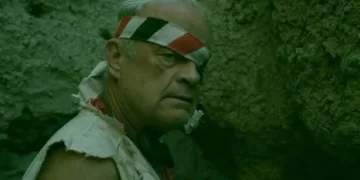










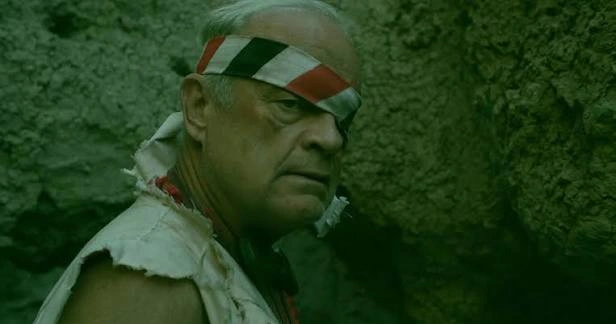

Lars Shrike knows his name because it is tattooed on his arm, which is the sort of useful information that becomes less useful by the minute. He stands alone beneath a green sky, dressed for a science-fiction adventure he cannot remember joining, carrying a solar umbrella and a sentient chrono-blaster that is running out of power. His first task appears simple: survive the desert and find a way off the planet. The film soon makes the word “appears” do exhausting amounts of work.
Gary Walkow builds the opening around uncertainty rather than danger. Lars worries about thirst, hostile creatures, and the possibility that he escaped from an intergalactic prison, yet every threat passes through his unreliable understanding. He wonders if he was engineered in a laboratory or given amnesia as part of his punishment. The explanations sound plausible to him because he has nothing sturdier available.
Kelsey Grammer plays that confusion without turning Lars into a joke. His upright posture suggests someone trying to preserve dignity while his eyes keep searching for confirmation that the world follows rules. The comedy comes from the distance between his confidence and his circumstances, especially when the chrono-blaster offers advice with the weary patience of a device that has apparently heard all this before.
The Film Changes Planets
The desert section establishes a clear objective. Lars needs a power source for the chrono-blaster so he can signal for transport. It is basic quest structure, wrapped in cheerful technobabble. Walkow then disrupts it with one quiet visual change.
Lars passes through a rock formation and notices that the sky is blue. The landscape has not transformed through a large effect or dramatic musical cue. The color simply stops supporting his story. His prison planet may have been Earth all along, or he may have crossed some invisible threshold into another reality. The screenplay wisely refuses to settle the issue at that point. Lars must revise his plan before he has finished understanding the first one.
The green color grading gives ordinary terrain the appearance of an alien wasteland, while Connor Bjornson’s camera stays close to Grammer instead of selling the landscape through grand compositions. That choice keeps the production’s modest scale from becoming the main event. Lars’s reaction matters more than the geography.
The approach has limits. Long stretches of walking and narration slow the dramatic movement, and curiosity sometimes has to drag the film forward by itself. Walkow has given Lars a mystery, a survival problem, and a talking weapon, then frequently asks him to stroll while considering them. Even existential science fiction benefits from an occasional appointment.
A Voice Looking for an Owner
Most of Grammer’s dialogue arrives through narration, a risky device in a film already concerned with thought, authorship, and unstable perception. The voice-over works best when it becomes part of the mystery instead of explaining it. “Am I narrating?” Lars asks.
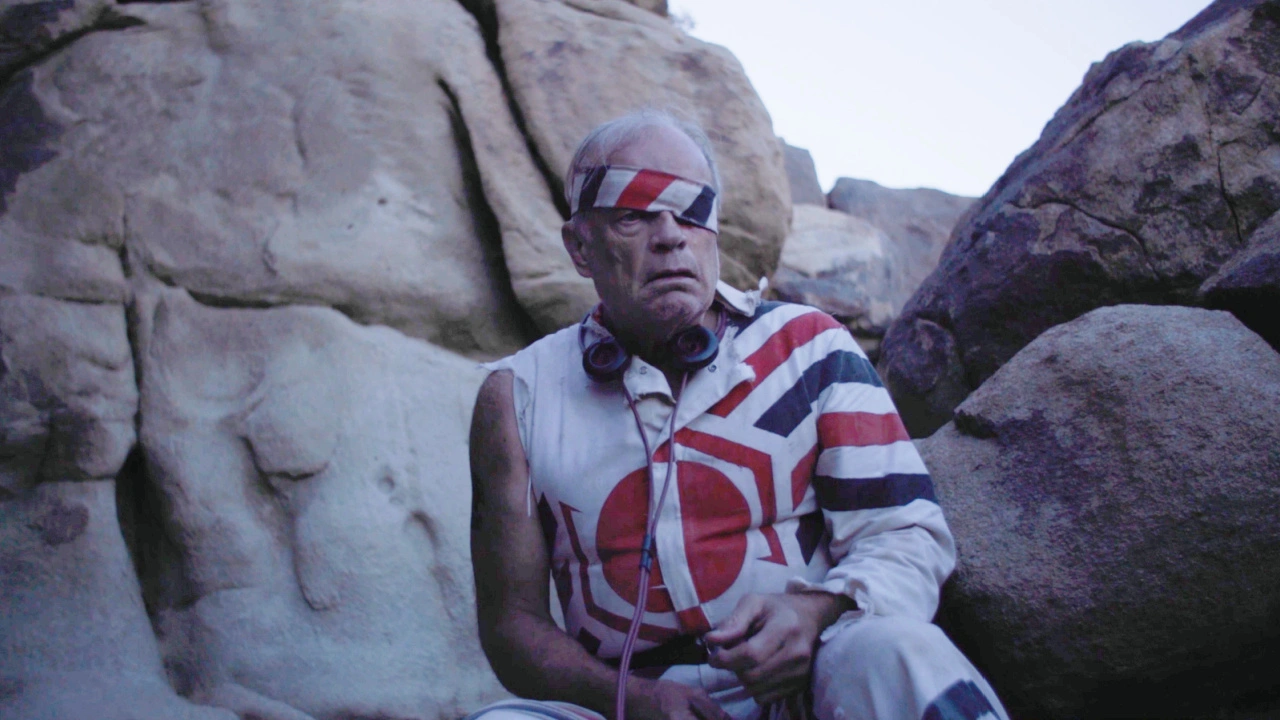
The question exposes the machinery of the film while deepening his panic. He hears his own thoughts as something that may be happening to him. At other points, another voice seems to answer inside his head, and Lars treats it as a remnant of imprisonment or psychological treatment. Walkow uses sound and editing to make his consciousness feel interrupted. Jump cuts and rhythmic stutters break the flow of his observations, giving his confusion a formal shape.
Grammer’s voice is polished enough to make Lars’s speculative theories sound briefly reasonable. His physical performance tells a different story. When Lars discovers that he can read, wonders if he has a family, or tries to imagine the crime that placed him in confinement, Grammer lets the questions register as personal losses rather than clues in a puzzle.
The film’s strongest emotional turn arrives at a public library. A young librarian initially reads Lars as an unhoused man in distress and helps him search his name online. The scene avoids treating kindness as sentiment. She performs a practical task, and the result dismantles him.
The search leads to The Trouble with Dick, a book connected to author Richard Kendred. Lars has found evidence that he exists. Unfortunately, the evidence suggests he exists because someone wrote him.
The Author in the Room
Walkow first explored this material in his 1987 film The Trouble with Dick, later extending the loose continuity through Crashing and The Trouble with Dot & Harry. David Clennon’s return as Richard Kendred gives Lars’s search a direct destination, but the history creates a structural problem. Viewers familiar with the earlier film may recognize the metafictional answer before Lars reaches it.
The later scenes spend too much time confirming connections that worked better as suspicions. Once Lars approaches his creator, the film shifts from an unstable identity mystery toward an argument about artistic responsibility. If a writer gives a character fear, desire, and consciousness, what obligation follows? Lars has been supplied with enough interior life to suffer, then denied a dependable past.
That idea gives his encounter with Kendred weight, especially after the librarian scene has established how desperately Lars wants a biography. Walkow also keeps a psychological reading alive. Lars may be a fictional escapee, a delusional drifter, or a man using science-fiction language to organize severe confusion. The people who help him do not need to solve that question before treating him as a person.
The ending weakens the immediate drama by turning toward continuation. A title card declares “Not The End,” promising that Lars’s search will proceed through another chapter. The franchise machinery arrives just as the character has reached the one man who might owe him an explanation. Lars finally meets his author, and the film starts negotiating a sequel.
Lars Shrike Walks the Night premiered on digital platforms on July 24, 2026, and is available for streaming or purchase on VOD services like Apple TV and Prime Video. The story follows an amnesiac man wandering through a surreal desert landscape who attempts to piece together his identity and mysterious origins.
Where to Watch Lars Shrike Walks the Night (2024) Online









Full Credits
Title: Lars Shrike Walks the Night
Distributor: Filmhub, Vortex Media
Release date: July 24, 2026
Running time: 85 minutes
Director: Gary Walkow
Writers: Gary Walkow
Producers and Executive Producers: Gary Walkow, Kelsey Grammer, Donald Zuckerman, Ryan J. Price
Cast: Kelsey Grammer, David Clennon, Christine Lin, Kati Schwartz, Will Amato, Elizabeth Gorcey, Bobby Furst, Laurie Drayton
Director of Photography (Cinematographer): J. Connor Bjornson
The Review
Lars Shrike Walks the Night
Lars Shrike Walks the Night asks a sharp question about fictional responsibility, then spends too long circling it. Gary Walkow’s green desert, fractured editing, and Kelsey Grammer’s wary physical performance give Lars’s confusion real shape, while the library scene turns an online search into a small existential crisis. The final act explains connections that were stronger as suspicions, and the sequel setup steals some force from Lars’s encounter with Richard Kendred. Still, this handmade sci-fi curiosity has enough wit, sadness, and formal purpose to survive its sluggish stretches.
PROS
- Grammer’s carefully unsettled performance
- Effective green-tinted desert imagery
- Narration tied to Lars’s instability
- Moving library identity search
CONS
- Deliberate pace often becomes sluggish
- Final act over-explains the premise
- Earlier films weaken some mystery
- Sequel setup interrupts the drama