











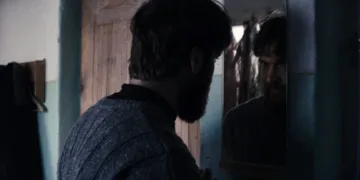











Utsugi cannot reliably command the left side of his body. He can, however, describe every gesture his daughter-in-law makes as though it were intended for him. Wayne Wang lets us hear those descriptions through Utsugi’s diary narration, which makes a door left open before a shower feel momentous. The door may mean very little to Susu. Utsugi has the time, the appetite, and the authority to turn it into a story.
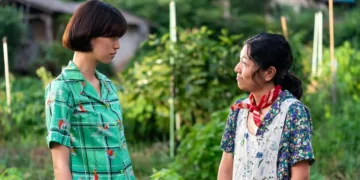
Susu (Fan Bingbing) has considerably less freedom to speculate. She helps Utsugi (Lily Franky) with physical therapy after a stroke, then stays behind to care for him when the rest of the family leaves for a summer retreat. Her husband Jokichi is having an affair, money is a worry, and the family’s expectation of a child falls heavily on her. The arrangement gives Utsugi ample opportunity to study her. It gives Susu a job to do.
I initially read his desire as another expression of patriarchal entitlement, with infirmity supplying convenient cover. The film’s first shot does little to discourage that reading: Utsugi tries to masturbate at his desk and cannot finish. Wang is candid about the distance between physical capacity and sexual appetite. Franky plays the humiliation without asking us to find it noble, and later lets jealousy make Utsugi petulant, even absurd. He can need help standing up and still make demands of the person helping him.
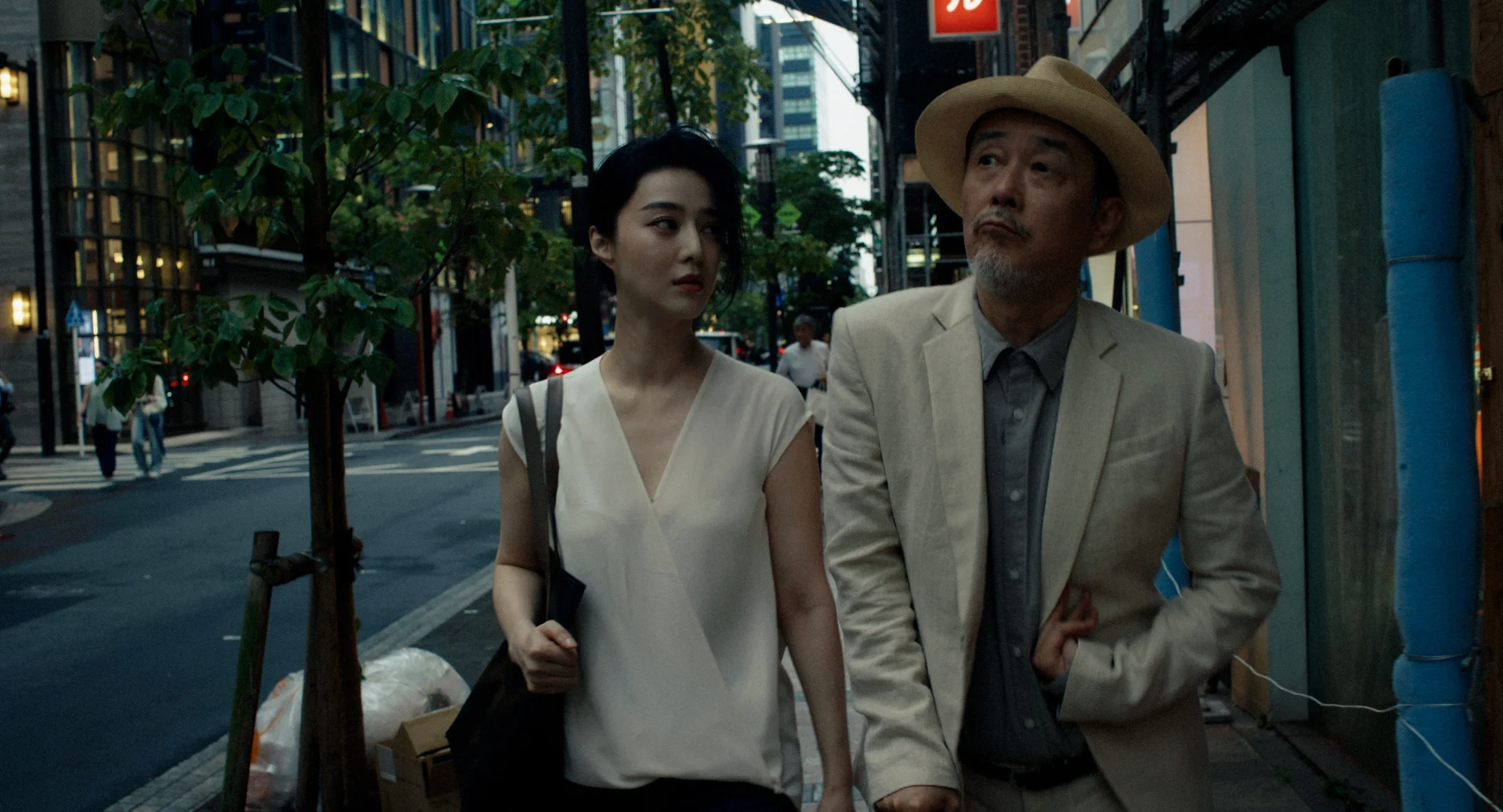
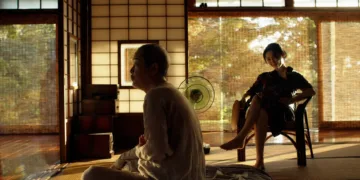
Yet the diary does something less comfortable than furnish excuses. Utsugi keeps trying to understand a woman whose intentions he cannot verify. When Susu positions her feet near him during therapy, he reads an invitation into the practical closeness of their bodies. She may know exactly what effect she has. She may also be permitting an old man to entertain himself while she completes an exercise. Wang allows both possibilities to survive the scene. Utsugi, naturally, would prefer a definitive answer.
The walks they share complicate my first judgment of him. Susu tells Utsugi she doubts she is suited to being a wife; he shows her the place in his garden where he wants to be buried. Neither disclosure settles the question of attraction. They do establish that each can say something to the other that would sit awkwardly at the family table. His fixation may contain a wish to be seen as a person with a future still worth discussing, however short that future looks. The wish deserves recognition. It grants him no special claim on Susu.
Bingbing keeps that distinction alive. Susu’s experience as a former hostess suggests she knows how men interpret attention, while her account of harassment in China gives their intimacy a history Utsugi’s fantasies cannot absorb. His narration remains certain of its own importance; she does not have to confirm it. Their foot-focused encounter is unsettling for that reason. It places his pleasure and her choices in the same frame without making either transparent. The film is strongest when Susu can act without becoming the solution to Utsugi’s questions.
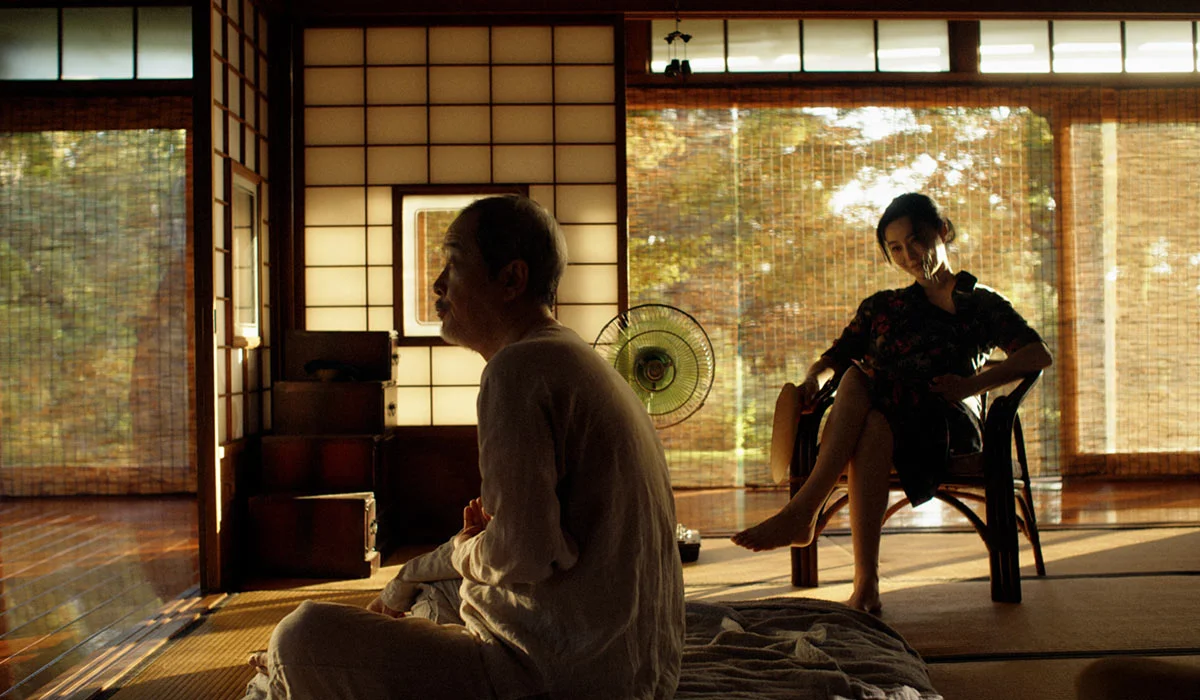
Much of this plays out inside a house that Wang and cinematographer Koichi Furuya refuse to make airless. Tall windows and open doors keep the garden in view; light leaves parts of faces and bodies obscured. Utsugi has room to watch Susu and ample opportunity to mistake proximity for understanding. Even the garden offers no escape from his interpretations. When he points out his intended burial place, death enters a conversation between two people who must return inside and resume the routines of care.
Those routines are also part of the family’s hierarchy. Hana helps manage Utsugi’s recovery, while Susu is expected to tend him and bear the pressure surrounding Jokichi’s desire for a child. The old man’s dependence has not erased the privileges of age and position. Wang finds an uncomfortable family logic here: care can be given freely and still be demanded by someone accustomed to receiving it. The question running beneath Utsugi’s diary is who gets time to have desires of their own.
The later escalation makes that question harder to hold in view. A confrontation with Jokichi brings long-standing resentments into the open, and the film raises the possibility that Utsugi’s grasp of events is failing along with his health. It is a consequential turn, though the louder family drama reduces some of the patient uncertainty built between him and Susu.
If his conduct can be explained primarily through illness, the diary becomes easier to dismiss. Franky and Bingbing continue to give the relationship its unruly mixture of care, calculation, embarrassment, and tenderness. I missed the earlier scenes in which Susu could leave a shower door open and still keep her reasons to herself.
Diary of a Mad Old Man world-premiered at the Toronto International Film Festival on September 18, 2026. Adapted from Jun’ichirō Tanizaki’s classic novel and directed by Wayne Wang, the drama follows a paralyzed, aging widower whose late-life libido is intensely reignited by his complex relationship with his daughter-in-law.
Where to Watch Diary of a Mad Old Man (2026) Online
Full Credits
Title: Diary of a Mad Old Man
Distributor: Bankside Films
Release date: September 18, 2026 (Toronto International Film Festival)
Running time: 1 hour 59 minutes (119 minutes)
Director: Wayne Wang
Writers: Kelvin Wyles, Jun’ichirō Tanizaki
Producers and Executive Producers: Shozo Ichiyama, Francey Grace, Andrey Epifanov, Eleonora Granata-Jenkinson, Kim Aubry, Hiroaki Kanenobu, Soichiro Koga, Gu Xiaodong
Cast: Lily Franky, Fan Bingbing, Youki Kudoh, Takumi Saitoh, Asana Mamoru, Momoka Ayukawa, Yo Osamu
Director of Photography (Cinematographer): Koichi Furuya
Editors: Ashley Pagàn, Masahide Koura
Composer: Arthur Sharpe
The Review
Diary of a Mad Old Man
Wayne Wang gives Utsugi’s desire an uncomfortable setting: a household where he needs Susu’s care and still expects her attention. Lily Franky and Fan Bingbing make their scenes difficult to judge in the best sense, while the open, shadowed house leaves room for uncertainty. The louder family conflict weakens that precision, especially when illness threatens to explain too much. The film lingers most when Susu can keep her reasons to herself.
PROS
- Franky’s vulnerable, unsettling performance
- Bingbing preserves Susu’s independence
- - Expressive use of the house and garden
CONS
- Late confrontation disrupts the quieter tension
- Suggested cognitive decline risks simplifying Utsugi
- - Final act narrows Susu’s ambiguity