

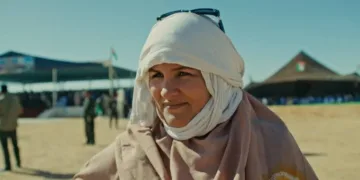

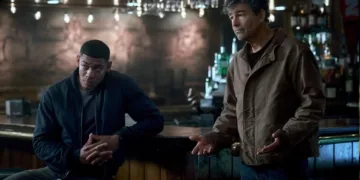








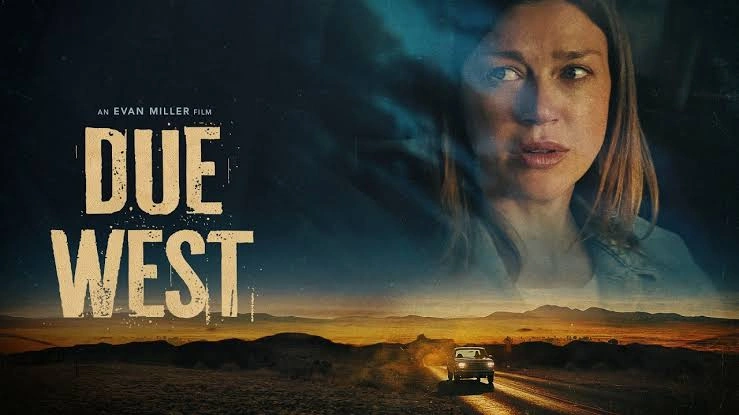

Control in Due West rarely arrives wearing a uniform. It appears as mileage, a dead pickup, an empty wallet, and the social fact that everyone in a small town recognizes everyone else’s vehicle. Evan Miller’s debut understands that power can become logistical before it becomes openly violent. A woman may technically have a choice while every road leading to that choice has been made longer, riskier, and more expensive.
Adrianne Palicki plays an unnamed bartender in rural West Texas whose 1993 Ford F-150 is barely functioning. She wants out, but the truck cannot reliably carry her to the next town, let alone toward another life. Guarded text messages about an appointment create the film’s first tension.
The nature of that appointment is kept unspoken, yet the secrecy surrounding it tells us enough. She needs an abortion, Texas has transformed that need into a covert operation, and poverty has turned privacy into a luxury. Call this administrative suspense: the fear produced by rules that remain off-screen while shaping every visible decision. There are no courtroom scenes or legislative speeches. The law is present as distance.
A Western Without Permission
Miller frames the Woman as a contemporary Western figure, though her frontier contains no open range. The opening image places Palicki outside a neon-lit dive bar in boots, jeans, and plaid, smoking against the wall. The iconography is familiar, then the film quietly rewrites its meaning. She is not waiting for a duel. She is calculating fuel, time, and the chance that someone will ask the wrong question.
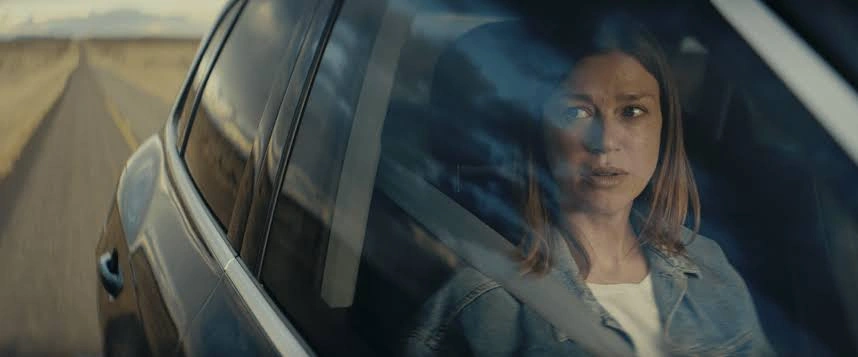
When the truck fails, the story’s politics become physical. A private medical decision now requires hitchhiking. Haley, a younger woman from Austin played by Ciara Bravo, offers a ride. Their exchanges move from caution to a fragile alliance built through gas money, road snacks, and the Woman’s blunt advice about staying alert when travelling alone. Haley stopping to pet a horse gives the film its clearest nod to the old West (the horse, sensibly, has no interest in symbolism).
The journey also exposes the film’s strongest idea. Masculine authority does not need a single villain. Pastor Mike’s persistent interest, Cody’s well-meaning concern, and Mindy’s resentment create a network of observation around the Woman. Each person can claim care. Together, they make concealment necessary.
The Politics of Not Saying
The word “abortion” is never spoken. At first, this silence feels exact. Miller keeps the Woman from becoming a mouthpiece and lets her predicament emerge through behavior: guarded replies, money trouble, glances at the clock, and the constant calculation of who can be trusted.
Palicki works almost entirely through containment. Her shoulders tighten before her voice does. She answers questions as though every extra word might become evidence. Then restraint begins to look suspiciously like reluctance.
The film presents her decision as fully justified, and the issue lies elsewhere. A drama does not owe every moral position equal airtime. The weakness lies in what happens once the situation becomes clear. The screenplay discovers little beyond it. Religion, class, family loyalty, and state power circle the Woman, yet none is examined with much pressure. The film knows she is trapped. It is less certain what it wants to say about the machinery of the trap.
I first read this sparseness as confidence. Later, I wondered if it was fear of committing to an argument beyond the evident one. Due West wants the authority of political cinema without the mess political thinking usually creates. That is a very modern form of caution.
A Performance Carrying the Missing Weight
Palicki keeps the film alive when its ideas stop developing. Her silence operates as defensive labor. In scenes with Cody, Mindy, and Pastor Mike, she listens with the tense patience of someone trying to end a conversation before it becomes dangerous. The role gives her few speeches, so small physical choices carry the character’s anger and exhaustion.
Henry Thomas gives Pastor Mike a soft persistence that proves more unsettling than open hostility. Odette Annable makes Mindy’s judgment feel domestic and practiced, while Matt Lauria gives Cody enough warmth to complicate his place in the Woman’s life. Bravo brings nervous movement to Haley, though some of the heavier dialogue sits awkwardly on her.
Jonathan Nicholas photographs West Texas through faded signs, empty roads, dim interiors, and harsh daylight. The landscape is never romanticized. It looks worn down by time and policy alike. Miller wants darkness without graphic depiction, and that hesitation weakens several passages, yet the image of the Woman stranded beside her failed truck needs no embellishment. Her body is legally contested. The machine that might carry it elsewhere will not start.
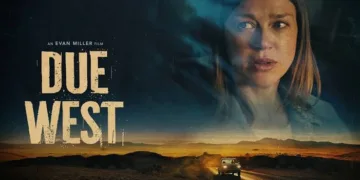
Due West is an American independent drama film that premiered at the Dallas International Film Festival on April 26, 2025. Set in West Texas, the film follows a small-town woman who turns to breaking the law to pay for expensive medical care. Viewers can find information on upcoming screenings and digital platform availability through independent film showcases and video-on-demand services.
Where to Watch Due West (2025) Online
Full Credits
Title: Due West
Distributor: No Mondays Productions
Release date: April 26, 2025
Running time: 81 minutes
Director: Evan Miller
Writers: Evan Miller, Hardy Janson
Producers and Executive Producers: Adrianne Palicki, Ezra Venetos, Beau Harris, Caitlin McFarland, Emily Gipson
Cast: Adrianne Palicki, Henry Thomas, Ciara Bravo, Matt Lauria, Odette Annable, Joey Oglesby, Austin Nichols, Ashley Fink
Director of Photography (Cinematographer): Jonathan Nicholas
Editors: Sandra Adair
Composer: Travis Howard
The Review
Due West
Due West understands that control over a body can be exercised through distance, poverty, silence, and the polite attention of people who believe concern grants them authority. Evan Miller’s modern Western gains force from Adrianne Palicki’s guarded performance and the practical cruelty of a broken truck. Yet restraint gradually becomes avoidance. The Woman’s ordeal remains persuasive, while the film rarely tests its ideas beyond the immediate plot. It locates the wound with precision, then hesitates to examine the system holding the knife.
PROS
- Adrianne Palicki’s restrained performance
- Effective modern Western framing
- West Texas atmosphere
- Quietly tense road narrative
CONS
- Surface-level political argument
- Underwritten supporting characters
- Uneven dramatic momentum
- Restraint sometimes becomes evasion