

























Shared memory is the first casualty in Sour Minnows. Ricky and Tepper return from a grocery run with different accounts of what happened, including a group of men lying in the road and licking tiny fish from the pavement. Tepper remembers dropping the groceries and fleeing. Ricky barely remembers the incident at all. The film treats this disagreement less like a mystery to solve than a crack spreading through the floor.
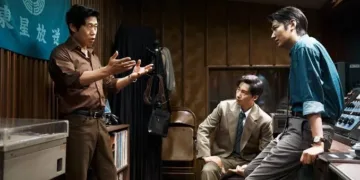
Harrison Atkins builds his sophomore feature around Ricky, played by David Brown, an unfocused cinephile who trains AI for money and talks about making art with the conviction of someone hoping ambition might arrive through repetition. His roommate Tepper, played by Chase Williamson, is already filming shorts, music videos, and anything else that gives him an excuse to hand strangers a camera release. Their Los Angeles life is casual, cluttered, and recognizable until time begins skipping without warning.
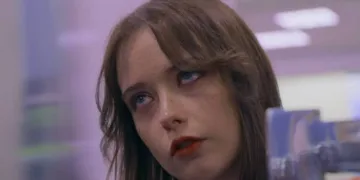
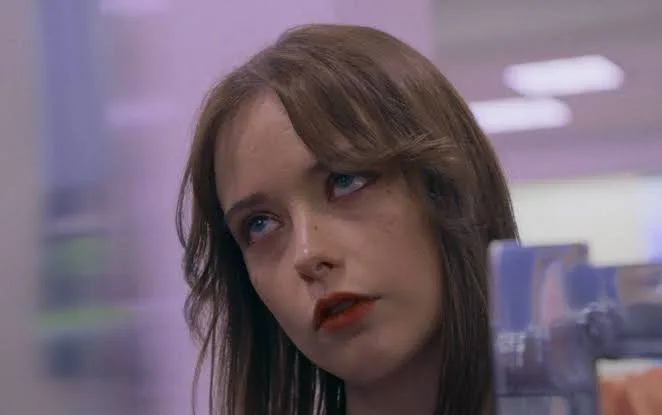
Aura, played by Suzanna Son, seems to be dating Ricky. She may have been dating him for longer than he remembers. Their uncertain relationship gives the film its most useful emotional pressure because forgetting an afternoon is frightening, while forgetting the shape of an intimacy is worse.
The Story Breaks on Purpose
Atkins replaces conventional progression with recurrence. Scenes appear to repeat, conversations arrive with missing beginnings, and characters respond to events the audience may or may not have seen. Ricky prepares to connect a hard drive so he and Tepper can watch a film starring the recently deceased Jojo “Vacation” Monica. Tepper insists they already watched it. Ricky has no idea what he means.
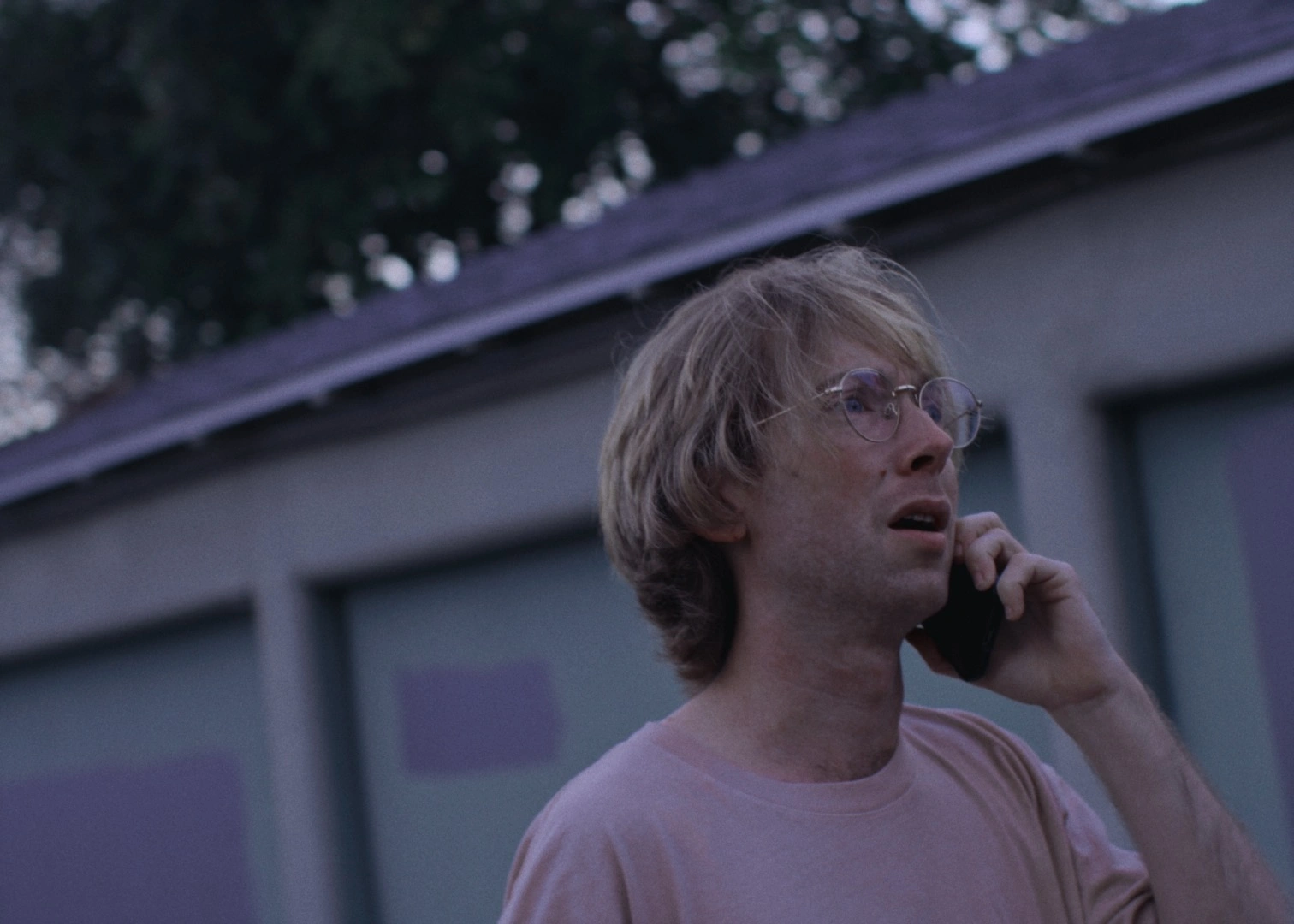
The structure places viewers inside Ricky’s instability rather than standing outside it with a diagram. One of the film’s funniest and saddest moments finds him typing “MEN’S ROOM” into his phone, leaving a breadcrumb for a future version of himself who may not remember why it matters. It is a pitiful defense against mental collapse, which makes it credible.
The disruptions grow stranger. Aura reaches through a mirror and emerges inside Ricky’s car. A news anchor delivers ornate warnings from an overgrown field while figures approach behind him. Jojo Monica appears in recorded footage describing a yellow being that inhabits and pilots his body. These elements eventually gather around the entity known as the Yellow Thing, yet the film is stronger before that name supplies even a partial explanation.
Ambiguity has to produce pressure. Atkins often manages that through editing, cutting away before a scene establishes stable ground. He also overloads the design with tunnel dwellers, pavement lickers, zombies, tiny fish, missing time, and nested films. At a certain point, confusion stops accumulating meaning and starts collecting furniture.
People in the Glitch
Brown prevents Ricky from becoming a delivery system for surreal images. His performance remains quiet as the circumstances grow louder. He pauses before answering basic questions, watches other people for clues, and tries to preserve ordinary behavior after ordinary behavior has stopped helping him.
A strip-mall sequence connects Ricky’s job to his deterioration with particular precision. He completes AI training modules while listening to another person describe arriving at places without remembering how she got there. The testimony mirrors his condition, but the system receiving it treats the woman’s distress as data to process. Ricky is doing the same work while losing the ability to explain himself.
Williamson gives Tepper a different form of absence. His constant filmmaking sounds productive until it becomes clear that creation is also his preferred method of avoiding attention, responsibility, and direct conversation. He can recruit anyone for a short, yet he struggles to recognize what is happening beside him. The character could use greater development, but his casual detachment makes Ricky’s panic look sharper.
Son has the hardest role because Aura must remain emotionally present while the film keeps making her behavior unreadable. Her calm during the dressing-room void sequence and the mirror intrusion leaves open several possibilities: she understands the phenomenon, she is affected by it, or she has accepted that explanation will not improve anything. The screenplay declines to settle the matter, and Son keeps the uncertainty alive through small shifts in warmth and distance.
Handmade Apocalypse
The film’s lo-fi construction is part of its argument. Grainy images, abrupt cuts, saturated blue passages, and yellow intrusions make the production feel handled rather than manufactured. The creature effects sometimes look limited, yet those limitations suit a story concerned with people being converted into recordings, labels, clips, and searchable facts.
Jojo Monica becomes the clearest example. His death is reduced to a news headline, an eccentric interview, and an old film downloaded by two strangers. The facts remain available while the person disappears behind them. Ricky faces the same reduction through his own collection of identities: AI trainer, stoner, aspiring artist, roommate, boyfriend. Each label is accurate. None explains why losing himself hurts.
Atkins places dense monologues beside blunt warnings, forcing the audience to distinguish information from recognition. The news anchor can speak at length about catastrophe while saying less than a frightened person leaving one practical instruction. Cinema receives similar treatment. Ricky and Tepper know cinematographers, performers, and film history, but their knowledge becomes another screen placed between themselves and immediate experience.
The closing dedication to Jeff Baena should not be used as a code that solves the film. It does sharpen the grief running beneath its comic nightmare. Ricky is repeatedly forced to see himself from outside, as if a life can be studied without being understood. The camera records him clearly. That proves very little.
Sour Minnows is a surrealist comedy-drama film that premiered at the Fantasia International Film Festival on July 24, 2026. The film follows two roommates in Los Angeles whose grip on reality begins to dissolve after they witness a bizarre encounter on an empty street. Viewers can catch screenings through upcoming festival circuits and independent exhibition platforms.
Where to Watch Sour Minnows (2026) Online
Full Credits
Title: Sour Minnows
Distributor: Rooftop Films, Fantasia International Film Festival
Release date: July 24, 2026
Running time: 83 minutes
Director: Harrison Atkins
Writers: Harrison Atkins
Producers and Executive Producers: Sarah Winshall, Kate Banford, Allison Bunce, Mel Barnes, Suzanna Son, Harrison Atkins, Anne Gormley
Cast: David Brown, Suzanna Son, Chase Williamson, Phil Burgers, Julia Jones, Ryan Perez, Carmen Christopher
Director of Photography (Cinematographer): Harrison Atkins
Editors: Harrison Atkins
Composer: Ryu Yoshizawa
The Review
Sour Minnows
Sour Minnows turns fractured memory into its organizing principle, trapping Ricky inside repetitions, missing time, and scenes that refuse to connect cleanly. Harrison Atkins sustains that instability through jagged editing, handmade imagery, and David Brown’s quietly panicked performance. The structure sometimes loses the distinction between productive confusion and narrative clutter, especially once the Yellow Thing receives partial explanation. Still, its rough form suits a film about people being reduced to files, labels, and disposable information. Few coherent stories feel this honestly disoriented.
PROS
- Bold fractured structure
- David Brown’s restrained performance
- Memorable surreal imagery
- Sharp ideas about AI and identity
- Effective lo-fi texture
CONS
- Emotional stakes develop unevenly
- Symbolism becomes overcrowded
- Explanations weaken some mystery
- Supporting characters remain elusive