


















![Kingdom Hearts Collection [I-III] Review](https://gazettely.com/wp-content/uploads/2026/10/Kingdom-Hearts-Collection-I-III-1-360x180.webp "Kingdom Hearts Collection [I-III] Review: KHII Holds Steady as Newer Entries Fluctuate 33")








Gloria can turn one Instagram like into a complete theory of romantic betrayal before Nick has finished sleeping beside her. She studies old photographs of him with his ex-girlfriend Kaylinn, assigns motives to every pose, and treats a comment beneath a post like intercepted evidence.
Chelsea Devantez’s Basic, expanded from her 2020 short, understands the comic potential of this behavior because it also understands the fear underneath it. Gloria is not searching for information. She is searching for proof that she will be abandoned.
Ashley Park makes that distinction visible. Gloria’s accusations arrive at full volume, yet Park keeps showing the panic behind them: the sleepless stare, the defensive speed of her answers, the way embarrassment becomes anger before anyone can examine it. When Nick refuses to participate in the trial she has staged inside her head, Gloria ends the relationship herself. It is self-protection conducted with the efficiency of demolition.
The opening act matches her disorder through quick jumps between Instagram posts, childhood memories, happier moments with Nick, and imagined scenes from Kaylinn’s life. Drew Van Steenbergen’s editing turns each new digital clue into another trapdoor.
The method is accurate and occasionally punishing. Gloria’s invented voice for Kaylinn repeats past the point of comic irritation, and the film spends a long stretch asking the audience to remain patient with someone who has exhausted everyone near her. Sympathy arrives late, carrying vodka and frozen snacks.
The Pivot
The story steadies once Gloria decides to confront Kaylinn at the bar where she hosts trivia. The scene is built around a useful structural correction. Gloria enters expecting the polished influencer she created from photographs. She finds a struggling comedian working a modest room, telling sharper jokes than Gloria wants to admit, and recognizing her immediately.
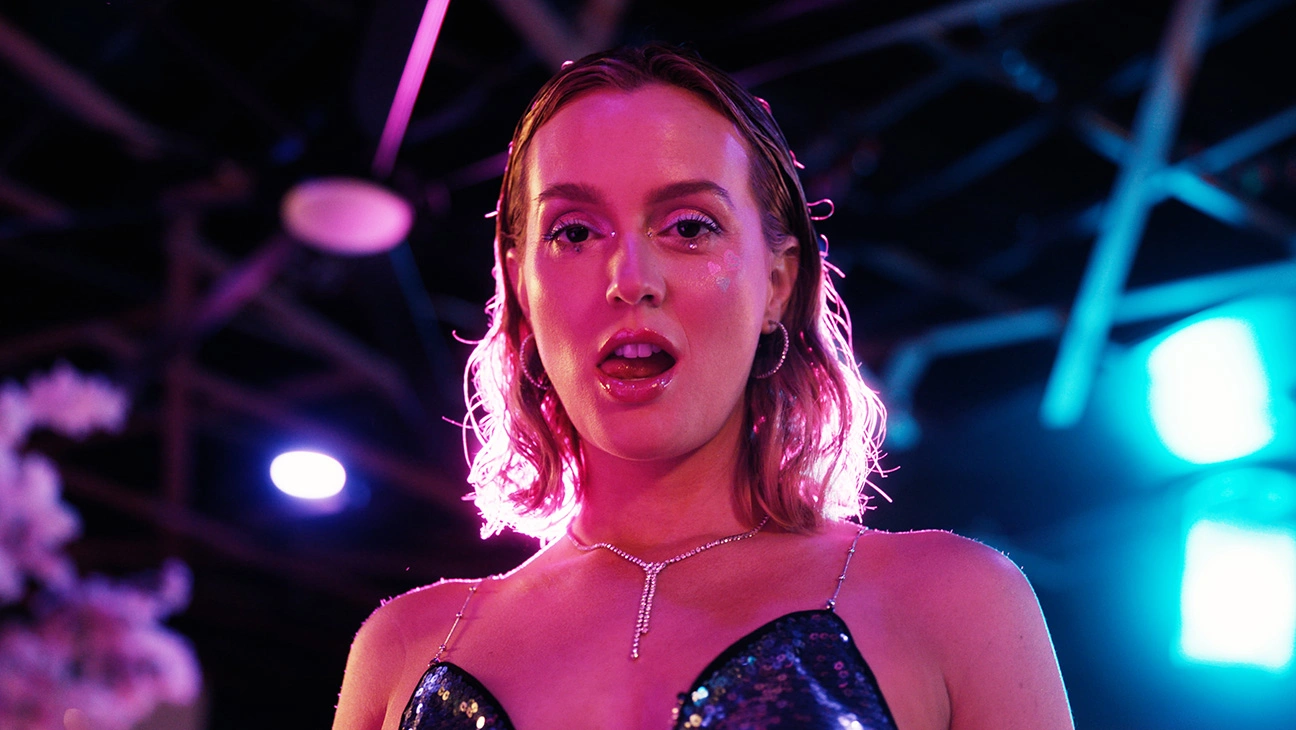
Leighton Meester handles two roles within one performance. The first is Gloria’s fantasy of Kaylinn, a sneering collection of poses, bikinis, and exaggerated confidence. The second is a guarded woman who enjoys inspiring jealousy for several minutes, then notices that Gloria is dangerously drunk and refuses to leave her alone. Meester’s dry delivery lets both versions overlap. Kaylinn can be generous and petty in the same exchange, which is where the character begins to feel written rather than corrected.
From there, Basic changes genres without announcing the paperwork. The romantic comedy becomes an overnight buddy film, moving through a drag bar, grilled-cheese conversations, street photographs, and an improvised skateboarding lesson. Each stop removes one assumption. Gloria discovers that Kaylinn’s social life is carefully staged but hardly effortless. Kaylinn discovers that Gloria’s hostility has been feeding on isolation rather than simple cruelty.
The route is familiar, yet Devantez gives it useful friction. The women do not become friends because the script suddenly declares them compatible. They bicker over who has behaved worse, test each other’s jokes, and slowly recognize the same fear operating under different costumes.
Two Women, One Placeholder
Park and Meester generate the film’s best chemistry, which exposes the thinness of Nick as a dramatic object. Taylor John Smith plays him with enough warmth to make Gloria’s loss credible, but the screenplay gives him little beyond patience, attractiveness, and a late redemptive gesture. He functions as the shared blank space onto which both women project their anxieties. The story is far livelier whenever he is absent.
That imbalance is partly deliberate. Gloria has invested so heavily in romance that her friendships have withered, while Kaylinn maintains a circle capable of teasing her without abandoning her. Zuri, Mallory, and Ashton Culture are not decorative proof of Kaylinn’s popularity. Their relaxed familiarity shows Gloria what a wider emotional life looks like. Kandy Muse, in particular, gives the group scenes an immediate comic charge, while Amber Ruffin and Nelson Franklin turn brief encounters into clean, efficient jokes.
Devantez also refuses to excuse Gloria by making Nick secretly guilty. The harder lesson is that pain from earlier relationships and her parents’ divorce may explain her surveillance, but explanation does not repair the damage. Gloria must face the unpleasant possibility that she created the outcome she feared. The screenplay is strongest when it lets that recognition sting before offering comfort.
Dressed for the Feed
Veronica Bouza’s cinematography and the design work create a city arranged like a social platform. Neon nightlife gives way to warm morning light, while Kaylinn’s pinks, frosted makeup, and conspicuous outfits suggest a person dressing for photographic evidence. Gloria’s reds carry anger before softening into cooler tones once she stops treating every room as a courtroom.
The magical-realist inserts extend the same idea. Gloria does not watch Kaylinn’s posts from a safe distance; she mentally performs inside them, inventing scenes that flatter her worst suspicions. A classical version of “Milkshake” and the Park-Meester song “Obsessed” push this inner theater toward pop absurdity. The jokes work because the filmmaking commits to Gloria’s distorted scale instead of placing a camera over her shoulder and asking a phone screen to do all the labor. Gloria spends hours trying to uncover Kaylinn’s secret. What she finds is a person.
Basic had its world premiere at the South by Southwest Film & Television Festival on March 16, 2026, and can be found through independent festival screenings and participating studio releases. The comedy follows a woman who spirals after a painful breakup and investigates her ex-boyfriend’s dating history, only to confront his most basic ex-girlfriend.
Full Credits
Title: Basic
Distributor: Marc Platt Productions, Fortitude International, BuzzFeed Studios, 100 Zeros, CaliWood Pictures
Release date: March 16, 2026
Running time: 96 minutes
Director: Chelsea Devantez
Writers: Chelsea Devantez
Producers and Executive Producers: Marc Platt, Katie McNicol, Adam Siegel, Nadine DeBarros, Michael Philip, Richard Alan Reid, Chelsea Devantez
Cast: Ashley Park, Leighton Meester, Taylor John Smith, Nelson Franklin, Kandy Muse, Ashley Nicole Black, Kenzie Elizabeth, Amber Ruffin, Jon Gabrus, Georgia Mischak, Kate Linder, Eleanor Choi
Director of Photography (Cinematographer): Veronica Bouza
Editors: Drew Van Steenbergen
Composer: Tara Trudel
The Review
Basic
Basic nearly exhausts its audience during Gloria’s opening spiral, then makes that irritation part of its design. Once Gloria meets the real Kaylinn, Chelsea Devantez replaces imagined rivalry with a funny, sharply observed friendship built through trivia, drag bars, grilled cheese, and mutual embarrassment. Ashley Park and Leighton Meester give the film its emotional spine, while Nick remains a handsome plot mechanism awaiting characterization. The route is familiar, but the people taking it feel specific.
PROS
- Excellent Park-Meester chemistry
- Sharp social-media satire
- Funny overnight friendship
- Expressive costumes and cinematography
- Strong supporting comic cast
CONS
- Frenetic opening act
- Thinly written romantic lead
- Predictable friendship arc
- Gloria initially tests patience