



















![Kingdom Hearts Collection [I-III] Review](https://gazettely.com/wp-content/uploads/2026/10/Kingdom-Hearts-Collection-I-III-1-360x180.webp "Kingdom Hearts Collection [I-III] Review: KHII Holds Steady as Newer Entries Fluctuate 33")









Emma Strand resents having to be both the man and the woman in her marriage. Coming from a novelist who objects to the women invented by celebrated male authors, the complaint is revealing. In Vivian Kerr’s Séance, Emma wants the authority to describe female experience for herself, yet reaches for familiar sexual roles when her husband Albert disappoints her. He will not take charge. She is tired of taking charge. Somewhere between those positions, an alternative to the marriage she escaped has begun to look unattractive.
I was ready to call this a failure of her independence. That is too easy. Emma and Albert have been married for six months without consummating the relationship; her frustration has a material cause. Respect for her work cannot substitute for sexual intimacy, and a husband’s agreeableness can leave his wife doing the work of deciding everything. The troubling part is her renewed attraction to George, the former husband who dismissed her ambitions. She has identified a real absence and started looking for its remedy in someone whose demands once drove her away.
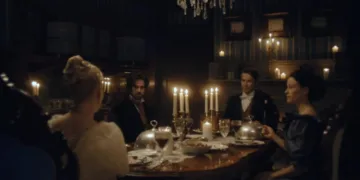
The encounter takes place on the California coast in 1892. Emma, played by Scottie Thompson, is holidaying with Albert, Connor Paolo’s accommodating painter, when they meet George and his new wife Lillian. George’s invitation to dinner brings the couples into a household already damaged by another absence: eight months earlier, George and Lillian’s daughter Hazel drowned. A storm encourages the visitors to remain, and Lillian proposes a séance. Four people assemble to contact a fifth, though their relations with the living provide plenty of unfinished business.
Emma’s writing matters because it gives her a language for rejecting other people’s versions of womanhood. She says she has never met women resembling those written by Twain and Dickens. Her successful novel follows her separation from George, linking creative recognition to an act of refusal.
Yet the dissatisfaction she expresses to Albert shows how little recognition settles. Kerr lets public accomplishment coexist with private dependence on the very expectations Emma can criticize elsewhere. Thompson’s movement between reserve with Albert, desire for George, and sympathy for Lillian keeps those attachments in play. Emma’s intelligence cannot organize them into a flattering account of herself. Nor should it have to.
There is something punitive about expecting an independent woman to demonstrate perfect independence in every appetite. Emma can make a bad choice without becoming evidence against her own freedom. Her responsibility is narrower and harsher: pursuing George threatens two people who have not consented to become the supporting cast of her romantic correction. Her growing sympathy for Lillian matters because it interrupts the convenient idea that the wife she might displace is merely an obstacle.
Lillian’s request to contact Hazel gives the gathering a different purpose. She believes her daughter remains nearby and wants to understand why she has not moved on. Albert responds sympathetically, George reluctantly, and Emma’s initial resistance becomes interest.

These responses make the ritual dramatically useful before anything inexplicable happens. Each participant has a different investment in what Lillian might discover. Albert’s willingness to accommodate her resembles his conduct toward Emma, but here it offers a kindness that Emma’s complaints about passivity do not quite account for. Paolo’s quietness acquires value through the change in recipient.
The levitating table and other disturbances threaten the group’s confidence in ordinary explanation. Kerr’s better uncertainty, however, concerns the people doing the explaining. Lillian’s distress invites doubt, while Jilon VanOver’s George has the social advantage of composure.
I found myself granting that composure authority, then had to reconsider what supported it. George blames Lillian for failing to save Hazel; she already carries that accusation herself. His controlled manner tells us little about the fairness of his judgment. Kerr’s increasingly distressed Lillian makes grief difficult to observe without also judging its expression. Her suffering proves neither the presence of a ghost nor the falsity of her account.
This tension is weakened by the attention repeatedly drawn back to Emma and George. Emma’s thwarted ambitions, sexual disappointment, and attraction receive a detailed causal history. George and Lillian’s marriage after Hazel’s drowning is less clearly established before the visitors arrive. Their loss supplies the evening’s supernatural occasion, yet the old romance sometimes makes Lillian’s household feel like a setting for Emma’s decisions. That imbalance limits how fully the film can test the judgments attached to its grieving mother.
The storm has its own apparent authority, and a small exchange usefully challenges it. Albert asks for an umbrella, prepared to return to their nearby hotel. Emma insists they stay. The house’s confinement is partly chosen; weather provides a respectable explanation for remaining where desire already wants to linger. (The umbrella lacks atmosphere, admittedly.) Kerr makes the familiar storm-bound setup ethically specific by letting one person attempt an exit and another refuse it.
Johanna Coelho’s candlelight, firelight, and moonlight give the mansion patches of visibility surrounded by uncertainty. Shadowed figures and lightning make recognition unstable; the staircases and wallpapered corridors extend that instability beyond the shared table.
Detailed gowns, shawls, and lace preserve the characters’ formal presentation while their relations grow disorderly. These surfaces support the domestic threat without requiring the supernatural incidents to become an uninterrupted series of shocks. The strongest suspense comes when Emma suspects people of arranging appearances: the possibility of deception turns looking around the house into an examination of her hosts.
When the group retires, Albert receives the study and Emma receives Hazel’s preserved bedroom. The separation gives the visitors’ troubled marriage a physical arrangement, but Emma’s room carries another family’s history. Among its dolls, a wind-up toy repeats “Mama” in a distorted voice.
I read that repetition as an unsettling narrowing of female identity, a mechanism with one demand and no capacity to hear an answer. It addresses motherhood from inside the room of a dead child. Emma has insisted on remaining near George and is lodged among belongings that make his bereaved family impossible to treat as an inconvenience.
Séance premiered during its festival run in late 2024 before expanding theatrically in October 2026. Set in 1892 California, the gothic psychological drama follows a woman seeking refuge from a storm at her first husband’s home, where an unsettling evening unfolds around a grieving family.
Full Credits
Title: Séance
Distributor: Independent
Release date: October 18, 2024 (Festival) / October 2, 2026 (Theatrical)
Running time: 1 hour 25 minutes (85 minutes)
Director: Vivian Kerr
Writers: Vivian Kerr
Producers and Executive Producers: Vivian Kerr, Johanna Coelho, Marion Kerr, Makenna Tuttle
Cast: Scottie Thompson, Jilon VanOver, Connor Paolo, Vivian Kerr
Director of Photography (Cinematographer): Johanna Coelho
The Review
Séance
Kerr makes independence an awkward achievement: Emma can reject the women men write without escaping the expectations through which she desires them. Séance gives that contradiction an effective gothic setting, where composure earns trust too easily and grief invites suspicion. Its domestic tensions sustain the horror, though the renewed romance sometimes crowds out the bereaved marriage that makes the ritual necessary. The umbrella offers an exit; Emma’s desires are less practical.
PROS
- Emma’s contradictory desires sustain the philosophical inquiry.
- The séance exposes competing interests and uncertain credibility.
- Lighting and domestic spaces turn marital tensions into threat.
- Albert’s quiet sympathy complicates easy judgments of passivity.
CONS
- The renewed romance sometimes diverts attention from Lillian’s grief.
- Limited detail about the bereaved marriage weakens scrutiny of George’s blame.