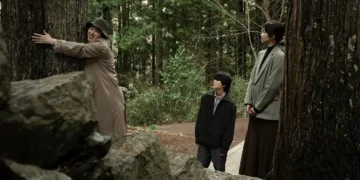
























Kotake and Koume make their entrance in pieces. Grayish hands curl around the edge of a shoji; a face follows. Then another pair of hands repeats the gesture, and another face appears. Reiko Takashima plays both elderly aunts, but Takashi Shimizu introduces them with the visual syntax of a haunting. Recognition arrives after apprehension. Before we can place these women within a household, we have already entertained the possibility that they belong to another world. An unfortunate first impression for one’s relatives, though an efficiently managed one.
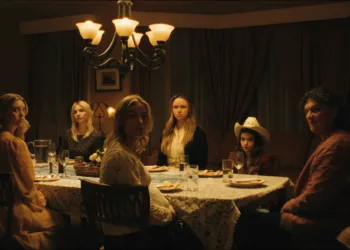
The surrounding architecture keeps that uncertainty alive. Shimizu and cinematographer Yasushi Ouchi use dark corners, negative space, and movements in shadow to make the Tajimi estate difficult to read. An apparently unoccupied area retains the possibility of a presence; a partly concealed figure invites a judgment before enough information becomes available. The historic buildings give this concealment physical credibility. Their recesses seem capable of accommodating whatever the family has declined to acknowledge. Looking becomes an anxious activity, and the audience starts supplying threats to supplement the visible evidence.
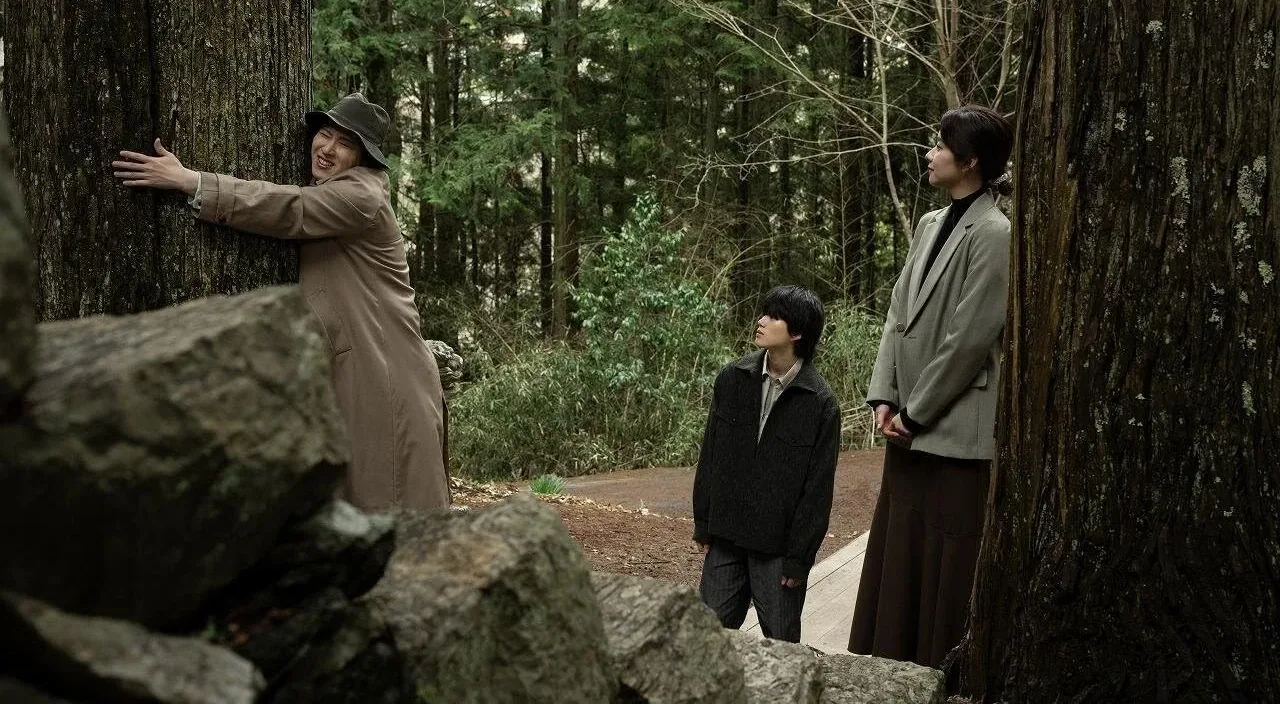
This is dangerous territory for Tatsuya Igawa, the young man summoned into the family. Played by Tomoya Oku, Tatsuya is unemployed in Tokyo when he learns that his estranged mother has died. Private detective Kosuke Kindaichi, whom the Tajimis have hired to locate him, accompanies his entry into a suddenly consequential inheritance.
Hisaya is dying, and the family requires someone to continue its name. The villagers remember the massacre committed by the former patriarch Yozo. When fresh murders coincide with Tatsuya’s arrival, ancestry supplies a ready accusation. He barely has time to become acquainted with his inheritance before becoming answerable for it.
Adapted from Seishi Yokomizo’s Kindaichi story, Village of Eight Gravestones finds its most compelling expression of this predicament in the recurring Kagura performance. Its masked enactment of historical killing initially carries the relative lightness of a familiar communal entertainment.
As the narrative returns to it, familiarity becomes a source of unease. The spectacle acquires implications its earlier appearance could not disclose. This is an effective manipulation of the spectator’s memory: we have seen the figures already, but our knowledge has changed, and the images change with it. Repetition makes the past increasingly difficult to contain.
The present murders follow the dance’s masked figures, turning preserved history into a pattern available for further violence. Masks also hang at entryways to repel spirits, an uneasy protective measure when the same visual vocabulary governs the killings. Shimizu gives these objects competing functions without exhausting them through explanation. Yozo’s massacre adds a different register of impersonality. Masked and carrying a sword, he moves through his victims with the systematic brutality of a slasher antagonist. The family’s history takes the form of a figure whose face cannot be consulted for hesitation, remorse, or any recognizable limit.
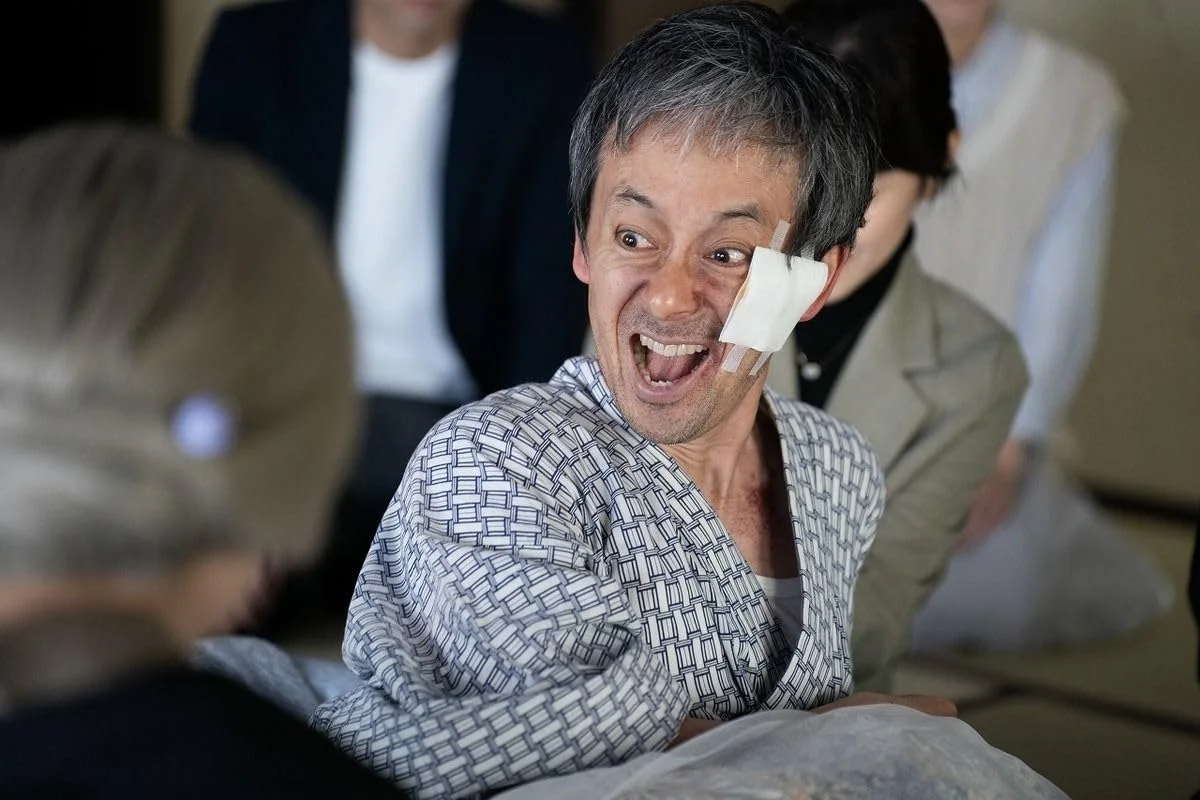
Kenichi Takitoh plays both Yozo and Hisaya, making recurrence a matter of flesh as well as ritual. A familiar face belongs to different generations and circumstances; the resemblance encourages connections that the characters’ conduct must still establish.
Here the film approaches a problem familiar to noir: how much authority should an incriminating appearance possess? The villagers have largely settled that question before Tatsuya arrives. Their dependence on the Tajimi fortune makes their hostility more uncomfortable. They need the family to persist while treating its continuation as a threat. A curse gives that contradiction the convenience of inevitability.
Kindaichi’s investigation introduces a more discriminating account of responsibility. There are relatives with interests in the inheritance, a suspicious doctor, and local police who resent an outsider’s involvement. Human motives remain plentiful. Yet Shimizu repeatedly pulls attention toward apparitions and violent disturbances, making the investigation share its authority with horror. The heavy, gothic score and abrupt sounds press the audience toward alarm, while the concealed areas of the image reward a slower, searching vigilance. The latter produces the more durable unease. It leaves us responsible for deciding what we have seen.
The passage between these modes is less secure than the individual images. Supernatural spectacle sometimes interrupts the developing inquiry rather than adding pressure to it, and the return to suspects and motives can feel like a resumption after an excursion. Still, the eventual connections satisfy without requiring every disturbance to be buried beneath an elaborate explanation. The film retains an absorbing uncertainty about the reach of human action. Its unevenness comes from the distribution of attention: the next frightening manifestation can become more urgent than the next useful discovery.
Matsuya Onoe’s Kindaichi helps these competing impulses coexist. His approachable manner and deadpan humor release tension without making him immune to the surroundings. He gets frightened. He makes mistakes. Those qualities cost him some of the traditional detective’s reassuring authority, but a man who remained perfectly composed here might require more explanation than the murders. His protective position beside Tatsuya also gives the film a modest source of warmth. Where the Tajimis see a necessary successor, Kindaichi offers something closer to companionship.
That relationship deserves more development than it receives. As the mystery expands, Kindaichi’s personality becomes less distinct, and Tatsuya increasingly recedes behind events that ought to be transforming his understanding of himself.
A recurring detective can solve a case without undergoing a personal renovation. Tatsuya’s thinness is harder to accommodate. His mother has died, strangers have assigned him a future, and his family history has made him an object of fear. The film gives these circumstances considerable narrative importance while spending comparatively little attention on how he absorbs them.
This leaves a troubling imbalance within Shimizu’s visual argument. The hands at the shoji, the returning masks, and Takitoh’s doubled face all make inherited identity forceful and legible. Tatsuya’s individual presence remains much less developed.
We understand why the village sees a bloodline when it looks at him; we receive fewer opportunities to discover what that way of seeing excludes. The film’s most consequential omission is the young man’s capacity to form an identity under this scrutiny. Without sufficient access to his choices, the spectator can recognize the injustice of the villagers’ judgment while remaining dependent on their account of who matters in the frame.
The Village of Eight Gravestones premiered internationally in July 2026 before its theatrical release in Japan on September 18, 2026. Directed by Takashi Shimizu, the atmospheric horror-mystery follows a young man who visits his ancestral village after his mother’s death, only to find himself trapped in a nightmare of local curses and escalating murders investigated by detective Kosuke Kindaichi.
Full Credits
Title: The Village of Eight Gravestones (Japanese: 八つ墓村)
Distributor: Shochiku, Kadokawa
Release date: July 28, 2026 (Fantasia International Film Festival), September 18, 2026 (Japan)
Rating: 15
Running time: 1 hour 54 minutes (114 minutes)
Director: Takashi Shimizu
Writers: Shintaro Ogai, Takashi Shimizu (based on the novel by Seishi Yokomizo)
Cast: Matsuya Onoe, Tomoya Oku, Mayu Hotta, Reiko Takashima, Kenichi Takitoh, Kiyohiko Shibukawa, Masanobu Takashima
The Review
Village of Eight Gravestones
Shimizu makes the Tajimi inheritance visible in concealed faces, returning masks, and shadows that invite accusation before knowledge. The ritual imagery gives this absorbing mystery a disturbing moral charge, while Onoe’s vulnerable Kindaichi supplies welcome warmth. Supernatural spectacle occasionally interrupts the investigation, and Tatsuya receives too little individuality to challenge the identity imposed on him. The film understands how a family becomes an incriminating image; its grasp of the person trapped inside that image is less assured.
PROS
- Precise use of concealment and negative space.
- Recurring ritual imagery gains disturbing significance.
- Onoe’s humor and vulnerability temper the dread.
- Satisfying connections within the central mystery.
CONS
- Horror spectacle sometimes interrupts investigative momentum.
- Tatsuya’s inner life remains underdeveloped.
- Kindaichi’s distinctive personality thins as events escalate.