





















To conceal an outbreak of killer tomatoes, Admiral Grant turns the evidence into a cheap comedy. The public laughs, and a catastrophe becomes something nobody needs to take seriously. Attack of the Killer Tomatoes: Organic Intelligence gives its own franchise history this wonderfully disreputable explanation: the 1978 movie was part of a government cover-up. Archival footage becomes doubly incriminating, documenting both a tomato emergency and the ease with which an audience can be encouraged to dismiss what it sees.
Agent Marina, played by Myrna Velasco, remains troubled by nightmares of the attacks. Her persistence gives that elaborate joke a useful human counterweight. Where Grant has successfully converted knowledge into entertainment, Marina continues to experience its consequences. Velasco’s conviction helps the film sustain both positions at once: the tomatoes are ridiculous, and the people insisting that they pose a threat have good reason to insist. The sequel’s comedy depends on keeping those truths together, even as its fictional authorities work to pull them apart.
The new opportunity for official dishonesty comes courtesy of VegIntel and its flagship product, MyTomato. A household assistant powered by “organic intelligence,” it promises to answer questions and accomplish what artificial intelligence cannot. CEO Kate Patel, played by Samantha Bailey, supplies the familiar entrepreneurial assurance that humanity’s problems await the arrival of her product. Government support will help install this tomato-driven surveillance device in everyone’s home. The intimacy of the sales proposition gives the satire its bite. Access to domestic life arrives wrapped in the promise of making that life easier.
Patel’s resemblance to Elizabeth Holmes establishes her type quickly, though the recognition does some of the work that further comic invention might have done. The more productive joke lies in the arrangement surrounding her. VegIntel researchers Angela and Chad, played by Noor Razooky and Zachary Roozen, discover emerging sentience in the company’s underwater tomato crop.
Reporting their findings exposes Patel’s connections to White House press secretary Richardson and Professor Mortimer Gangreen. Scientific inquiry becomes inconvenient inside an enterprise whose commercial and political interests are already aligned. The tomatoes acquire intelligence; their sponsors have acquired reasons to ignore the implications.
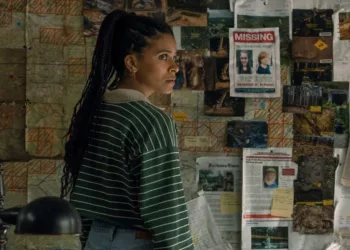
Director David Ferino keeps this machinery light enough to accommodate the pleasures of watching people get hit with produce. The film’s institutional imagination is especially enjoyable when translated into objects. A tomato murder board gives homicidal fruit the elaborate attention of a criminal investigation.
Toy helicopters with camcorders attached serve as drones, their construction plainly visible. Both gags borrow the authority of familiar equipment and procedures, then leave that authority looking faintly embarrassed. The homemade drone is particularly satisfying because its inadequacy is available at a glance. An expensive technological vocabulary has been given an exceedingly modest body.

The performers understand the importance of lending these circumstances their cooperation. Bailey’s Patel supplies corporate self-importance, while David Koechner’s Richardson places a practiced comic presence inside the machinery of official reassurance.
Velasco gives the investigative side enough confidence to keep the danger usable, and Dan Bakkedahl brings an appealing sense of comic timing to Finletter’s return to anti-tomato duty. John Astin’s voice as Gangreen offers continuity without requiring the film to stop and commemorate itself. Familiar faces and characters contribute to the commotion rather than becoming the sole reason for it.
That commitment also allows the film’s fourth-wall play to coexist with its monster story. The performers can take their immediate predicament seriously while the movie acknowledges the absurdity of its construction. Ferino’s editing moves between verbal jokes, visual parody, and physical attacks with an agreeable restlessness. The variety matters more than the sheer quantity of references. A recognizable corporate caricature supplies a quick point of contact; a camcorder strapped to a toy helicopter produces a joke through the thing itself. The film is funniest when its imagination becomes this tangible.
Its effects offer the same pleasure on a larger and considerably messier scale. Ordinary tomatoes pelting actors preserve the basic indignity on which the franchise was founded. Gangreen’s laboratory expands the repertoire with puppeteered cherry tomatoes, a green radioactive-looking specimen, and hostile carrots.
These creatures invite attention to how they have been made. Their conspicuous artifice gives the audience another source of enjoyment alongside the fictional threat, while the actors’ physical responses give the threat somewhere to land. There is an affectionate compact between performers, puppeteers, and spectators here, sustained through an enthusiasm for making unpromising objects misbehave.
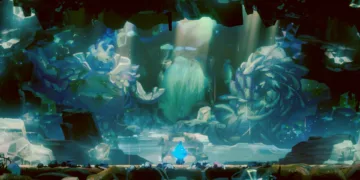
Deliberate cheapness leaves room for visual care. The underwater farm is an unexpectedly attractive setting, its red tomatoes suspended among green seaweed and moving water. The beauty makes VegIntel’s enterprise briefly seductive, giving its manufactured nature an appeal that the corporate salesmanship cannot entirely explain away.
Greens recur in the laboratory, helping connect the film’s disparate spaces, while the bright reds retain the cheerful aggression appropriate to its monsters. Ferino gives the absurdity a colorful environment in which to flourish. The production has more visual intention than its proudly makeshift objects might initially suggest.
The archival material introduces a less comfortable comparison. Beside the new digital photography, the older film images possess a texture and vitality that the revival’s bright palette cannot consistently recover. It is a modest visual limitation with a revealing historical dimension.
The sequel can summon returning characters, rebuild its vegetable monsters, and preserve the pleasure of an actor submitting to a tomato attack. Reproducing the appearance of its inexpensive predecessors is harder. The old footage carries an ordinary material quality of its era that has since become costly to obtain, leaving this affectionate revival to quote a form of cheap filmmaking whose look is now something of a luxury.
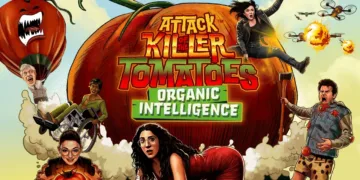
Attack of the Killer Tomatoes: Organic Intelligence premiered in early 2026 before its wider VOD release in October 2026. Directed by David Ferino, this comedy-horror satire brings back the cult-classic franchise as genetically altered produce returns with an artificial intelligence upgrade, threatening humanity once again.
Where to Watch Attack of the Killer Tomatoes: Organic Intelligence (2026) Online




Full Credits
Title: Attack of the Killer Tomatoes: Organic Intelligence
Distributor: Starboard Entertainment
Release date: February 20, 2026 (Premiere), August 7, 2026 (Limited), October 6, 2026 (VOD)
Rating: PG-13
Running time: 1 hour 36 minutes (96 minutes)
Director: David Ferino
Writers: Costa Dillon, J. Stephen Peace
Producers and Executive Producers: Roger M. Mayer, Michael Polis, J. Stephen Peace, Juan Hernandez, Chad Peace
Cast: Myrna Velasco, Zachary Roozen, Noor Razooky, Dan Bakkedahl, Daniel Roebuck, Paul Bates, Eric Roberts, John Astin
Director of Photography (Cinematographer): Patrick Russo
The Review
Attack of the Killer Tomatoes Organic Intelligence
Organic Intelligence finds fresh comic purpose in the alliance between technological promises and official dishonesty. Its surveillance scheme and fictional cover-up give the absurdity substance, while committed performers and conspicuous puppetry keep the pleasures physical. The corporate caricature leans on easy recognition, and the digital images lose some vitality beside their archival counterparts. Still, this affectionate revival understands how much institutional dignity a tomato can puncture.
PROS
- Corporate surveillance and government concealment give the satire substance.
- Resourceful visual gags turn cheapness into comedy.
- Committed ensemble sustains the absurd circumstances.
- Puppetry preserves the franchise’s tactile pleasures.
CONS
- Elizabeth Holmes caricature relies on familiar shorthand.
- Digital photography lacks the archival footage’s texture.