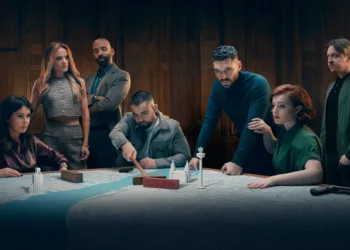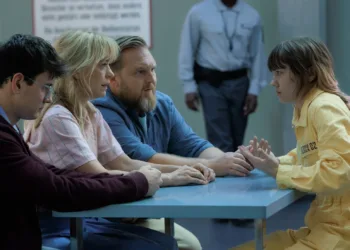




























Michael Kavanagh has a useful way of describing his participation in a collapsing criminal enterprise: “Things happened, none of which I could avoid.” The sentence leaves remarkably little room for the man who killed Ronnie Phelan. Michael had reasons, including Ronnie’s murder of Davy and a succession arrangement that threatened his own position. Still, the knife required someone to hold it. His account makes agency sound like something other people have.
Then the second season gives his defence an uncomfortable degree of truth. Having attempted a fresh start in Spain with his pregnant partner Diana, Michael is forced back to Liverpool by Ricardo’s brother Felipe. Banksey has killed Ricardo; Felipe holds Diana and the widowed Cheryl hostage and demands a recorded execution of the killer. Michael cannot simply decline. Judging his predicament requires keeping two things in view: his responsibility for helping sustain this world, and the real coercion restricting his choices within it.
This City Is Ours: A Crime Family Saga is most interesting in that uncomfortable interval. Stephen Butchard’s drama keeps supplying reasons to care about Michael without making his explanation of himself entirely trustworthy. James Nelson-Joyce’s strained, brooding intensity helps. His Michael carries the effort of maintaining control into situations where control has already become a fiction. The concern for Diana is credible; the suggestion that a sufficiently loving future can cancel his past is much harder to accept.
Back in Liverpool, Ronnie’s absence exposes several competing accounts of what loyalty should purchase. Jamie Phelan (Jack McMullen) regards his father’s organisation as an inheritance. His approach to the Albanians, intended to support his ambitions across the city, suggests someone impatient to exercise authority before acquiring the judgment it requires. Jamie’s claim rests on belonging, which leaves him badly equipped when belonging fails to persuade anyone. Ozzie Thompson arrives with a different invoice.
Out of prison and seeking compensation for time served, Shaun Evans’s newcomer treats loyalty as an investment awaiting its return. His questions about Ronnie carry the awkwardness of an obligation whose guarantor has died. Evans makes the amiability unsettling: friendliness permits him to keep approaching people who might prefer considerable distance. Between Jamie’s inheritance and Ozzie’s unpaid service, the criminal family starts to resemble an institution whose members have never agreed on their contracts. Everyone remembers what they contributed. The benefits package remains contentious.
Elaine and Rachel have to work within the consequences. Julie Graham’s matriarch and Laura Aikman’s pragmatic negotiator contain Jamie’s excesses and maintain relationships his ambitions threaten to damage. Their practical authority gives the organisation a dimension his claims to leadership cannot supply. There is an economical criticism of dynastic power here: the presumed successor needs others to perform the judgment that supposedly qualifies him to succeed.
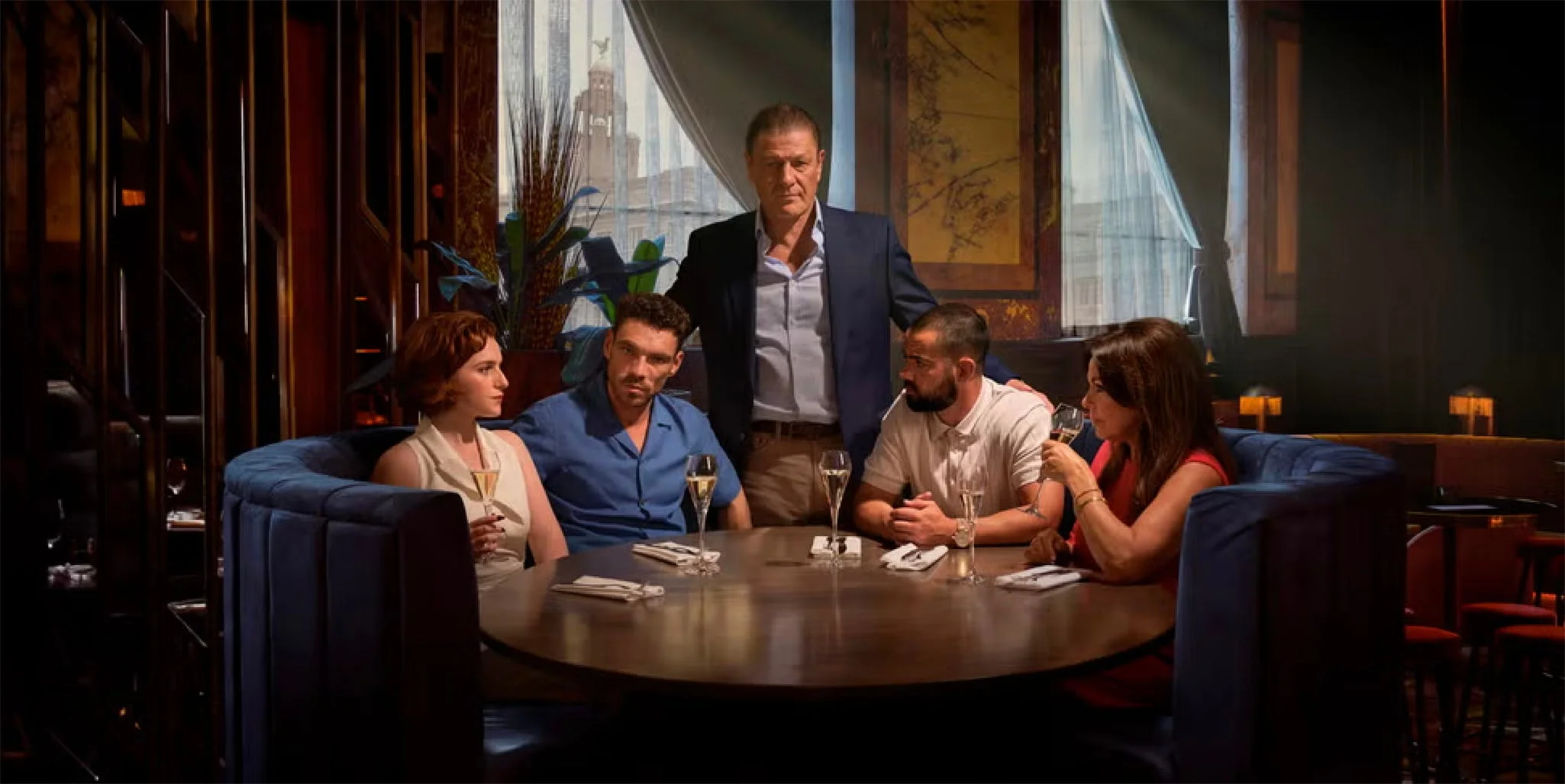
That distribution of competence makes the Spanish hostage plot feel comparatively blunt. Diana and Cheryl become leverage through which Felipe directs Michael’s actions. The demand for an execution video efficiently connects grief, retaliation and another prospective killing, but it gives the captive women little room within that immediate bargain. Diana’s pregnancy intensifies Michael’s urgency. It also risks making her future chiefly a measure of what he stands to lose. The Liverpool negotiations permit authority to emerge through behaviour; Felipe’s arrangement assigns everyone a function at gunpoint.
I initially found Michael’s concern about Diana’s IVF injections suspiciously convenient. A violent man worrying about medical care is an efficient invitation to grant him moral credit. Yet “convenient” does not quite account for what the detail establishes. The concern is specific, practical and directed towards a life they have struggled to create. Dismissing it as an excuse would let my judgment become as selective as Michael’s own. His tenderness can be sincere without conferring innocence. What needs questioning is his apparent belief that protecting this relationship makes his other commitments separable from it.
Banksey reminding his teenage son to empty the cat’s litter tray extends that problem into an agreeably unglamorous household task. Criminal power offers no exemption from reminding a teenager to do something twice. The detail gives Banksey a recognisable domestic existence without explaining away his violence. Mike Noble benefits from that refusal to make menace his character’s sole occupation. A man can kill someone and remember the cat. The difficulty lies with our wish for one fact to simplify the other.
Cheryl’s improvised farewell to Davy resists that simplification through grief. Playing “Ave Maria” on her phone over his makeshift grave gives the burial a painfully inadequate ceremony. Saoirse-Monica Jackson has a concrete act of care to perform amid the business of disposing of a body. The phone supplies something the circumstances cannot: a little dignity, however fragile. It is a better use of domestic feeling than treating every attachment as another vulnerability for the plot to exploit.
The drama’s humour can be less forgiving. Banksey’s inquiry about Ando’s protective vest, followed by his decision to shoot him, turns a practical question into a vicious demonstration. The exchange permits laughter without removing the cruelty producing it. It also prevents the household material from settling into reassurance. Remembering a chore has told us something about Banksey, but he remains capable of conducting this experiment on another person.
Then the car wash puts that same man inside a situation he cannot read. Collecting a drug shipment ought to be familiar work; foam covering the windscreen removes the information on which familiarity depends. Water jets become alarming because an ordinary mechanical process can conceal an approaching threat.
The sequence earns its tension through restricted sight and anticipated sound, with no elaborate criminal strategy required. Watching Banksey wait, I find my attention narrowing to his immediate survival. Ricardo’s death remains part of what I know about him, but it has little practical use while the glass is covered. I want the wash to finish so he can see outside.
This City Is Ours: A Crime Family Saga Season 2 premiered on BBC One and BBC iPlayer on October 25, 2026, streaming on AMC+ internationally. Created and written by Stephen Butchard, the Liverpool-set crime drama picks up with Michael Kavanagh and Diana Williams living in exile in Spain, where their attempt at a quiet life is shattered when new criminal elements drag them back into the violent world of organized crime.
Where to Watch This City Is Ours: A Crime Family Saga Season 2 Online







Full Credits
Title: This City Is Ours: A Crime Family Saga Season 2
Distributor: BBC One, BBC iPlayer, AMC+, Left Bank Pictures
Release date: October 25, 2026
Rating: TV-MA
Running time: 60 minutes per episode (8 episodes)
Director: Saul Dibb, Chris Baugh, Eshref Reybrouck
Writers: Stephen Butchard, Joseph Stanley
Producers and Executive Producers: Stephen Butchard, Andy Harries, Sian McWilliams, Rebecca Hodgson, Saul Dibb, Simon Maloney
Cast: James Nelson-Joyce, Hannah Onslow, Álvaro Morte, Shaun Evans, Jack McMullen, Julie Graham, Laura Aikman, Bobby Schofield
- Composer: Rael Jones
The Review
This City Is Ours: A Crime Family Saga Season 2
The second season earns its sympathy through the awkward coexistence of care and cruelty. Michael’s tenderness deserves belief; his account of his innocence deserves scrutiny. I found that distinction persuasive, especially when ordinary household concerns complicated the criminal posturing. Shaun Evans brings an unsettling friendliness to Ozzie, and the car wash delivers exceptional suspense. Felipe’s hostage bargain is a blunter instrument, restricting the women whose safety drives it. The drama is strongest when affection makes judgment difficult without making responsibility disappear.
PROS
- Domestic details deepen the moral argument.
- Shaun Evans’s quietly threatening Ozzie.
- Elaine and Rachel’s practical authority.
- Exceptionally tense car-wash sequence.
CONS
- Mechanically blunt plotting around Felipe’s demands.
- Restricted agency for Diana and Cheryl during captivity.