






















Quentin remembers Sadie and Jack together, which is part of the pleasure of returning to Little Elm: someone else has kept a place for your younger self. The local driver’s recognition gives their old romance a continuing existence outside either lover’s memory. Grayson Berry’s Where Fireflies Dance finds considerable warmth in that arrangement. These people have a history, and the town can supply witnesses (whether anyone requested them is another matter).
Jack’s sister Charlotte has taken her involvement further. She has kept an important secret in the name of protecting him, turning affection into a claim of authority over what he should know. Her conduct complicates the welcome. A community can remember your life while leaving you poorly informed about it. Through Charlotte’s withholding, and former schoolmate Lylah’s lingering hostility toward Sadie, the film gives its reassuring homecoming an uncomfortable underside: returning means encountering other people’s unfinished versions of you.
Sadie Leggett, an elementary-school teacher and aspiring artist played by Billie D. Merritt, arrives through an interruption. A grounded flight derails her summer getaway and sends her back toward the hometown she left, unfinished family concerns, and high-school sweetheart Jack Ryland (Brady McInnes). The machinery is familiar enough. What matters is whether Sadie’s return allows her to become someone, rather than simply resume a role everyone remembers her playing.
Merritt gives that distinction emotional substance. Her warmth makes Sadie easy company, while the grief she carries prevents her good nature from becoming an all-purpose solution. There is room in the performance for someone who can respond generously to others while remaining unsettled herself.
Her connection with Haley, a local café employee she takes under her wing, is especially useful here. Sadie has something to offer beyond her availability to Jack. Alongside her artistic ambitions, that relationship gives the homecoming a life outside the central reunion. She has more to recover than a boyfriend.
The romance is less consistently persuasive than Sadie’s individual journey. McInnes gives Jack understandable hesitation: being unexpectedly reunited with someone who hurt you does not oblige you to become immediately grateful. Attraction revives, but resentment remains available beneath it. The difficulty is that their shared history sometimes does more work than their present interaction. We understand why the relationship matters before we are equally convinced that these two people can now make it function differently.
I initially found the town’s confidence in their reunion rather winning. Perhaps everyone else can see something the couple’s injured pride keeps obscuring. Charlotte’s protective secrecy makes that reading harder to sustain. If the past has been shaped by withheld information and broken trust, communal confidence becomes a questionable guide. The relationship needs an opportunity for both people to reconsider what happened and choose with better knowledge. Berry’s film acknowledges this need, although its eagerness to restore the couple occasionally runs ahead of the emotional negotiation.

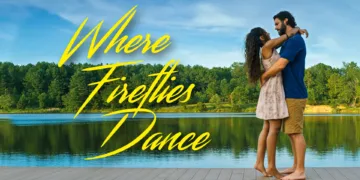
The encounters on the water express their renewed closeness more lightly. Sadie first finds Jack fishing alone on a dock; later, a boat outing ends with both of them in the lake. The progression from solitary occupation to shared indignity has an appealing physical logic. Falling into water together briefly removes the burden of presenting oneself as the person who has coped best since the breakup. They can be awkward together. That is a modest but credible form of intimacy, and the film benefits from letting it happen without demanding that it settle their history.
At roughly 70 minutes, the picture has little interest in making reconciliation an endurance event. Its early movement can nevertheless feel meandering. Sadie’s encounters with townspeople build a social environment around her, but the transitions do not always make those episodes feel cumulative. We move from one piece of local life to another when the developing relationship could use a stronger sense of consequence. Some of that wandering is productive: it gives Sadie room to exist before the romance takes over. Some of it leaves the narrative starting up again.
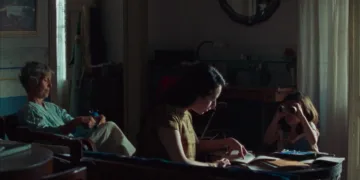
Ted Ramasola’s cinematography accommodates the film’s competing attractions to place and private feeling. Static wide compositions give the surroundings a presence beyond decorative scenery, while intimate close-ups allow Merritt’s performance greater weight. The contrast helps establish why Sadie might find something worth recovering here. Little Elm has room, familiarity, and people whose attention can feel sustaining even when it becomes intrusive. The camera makes that appeal accessible without requiring the town to become an enchanted refuge.
The country soundtrack is more insistent. It supplies an immediate regional and emotional vocabulary, but its romantic emphasis can overstate feelings that would benefit from less assistance. During the less convincing stretches of the central pairing, the music seems overly confident about our investment. Merritt can hold attention through Sadie’s unresolved feelings; the musical cues sometimes hurry us toward a simpler response. The issue is one of pressure. A film this committed to gentleness can afford to trust its quieter resources.
Its happy resolution is satisfying because Sadie’s return has become more than the recovery of an old attachment. Teaching, artistic desire, grief, and the capacity to encourage someone else remain parts of the woman who enters that relationship. Berry gives both lovers a future that permits individual growth, and that possibility matters more than the surprise of where the story lands. The town may recognize the couple it remembers. Sadie and Jack still need permission to become people their neighbors have yet to meet.
Where Fireflies Dance was released on digital HD and video-on-demand platforms by Freestyle Digital Media on August 7, 2026. Directed by Grayson Berry, the romantic dramedy follows an elementary school teacher who returns to her small hometown during summer vacation and is forced to confront unresolved feelings after running into her high school sweetheart.
Where to Watch Where Fireflies Dance (2026) Online





Full Credits
Title: Where Fireflies Dance
Distributor: Freestyle Digital Media
Release date: August 7, 2026
Rating: 13+
Running time: 1 hour 10 minutes (70 minutes)
Director: Grayson Berry
Writers: Grayson Berry
Producers and Executive Producers: Grayson Berry, Patty Parker Mathes, Frank McEachern, Brandi Price
Cast: Deke Anderson, Hanh Berry, Amber Burroughs, Kevin Crank, Katerina Damm, Billie D. Merritt, Colleen Mooney, Brandi Price
The Review
Where Fireflies Dance
Billie D. Merritt gives this modest romance its emotional credibility, making Sadie’s homecoming feel like an opportunity to grow. The town’s affection comes with assumptions, and Berry finds something worth examining in that mixture. Uneven chemistry, episodic pacing, and insistent music occasionally hurry the reconciliation. Still, the happy ending earns its warmth by leaving room for the lovers to become people their neighbors haven’t already figured out.
PROS
- Merritt’s warmth and convincing portrayal of grief.
- Community relationships complicate the comforting homecoming.
- Sadie retains ambitions and connections beyond romance.
- Framing balances local surroundings with emotional intimacy.
CONS
- Romantic chemistry is inconsistently persuasive.
- Episodic transitions weaken narrative momentum.
- Music sometimes overstates the romantic feeling.