




























Jim Lee offers Apollo pieces of a life Apollo cannot remember, including the deaths of the other astronauts on his mission. The offer comes with an obligation: Apollo must help explain what happened. In Orion, recovering a person’s memory and obtaining his testimony occupy the same conversation, conducted by the same reassuring NASA interrogator.
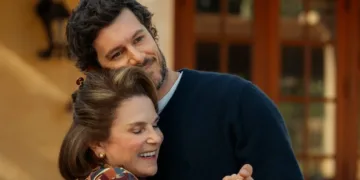
Andrew McCarthy gives Jim the manner of someone accustomed to making difficult procedures sound reasonable. Apollo, played by Drew Van Acker, has survived a catastrophic mission and returned with amnesia. Before he can assemble an account of himself, someone else is already supplying its terms.
Apollo complicates that arrangement by insisting he did not kill his crewmates. His certainty is peculiar in a man who cannot recall the mission itself. It prevents the interrogation from settling into a comfortable picture of institutional authority pressing down on an innocent, bewildered subject.
Van Acker lets confusion coexist with an alertness that makes Apollo difficult to read. Small movements of his eyes, pauses before speaking, and controlled breathing suggest a person assessing the exchange even as he struggles to understand his circumstances. Lost memory has made him dependent on Jim, but that dependence does not render everything he says transparent.
Director Jaco Bouwer and screenwriter Anne Vithayathil locate the pressure between these men in the ordinary business of conversation. Jim discloses, encourages, and steers. McCarthy’s affability acquires an unpleasant edge through the slight delay of a look or the movement of a hand toward his chin.
His delivery and physical behavior do not always offer the same reassurance. When Apollo’s emotional connection to Mary enters the questioning, private attachment becomes available for investigative use. The discomfort comes from the ease with which concern can accommodate an ulterior purpose. Jim does not need to abandon his helpful manner to make the exchange coercive.
Apollo’s work as a linguist provides another account of what communication might accomplish. He has developed a language without words, using an instrument to communicate through music and sound with an intelligent alien life form. The device, with its dark surfaces, tubing, and cavities containing a sand-like substance, is strange to the viewer but familiar to his hands. He knows how to interact with it while remaining unable to explain essential parts of his own history. That discrepancy gives the amnesia premise substance. Knowledge can survive as a practice even when the story a person tells about possessing it has disappeared.
The instrument also changes the stakes of Jim’s investigation. Contact with another intelligence brings competing intentions into view, including the desire to turn alien knowledge or technology toward weaponization. Communication becomes entangled with appropriation: establishing access can be the first step toward claiming use.
Yet the promise of a language beyond words should not be mistaken for proof of a language beyond manipulation. Sound offers Apollo another means of exchange; the ethical question remains attached to what people want from the exchange. The film’s institutional setting gives that question an immediate shape, with discovery subjected to the demands of an interrogation.
Bouwer’s visual choices make the audience’s access similarly conditional. Cinematographer David Kruta brings the camera close enough to Apollo’s eye and face to expose reactions that a wider shot might conceal. Such scrutiny gives him little visible privacy, while leaving the viewer without a secure grasp of his surroundings.

During his awakening, darkness, isolated surfaces, and the measured intercom voice fragment the available evidence. The institution can inspect Apollo; the audience can inspect his expression. Neither activity automatically produces understanding. The close-ups make his body available for interpretation while his experience remains difficult to reconstruct.
That restriction takes a different emotional form when Debby Ryan’s Mary appears beyond glass against a black background. She is visible, but the image provides almost nothing through which to place her. Glass permits sight while preserving separation, an apt arrangement for a person whose emotional importance can be acknowledged without becoming accessible.
Ryan’s presence brings attachment into an environment organized around questioning. The warmer light and skin tones of Apollo’s recollections offer a different kind of proximity, though their warmth cannot authenticate them. A memory may feel inhabitable and still be an uncertain account of what occurred.
Sound gives the film a means of approaching uncertainty without making every sensation a warning. Pierre-Henri Wicomb’s restrained score leaves space for mechanical tones, vibrations, breathing, and silence. These sounds demand attention without consistently telling the audience how to feel about them.
Silence allows a pause between the men to retain its ambiguity: a delay may belong to confusion, calculation, or the effort to remember. This is a productive formal choice for a story concerned with communication beyond speech. Listening becomes an activity that requires patience, rather than a route to an answer already secured by dialogue.
The late expansion into more explicit science-fiction imagery changes the scale of the encounter, and the reversals give earlier behavior new significance. Apollo’s familiarity with the device and the evasions surrounding Jim’s questions provide material that can bear such reconsideration.
The film has planted discrepancies within the conversation, so retrospective clarification has something concrete to work upon. Its visual effects need not invalidate the intimacy that precedes them. The greater pressure comes from the screenplay’s timing, which reserves some of its richest material until the concealed circumstances can finally be discussed.
The middle exchanges are strongest because Apollo and Jim can begin arguing over purposes, rather than circling information they cannot yet disclose. Their rapport remains tense, but the tension acquires a subject: what contact means and what either man wants to obtain from it.
The earlier delay sometimes limits that debate. Apollo’s unexplained certainty and practical knowledge justify suspicion; repeated evasion cannot keep deepening suspicion indefinitely. Time spent protecting the puzzle is time unavailable to develop the competing claims on the discovery. Once the conversation reaches those claims, the confinement becomes especially productive, forcing a disagreement about another intelligence to pass through the human habits of pressure, selective disclosure, and possession.
Orion arrived in select U.S. theaters on October 2, 2026. The psychological sci-fi thriller follows an amnesiac astronaut and an investigator racing to uncover what killed a doomed space crew before a hidden threat reaches Earth.
Full Credits
Title: Orion
Distributor: Blue Harbor Entertainment
Release date: October 2, 2026 (United States)
Running time: 1 hour 36 minutes (96 minutes)
Director: Jaco Bouwer
Writers: Anne Vithayathil
Producers and Executive Producers: Elle Army, Scott Army, Sunil Perkash, Drew Van Acker
Cast: Debby Ryan, Andrew McCarthy, Drew Van Acker, Theodora Miranne, Sandra Brown, Daniel Bisla, Karin Ann, Natalia Lesz
Director of Photography (Cinematographer): David Kruta
Editors: Ian Holden
Composer: Pierre-Henri Wicomb
The Review
Orion
Orion makes first contact answerable to an unsettling human habit: treating understanding as something to extract. McCarthy’s reassuring pressure and Van Acker’s guarded uncertainty give that argument dramatic force, while close framing and restrained sound keep observation from becoming certainty. The screenplay spends too long protecting its puzzle, limiting the development of its richest ethical dispute. Its strongest exchanges make the interrogation room a persuasive setting for examining humanity’s claims on another intelligence.
PROS
- McCarthy and Van Acker sustain a tense, ambiguous rapport.
- Sound-based communication gives Apollo’s linguistic work concrete substance.
- Close framing and restrained sound support the uncertainty.
- Institutional pressure sharpens the ethics of first contact.
CONS
- Prolonged early concealment delays the central ethical debate and limits its development.