




















The timer reaches zero while your anti-tank gun is still turning. Infantry are repairing the bunker beside it, another enemy squad is crossing the road, and the artillery strike you wasted thirty seconds ago is still on cooldown. Company of Heroes 3: Final Stand is at its best in these tiny disasters, where a defensive plan survives because three units manage to do their jobs at exactly the right moment.
Relic Entertainment has stripped Company of Heroes 3 down to a wave-survival format. Pick US Forces, British Forces, Deutsches Afrikakorps, or Wehrmacht, choose one of five maps and an enemy faction, then protect your headquarters through twelve escalating assaults. Territory capture and elaborate base construction are gone. Cover, unit counters, positioning, and battlefield improvisation remain. It is a smart reduction of Company of Heroes. The problem is how little Final Stand builds around it.
When the Line Starts to Bend
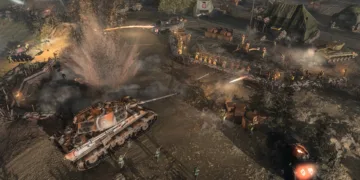
Early waves give you room to settle in. Infantry push toward predictable approaches while engineers lay mines, construct defensive positions, and repair whatever gets damaged. Later rounds change the temperature quickly. Mortars begin punishing static formations, armor rolls toward chokepoints, and stronger boss units force anti-tank weapons into positions where one bad flank can collapse an entire sector.
That escalation creates Final Stand’s strongest feeling: panic with enough information to remain tactical. Attack directions are telegraphed, so failure rarely comes from having no warning. It comes from knowing what is approaching and realizing your defenses are wrong anyway.
Resources arrive steadily rather than being generated through captured territory, and supplies can drop onto the battlefield. Every wave then offers randomized choices that can unlock units, passive improvements, or support abilities. One run may give you snipers and stronger infantry before opening access to armor. Another can hand you artillery, air support, healing bonuses, or defensive upgrades.
Those choices create tension because they decide what kind of army you are capable of fielding. They can create frustration for the same reason. Facing later armor without receiving strong anti-tank options feels less like adapting to adversity and closer to being denied the tools your tactical knowledge says you need. Company of Heroes has always made counters matter. Final Stand occasionally lets randomness interfere with the satisfaction of applying that knowledge.
Also Read





A Familiar Battlefield Under New Pressure
Removing territory capture puts extra attention on micro-management, and the existing Company of Heroes 3 combat holds up beautifully under that pressure. Anti-tank crews need infantry protecting their flanks. Armor has to be positioned where it can support rather than become an expensive wreck. Engineers remain invaluable because repairing a battered defensive position between waves can decide the next fight before it starts.

Support abilities create some of the best saves. An artillery strike breaking up infantry before they reach a bunker can turn a collapsing front into a manageable fight. Calling an airstrike too early can leave you helpless when the heavier wave follows. The cooldown becomes emotional punctuation: relief when an ability returns, dread when you realize it will not.
The battlefield sells these moments. Tank tracks scar the terrain, artillery leaves craters, damaged buildings crumble, and destroyed vehicles remain where they died. Infantry shout through explosions while tanks rumble into firing positions. By wave ten or eleven, a clean defensive map can look like a record of every mistake you survived. That physical deterioration makes a successful defense feel earned. You remember where the first bunker fell because its ruins are still sitting there.
Too Little Around the Fighting
Relic gives the mode several reasons to repeat runs. Four factions have permanent perk progression, higher difficulties unlock for players willing to keep pushing, medals provide targets to chase, and Endless Mode allows a successful twelve-wave defense to continue until the line finally breaks.

The progression rarely changes your relationship with the battlefield enough. Many perks improve familiar values such as unit health, production speed, resource generation, firing performance, or defensive strength. Different factions have their own trees, yet too many upgrades feel like variations on the same arithmetic rather than invitations to discover a radically different style.
Five maps have useful tactical distinctions through roads, buildings, chokepoints, hills, and defensive positions, but their shared structure becomes recognizable quickly. Boss units suffer from a similar problem. Their extra durability raises the threat without producing encounters that demand fresh thinking.
Co-op should help. Splitting responsibilities with another player can turn a frantic defense into something wonderfully collaborative, especially when one force reinforces a sector seconds before it collapses. Yet limited communication and awkward public-room functionality make finding that experience harder than necessary. A survival game built around two-player cooperation badly needs a smoother way to connect strangers.
The strange part is that the individual battles can still stick with you. You remember the tank that broke through your mines, the artillery strike that saved an exposed headquarters, or the infantry squad that somehow survived while everything beside it burned. Final Stand keeps generating those little battlefield stories because Company of Heroes 3 already knows how to make units feel valuable. There simply are not enough new ways to tell them.
The Review
Company of Heroes 3: Final Stand
Company of Heroes 3: Final Stand understands the pleasure of seeing a defensive line bend without quite breaking. Mines detonate, anti-tank crews scramble into position, artillery buys another precious few seconds, and twelve waves can disappear surprisingly quickly. The trouble comes between those moments. Random upgrade choices can undermine smart planning, faction progression rarely changes the rhythm enough, and limited matchmaking makes co-op harder to enjoy than it should be. Relic preserved the feeling that makes Company of Heroes combat special. It simply built too small a home for it.
PROS
- Excellent tactical combat
- Tense late-wave defenses
- Satisfying battlefield destruction
- Flexible randomized upgrades
- Fun two-player coordination
CONS
- Thin map selection
- Essential counters rely on RNG
- Similar faction progression
- Poor co-op matchmaking options
- Weak value for the asking price