





























Gambling in video games offers something the real casino never can: consequence without financial ruin. CloverPit, from developer Panik Arcade, understands this appeal and twists it into something darker. You’re trapped in a decrepit prison cell with a slot machine, an ATM displaying your debt, and a grate beneath your feet that will open if you fail to pay. The setup is grimly efficient. Three rounds to meet an escalating payment, or you fall to your death. There’s no elaborate tutorial, no reassuring hand-holding. The game simply tells you to start spinning.
What makes CloverPit compelling is how it balances mechanical simplicity with strategic complexity. The slot machine itself requires no prior knowledge to understand, which gives it an accessibility that card-based roguelikes often lack. You don’t need to know poker hands or deck-building theory to grasp the basics here. This directness serves the game’s horror atmosphere well.
The prison cell setting, complete with bloodstains and industrial decay, contrasts sharply with the bright, pulsing slot machine. You’re not here to have fun; you’re here to survive. Yet the game becomes genuinely addictive once you start understanding how its systems interlock, transforming what seems like pure chance into something you can manipulate and control.
The Mechanical Foundation
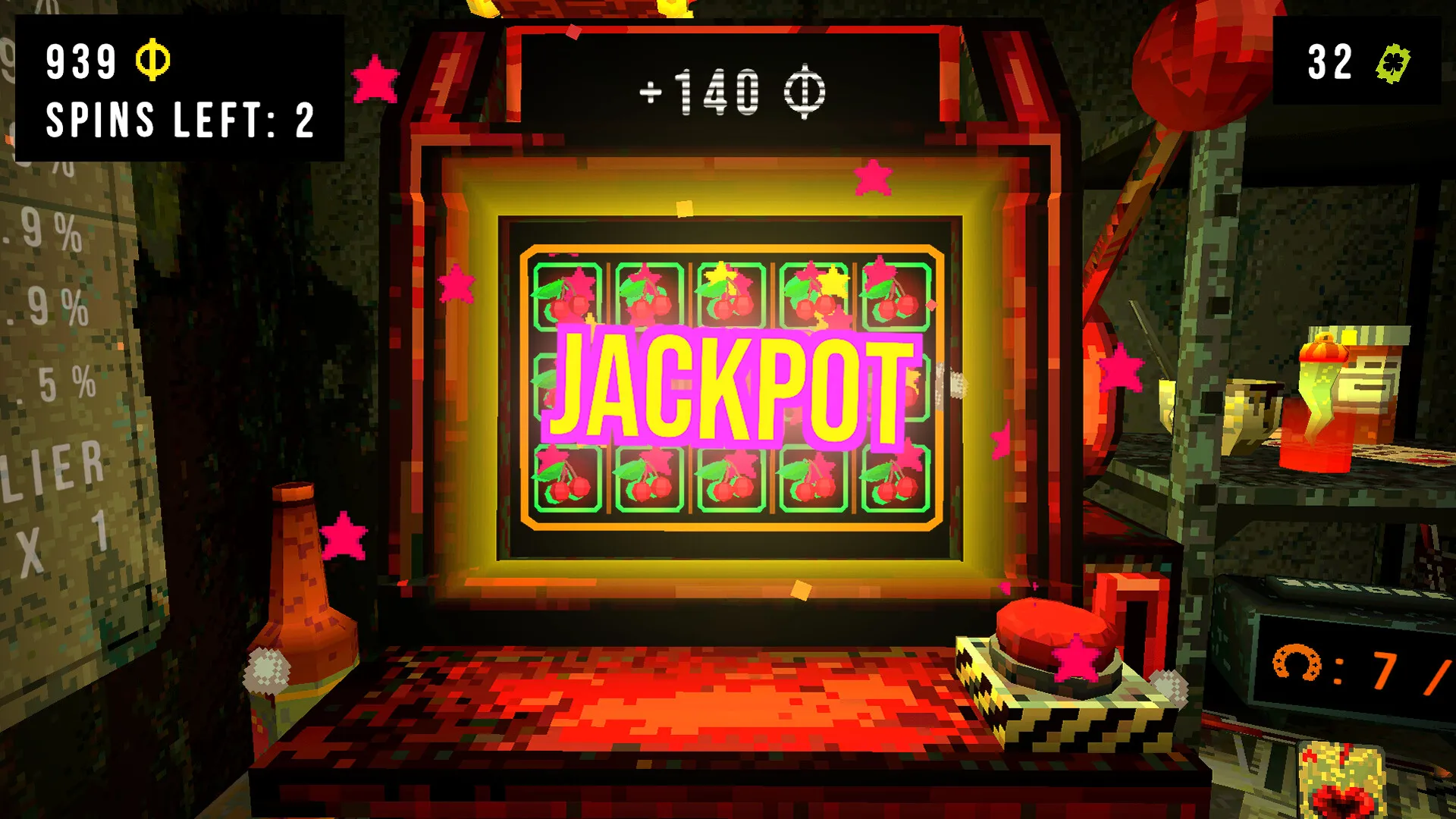
The slot machine presents a grid of five reels and three rows, creating fifteen symbol positions each spin. The scoring system starts straightforward: match three symbols in a row to earn coins, with longer lines paying better. Beyond simple horizontal matches, the game recognizes diagonal patterns and other configurations that increase your payout. Fill all fifteen positions with the same symbol and you hit the jackpot. You receive seven spins per round by default, though certain charms can modify this number.
The ATM beside the machine serves a dual purpose. You can deposit coins between spins to earn interest, creating a passive income stream that grows each round. This mechanic introduces immediate strategic tension: do you bank your winnings early to build interest, or hold onto liquid cash in case you need it later? The game rewards forward planning. Depositing enough coins to instantly clear your next debt target grants you Memory Card packs, limited-use modifiers that can dramatically alter future runs.
Each debt cycle consists of three rounds. You’ll start with modest targets around 75 coins, but successful runs push these requirements into the thousands, then hundreds of thousands, eventually reaching millions. The game makes no apologies for this escalation. Fail to meet your deadline and the floor opens beneath you. The run ends.
Also Read





You can pay your debt early for a small bonus, which adds another layer of decision-making. Sometimes banking everything immediately makes sense, especially if you’ve unlocked interest-boosting charms. Other times, pushing your luck while you have a cushion of safety can lead to better long-term positioning. The system feels purposefully designed to encourage risky behavior. You’re never quite safe, even when you’re ahead.
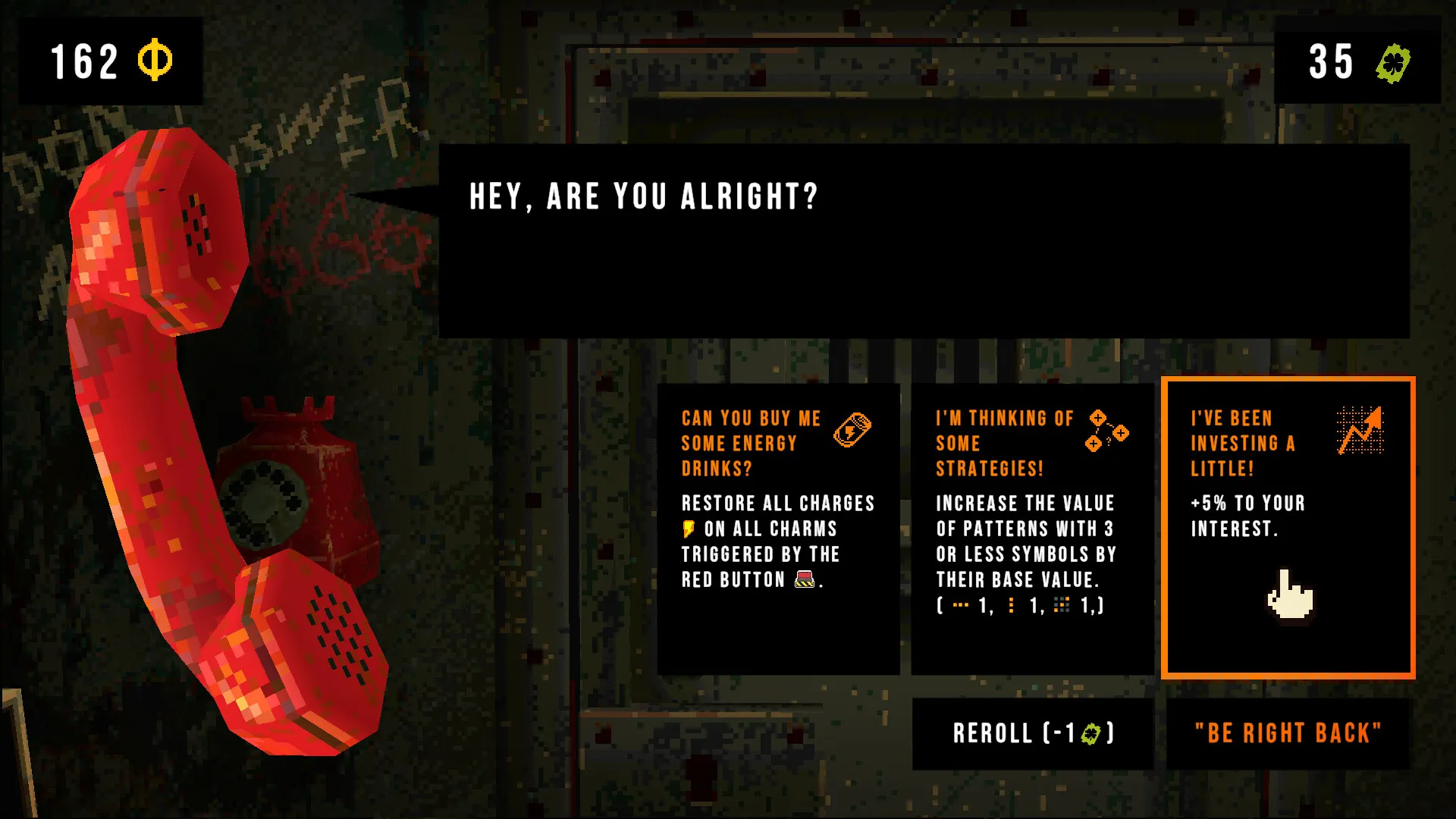
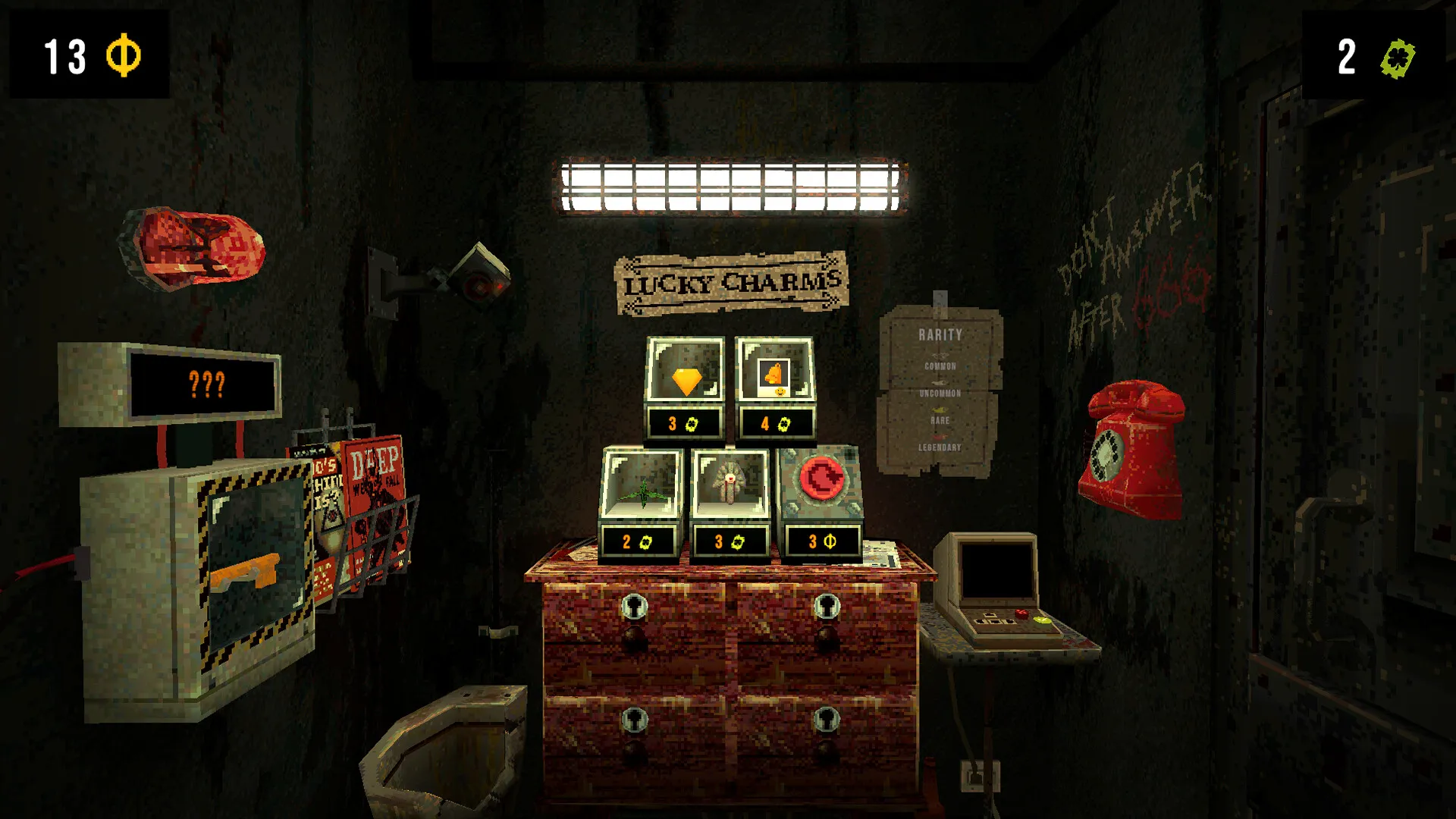
Between rounds, you receive tickets to purchase charms from vending machines scattered around your cell. A mysterious voice also calls your phone, offering optional modifications to your run. These calls present orange and red options that alter symbol spawn rates, adjust payout values, or apply modifiers to your existing charms. Some charms specifically track how many phone deals you’ve accepted or rejected, creating another consideration when deciding whether to take the stranger’s offer.
As runs progress, the game introduces detrimental patterns like Pattern 666, which wipes your accumulated winnings if it appears on the reels. These punishments arrive without warning and force you to adapt. A strategy that carried you through the first few debt cycles won’t sustain you indefinitely. The game demands constant evolution.
The Charm Economy and Synergy Crafting
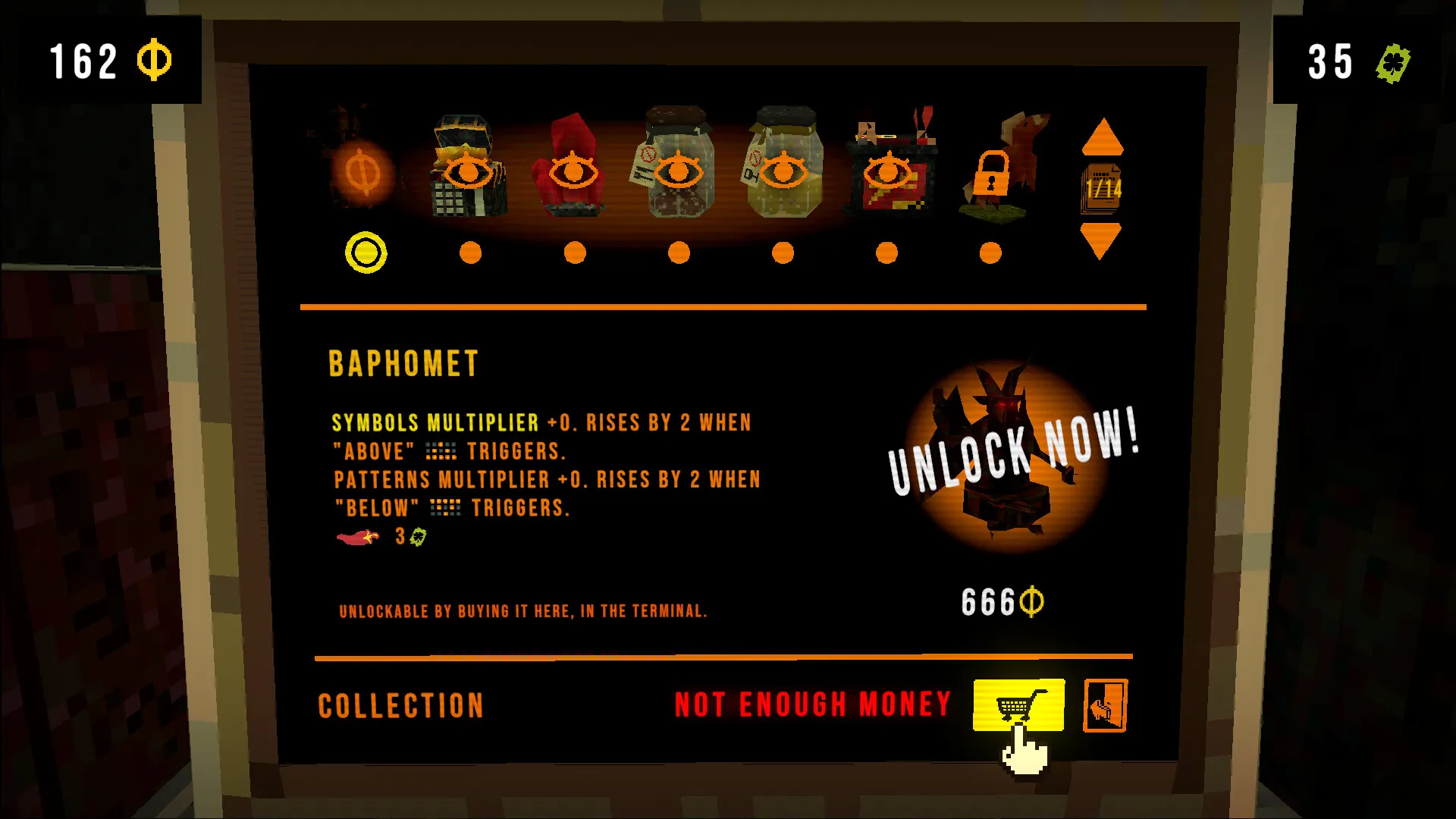
CloverPit features over 150 charms, each offering different effects on the slot machine’s behavior. You unlock them through various means: some appear simply by playing, others require specific synergies to trigger, and a few hide in your cell’s environment. The game features genuine humor in its unlock conditions. Using the broken toilet in the corner unlocks two separate charms, one for each bodily function. These aren’t throwaway jokes either; the charms themselves prove mechanically useful.
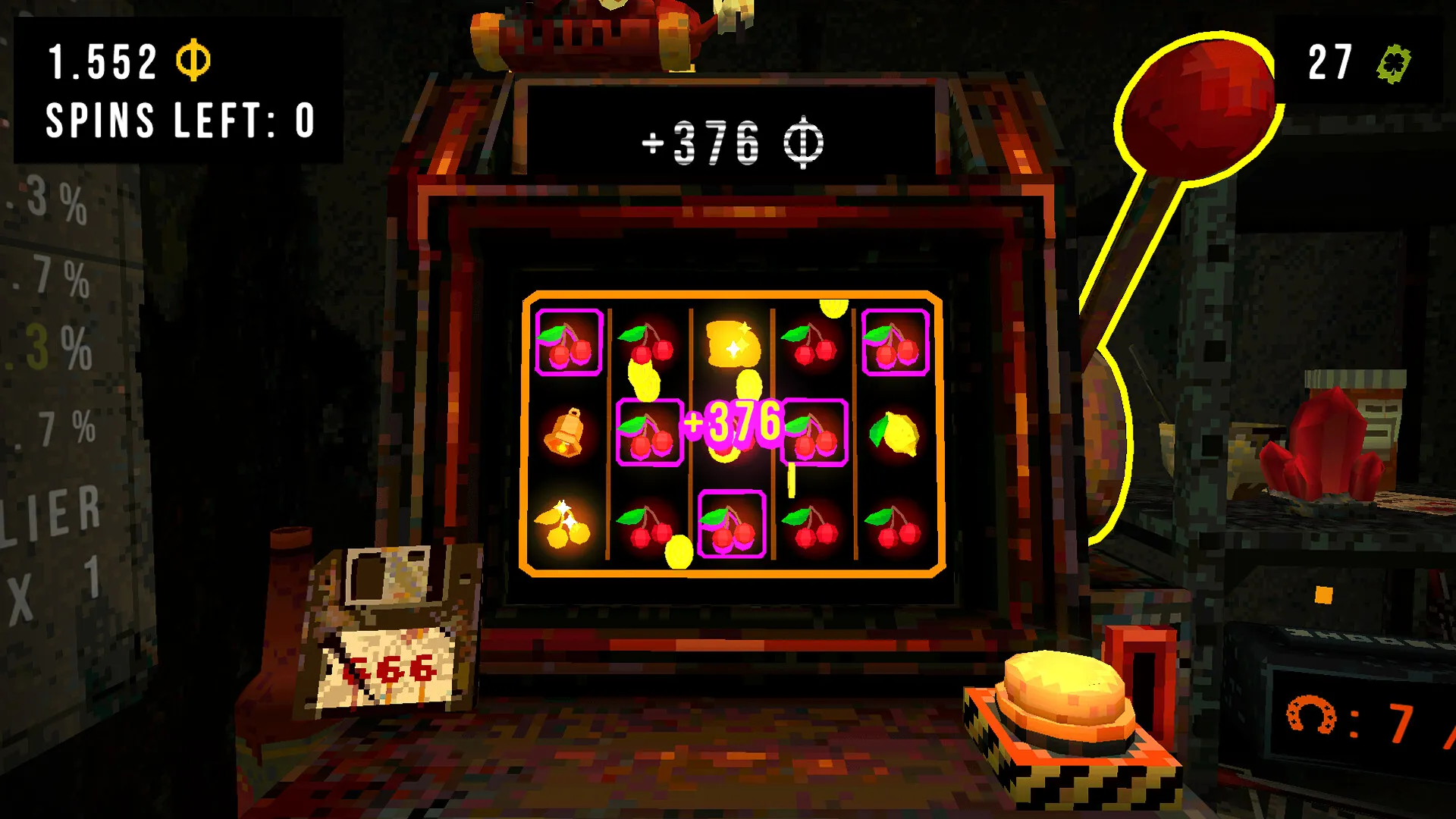
The variety spans from straightforward to bizarre. Lucky Cat grants bonus coins equal to your banked interest when you trigger three or more patterns in a single spin. Grandma’s Wallet adds 15% interest that decreases by 3% each round, encouraging you to deposit early and often. A Bible protects you from cursed numbers. A jar of urine multiplies winnings on yellow symbols. The descriptions can be dense with percentages and specific conditions, which creates initial confusion but rewards careful study.
Charms divide into passive and active categories. Passive charms work automatically once purchased. Active charms require manual triggering via a red button on the machine, adding a timing element to your decision-making. Knowing when to activate effects becomes crucial as you build more complex strategies.
The game explicitly tells you to seek interactions between charms or die. This directive isn’t hyperbole. Early runs feel brutally random, with low payouts and debt counters that climb faster than you can earn. Your first few attempts will likely end in failure, tumbling through the grate because the machine simply didn’t give you the symbols you needed.
Then you start noticing patterns. Lucky Cat synergizes beautifully with Grandma’s Wallet because the interest boost directly increases the Cat’s payout. Certain charms manipulate your luck stat, and pushing this stat above specific thresholds guarantees jackpots. You can combine symbol frequency modifications from phone deals with pattern-focused charms to create reliable scoring engines. Some builds focus entirely on interest accumulation, treating the slot machine almost as a side activity while your banked coins multiply. Others eliminate low-value symbols from the reels, ensuring even modest wins pay handsomely.
The transformation from luck-dependent gambling to systematic optimization is where CloverPit reveals its depth. You begin to see the slot machine as a puzzle with multiple solutions rather than a random number generator. The satisfaction when a carefully constructed build clicks into place and sends your coin total soaring rivals any roguelike I’ve played. Watching a chain of synergies trigger in sequence, each feeding into the next, delivers the precise dopamine hit the game’s thematic framework criticizes you for chasing.
The mysterious caller between rounds represents another psychological element. The voice offers deals that seem beneficial in isolation but require context to evaluate properly. Increasing the spawn rate of a particular symbol helps if you have charms that reward that symbol. The same modification becomes a liability if you’ve built around different icons.
Some charms specifically care about your phone interaction history. This creates metagame considerations. Do you accept a deal that helps immediately but might lock you out of a powerful charm later? The phone system exemplifies how CloverPit layers strategic decisions. Nothing exists in isolation. Every choice ripples forward.
Persistence Without Permanence
CloverPit takes a hard stance on meta-progression: there isn’t any. Each run begins fresh. The tickets you earn buy charms only for that attempt. When you die, everything resets. This design choice reinforces the oppressive atmosphere. You’re not building toward eventual freedom through accumulated power. You’re surviving moment to moment, run by run.
What persists is knowledge. Unlocking a charm adds it permanently to the pool of possibilities. You’ll see it in future vending machines, though you can’t predict when. The computer terminal in your cell displays all charms, their unlock requirements, and their effects. This information becomes invaluable as you learn which combinations work well together. The game respects your time enough to provide this reference, even as it refuses to give you mechanical shortcuts.
The frequency of unlocks maintains engagement through the brutal early hours. You’ll fail often at first, but nearly every run adds new charms to the pool. This steady drip of content keeps you returning despite setbacks. There’s always something new to try, a different combination to test.
After reaching certain milestones, the ATM begins offering Memory Card packs when you can instantly clear a debt without spinning. These cards modify fundamental rules for a single run. One might limit you to a single round per debt cycle but grant 21 spins instead of the usual seven. Another provides a fixed pool of tickets upfront while preventing any additional ticket gains throughout the run.
Memory Cards introduce genuine excitement and genuine risk. Getting a powerful card combination can enable runs that would otherwise be impossible. Wasting cards on a run that dies quickly to bad luck feels terrible, especially if you’ve been saving them. The system creates its own gambling layer outside the slot machine itself. Do you burn your cards trying for a breakthrough, or save them hoping for a better opportunity?
Progression also unlocks drawers where you can store charms during a run. I initially expected this to function as a bank, preserving powerful items for my next attempt. The reality is far more unsettling. Stored items transform. A charm becomes a severed human hand. Retrieving it increases all your debt targets by a percentage.
This twist adds narrative weight to a mechanical system. The cell isn’t a neutral space. Something watches and manipulates what happens here. The drawers serve as risk-reward calculations wrapped in horror imagery. Sometimes accepting a 10% debt increase is worth it if the charm enables a strong synergy. Sometimes it’s suicidal.
CloverPit doesn’t hide that it has an ending. The game continues pushing debt requirements higher long after you’ve met initial goals, clearly driving you toward something. I won’t spoil the specifics, but the structure differs from some roguelikes that offer infinite scaling. There’s a finish line here for players who want it.
The game also accommodates casual engagement. You can treat each run as a self-contained experience, seeing how far you get before the machine crushes you. The flexibility to play at your own pace, either chasing completion or just enjoying the act of spinning, demonstrates confident design. CloverPit knows its core loop is strong enough to support both approaches.
Atmosphere as Argument
CloverPit commits fully to its horror aesthetic. The prison cell uses low-poly models with pixelated textures, creating a deliberately grimy environment. Rust covers metal surfaces. Bloodstains mark the walls. The broken toilet sits in the corner, a reminder of your degrading circumstances. Flickering lights cast unstable shadows. Every visual element reinforces claustrophobia and decay.
The slot machine itself becomes a grotesque centerpiece, pulsing with unnatural energy against the dark surroundings. Its bright, colorful lights should feel inviting. Instead, they emphasize how wrong this situation is. You’re trapped in a cell with what appears to be a demonic object, forced to engage with it for survival.
As you purchase charms, they manifest physically in the space. Vending machines appear. Objects accumulate on surfaces. The cell gradually transforms into a shrine of desperation, every item a monument to your attempts at survival. This visual progression mirrors your psychological state. You’re not escaping; you’re decorating your prison.
CloverPit eschews background music entirely. What you hear are environmental sounds: the mechanical clunk and whir of the slot machine, dripping water from unseen pipes, distant groans that might be structural or might be something worse, and the constant hum of a giant industrial fan. You can adjust the fan’s volume separately from other effects, a curious touch that acknowledges how maddening that persistent drone becomes.
The slot machine announces itself with “Let’s go gambling!” before your first spin, a cheerful voice line that feels increasingly sinister as runs progress. When Pattern 666 appears, stealing your accumulated winnings, the machine emits a distinct error buzz that sends a spike of anxiety through you. Other failures trigger distorted audio cues that make losing feel personally directed at you.
The absence of music lets these details dominate. Long periods of relative silence punctuated by mechanical noise and ominous ambiance create psychological pressure. The soundscape never lets you forget where you are or what’s at stake.
CloverPit tells its story through atmosphere and environmental details rather than exposition. Your unseen host speaks politely, offering helpful information about the rules, while remaining completely indifferent to your survival. The mysterious phone caller presents deals without explaining who they are or why they’re helping. The cell contains hints about previous occupants and what might have happened to them.
This restraint works effectively. The game doesn’t need to explain its metaphor about gambling addiction and psychological manipulation; the mechanics themselves make the argument. You’re trapped in a cycle of risk and reward, chasing the high of a massive payout, accepting increasingly dangerous modifications to your circumstances because you believe you can beat the system. The horror isn’t supernatural; it’s behavioral.
Dark humor provides occasional relief without undermining the tone. The toilet achievements and absurd charm descriptions acknowledge the game’s self-awareness. CloverPit knows it’s trapping you in a compulsion loop and isn’t shy about pointing this out. The game wants you to recognize what it’s doing to you even as you continue playing.
Where the Machine Breaks Down
CloverPit’s biggest weakness is its initial inaccessibility. The game provides minimal explanation of its mechanics, leaving you to puzzle out crucial systems through trial and error. Terms like “chain ranking” appear in charm descriptions without definition. Pattern recognition matters enormously for certain builds, but the game never clearly explains which patterns exist or how they’re scored.
This lack of clarity means you’ll ignore powerful charms early on simply because you don’t understand what they do. I spent several runs dismissing items that would have dramatically improved my success rate because their descriptions referenced mechanics I hadn’t grasped yet. A short tutorial or better in-game documentation would smooth this learning curve without compromising the game’s mysterious atmosphere.
The density of charm descriptions compounds the problem. Many effects are percentage-based with multiple conditional triggers. Reading through these while trying to make quick purchasing decisions between rounds creates cognitive overload. You either slow down significantly to parse everything, disrupting the game’s pace, or make uninformed choices and learn through expensive failure.
Early runs can feel genuinely unwinnable. You’ll spin the reels seven times and receive payouts so low that meeting even the initial 75-coin debt becomes impossible. The randomness that makes successful runs exciting becomes punishing when it stacks against you repeatedly. Consecutive bad runs create frustration that tests your patience before you’ve developed the understanding needed to mitigate poor luck.
Some configurations appear fundamentally broken from the start. Getting poor charm offerings combined with unhelpful phone deals can doom a run before you’ve had a chance to build any synergy. This becomes especially painful after you’ve unlocked Memory Cards. Wasting limited-use modifiers on a run that was dead on arrival feels terrible, and the game offers no way to recognize this early enough to cut your losses.
The RNG nature means you’ll experience streaks of failure that make progress feel impossible. You’re waiting for that one good run where the pieces align, but there’s no guarantee when that will happen. For players who value consistent progression, this variance might prove intolerable.
The counterpoint is that CloverPit fundamentally changes as you learn its systems. What initially seems like impenetrable randomness reveals itself as a puzzle with optimal solutions. You start recognizing which charms enable which strategies. You learn to evaluate phone deals in context rather than isolation. You understand when to take risks and when to play conservatively.
Bad runs become learning experiences. You notice patterns in how symbols appear. You discover new synergies. You develop intuition about which builds can scale to higher debt requirements and which will stall out. This knowledge accumulation transforms your relationship with the game’s randomness. You can’t eliminate variance entirely, but you can dramatically improve your odds through informed decision-making.
The reward for persistence is substantial. When you finally assemble a broken combination that sends your coin total into the millions, clearing debts that seemed impossible hours earlier, the satisfaction validates every failed attempt that came before. CloverPit earns its victories through your growing mastery of its systems rather than handing them to you through accumulated meta-progression.
The Addiction Loop Perfected
CloverPit succeeds at what it sets out to do, which is both impressive and slightly disturbing. The game creates a compulsion loop so effective that putting it down requires active effort. “Just one more run” becomes a mantra as you convince yourself the next attempt will be the one where everything clicks.
This works because the core experience satisfies on multiple levels. The immediate gratification of watching numbers increase provides constant small rewards. The deeper satisfaction of discovering powerful synergies keeps you engaged long-term. The atmospheric horror adds tension that makes success feel meaningful rather than routine. The game balances being approachable enough for casual sessions while offering sufficient depth for optimization-focused play.
The lack of traditional meta-progression actually strengthens the addiction. Because each run stands alone, there’s no sense of “wasting” a session. You’re not grinding toward some distant upgrade that will eventually make the game easier. You’re testing strategies and refining knowledge, both of which carry forward implicitly. This pure roguelike structure respects your time while keeping you engaged through intrinsic motivation rather than extrinsic reward schedules.
For roguelike enthusiasts and players who enjoy build crafting, CloverPit offers exactly what it promises: a gambling game that becomes a strategy game once you understand it. The horror atmosphere provides more than aesthetic flavor; it comments on the systems you’re engaging with. The game is mechanically sound and thematically coherent in ways many indie projects struggle to achieve.
The initial learning curve represents a genuine barrier. Players seeking immediate gratification or clear explanations will bounce off hard. Those frustrated by RNG variance might never reach the point where they can effectively manage it. CloverPit demands patience and accepts that some players won’t give it the time needed to reveal its depth.
For those who push through, the game offers dozens of hours of compelling gameplay. The charm catalog is large enough that you’ll keep discovering new combinations well past your first victory. The flexibility to engage casually or seriously makes it easy to return to repeatedly. The price point delivers substantial value for the content provided.
CloverPit understands that gambling appeals not because of the money, but because of the psychology. The anticipation of the spin, the dopamine hit of a big win, the compulsion to chase losses with one more attempt. The game replicates these patterns while removing real-world financial stakes, then wraps them in a horror aesthetic that acknowledges exactly what it’s doing to you.
You’ll keep pulling the lever anyway. The first step is admitting you have a problem. The second step is loading up another run because maybe this time you’ll finally hit that perfect synergy that takes you past 5 million coins. The house always wins, but sometimes you take it for everything it’s worth before you fall through the floor.
The Review
CloverPit
CloverPit transforms simple slot machine mechanics into a strategically rich roguelike that respects player intelligence. The horror aesthetic and gambling addiction metaphor work in tandem with deep synergy systems, creating something genuinely compelling. The steep learning curve and brutal early RNG will turn away impatient players, but those who persist discover a masterfully designed compulsion loop. It's accessible enough for casual sessions yet deep enough for serious optimization. A must-play for roguelike fans willing to endure initial frustration for long-term satisfaction.
PROS
- Deep synergy system hidden beneath simple mechanics
- Excellent atmospheric horror presentation
- Over 150 charms provide massive build variety
- No meta-progression creates pure roguelike experience
- Frequent unlocks maintain engagement
- Flexible play styles (casual or optimization-focused)
- Strong thematic cohesion between mechanics and narrative
- Addictive core loop with substantial replay value
CONS
- Steep learning curve with minimal tutorials
- Dense charm descriptions with unexplained terminology
- Early runs feel brutally RNG-dependent
- Some seeds appear fundamentally unwinnable
- Wasting Memory Cards on bad runs creates frustration
- Could benefit from better mechanical explanations