




















The ugliest thing beneath Devil’s Island may be the creature, but it is hardly the first force prepared to consume the men working there. Mathieu Turi places The Deep Dark in 1956, when Moroccan newcomer Amir (Amir El Kacem) leaves home for a mining job in northern France and discovers that opportunity comes packaged with its own hierarchy. Some workers resent him for arriving from Morocco while conveniently forgetting how many of their own families arrived from elsewhere. The mine has already taught everyone which histories count.
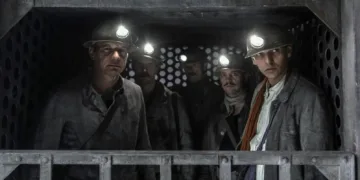
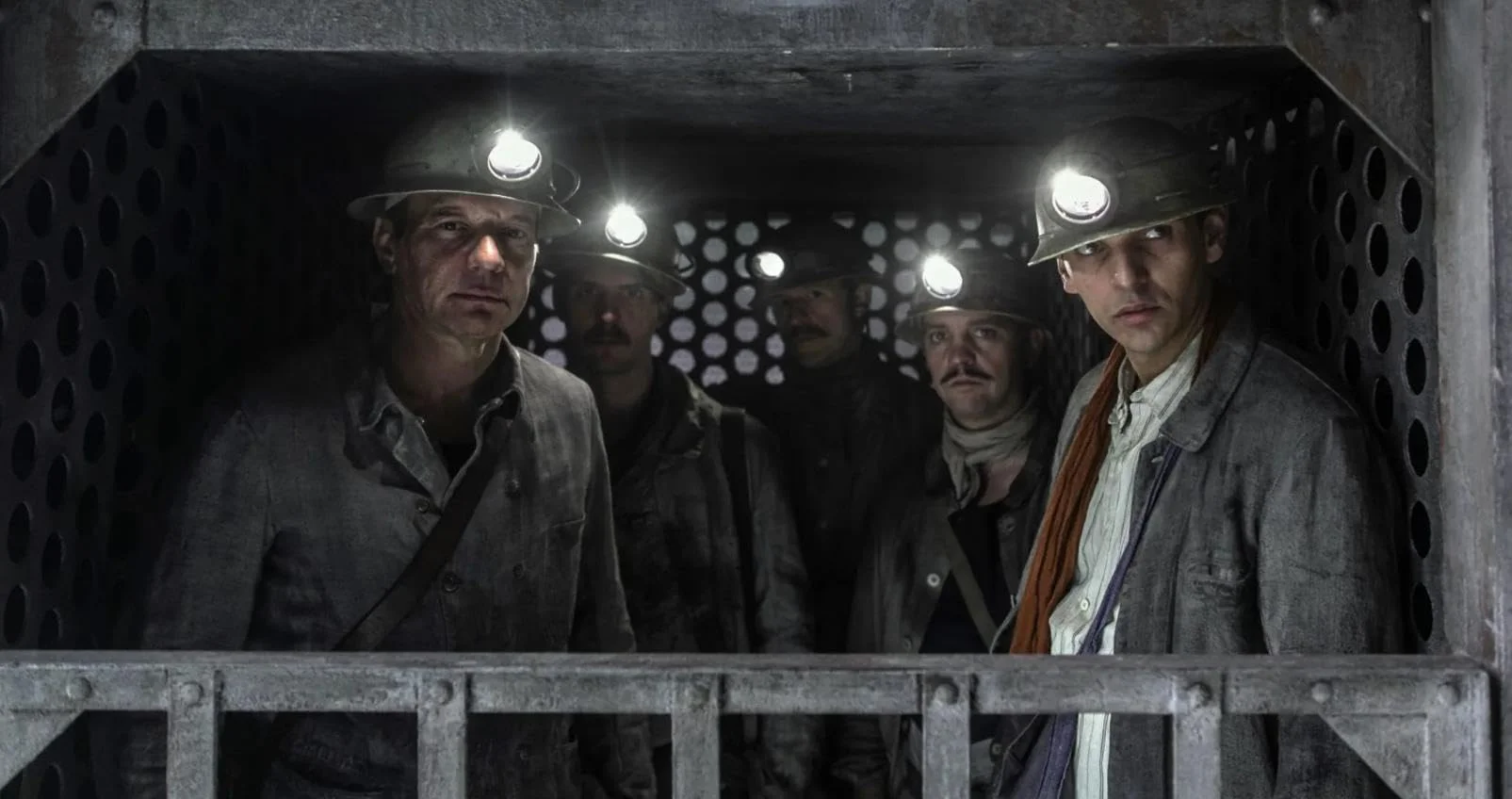
Amir lands on Roland’s crew, led with weary authority by Samuel Le Bihan. Their routine is interrupted by Professor Berthier (Jean-Hugues Anglade), who has paid for access to a section roughly 1,000 metres underground. Safety objections carry little weight once money enters the conversation. Roland’s men escort Berthier into unexplored tunnels, discover evidence of an ancient civilization, and soon lose their route back after a collapse. Then something buried there begins moving.
Labor Before Horror
Turi understands mining well enough to make the job frightening before introducing anything supernatural. An early sequence involving a dead canary and a dangerous gas pocket establishes how narrow the margin for error already is. Roland’s authority comes from knowing when to stop, where to blast, and which warning signs cannot be ignored. Berthier treats that expertise as an inconvenience whenever it delays his archaeological mission.
That conflict gives the film its sharpest social dimension. Berthier depends entirely on workers whose lives he is prepared to risk. His wealthy patrons remain absent, insulated from the danger their money has purchased access to. The arrangement resembles a miniature colonial machine: knowledge and artifacts flow upward while risk remains with the people doing the physical work.
Amir occupies an especially revealing position inside it. His French fluency and education initially distinguish him from the assumptions made by several colleagues, then become practical assets once inscriptions and artifacts appear. El Kacem plays those shifts without turning Amir into a symbolic saint. Watch how cautiously he listens when Berthier explains the writing around the crypt. Amir is learning, yet he is also measuring the man teaching him.
Louis (Thomas Solivérès) and Polo (Marc Riso) complicate the class argument when they steal artifacts hoping to sell them. Their choice helps awaken the entity, but Turi makes their greed materially different from Berthier’s. They want an escape from economic precarity. Berthier already possesses privilege and spends other people’s safety to satisfy it.
Also Read





What the Darkness Hides
Cinematographer Alain Duplantier gives the mine a geography instead of reducing it to anonymous black corridors. Industrial tunnels, chambers, carved brickwork and older passages remain distinct enough that splitting the survivors into different routes creates tension rather than confusion. The setting gradually changes from workplace to archaeological intrusion.
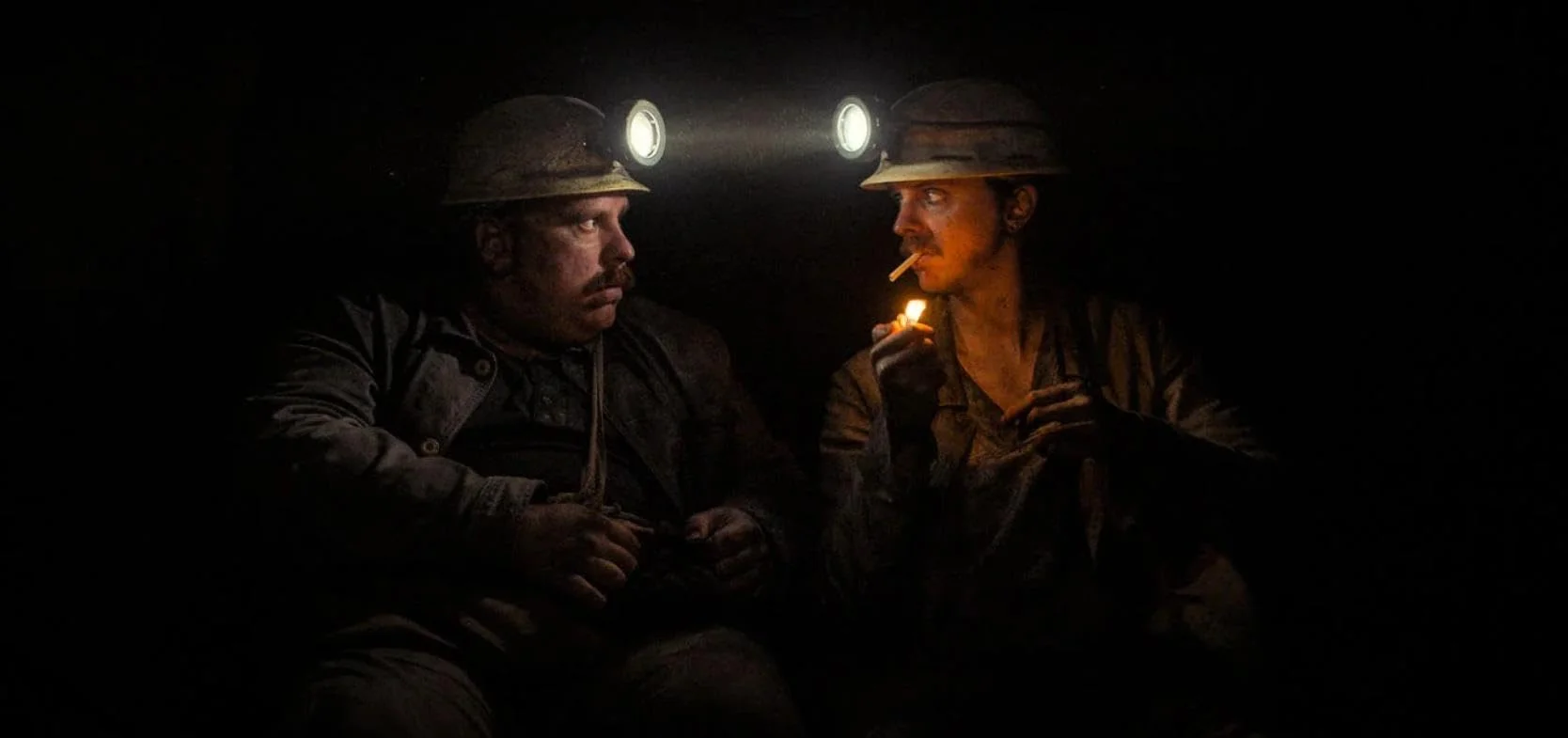
Light does much of the storytelling. Headlamps and torches illuminate narrow cones while leaving the edges of the frame uncertain, encouraging the eye to search spaces it cannot properly read. Turi’s finest scare turns an old camera flash into a brutal measuring device. Each burst exposes the creature for an instant, and each new image reveals that it has moved closer. The scene makes sight itself dangerous. Looking provides information, then immediately removes the safety of ignorance.
The creature benefits enormously from practical effects. Puppeteered movement gives its limbs and body a physical irregularity that digital monsters often polish away. Attacks carry weight because actors appear to occupy the same filthy space as the thing hunting them. A sequence involving Cartouche, the miners’ blind white horse, works especially well because the animal has already been established as part of the mine’s working culture before becoming part of its horror.
The design also connects the creature to something older than predation. Cave drawings, inscriptions and the crypt suggest a civilization that understood this entity as a god rather than an animal. That shift pulls The Deep Dark toward cosmic horror without abandoning the dirt, machinery and exhausted bodies of its mining story.
Too Much Light, Too Many Answers
The film becomes less frightening whenever Berthier turns mystery into explanation. His later account of the entity’s history supplies useful mythology, yet the flashbulb sequence has already demonstrated a stronger principle: uncertainty makes this creature enormous. Once its origins and intentions receive clearer definition, some of that scale contracts.
The middle stretch suffers from the same impulse. The opening establishes the crew with careful efficiency, and the collapse gives the narrative an immediate survival problem. Momentum then softens as characters stop moving long enough to exchange information the film could have left embedded in inscriptions, behavior and fragments of discovery. Certain passages are also lit too generously, revealing details that would feel nastier if they remained half-seen.
Turi recovers pressure once casualties accumulate and the group’s loyalties begin shifting. Amir’s development is particularly effective because survival grows from qualities established before the horror began. His intelligence, linguistic ability and willingness to observe become useful in circumstances where physical experience alone cannot solve the problem. He does not suddenly transform into an action hero. He simply becomes harder for the mine, the monster and the social order above them to dismiss.
The familiar echoes of The Descent and Alien remain visible, from the trapped underground group to the secretive academic whose priorities endanger everyone nearby. The 1950s setting gives those genre patterns a harsher political charge. Here, the men enter the darkness because someone with money has decided their lives are affordable.
The Deep Dark was released in cinemas on November 29, 2023, via Alba Films. Set deep underground, the film follows a crew of miners and a professor who become trapped by a landslide and accidentally awaken a bloodthirsty ancient creature.
Where to Watch The Deep Dark (2023) Online










Full Credits
Title: The Deep Dark
Distributor: Alba Films
Release date: November 29, 2023
Running time: 1 hour 48 minutes
Director: Mathieu Turi
Writers: Mathieu Turi
Producers and Executive Producers: Eric Gendarme, Thomas Lubeau
Cast: Samuel Le Bihan, Amir El Kacem, Thomas Solivérès, Jean-Hugues Anglade, Bruno Sanches, Diego Martín, Marc Riso
Director of Photography (Cinematographer): Alain Duplantier
Editors: Joël Jacovella
Composer: Olivier Derivière
The Review
The Deep Dark
The Deep Dark turns a familiar underground creature feature into a story about labor, migration, and people treated as expendable by those with money and institutional power. Mathieu Turi’s real locations, carefully mapped tunnels, limited lighting, and practical creature effects give the horror a physical menace, while Amir’s progression from unwanted newcomer to resourceful survivor supplies its emotional weight. The middle stretch loses pressure when Berthier explains too much, yet the flashbulb sequence shows how frightening the film becomes when darkness is allowed to keep its secrets.
PROS
- Excellent practical creature effects
- Strong underground geography
- Effective flashbulb horror sequence
- Thoughtful class and migration themes
- Amir’s convincing character progression
CONS
- Exposition slows the middle act
- Creature mythology becomes too explicit
- Some scenes reveal too much visually