



























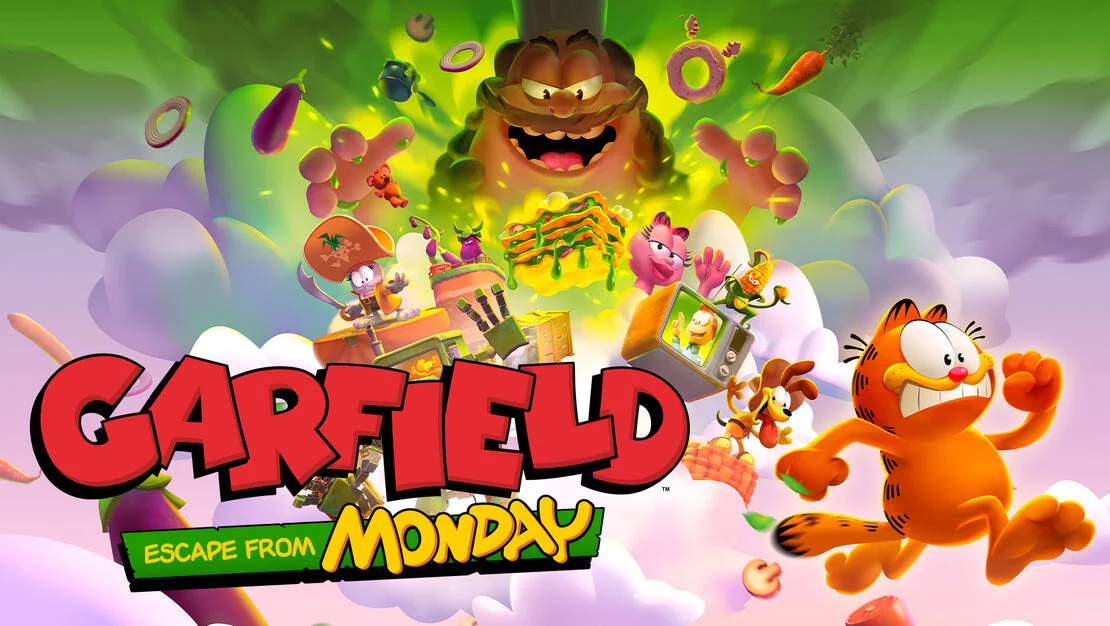

A Garfield platformer arriving in 2026 does not need to outjump Mario to make its case. Expectations around this particular license are modest enough that simple competence already counts for something. That is where Garfield – Escape from Monday finds its footing. OSome Studio has made a straightforward 3D platformer that rarely surprises, yet its responsive movement, accessible level design, and light collectible hunt make it far easier to enjoy than its conservative design might suggest.
Its setup understands Garfield well enough. Jon feeds him spinach lasagna inspired by Chef Monday’s recipe, Garfield falls into a deep sleep, and his subconscious turns healthy eating into a nightmare filled with vegetables, sugar-free food, and other culinary horrors. It is thin material, though it works as an excuse for a colorful platforming adventure built around Garfield’s established hatred of effort and anything remotely nutritious. Jon, Odie, Arlene, Pookie, Nermal, and other familiar faces appear along the way, keeping the game connected to the wider Garfield cast.
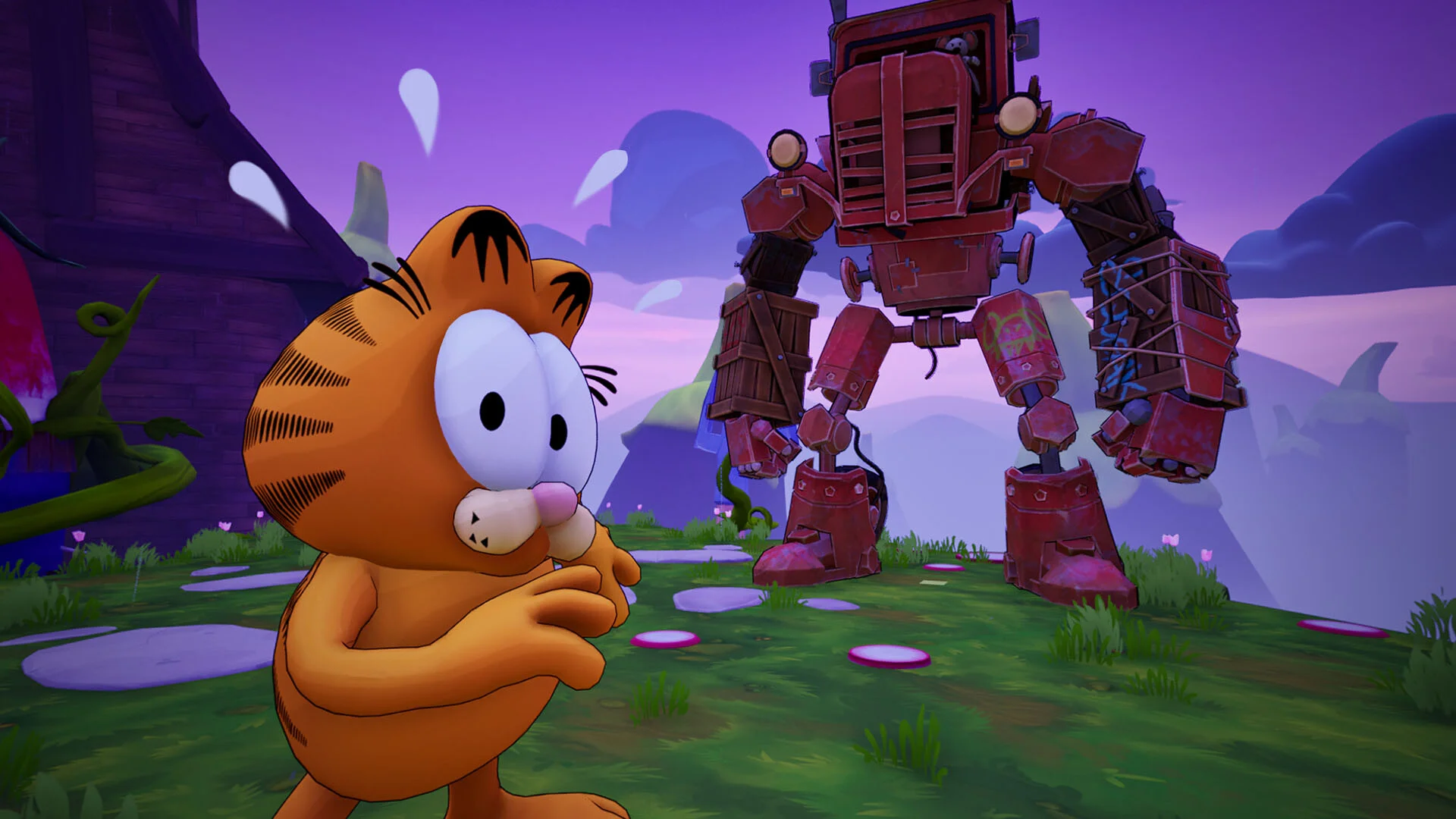
The obvious comparisons are games such as Super Mario 3D World and Super Lucky’s Tale. Escape from Monday borrows the basic language of accessible 3D platforming without approaching the mechanical range of either. Garfield can jump, wall jump, dash through the air, roll across the ground, crouch, perform a ground pound, and use a simple attack against enemies. The camera can be freely controlled and quickly recentered, which helps keep traversal comfortable even when platforms become tighter.
The important part is how little friction any of this creates. Garfield handles cleanly, movement is easy to understand, checkpoints are generous, and enemies rarely interfere for long. Boss encounters follow the same philosophy, offering a small change of pace rather than a serious test of timing or mastery.
For experienced platformer players, that means the campaign can feel undemanding almost immediately. For younger players, the same simplicity makes much better sense. Tutorials arrive clearly, mistakes are rarely punished heavily, and individual stages can be cleared without memorizing complicated mechanics. Escape from Monday behaves like an introduction to the genre, and judged from that angle, its low difficulty feels deliberate rather than careless.
The better question is what keeps those easy stages interesting. Exploration carries much of that burden. Food scattered throughout each level fills Garfield’s Yum meter, while hidden pieces of lasagna encourage players to move away from the direct path to the exit. Lasagna functions as currency for furniture and customization options in Jon’s house, so it does not carry the same progression weight as a Power Star in Super Mario 64 or a Power Moon in Super Mario Odyssey. Finding everything still gives each stage a second objective beyond reaching its endpoint.
That distinction matters because simply finishing a level is rarely difficult. Finding every concealed collectible can require a closer inspection of platforms, corners, and alternate routes, occasionally providing a reason to replay a stage that was otherwise completed without much resistance. The collectible design gives completion-focused players something to chase even after the platforming itself has stopped asking many questions.
There are limits to how far that structure can carry the game. Some levels repeat familiar ideas longer than they should, and occasional collectible pop-in works directly against the pleasure of searching. Food items that appear only when Garfield gets close can turn exploration into sweeping apparently empty spaces in case something decides to materialize. Jon’s house customization provides another reward layer, although decorating it never becomes substantial enough to make the lasagna economy especially exciting.
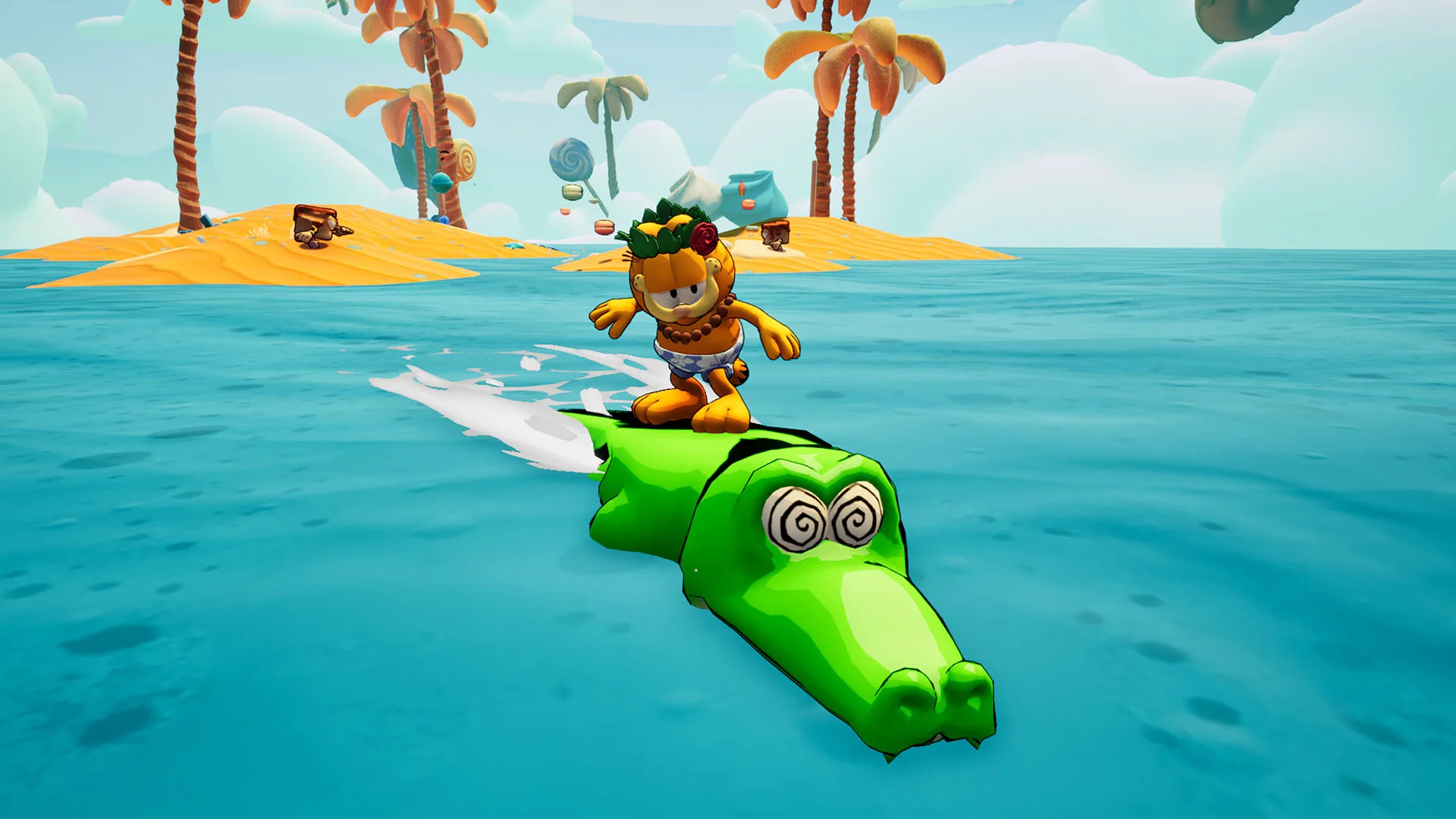
The costume system provides the clearest attempt to vary traversal. Garfield can dress as a turkey for extra aerial movement, use a cowboy costume with a lasso, or put on a surfer outfit to travel across water. Each ability changes how specific obstacles are approached and gives its associated stages a slightly different rhythm.
These transformations fit the dream premise nicely. A turkey costume granting Garfield extra airtime hardly needs serious explanation inside a nightmare caused by spinach lasagna. Mechanically, however, the costumes remain temporary additions rather than abilities that deepen across the adventure. Stronger platformers often introduce a movement idea and then keep finding harder or stranger applications for it. Escape from Monday tends to present its gimmick, use it cleanly, and move on. Variety arrives, though rarely escalation.
Visually, the game fares better. Characters and environments have a colorful cartoon quality that suits Garfield, and the lighting gives several areas a pleasant polish beyond what the simple geometry might suggest. Performance is stable as well, with smooth play and few technical interruptions. The aforementioned collectible pop-in is the obvious exception because it affects play as much as presentation.
The voice work is harder to embrace. Garfield talks frequently, usually through one-liners about the situation or his lack of enthusiasm for participating in it. That should be natural territory for the character, yet the delivery can become monotonous, especially once similar remarks start repeating across stages. For longtime Garfield fans, unfamiliar voices may create additional distance. The visuals recreate the license convincingly, while the performances do less to sell the same familiarity.
That contrast says plenty about Garfield – Escape from Monday as a whole. OSome Studio understands the basic requirements of a family-friendly licensed platformer and executes them with solid consistency. Movement feels good, levels are readable, collectible hunting gives completionists something extra to pursue, and the costumes interrupt the basic loop often enough to prevent complete sameness.
Players raised on stronger 3D platformers will notice everything the game leaves unexplored. Its mechanics rarely build toward demanding combinations, bosses offer minimal resistance, and its level ideas tend to stop shortly after they have been introduced. Compared with the genre’s better examples, its ambitions are plainly limited.
Compared with the weaker Garfield games that have surrounded the character over the years, simple competence feels considerably less trivial. Escape from Monday understands the audience it is serving and gives them a polished, uncomplicated way to spend time with Garfield. It may never make Mondays exciting, which would probably be a betrayal of the license anyway.
The Review
Garfield - Escape from Monday
Garfield - Escape from Monday succeeds by keeping its ambitions modest and executing them cleanly. Responsive movement, accessible stages, collectible hunting, and costume abilities make it an easy game to enjoy, especially for younger players and Garfield fans. Experienced platformer players will find little mechanical challenge, while repetitive ideas, weak boss encounters, collectible pop-in, and monotonous voice work keep it well below the genre's strongest games. Still, compared with Garfield's uneven gaming history, this is a pleasant surprise and a solid entry point into 3D platformers.
PROS
- Responsive, accessible movement
- Collectibles encourage exploration
- Costumes add welcome variety
- Colorful, polished presentation
- Well suited to younger players
CONS
- Very low difficulty
- Limited mechanical development
- Repetitive level ideas
- Annoying collectible pop-in
- Monotonous voice work