




























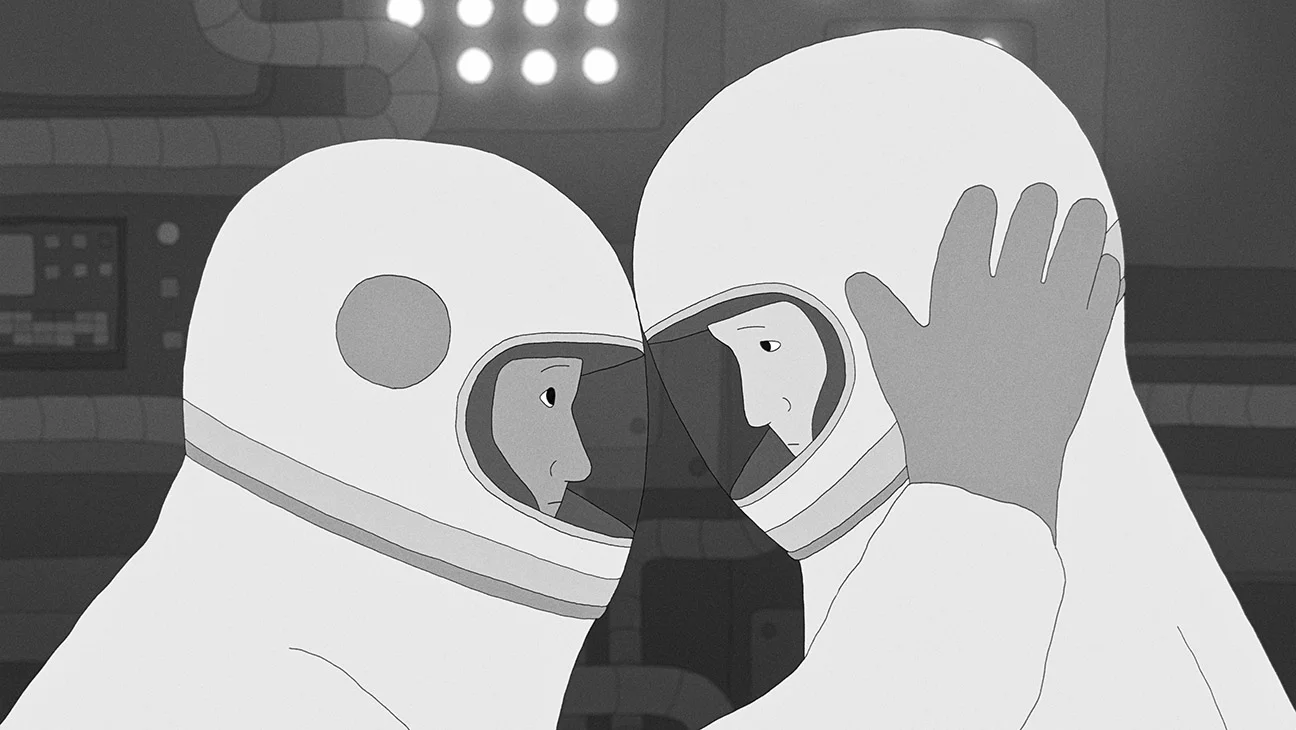

Humanity has reached distant asteroids and somehow managed to bring the employee handbook with it. That is the bitter joke beneath Moonfish, Daniel Zvereff’s monochrome animated feature about a future that has mastered interplanetary extraction while remaining painfully familiar in its treatment of labor. The machinery has changed. The bargain has not. Corporations have divided up the reachable planets, moons and asteroids, intelligent robots are considered too valuable for hazardous work, and people are sent instead because a human body is treated as the cheaper thing to lose.
Cassius and Vesper are two of those workers. Their assignment is brutally simple: mine enough material to satisfy the quota, then earn transport home. Signs scattered through their environment reduce company policy to a phrase with the efficiency of a threat: “NO QUOTA, NO PICK-UP.” When Vesper dies early in the mission, Cassius is left alone with work designed for two bodies and a company that shows no sign of adjusting its expectations simply because one of those bodies is now buried beneath rocks. Science fiction often imagines space as the point where human society escapes its old limitations. Moonfish imagines the opposite. We export them.
The asteroid has no office tower, supervisor or boardroom, yet the corporation is present everywhere. Cassius must maintain his daily mining total. He requires regular injections to manage radiation exposure. A small display registers failure with a sad face when the quota is missed. Even the goldfish traveling with him depends on a filtration system that needs constant attention. Zvereff builds an economy of tiny obligations in which survival and productivity become almost indistinguishable.
That is where the film’s critique gains its force. Cassius is not crushed by a flamboyantly evil regime. He is crushed by procedure. The rules have been written so cleanly that nobody needs to threaten him in person. His employer can remain invisible because the deadline, the machinery and the conditions of retrieval have already entered his daily routine. The absurdity lies in the scale of the achievement. Civilization has crossed unimaginable distances only to recreate the logic of precarious employment on another rock.
Vesper’s death shifts the film into grief, but Moonfish refuses to separate emotional collapse from the system producing it. Cassius is grieving while continuing to mine because grief has no recognized place inside the contract. His work does not stop. His quota does not shrink. His employer does not arrive. The emotional crisis becomes another private problem that must be managed beside radiation levels and equipment maintenance.
His only companion is Vesper’s goldfish, and eventually he begins hearing Vesper’s voice through it. The film leaves the precise nature of these conversations unresolved, which matters less than the need they reveal. Cassius has been reduced to such complete isolation that a fish becomes the only relationship available outside the demands of labor.
Those conversations allow Moonfish to ask larger questions about the world Cassius left behind. Earth was hardly a paradise. Corporate power had already narrowed human choice there, and Cassius speaks about a life lived inside a social order where choosing between employers barely qualifies as freedom. Distance changes the weight of those complaints. Sunshine, fresh air and ordinary human contact begin to look extravagant from a place where everything is gray and every day is measured by extraction.

Zvereff makes that deprivation visible. The film’s stark black-and-white animation strips the asteroid and the capsule of nearly every visual comfort. The 4:3 frame compresses Cassius inside already confined spaces, turning the supposed infinity of space into something claustrophobic. A loose screw rattling above him, a blinking quota indicator and the tiny routines of maintaining the fish tank acquire unusual importance because there is so little else to interrupt the repetition. The minimalism gives the film its politics.
The same principle governs the sound. The rattle of hardware and Sami Jano’s tense score keep the habitat unsettled, while periods of silence leave enough empty space for Cassius’s mind to begin supplying company.
The goldfish gradually changes the film’s relationship with the asteroid itself. Through Vesper’s remembered perspective, Cassius begins to consider the possibility that this place is something other than a deposit waiting to be exhausted. Strange sounds suggest a presence beneath the surface. The idea remains ambiguous, yet the change in attention is significant. The corporation sees mineral yield. Cassius begins to see an environment.
That shift keeps Moonfish from settling into a simple parable about escaping bad employment and going home. Earth represents familiarity and human connection, but it is also the society that produced this arrangement. The asteroid represents exploitation, isolation and danger, yet it slowly acquires the possibility of meaning once Cassius stops seeing it solely through the company’s extractive logic.
The distinction gives the film’s late warmth its credibility. Hope does not arrive through institutional reform, technological rescue or heroic conquest. It appears through a smaller recovery of value: conversation, memory, attention, sunlight, the recognition that a place might possess significance beyond what can be removed from it.
That modesty suits Moonfish. Its future is bleak because so much of it feels administrative rather than fantastical. The machines became smarter, the corporations became larger, and humanity reached farther into space. None of those developments taught anyone what a human life should be worth. The film leaves Cassius stranded inside that failure, staring at a world his employer sees as inventory and learning, slowly, to see something else.
Moonfish had its world premiere in the Biennale College Cinema section at the 83rd Venice International Film Festival on September 6, 2026. The animated sci-fi drama follows a grieving astronaut on a deep space mining mission who loses his sole companion and must fulfill a rigorous corporate quota to return home, slowly losing his grip on reality.
Full Credits
Title: Moonfish
Distributor: New Europe Film Sales
Release date: September 6, 2026 (Venice International Film Festival)
Running time: 1 hour 29 minutes (89 minutes)
Director: Daniel Zvereff
Writers: Daniel Zvereff
Producers and Executive Producers: Rebecca Wyzan, James Belfer, Mireia Vilanova, Morgan Spector, Lucy Liu
Cast: Morgan Spector, Lucy Liu
Editors: Daniel Zvereff
Composer: Sami Jano
The Review
Moonfish
Moonfish turns the fantasy of conquering space into a story about carrying exploitation farther from Earth. Its monochrome animation, boxed-in frame, mechanical routines and quietly cruel quota system make Cassius’s isolation feel socially produced rather than merely existential. The goldfish device gives his grief somewhere to speak, while the asteroid’s gradual transformation from resource to place gives the film its fragile warmth. Its minimalism can make the experience austere, but the severity suits a future where human life has become the cheapest thing in the room.
PROS
- Sharp critique of labor and automation
- Monochrome visuals reinforce the film’s social argument
- Strong use of confined space and routine
- Goldfish conversations deepen grief and isolation
- Hope emerges without softening the dystopia
CONS
- Severe minimalism may distance some viewers
- Ambiguity around the asteroid can feel deliberately elusive
- Sparse presentation limits emotional immediacy at points