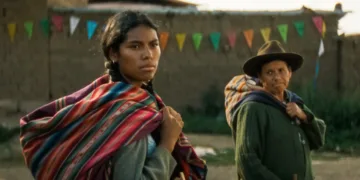























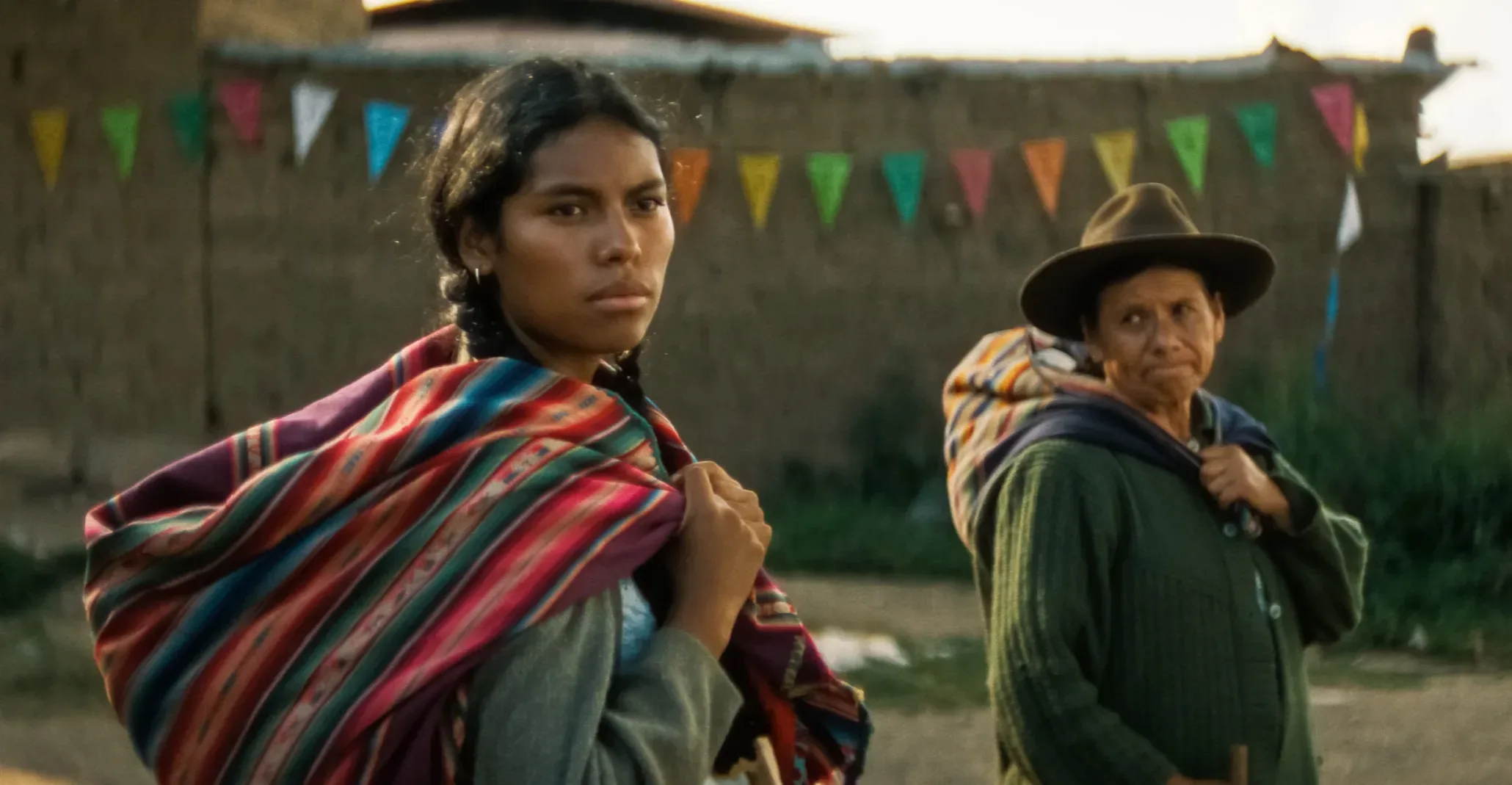

A young woman spends her days helping other women bring children into the world, yet the life waiting for her has already been decided. That contradiction gives The Condor Daughter its quiet ache. Clara knows the songs sung during births, the touch of hands across a pregnant belly, the rhythms Ana has carried through years of work in their Quechua community in the Bolivian Andes. She can perform every gesture asked of her. What she cannot do is convince herself that inheritance and desire are the same thing.
Álvaro Olmos Torrico lets that uncertainty gather slowly. Clara listens to a small radio. She sings. Flora talks about the city. A stranger hears Clara’s voice and offers her work performing at special events. None of these details would amount to much in a louder film, but here they accumulate like distant lights appearing beyond a familiar horizon. Clara’s dissatisfaction rarely announces itself directly. It exists in attention, in curiosity, in the brief mental distance between what Ana expects and what Clara has begun imagining.
That makes their conflict richer than a simple contest between tradition and modern life. Ana’s work has genuine value. In an isolated rural community where medical care is difficult to reach, her knowledge is practical, respected, and bound to a way of understanding birth that has survived through generations. The songs are not decoration. The rituals are not quaint remnants arranged for an outsider’s admiration. They belong to people’s bodies and memories. The film is equally unwilling to pretend that continuity comes without pressure.
Clara reacts with horror when the community gathers to punish a young woman who has broken its rules. She also appears less hostile than Ana toward modern medicine, sensing the possibility that hospital care and inherited midwifery might exist beside each other. Ana hears something different in that suggestion. To her, the hospital threatens a chain of knowledge whose survival depends on someone choosing to carry it forward. When Clara questions the practice, Ana does not hear curiosity alone. She hears disappearance approaching.
Marisol Vallejos Montaño plays Clara with an openness that suits this uncertainty. Her longing never hardens into the kind of rebellion that would make the character easy to classify. She has duties she understands and affections she does not reject. She is simply capable of imagining herself elsewhere. María Magdalena Sanizo makes Ana far less transparent. Her restraint gives the older woman a severity that can feel immovable, yet much of that severity begins to read as fear once Clara leaves for Cochabamba. That departure changes the film’s emotional gravity. Clara enters the city she has imagined; Ana must enter it because Clara is gone.
The reversal is quietly devastating. In the mountains, Ana belongs to a social world that understands her authority. People know what she does, what her knowledge means, where she stands. In the city, those certainties lose their surrounding structure. She searches through unfamiliar spaces, appears on a radio program asking for help, even finds herself inside a nightclub. Nothing about Ana herself has become smaller, yet the world around her no longer confirms the identity she has spent a lifetime inhabiting.
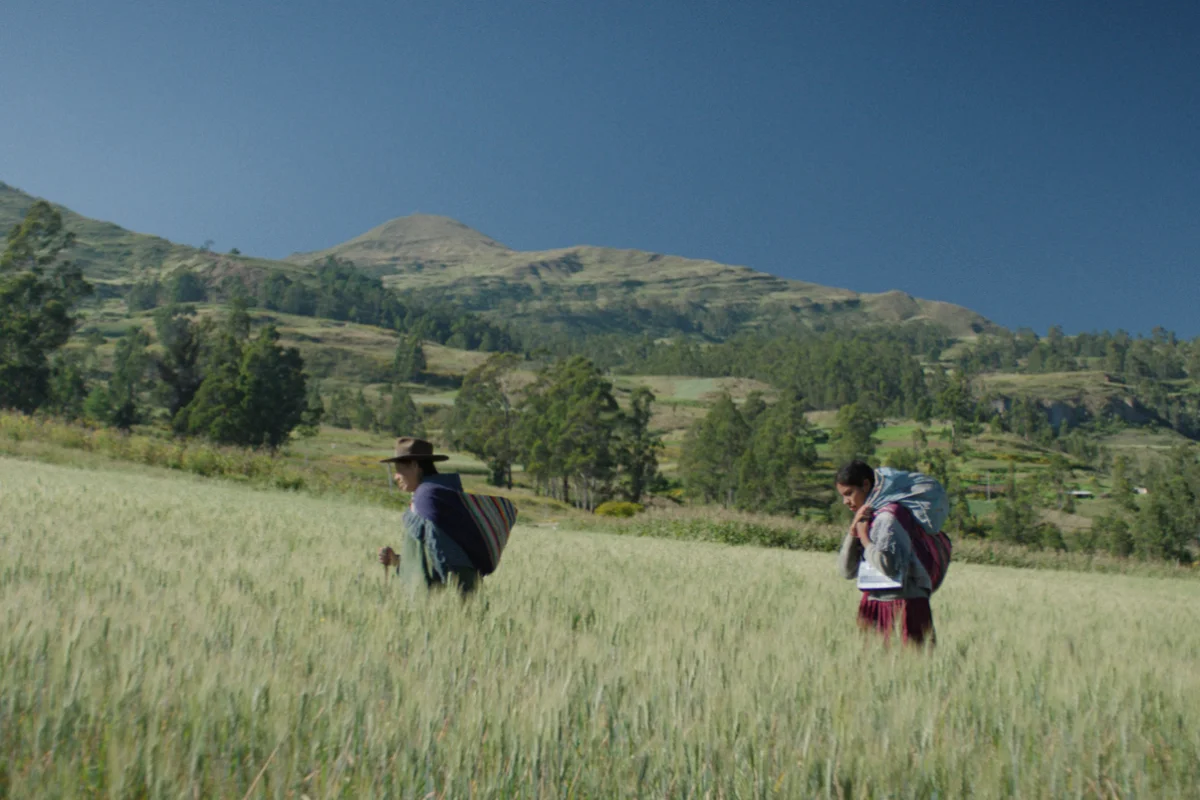
Nicolás Wong Díaz’s cinematography deepens that displacement without turning Bolivia into scenery for its own sake. The Andes possess a severe physical presence: slopes, open distances, worn faces, sunlight across earth. Their scale makes the community seem ancient and rooted, while also revealing how physically narrow Clara’s available life can feel. Later, the city offers greater movement and possibility, but through Ana’s eyes that openness becomes confusion. Space changes meaning according to who is standing inside it.
Torrico’s patient pacing asks the viewer to remain in those spaces for a long time. The film carries little exposition, avoids voice-over, and rarely converts emotion into speeches. That restraint suits a story built around things people cannot fully say to each other. There are passages where its stillness comes close to stalling, particularly before Clara’s departure gives the narrative a stronger pull. Yet the slowness has a purpose. These characters belong to lives organized by repetition, seasons, ritual, work. Abruptness would betray them.
Music becomes the film’s most beautiful contradiction. Clara inherits songs through Ana’s midwifery, music connected with birth and communal memory, yet singing is also the talent that points toward another life. The radio first carries the outside world into Clara’s home. Later, radio becomes one of Ana’s tools for trying to find the daughter who followed that world away. The same medium calls outward and back.
There is something painful in that symmetry. Parents pass things down believing continuity will preserve them, but inheritance changes the moment another person receives it. Clara can learn Ana’s songs without becoming Ana. She can carry the memory of the mountains into the city without remaining physically inside them. What survives may survive differently.
The film refuses the comfort of treating change as either rescue or corruption. Modern medicine offers possibilities Clara can see and Ana mistrusts. Traditional knowledge offers care, identity, and belonging while existing inside a community capable of harsh judgment. Neither world arrives clean.
That ambiguity gives The Condor Daughter its melancholy power. Torrico is watching a culture confront the oldest problem any culture faces: how to remain itself after the next generation becomes free enough to choose something else. There is no victory in that question. Only movement, memory, and the uneasy knowledge that love cannot preserve another person by keeping them unchanged.
The Condor Daughter premiered at the Toronto International Film Festival on September 7, 2025, and expanded to international theatrical and festival runs through 2026. The drama follows a young Quechua midwife in the Bolivian Andes with a gifted singing voice who leaves her remote village to pursue a musical career in the city, forcing her adoptive mother to journey after her.
Full Credits
Title: The Condor Daughter
Distributor: Bendita Film Sales
Release date: September 7, 2025 (Toronto International Film Festival)
Running time: 1 hour 49 minutes (109 minutes)
Director: Álvaro Olmos Torrico
Writers: Álvaro Olmos Torrico
Producers and Executive Producers: Álvaro Olmos Torrico, Cecilia Sueiro Mosquera, Diego Sarmiento Pagán, Federico Moreira, Iris Sigalit Ocampo Gil, Aniceto Arroyo
Cast: María Magdalena Sanizo, Marisol Vallejos Montaño, Nely Huayta, Alisson Jimenez, Gregoria Maldonado
Director of Photography (Cinematographer): Nicolás Wong Díaz
Editors: Álvaro Olmos Torrico, Irene Cajías
Composer: Cergio Prudencio, Marcelo Guerrero
The Review
The Condor Daughter
The Condor Daughter finds its deepest feeling in the distance between inheritance and desire. Its patient rhythm occasionally drifts, yet Álvaro Olmos Torrico gives that slowness purpose through Clara and Ana, whose bond becomes a study of what happens when love asks another person to remain unchanged. Nicolás Wong Díaz's landscapes and the film's use of music deepen that tension without reducing either tradition or modern life to an easy answer. Its sadness is quiet, but it lingers.
PROS
- Strong central relationship between Clara and Ana
- Beautifully expressive cinematography
- Music carries real thematic weight
- Refuses easy moral answers
- Restrained performances suit the material
CONS
- Early pacing can feel inert
- Narrative momentum arrives late
- Some viewers may find the restraint too distant