













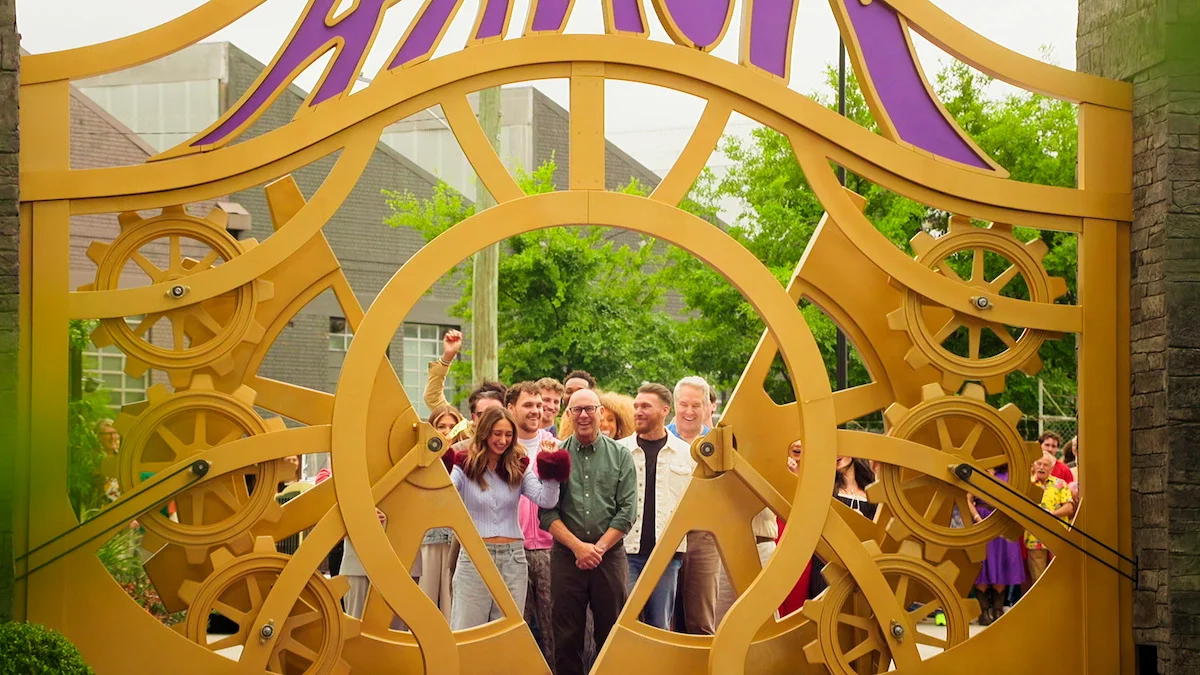

A game show can survive a silly premise, a gaudy set, even a certain amount of producer interference. What it cannot survive is confusion about what the contestants are actually trying to do. That is the problem hanging over Wonka’s the Golden Ticket almost immediately. Netflix has built a lavish recreation of Willy Wonka’s world, filled it with chocolate rivers, Oompa Loompas, Wonkavision rooms, oversized props, and familiar visual jokes, then dropped a competition inside it that often behaves as if rules are an optional extra.
Twelve Golden Ticket winners arrive with partners and move through physical, mental, and social challenges for a $3 million prize. That setup sounds clean enough. The trouble is that the show rarely lets the audience form a stable picture of how one round connects to the next, when an elimination is coming, or which decisions are skill-based and which are simply there because production needs somebody gone. Good competition television creates what I would call readable cause and effect: you understand the options before a player acts, then you watch the consequences unfold. Here, the consequences often arrive before the structure has made sense.
The TV-room sequence is the clearest example. Contestants spin a wheel, a group is selected largely by chance, and another player winds up holding the power to send people home. It takes up a substantial stretch of the episode without producing much strategic tension because there is so little for the contestants to control.
Randomness can be exciting when players have tools to respond to it. Here it often replaces the game itself. The series then compounds that problem by ending episodes mid-challenge, leaning on interruption as suspense instead of earning suspense through the choices already in play.
That structural fog would be easier to forgive if the contestants were carrying the drama. They are not, mostly because the editing gives them so little time to become people before the machinery starts removing them. The opening rushes through Golden Ticket discoveries, introductions, and arrival at the factory with such speed that the cast feels less introduced than deposited.
Reality television editors create character through accumulation: a reaction here, an alliance there, a recurring habit, a small conflict that changes shape three episodes later. Wonka’s the Golden Ticket often asks us to feel the emotional payoff before it has done that groundwork. Contestants cry over departures and broken trust while I am still trying to remember which partner belongs to whom.
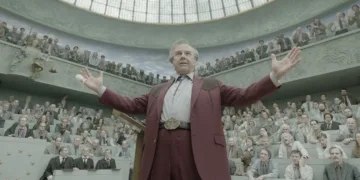
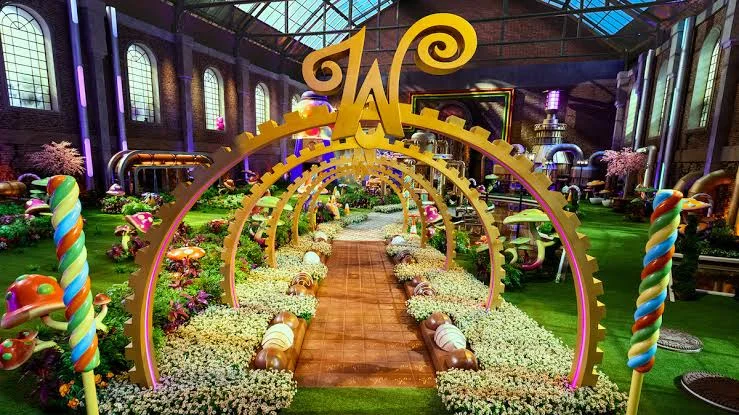
That disconnect matters because the sets are frequently excellent. The chocolate room has scale, the TV room is instantly recognizable, the half office and other recreations understand the strange visual logic of the 1971 film. Production design is doing what good production design should do, which is give the world its own physical rules.
The irony is that the competition occupying those spaces has fewer readable rules than the rooms themselves. I kept wanting the challenges to use the architecture in a meaningful way, to make the factory part of the decision-making rather than an expensive backdrop contestants walk through on the way to another elimination ceremony.
The most revealing creative choice is the AI recreation of Gene Wilder’s voice. The production notes that Wilder’s estate approved its use, which answers the permission question and leaves the artistic one untouched. A synthetic voice can reproduce surface qualities such as pitch, tone, and familiar cadence. Performance is harder.
Comedy lives in timing, hesitation, emphasis, and response. Those tiny choices are why one line feels mischievous and another feels threatening. The generated Wonka can sound recognizably like Wilder, yet the jokes often arrive without the human timing that made Wilder’s performance so elastic.
The show makes that limitation stranger by treating the AI voice as if it is the host while frequently routing actual instructions through written cards, Oompa Loompas, another disembodied voice, or guest hosts such as Nick Cannon and Howie Mandel. Contestants often do not appear to react to Wilder’s voice directly. The effect is less like a character controlling the tour and closer to an audio layer added after the main interaction has already happened. That gap turns the technology from a hosting device into a reminder that the host is not really there.
There is one challenge that shows a much better version of the series hiding inside all this machinery. In the gum game, one member of a pair buzzes after seeing an image of a city or country, while the partner has to supply the answer. Get it wrong and the person who buzzed has to eat gum. Get it right and the pair can force someone else to take the risk. One piece carries the elimination effect. Suddenly the design has shape. Knowledge matters, trust matters, and one person’s confidence creates danger for somebody else.
The best part is what happens around that mechanic. Bill makes a choice that frustrates Kayla after she has indicated that Hunter can be trusted. Hunter and Bill begin pushing back at each other. Jeff puts himself at risk and alarms Ava. Those reactions work because the challenge creates them. The game is no longer asking contestants to perform emotion for the camera. It is producing a situation where emotion emerges from a decision the audience can understand.
That is what makes the gum game such an awkward success for the series. Once a challenge lets one person’s choice alter another’s fate, the factory stops being scenery and becomes part of the game. The show soon returns to contestant-selected eliminations and familiar reality-competition ceremonies, but by then it has already demonstrated the alternative: make the temptation legible, make the decision matter, and let the people supply the drama.
Wonka’s the Golden Ticket premiered on Netflix on September 23, 2026. The reality competition series follows contestants as they battle through various challenges inside a retro-futuristic chocolate factory to secure a golden ticket.
Where to Watch Wonka’s the Golden Ticket Online


Full Credits
Title: Wonka’s the Golden Ticket
Distributor: Netflix
Release date: September 23, 2026
Rating: TV-PG
Running time: 45–60 minutes per episode
Director: Rich Kim
Writers: Not publicly specified
Producers and Executive Producers: Alison Holloway, Emer Harkin
Cast: Mitchell Marion, Ash Hodgkinson, Tiffany Sarich
The Review
Wonka’s the Golden Ticket
Wonka’s the Golden Ticket has the money, iconography, and production craft to create an entertaining competition, yet its game design keeps undermining those strengths. Vague rules, arbitrary eliminations, and thin contestant development make too many challenges feel inert. The AI recreation of Gene Wilder adds another distraction, especially when the show struggles to make him feel present as an actual host. The gum challenge proves the format can work when choices create readable consequences. The frustrating part is how rarely the series follows its own best example.
PROS
- Impressive recreation of Wonka’s factory
- Strong production design
- Gum challenge creates genuine strategic tension
- Some clever use of partnerships
CONS
- Frequently unclear competition rules
- Arbitrary elimination mechanics
- Weak contestant development
- AI Wilder voice lacks human comic timing
- Spectacle often substitutes for meaningful gameplay