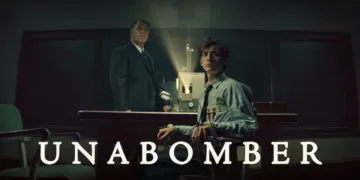





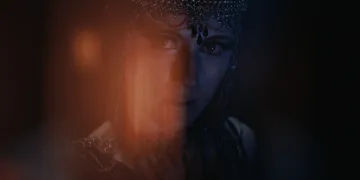
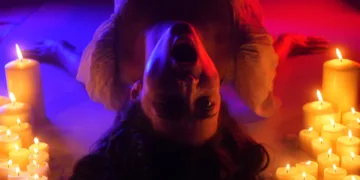

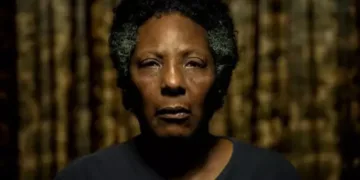
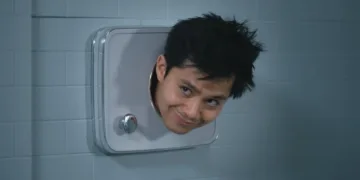





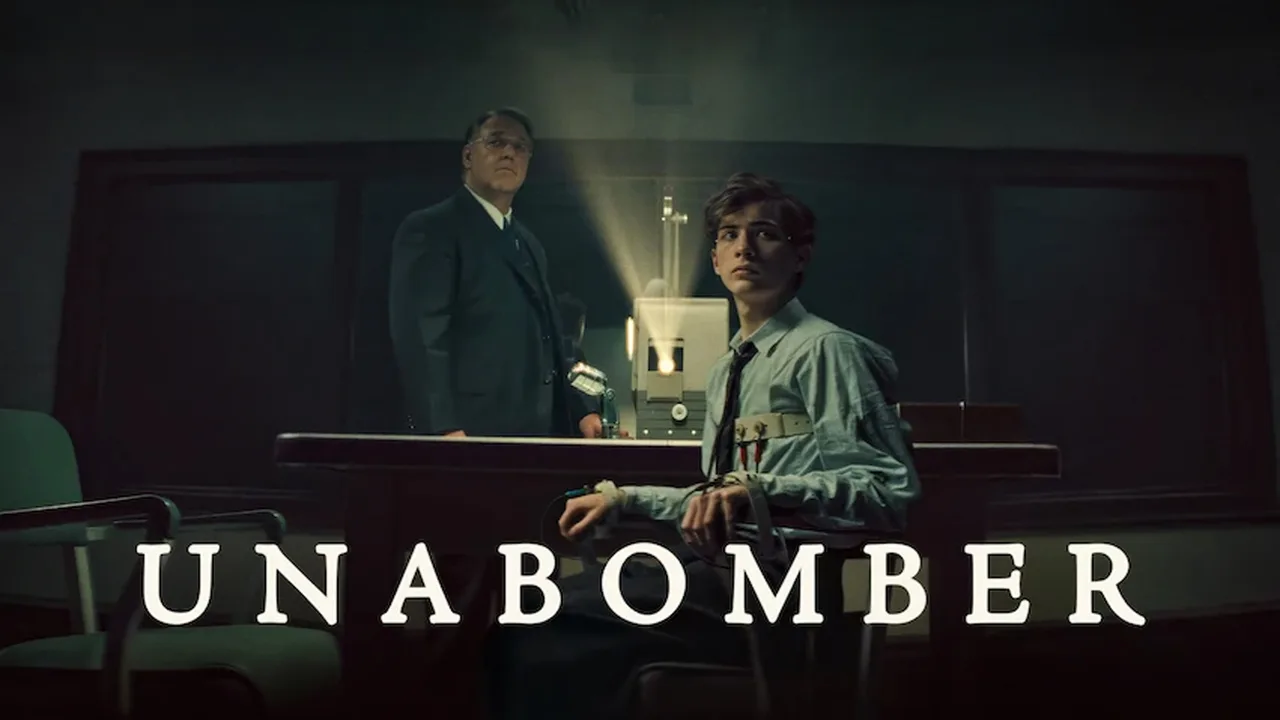

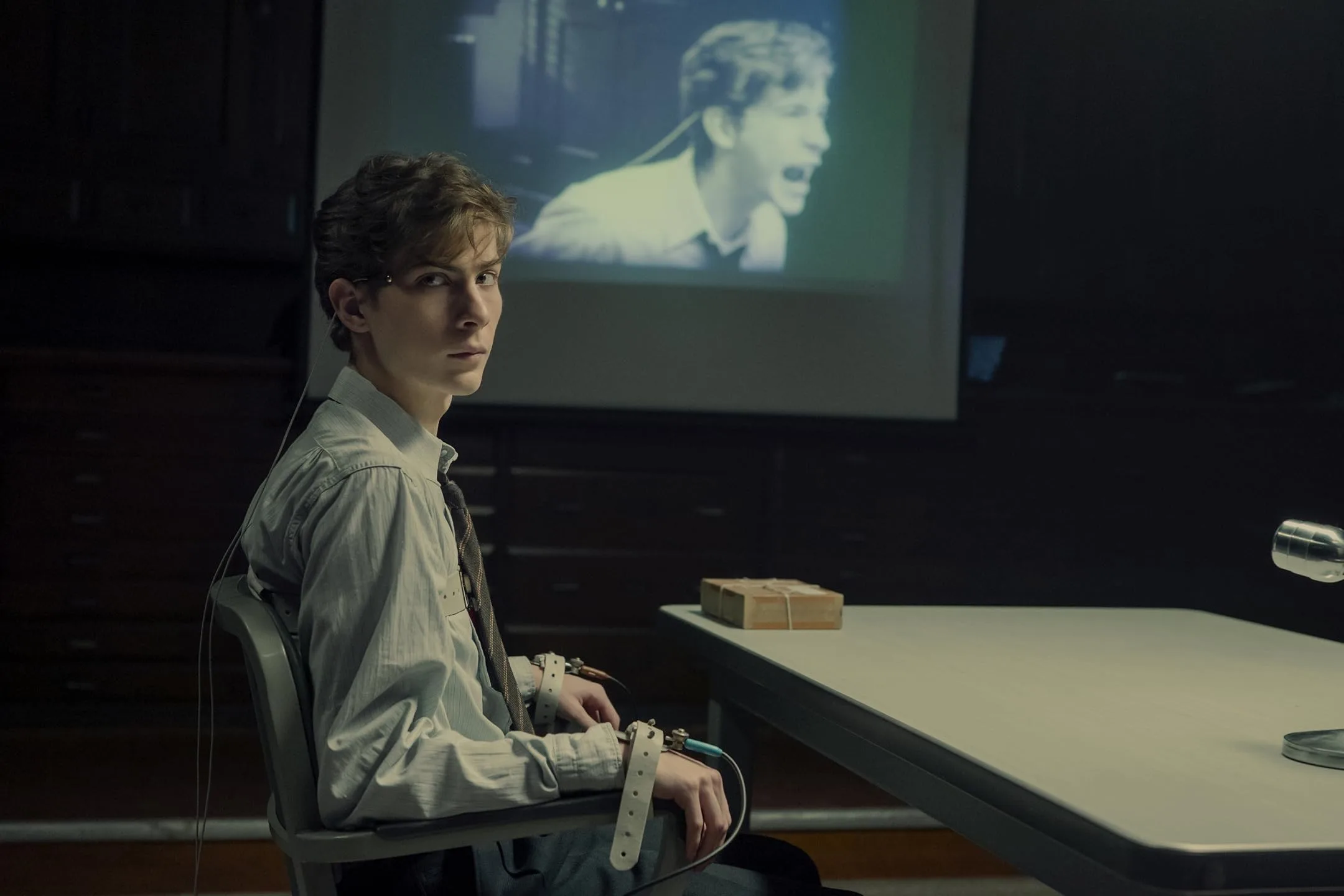
Henry Murray asks a gifted student to defend his beliefs, then arranges for those beliefs to be attacked while the student is strapped to a chair and monitored. The professor calls it an experiment. Young Ted Kaczynski thought he had been invited into an intellectual exchange, which makes the deception sting before the film asks us to think about anything Ted will do later. Russell Crowe plays Murray with the composure of a man who can describe cruelty as a research method and sleep perfectly well afterward.
Jacob Tremblay gives Ted a brittle certainty in these scenes. He argues fiercely, even as the exercise turns personal, and his conviction makes Murray’s choice to exploit him feel particularly ugly. Director Janus Metz Pedersen puts the wires, harsh light and recorded confrontation to use: this is an institution studying a young person’s distress while manufacturing it. I found myself wanting the film to stay with that abuse. Then I had to question what, exactly, I was asking it to prove.
Unabomber moves between Ted’s time at Harvard in 1958 and an FBI investigation decades later. Shailene Woodley plays Joanne Miller, an agent who suspects the prevailing psychological profile has sent investigators in the wrong direction. She looks instead to the language of the bomber’s manifesto, hoping his words will reveal the person behind it. Across the two periods, the film places Ted before people convinced they can discover something decisive by examining what he says.
That parallel is stronger than the film’s account of what follows from it. Murray’s study could have harmed Ted without having caused his bombing campaign. Yet the cuts between the experiment and the manhunt keep bringing us back to Harvard for an answer to crimes committed decades afterward. We see the boy subjected to an ordeal and scarcely see the adult making his choices. The years between become a space the film fills with implication.
I resisted that framing at first because it seemed to turn Ted into a student damaged by one monstrous professor. Still, the Harvard scenes deserve their emotional force. Tremblay’s Ted believes his ideas have earned him a place in Murray’s study, and Crowe’s measured attention makes the betrayal credible. Annabelle Wallis’s Christiana Morgan offers him sympathy amid the experiment. Those moments give a young participant the care Murray withholds. My objection is to the certainty the film builds around them: it even has Murray diagnose Ted with schizophrenia, giving its account of his mind a neatness the disputed history cannot bear.
The investigation could have challenged that neatness. Miller’s attention to the manifesto recognizes that Ted put his beliefs into words and wanted them read. She pushes against a colleague, Leo, to treat his language as evidence rather than accept a ready-made profile. But her work is compressed into familiar procedural friction, and Woodley has little opportunity to show how Miller’s interpretation changes as the evidence develops. Identifying a writer is one task; explaining why he killed people is another. The film brings the timelines together as if success at the first might validate an answer to the second.
Its treatment of the victims makes that leap harder to accept. Early on, Thomas J. Mosser takes a package into another room while his wife and daughter remain nearby. The camera closes in on the act of opening it, cutting back to his family as we wait for the bomb. The sequence is effective at producing dread, though it holds us close to the mechanics of his death for only a short time before turning its attention to Ted’s childhood. Three people were killed in Kaczynski’s campaign. The film can evoke the cost of one murder, yet gives far greater dramatic space to the suffering of the man responsible.
There is a difficult film somewhere inside this one. Ted’s criticisms of technological power need not be treated as nonsense for his violence to be condemned; Murray’s conduct need not be minimized to preserve Ted’s responsibility. Unabomber touches both problems through the manifesto and the experiment, then favors a clearer line from one injured boy to one infamous killer. That line gives the two timelines a shape, but leaves too much of the adult life between them unseen.
Over the closing credits, the real Kaczynski speaks about his wish to be depicted truthfully. He had his own reasons for wanting control of that account, so his voice cannot settle the matter. Hearing it after nearly a whole film spent interpreting him is unsettling all the same. Murray wanted Ted’s beliefs to yield a result. Miller wanted his writing to yield a name. By then, I wanted to know why the film had been so eager for his childhood to yield a cause.
Unabomber is a feature film that premiered globally on Netflix on September 25, 2026. The movie traces the origins of Ted Kaczynski, moving between his high-stress years as a young math prodigy at Harvard subjected to controversial psychological experiments and the eventual FBI investigation leading up to his arrest. You can stream the movie directly on Netflix.
Where to Watch Unabomber Online


Full Credits
Title: Unabomber
Distributor: Netflix
Release date: September 25, 2026
Rating: R
Running time: 112 minutes
Director: Janus Metz
Writers: Sam Chalsen, Nelson Greaves
Producers and Executive Producers: Sophie Cassidy, Doug Belgrad, Sam Chalsen, Nelson Greaves, Donald J. Lee Jr.
Cast: Jacob Tremblay, Russell Crowe, Shailene Woodley, Annabelle Wallis, Alexander Ludwig, Steven Ogg, Marc Menchaca, Michael Laurence
Director of Photography (Cinematographer): Yves Bélanger
Editors: Zach Staenberg
Composer: Marco Beltrami
The Review
Unabomber
Unabomber finds its strongest material in the Harvard experiment, where Jacob Tremblay and Russell Crowe make institutional cruelty painfully clear. The trouble comes when the film treats that cruelty as a tidy explanation for murders committed decades later. Its hurried investigation cannot test the claim, and the victims receive far less attention than the young man who will kill them. The closing archival voice leaves a question the drama was too eager to answer.
PROS
- Tremblay and Crowe give the Harvard scenes force
- The experiment’s cruelty is vividly staged
- - The parallel between interrogation and investigation has promise
CONS
- The film presses abuse into a simplistic cause
- The adult Kaczynski remains largely unseen
- Miller’s investigation feels compressed
- Victims receive limited attention