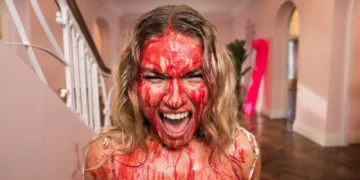



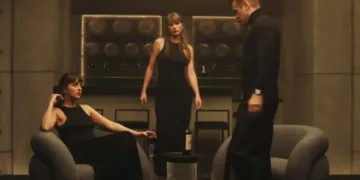

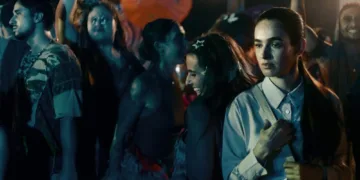








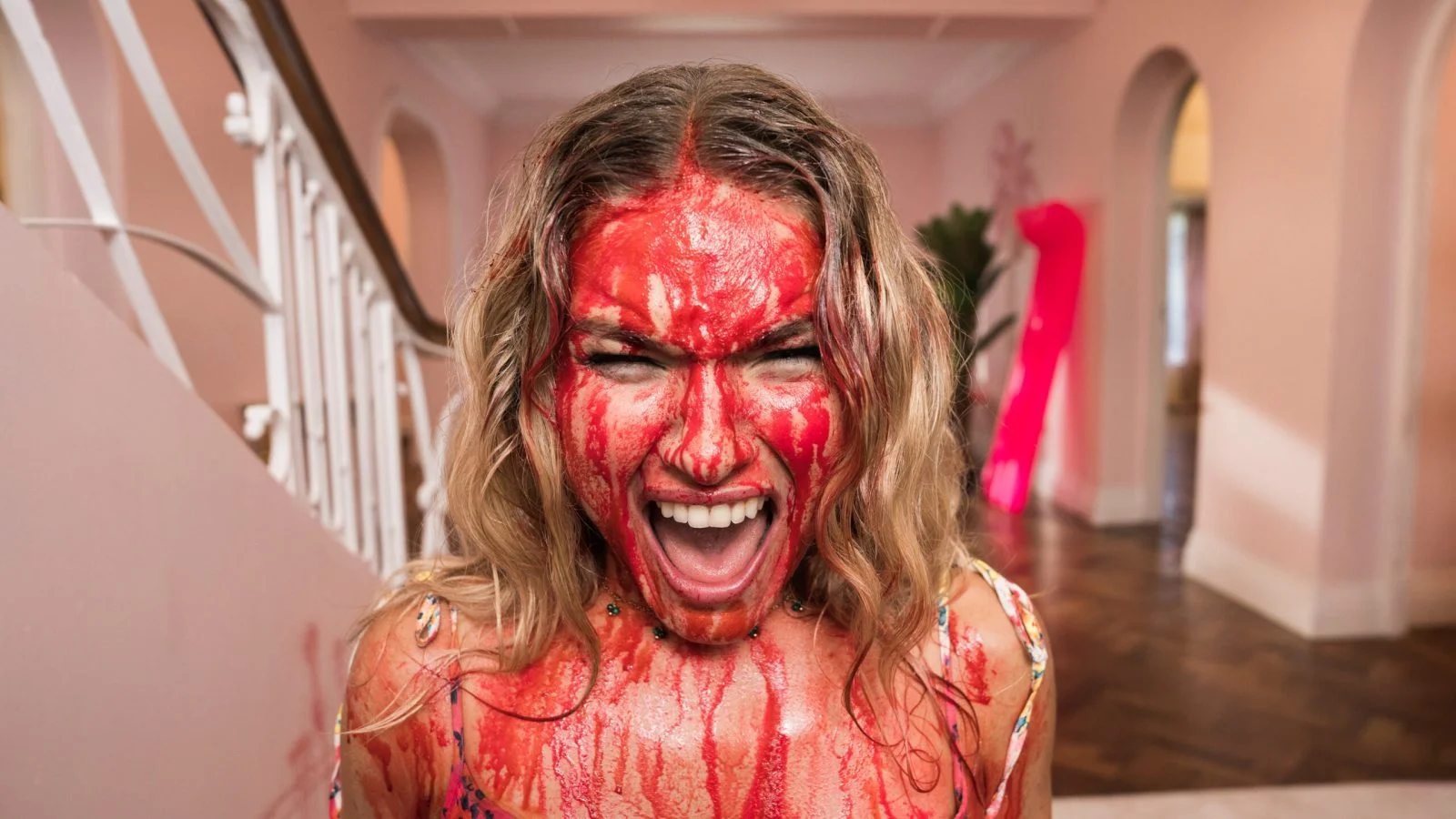

The figures in Nora’s memory stop moving. The image turns red, and she walks among them, searching the night of a murder for something she failed to understand while it was happening. Director Jem Garrard gives her recollection a physical form: people remain fixed in place while the witness changes her position and looks again. The device makes an uncertain memory worth examining. It also gives Buzzkill its most persuasive visual idea, one that asks us to pay attention to a woman everyone around her has learned to discount.
Elsewhere, Garrard’s camera has little patience for stillness. Whip pans and flips during scuffles suit a sorority horror comedy driven by Nora’s attempts to outrun supervision and get herself drunk. The contrast matters. In the present, movement keeps upsetting her plans; inside a memory, she can finally inspect what she missed. The red tint sets those passages apart without making their contents automatically trustworthy. Nora has found a way back to the scene, but she still has to work out what she saw.
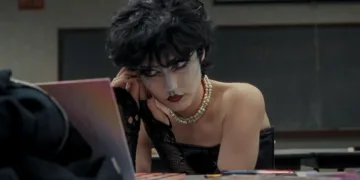
Siena Agudong plays Nora, the Sigma sister who witnessed the murder of sorority president Sarah (Frances Sholto-Douglas) while intoxicated. Five weeks later, Sarah’s former boyfriend James is accused, and Nora remains convinced the explanation is wrong. She believes another bout of drinking will restore the missing details.
Her sisters, led by Kendell (Brec Bassinger), have endured enough of her behavior and intend to keep her sober during a campus party crawl. Their intervention is understandable. Nora’s insistence on drinking is also the only investigative method she has found. Suzanne Keilly’s script gets useful comic friction from making both positions defensible for longer than a slasher usually bothers to.
Nora leaves herself clues in black marker, though the woman who wrote them was hardly an expert in clear documentation. “A Slut,” discovered on her forehead, is evidence of something; deciding what it means is another matter.
That gap between record and interpretation supplies the mystery with its better jokes. Agudong plays Nora’s drunken determination with enough timing and warmth that a character repeatedly making a mess of other people’s plans remains good company. She can stumble into a problem, realize half a beat too late what she has done, and keep pursuing the thought she nearly lost.
Angela Daytona Wu’s Beth gives that pursuit its best rhythm. Beth believes Nora and helps her seek out alcohol, even as the other sisters tend to forget she is there. Her willingness to go along with Nora’s schemes makes their investigation feel like a partnership rather than a succession of solo drunken antics.
It also sharpens a small irony in the group: the sister whose testimony is dismissed works most closely with the sister whose presence barely registers. Wu finds comedy in Beth’s cheerful cooperation, including the extended business with a lampshade, without treating her as another obstacle for Nora to knock over.
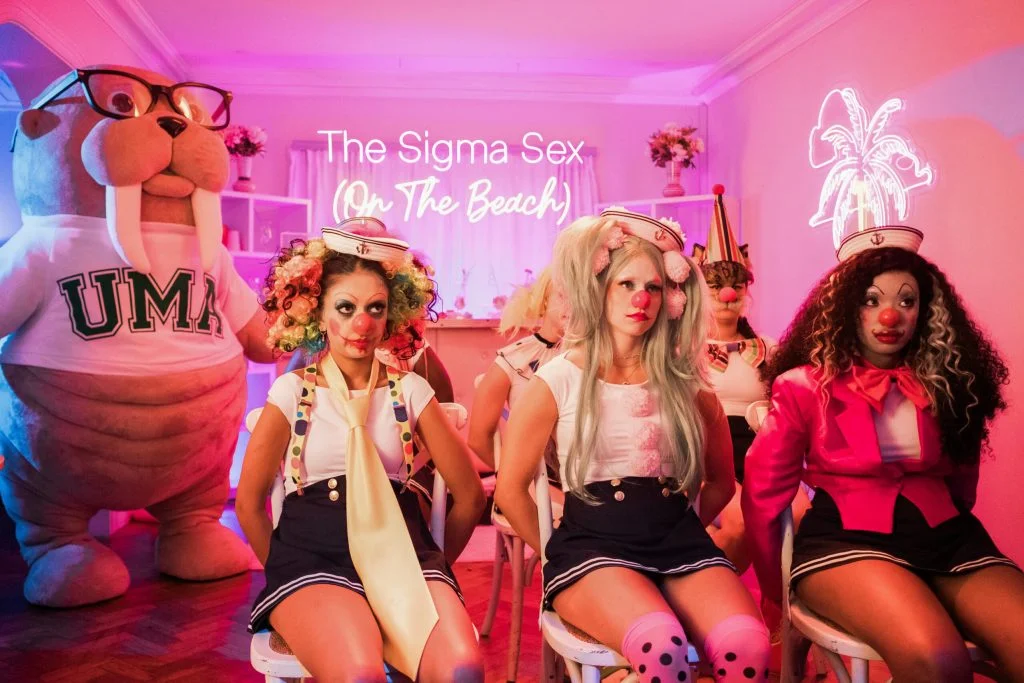
The campus crawl provides a crowded, neon-lit route for the masked killer, and the murders put party objects to unpleasant use, among them a broken vodka bottle and a pledge paddle. Garrard moves through the festivities briskly.
Yet the staging has greater energy when Nora is chasing a memory than when the killer is pursuing a victim. The costume-filled setting offers places to hide in plain sight, but the stalk-and-slash passages seldom draw out that uncertainty. Blood arrives readily; dread has less time to gather. The film’s pace keeps the evening entertaining while denying several attacks the suspense their setting might have supplied.
A familiar sorority slasher could have made Nora an early casualty and left the investigation to somebody with cleaner habits. Buzzkill instead makes her the person best placed to question the obvious suspect. That reversal has company in recent college-set horror comedy, particularly Happy Death Day.
Garrard’s memory sequences give this film its own angle on the convention: Nora’s apparent disqualification as a witness becomes the reason she must look harder. The idea loses some force as the suspect pool widens. Kendell’s effort to control the house gives her a defined relationship with Nora, but several other sisters are easier to recognize by a trait than by a consequential choice. Their opposition helps the comic scramble; it offers less for the mystery to examine.
The film is at its liveliest when Agudong and Wu make another improbable attempt to recover a clue, then Garrard lets Nora step back into that suspended red past. Those passages grant her the time and attention most of her sisters refuse her.
Buzzkill premiered globally as a Tubi Original on September 25, 2026. The horror-comedy follows a party girl trapped with a masked killer who must get drunk to unlock tipsy memories that reveal the murderer’s identity.
Where to Watch Buzzkill (2026) Online

Full Credits
Title: Buzzkill
Distributor: Tubi
Release date: September 25, 2026
Rating: TV-MA
Running time: 1 hour 36 minutes (96 minutes)
Director: Jem Garrard
Writers: Suzanne Keilly
Producers and Executive Producers: Blue Ice Pictures
Cast: Brec Bassinger, Siena Agudong, Frances Sholto-Douglas, Jacques Adriaanse, Jessie Diepeveen, Aliyahs Interlude, Liam Bosman, Alessa Maria-Dione
The Review
Buzzkill
Garrard’s red-tinted memory sequences give Buzzkill a sharp visual question: why dismiss the witness willing to look again? Siena Agudong and Angela Daytona Wu make the search funny and unexpectedly warm. The murders arrive with energy, though the stalking rarely builds much dread, and several sisters remain sketches. The film’s best suspense lies in what Nora might remember.
PROS
- Inventive visual staging of Nora’s memories
- Strong comic partnership between Agudong and Wu
- Brisk, colorful party setting
CONS
- Slasher sequences build limited suspense
- Several sisters lack definition
- The mystery leans heavily on its central device