






















Sophie gets her place at the Mary Tyrone Tennis Academy because another player has left. She can see a chance to advance her career. We have seen the previous student die on a court under an assault involving a ball machine, so her arrival feels rather different to us. Writer and director Nikias Chryssos gives away the danger early and lets Sophie walk toward it. For a while, the uneasy part is watching her try to decide which demands belong to elite training and which should send her running.
Mary (Elina Löwensohn) makes that distinction difficult by treating every objection as a failure of commitment. Sophie (Sandra Guldberg Kampp) and the other young players must endure punishing sessions under coach Stavkos (Zlatko Burić), consume dubious meals and smoothies, and keep their distance from one another.
Then Mary offers a coveted opportunity that only one of them can claim. The competition gives the girls a reason to accept what the academy asks of them, even as its staff become harder to trust. Sophie has ambitions of her own, shaped in part by her mother’s former tennis career. She cannot dismiss the place as easily as the audience can.
That gap between Sophie’s hopes and our knowledge is the film’s best source of tension. A hidden tack driven into a player’s toe makes the court itself feel hostile; the next step matters before anyone swings a racket. Chryssos and cinematographer Constantin Campean often move close to sweat, strain and injury during play.
Those views put us near the physical cost of competition. They are less successful at making the matches absorbing as tennis. We see what exertion does to the players, but get fewer chances to feel the particular suspense of a rally or a contest changing direction.
Fred (Vincent Romeo), the academy’s unsettling handyman, pushes that physical emphasis into grotesque territory when he obtains animal intestines for racket strings. It is a nasty, memorable use of a piece of tennis equipment. It also shows the film’s limits.
Once an image has made the academy’s cruelty unmistakable, another act of cruelty has to change our understanding or our attachment to someone there. Fred’s appearances increasingly promise another ordeal, and the waiting becomes less anxious when its reward is so predictable.
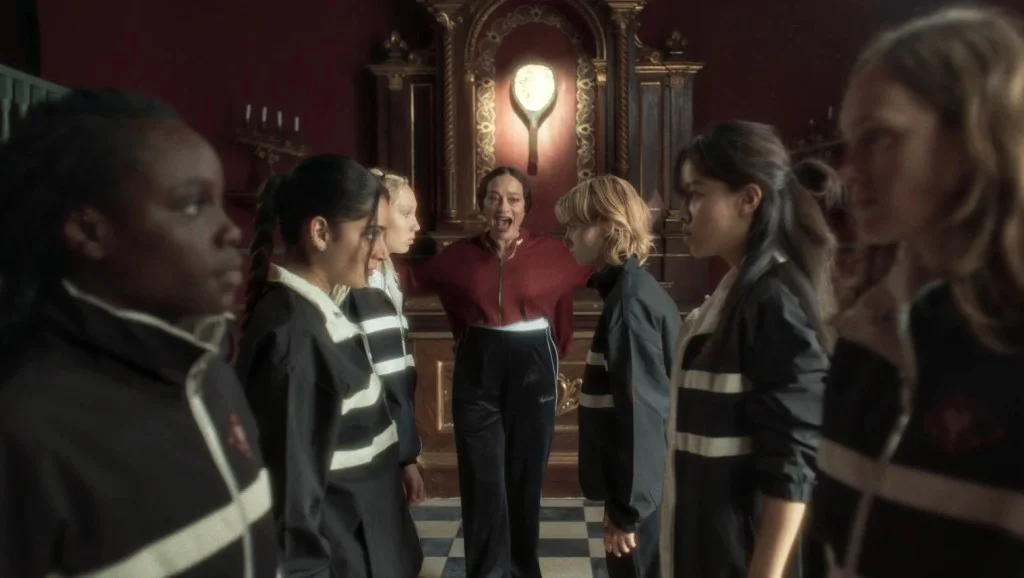
Kampp helps hold our attention through that repetition. Sophie watches carefully and gives little away, which leaves room for uncertainty about what she might do once she understands the academy. Her restraint has a cost, though. The film asks us to track a young woman being changed by competition while keeping much of her response beyond our reach. Mary’s rules tell us what Sophie stands to lose; Kampp’s performance does not always let us feel how close she is to losing it.
Her attraction to Bana (Tracy Gotoas) briefly gives that loss a human scale. Their connection allows Sophie to want something from another player besides victory, in a place designed to make closeness dangerous. An intimate moment involving blood pulls the relationship into the film’s violent world.
The choice is striking, though it leaves too little ordinary time between them for the threatened bond to carry all the weight it could. The scene makes it harder to tell where desire ends and the academy’s idea of endurance has taken hold, but the relationship needs space to matter beyond that provocation.
Bloody Tennis grows livelier as the consequences of losing become immediate and Sophie’s choices come into sharper focus. That late energy brings some pleasure to the film’s ugly invention. It cannot restore all the tension lost during the repeated training and punishments, when we were often waiting for Sophie to catch up with what the opening had told us. The film is most affecting when a tack in a player’s toe makes the next step frightening or Sophie’s attachment to Bana complicates the contest. Those moments make the violence hurt in a way another display of blood cannot.
Bloody Tennis premiered globally on Shudder on September 25, 2026. The horror film follows a young athlete admitted to an elite, secluded tennis academy where extreme competition masks a dark and terrifying reality.
Where to Watch Bloody Tennis (2026) Online






Full Credits
Title: Bloody Tennis
Distributor: Shudder
Release date: September 25, 2026
Running time: 1 hour 34 minutes (94 minutes)
Director: Nikias Chryssos
Writers: Nikias Chryssos
Producers and Executive Producers: Jonas Katzenstein, Maximilian Leo
Cast: Sandra Guldberg Kampp, Elina Löwensohn, Helena Zengel, Zlatko Burić, Tracy Gotoas, Lily Taïeb, Lucie Zhang
Director of Photography (Cinematographer): Constantin Campean
Composer: Jim Williams
The Review
Bloody Tennis
Bloody Tennis makes the academy’s courts feel dangerous through bodily strain, a cruel training regime and a few nasty uses of tennis equipment. Kampp’s guarded Sophie holds our interest, and the final stretch finds welcome energy. Too often, though, the film shows us the threat early and leaves us waiting for Sophie to catch up. Its violence lands hardest when her bond with Bana gives her something to lose.
PROS
- Tense opening built on what the audience knows
- Physical, unsettling views of play
- Livelier final stretch
CONS
- Repeated ordeals dull the suspense
- Matches lack sporting tension
- Sophie and Bana need more time together