

























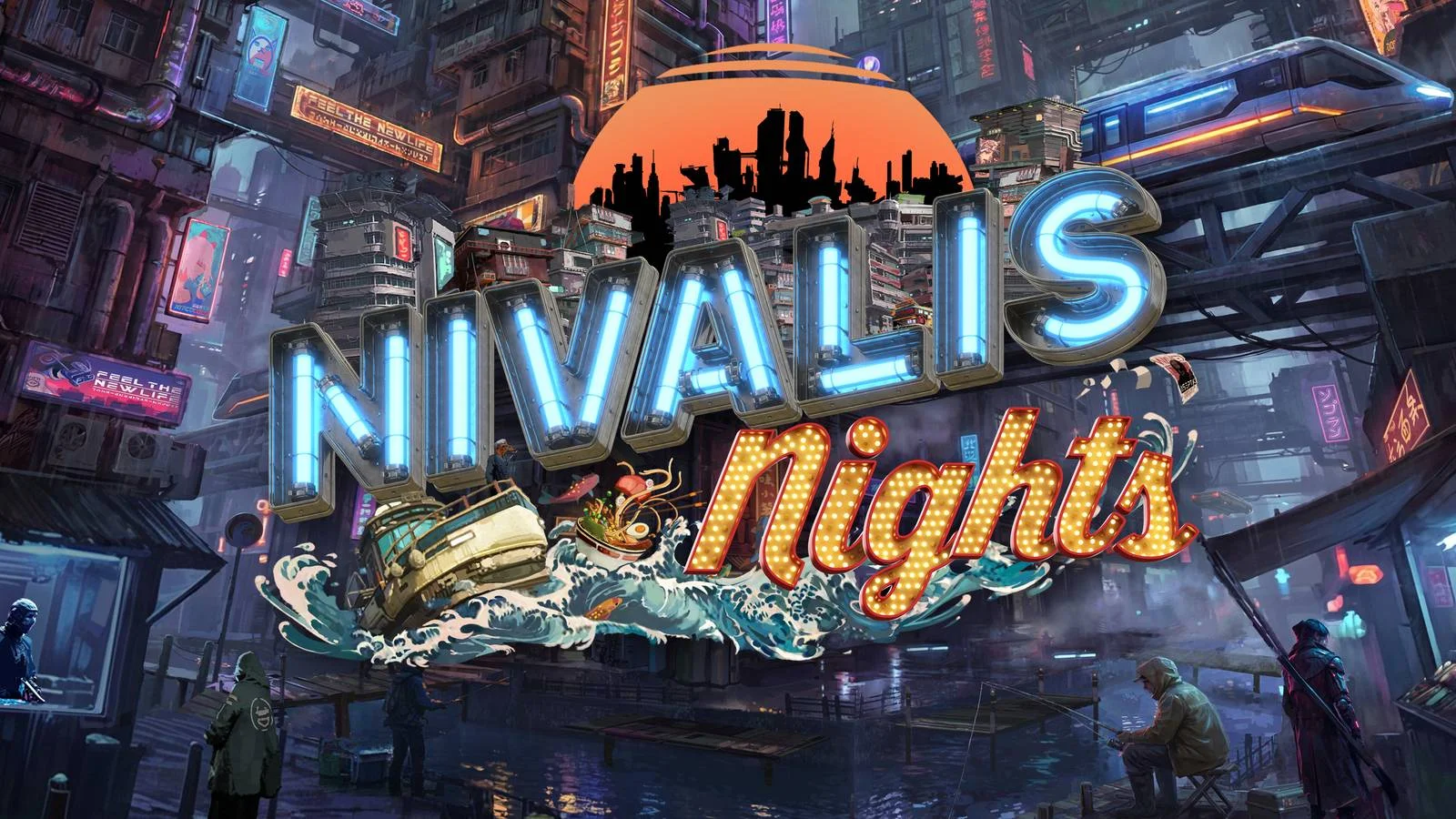

Returning to Cloudpunk’s city as a restaurant owner changes which parts of it you need to understand. Suppliers, potential employees, and neighboring businesses acquire a practical importance alongside the skyline. Ion Lands uses that familiar setting for a separate game, Nivalis Nights, where the first substantial opportunity is a struggling noodle stand called Ramen Noir. The debt comes with it. With Banor explaining the basics and Ava, an AI connected to your mind, providing guidance, settling into the city means learning how to keep this modest operation solvent.
The restaurant gives that change of perspective a satisfying progression. Initially, buying ingredients, preparing orders, serving customers, and cleaning all require your attention. Expansion then complicates tasks you already understand. A larger menu demands additional stock, but ingredients spoil after two days, making excessive purchasing expensive. Increased demand puts pressure on staff and equipment. Orders that cannot be fulfilled lead to discounts, free meals, and poorer business reviews. Success creates fresh decisions about capacity, rather than allowing you to repeat the opening routine indefinitely with larger numbers.
The nightly financial report helps make those decisions legible. Earnings, expenses, outstanding debt, and your standing among other owners provide a useful account of what the day accomplished. Better equipment and recipes offer tangible reasons to reinvest, while larger restaurants and nightclubs extend the ambition beyond the original stand.
Ingredient production also gives the futuristic setting a practical role. Climate-controlled greenhouses can reduce dependence on vendors, and even meat grows from pellets. This is a cyberpunk economy you encounter through purchasing and production, with the daily question of how much food you can afford to keep available.
Hiring changes the nature of that work. Employees have different statistics, schedules, and suitable roles, so adding another person requires some thought about what the business needs. Cooks and waiters gradually release you from individual tasks; managers can take over shopping and scheduling.
Delegation is a credible reward for building a functioning operation. It also exposes a weakness in the wider simulation. Once the restaurant needs less supervision, the activities outside it must provide enough purpose to fill the time you have earned. Quests and exploration can do that, but slow unlocks and waiting periods sometimes leave the routine short of interesting decisions.
The domestic side has particular difficulty carrying that responsibility. Apartments offer furniture, plants, and lighting to arrange, yet objects such as the treadmill, shower, and washing machine contribute little sustained activity. There is no need to maintain hunger or hygiene, which sensibly avoids adding another set of chores to an already demanding opening.
The limitation is how rarely the home becomes useful after decoration. Sleeping on the boat further loosens your dependence on it. Fishing supplies ingredients and a pleasant reason to visit the water, but its simple casting and reeling cannot provide the same continuing involvement as balancing the restaurant’s stock and staffing.
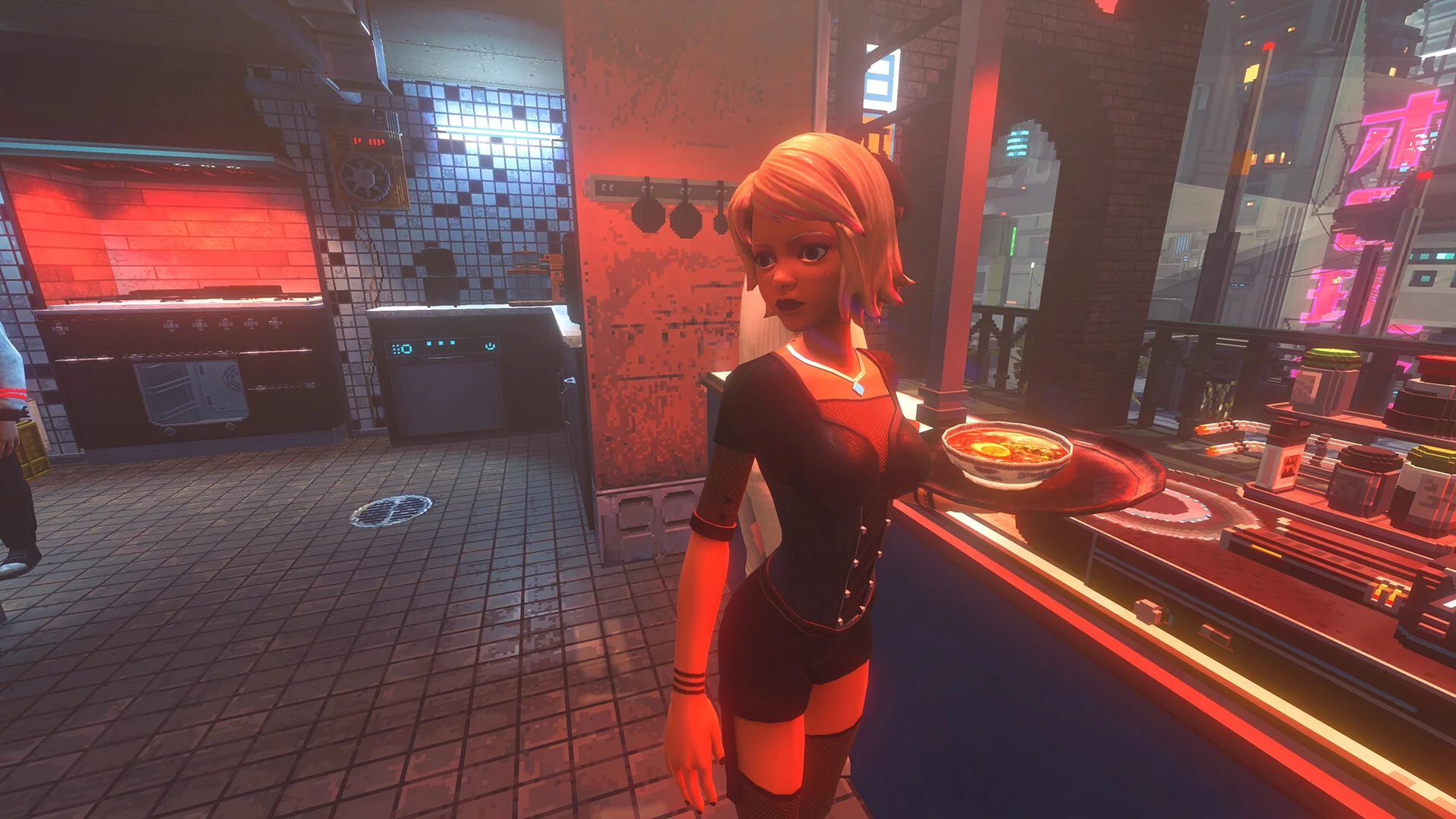
Conversations help bridge that gap because they feed both progression and attachment. Recipes arrive through people, quests, and visits to restaurants, giving contacts a role beyond incidental conversation. The city’s corporate restrictions make those connections consequential.
CorpSec can ask for cooperation, questionable work, or information about fellow entrepreneurs, while collaboration between business owners is itself prohibited. Refusing to cooperate or choosing solidarity gives the restaurant’s expansion a social setting. The serial killer investigation strengthens that connection in a different way: victims carry substantial debt, so your own balance sheet belongs to the story’s threatening circumstances.
The smaller stories give this world its most distinctive character. A quest involving a dead husband’s persona construct inside a Flavor unit places recognizable attachment inside the city’s technology. Elsewhere, a detective-like robot delegates work it apparently has the capacity to perform, and a therapy-bot charges 10 Lims for generic wellness advice.
These encounters find humor in services that offer less help than their purpose suggests. They also give the city interests beyond your commercial success. The voice acting for named interactable characters helps sustain attention through these encounters, making a trip away from the restaurant feel worth taking even when it does not immediately improve the business.
Written encounters and ongoing relationships are less evenly matched. Dialogue choices can affect connections and quest outcomes, and the possibility of failing a quest gives conversation some weight. Dating, however, does not permit casual interaction whenever you meet a partner.
A character can walk past without engaging unless a quest or conversation is available; the known-characters tab’s speech bubble tells you when there is something to say. That restriction makes intimacy depend heavily on scheduled content. For players returning to Cloudpunk’s setting hoping to establish a lasting place within it, the distinction matters: Nivalis Nights gives you people worth knowing, but limited ways to spend ordinary time with them.
The environment remains a strong reason to linger between those encounters. Voxel and pixel-inspired architecture gains texture from neon reflected across wet streets, thunderstorms, and moving clouds. Synth music and ambient sound give the districts continuity while you move between errands.
Taking the boat out during rain offers a welcome change from watching orders and expenses. Loading screens separate districts, so the city is not a seamless expanse, but its weather and waterways still make travel attractive. The visual appeal earns time that the thinner domestic activities sometimes struggle to occupy.

Finding a particular destination is another matter. The map works chiefly as a district and fast-travel display, without the local detail needed to locate businesses efficiently. Compass markers accumulate even for quests in other districts, and fast travel often leaves you near a transport station instead of the contact you came to visit.
These inconveniences become especially noticeable when recipes and relationships require repeated trips. The restaurant interface has a related problem: an extensive recipe collection lacks an ingredient filter, forcing you to inspect dishes individually when trying to use available stock. Collecting options is satisfying; putting them to work involves unnecessary searching.
Technical instability can interrupt the same pleasures. Busy areas can stutter and lose frame rate, while clipping, stuck characters, and occasional crashes further disturb the city’s activity. Performance severity varies, but these problems deserve weight in a game that invites unhurried exploration. The tutorials are uneven too. Ava can interrupt frequently while practical information, including how to equip and use the fishing rod, remains insufficiently explained.
The 1 A.M. curfew exposes the cost of those omissions particularly clearly. Transport closes, creating a useful reason to plan your evening, yet emergency apartments in each district allow nighttime activity to continue. Without adequate guidance about that accommodation, a player can spend the evening trying to get home instead of discovering what the city permits after dark.
The Review
Nivalis Nights
Nivalis Nights gives Cloudpunk’s city a satisfying new purpose through restaurant ownership. Stock, staffing, and expansion make growth worth working toward, while personal stories give you reasons to leave the kitchen. The surrounding life simulation struggles to match that depth: apartments offer limited activity, relationships depend on available conversations, and automation can leave quiet stretches underfilled. Awkward interfaces and uneven performance complicate the return, but players interested in building a business within this setting will find a rewarding routine.
PROS
- Restaurant growth creates meaningful decisions about stock and staffing.
- Personal quests connect business ownership to city life.
- Weather, lighting, and sound reward unhurried exploration.
- Delegation creates freedom to pursue other activities.
CONS
- Domestic activities offer limited depth.
- Relationships lack casual, ongoing interaction.
- Maps, recipe menus, and tutorials create unnecessary friction.
- Performance instability and glitches interrupt exploration.