






















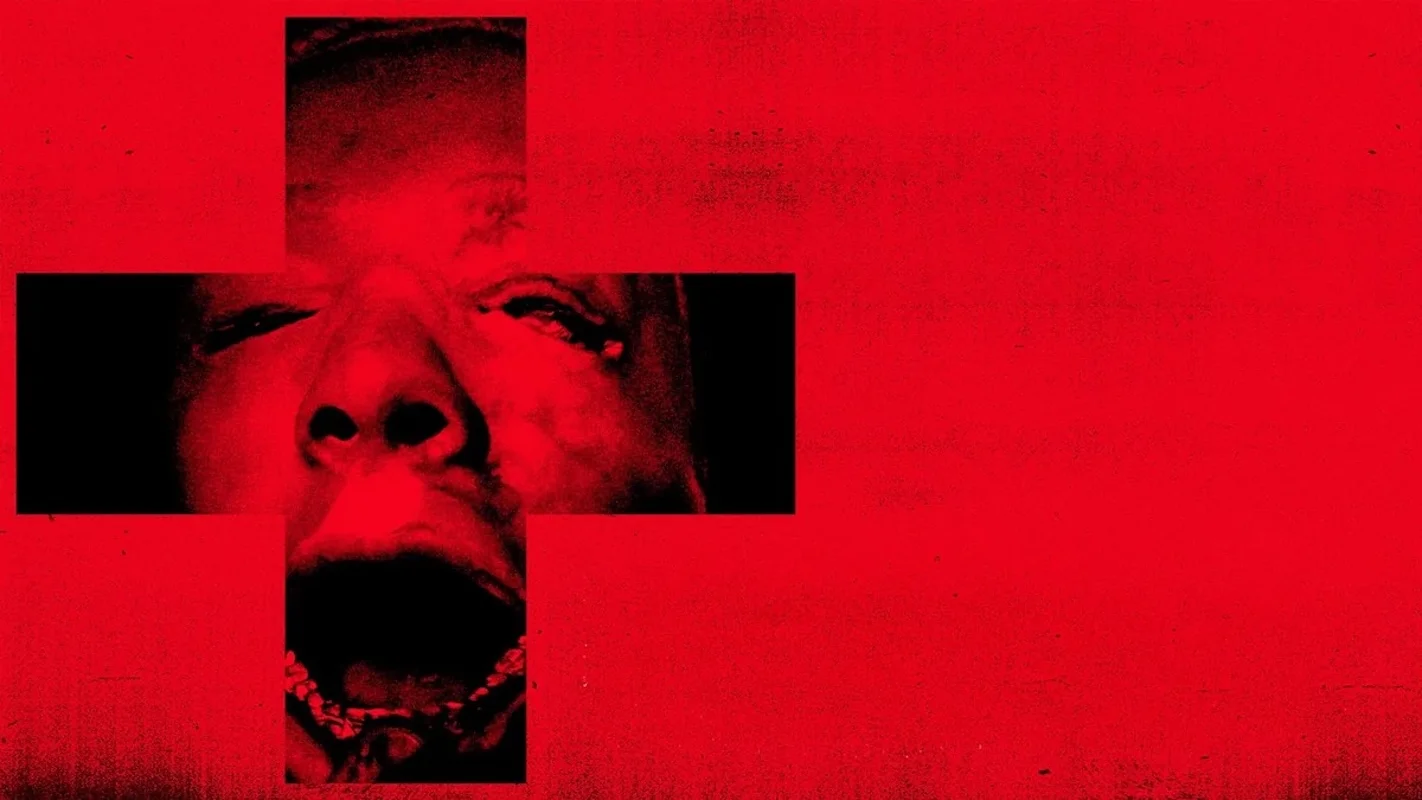

The security cameras in Nicholas Pineda’s Infirmary give you enough time to become suspicious of an empty hallway. Your attention drifts toward doorways and the far end of the frame, checking for something the image might be concealing in plain sight. Edward, a veteran arriving for his first overnight security shift at an abandoned psychiatric hospital, has been hired to perform much the same task. Watching these recordings, you begin doing the job with him. An uneventful view starts to feel like something you have failed to inspect properly.
Switching to the guards’ bodycams changes that relationship. The fixed cameras let you examine a space from a distance; the footage attached to a moving person makes every approaching doorway an immediate concern. Pineda moves between the anxious patience of observation and the discomfort of entering the place you were watching. Occasionally, the wider surveillance view gives the audience information Edward lacks. That advantage is unpleasantly useless. You can search the image for danger, yet the person whose safety interests you remains beyond your reach.
Wilshire Hospital supplies plenty to search. Damaged ceilings, grime, suspended dust and corridors washed in yellow-green light make the building feel physically disagreeable before its history enters the conversation. Patchy illumination leaves Edward dependent on a flashlight, whose beam offers temporary reassurance while making everything outside it harder to ignore.
The early tour also gives these spaces a place in your memory. Anyone familiar with survival-horror games will recognize the nervous habit of learning a route while wondering how safe it will remain. Here, similar hallways and darkness make that knowledge uncertain. Recognizing a room does little to settle your nerves about reaching it.
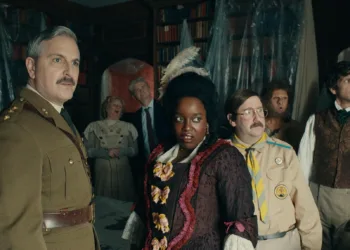
Edward’s guide offers even less reassurance. Lester, the longtime guard played by Mark Anthony Williams, treats induction as an opportunity to insult and frighten his replacement. His nastiest prank involves locking Edward inside a morgue compartment used for corpses.
It is an effective source of discomfort because the threat comes from someone Edward needs to trust. Starting a new job already means accepting another person’s account of how things work. Lester makes that dependence humiliating, then leaves Edward to distinguish genuine warnings from another attempt to amuse himself.
Williams commits to the hostility, making Lester’s company tiring in a way that serves the setting. There is little comfort available from sharing the shift with him. His refusal to enter the corridor toward the basement becomes particularly unsettling beside his willingness to conduct the morgue prank. He can manufacture fear in one room and acknowledge his own fear of another without giving Edward a dependable way to separate the two. Later disturbances therefore carry a useful uncertainty: Lester has established himself as a plausible human explanation for something that feels wrong.
Edward receives less dramatic definition. His discharge following an injury and his attempt to find civilian employment give the shift a personal purpose, but the repeated searching and investigating do little to develop that purpose. We spend considerable time close to his movements without gaining comparable access to his feelings about this new life.
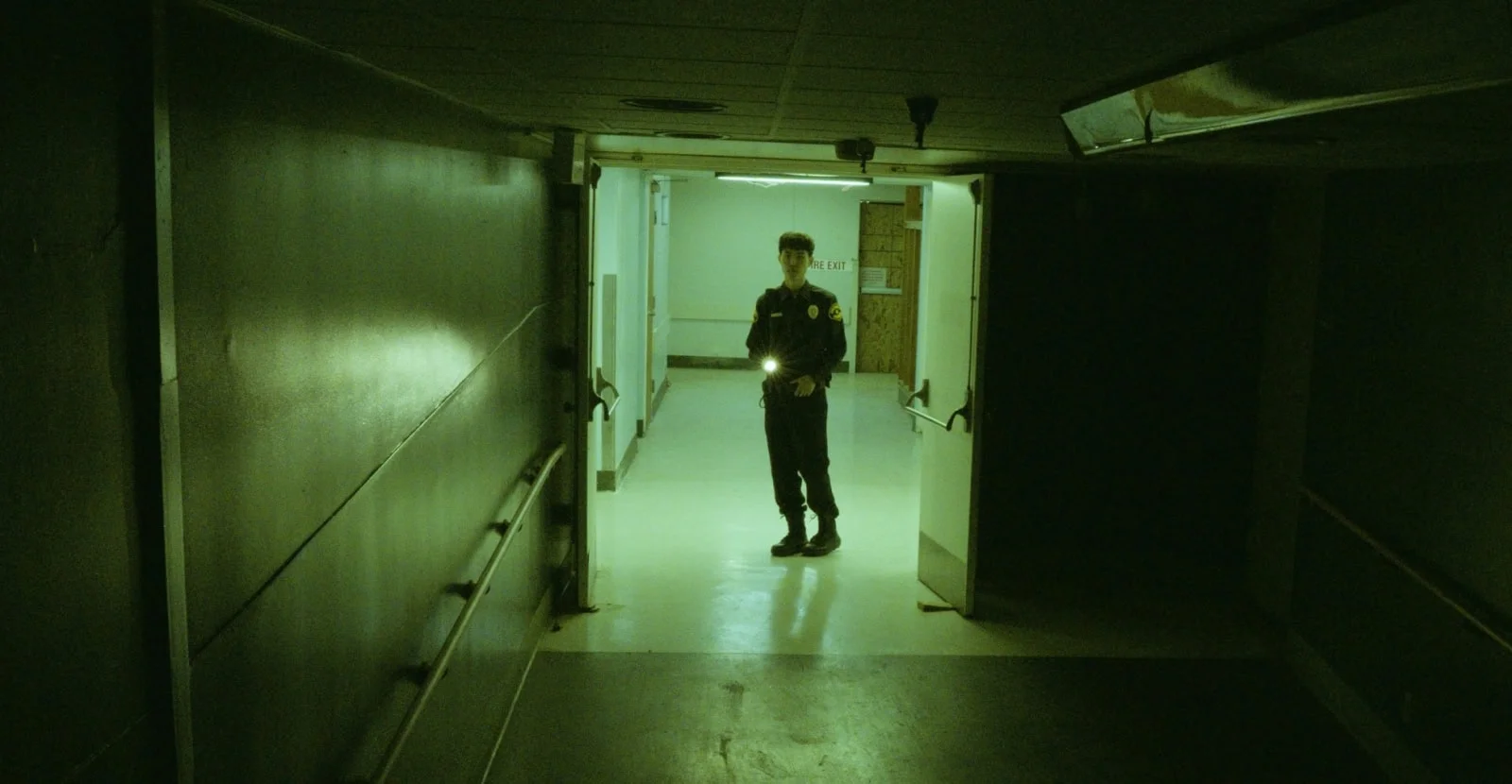
The bodycam supplies physical proximity almost automatically; attachment takes further work. I wanted him to get out because moving through this building looked miserable and dangerous. The film gives that immediate concern much firmer support than a lasting interest in who he is.
The medical mannequins help bridge that gap by making the danger unusually easy to imagine. Introduced in the chapel beneath red light from a stained-glass window, their awkwardly fixed bodies are disturbing before they appear elsewhere in the hospital.
Lester’s account of the Wilshire couple’s cruel experiments, including attempts to transfer patients’ minds or souls into artificial bodies, gives their stillness a horrible possibility. Once their placement becomes unreliable, watching them involves remembering where they belonged. A stationary figure can keep troubling you between appearances because the next view might contradict what you thought you knew.
Some of the simpler disturbances work through a similar manipulation of attention. A door opens by itself, inviting Edward to investigate, then slams shut as he approaches. Echoing footsteps give him something to locate without immediately supplying a source.
These incidents turn curiosity into exposure: finding out what happened requires getting closer. Across the repeated walks, noises and inspections, however, that exchange becomes familiar. The hospital’s history supplies sinister background, but the encounters do not consistently deepen our understanding of it or Edward. Anticipation starts to settle into a routine of waiting for the next interruption.
The soundtrack pushes that routine toward an easier response. Droning music and emphatic jump-scare sounds tell the audience how to receive images that are supposedly recovered evidence from an unresolved 2023 incident. The issue is emotional before it is a question of format purity.
Searching a quiet frame lets anxiety develop at your own pace. A musical warning starts directing that search, and a loud sting can end it with a reflexive jump. Those jolts have force, but they repeatedly interrupt the more absorbing sensation that something might have escaped your notice. The footage begins to feel prepared for your reaction.
The power failure intensifies Edward’s exposure while narrowing the opportunities for that patient watching. The late stretch becomes frantic and disorienting, trading the earlier inspection of spaces for the urgency of moving through them. Night vision introduces a particularly uncomfortable difference between seeing a recording and occupying the recorded space. The image gives the viewer details that darkness denies Edward. You can keep examining what surrounds him while he struggles to read the place himself.
Infirmary premiered on Shudder and AMC+ on October 2, 2026. The found-footage horror film follows the recovered bodycam footage of a security guard who vanished on his first night guarding an abandoned psychiatric hospital.
Where to Watch (2026) Online




Full Credits
Title: Infirmary
Distributor: Shudder, AMC+
Release date: October 2, 2026
Rating: TV-MA
Running time: 1 hour 25 minutes (85 minutes)
Director: Nicholas Pineda
Writers: Katy Krauland
Producers and Executive Producers: Nicholas Pineda, Katy Krauland
Cast: Paul Syre, Mark Anthony Williams, Danielle Kennedy, Corinna Wagner-Smith
The Review
Infirmary
Infirmary made me anxious about entering its corridors without making me equally invested in the man walking through them. The surveillance views, shifting mannequin placements and Lester’s cruel induction give that anxiety a tangible shape. Repeated investigations and emphatic sound cues gradually weaken the pleasure of searching for danger yourself. There is effective horror here, especially in the hospital’s oppressive spaces, but Edward’s thin characterization limits how deeply it settles.
PROS
- Surveillance and bodycams create different kinds of vulnerability.
- Decaying hospital spaces sustain physical unease.
- Unreliable mannequin placements reward anxious attention.
- Lester’s pranks complicate trust and apparent danger.
CONS
- Edward’s personal stakes receive limited development.
- Repeated investigations make anticipation increasingly routine.
- Musical warnings and loud stings weaken immersion.