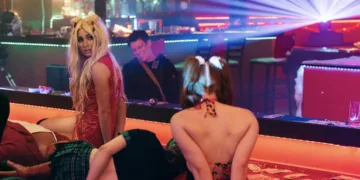




























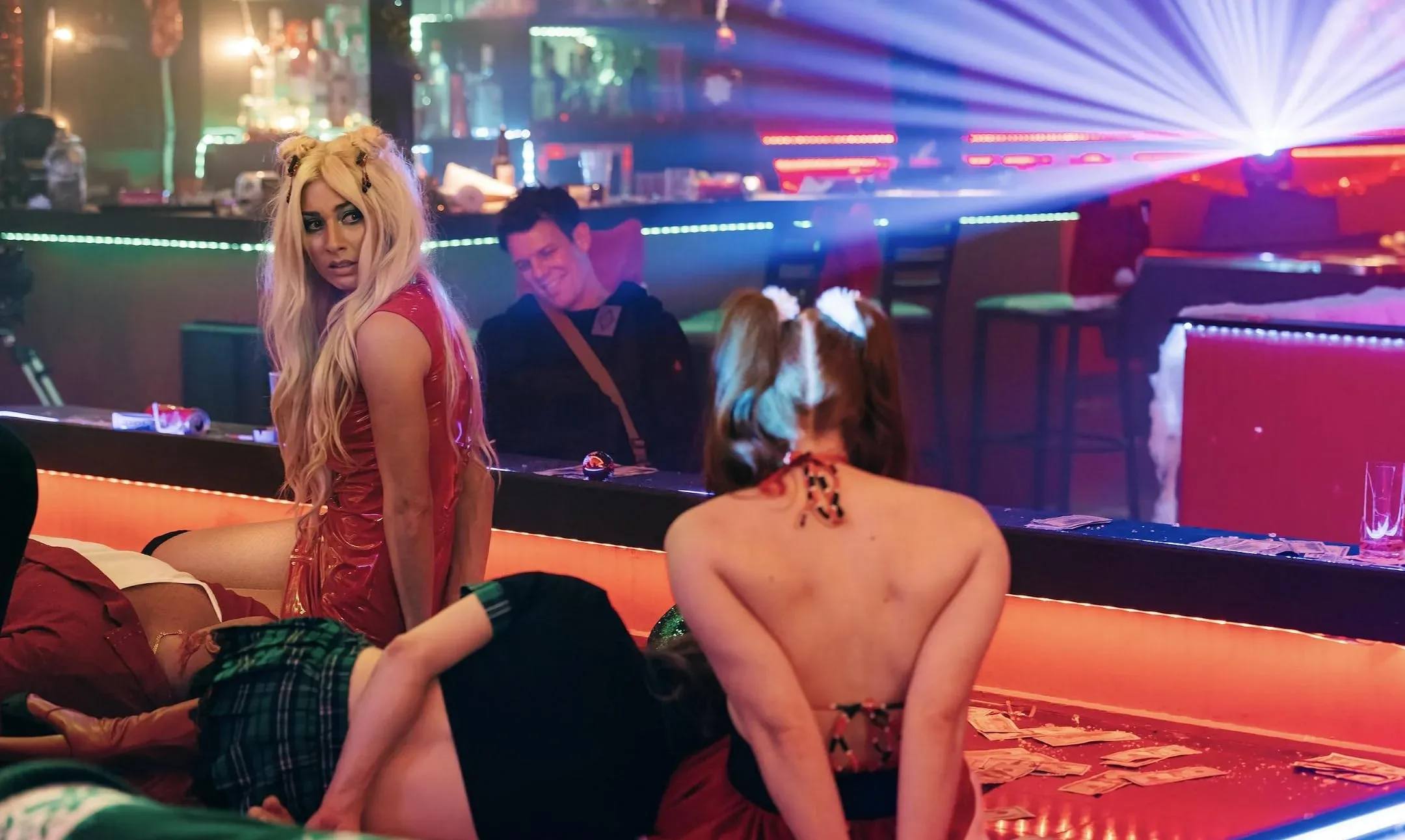

The gunmen at Hawg Heaven have a volume problem. During the armed standoff in Clark Duke’s Stranglehold, music obstructs their shouted exchanges, and subtitles carry the dialogue across the screen. Threats must compete with the club’s own entertainment. The written words give us a readable version of a conversation the people conducting it struggle to manage, placing the audience in an unusually comfortable position: we can follow the aggression while enjoying its failure to impose order.
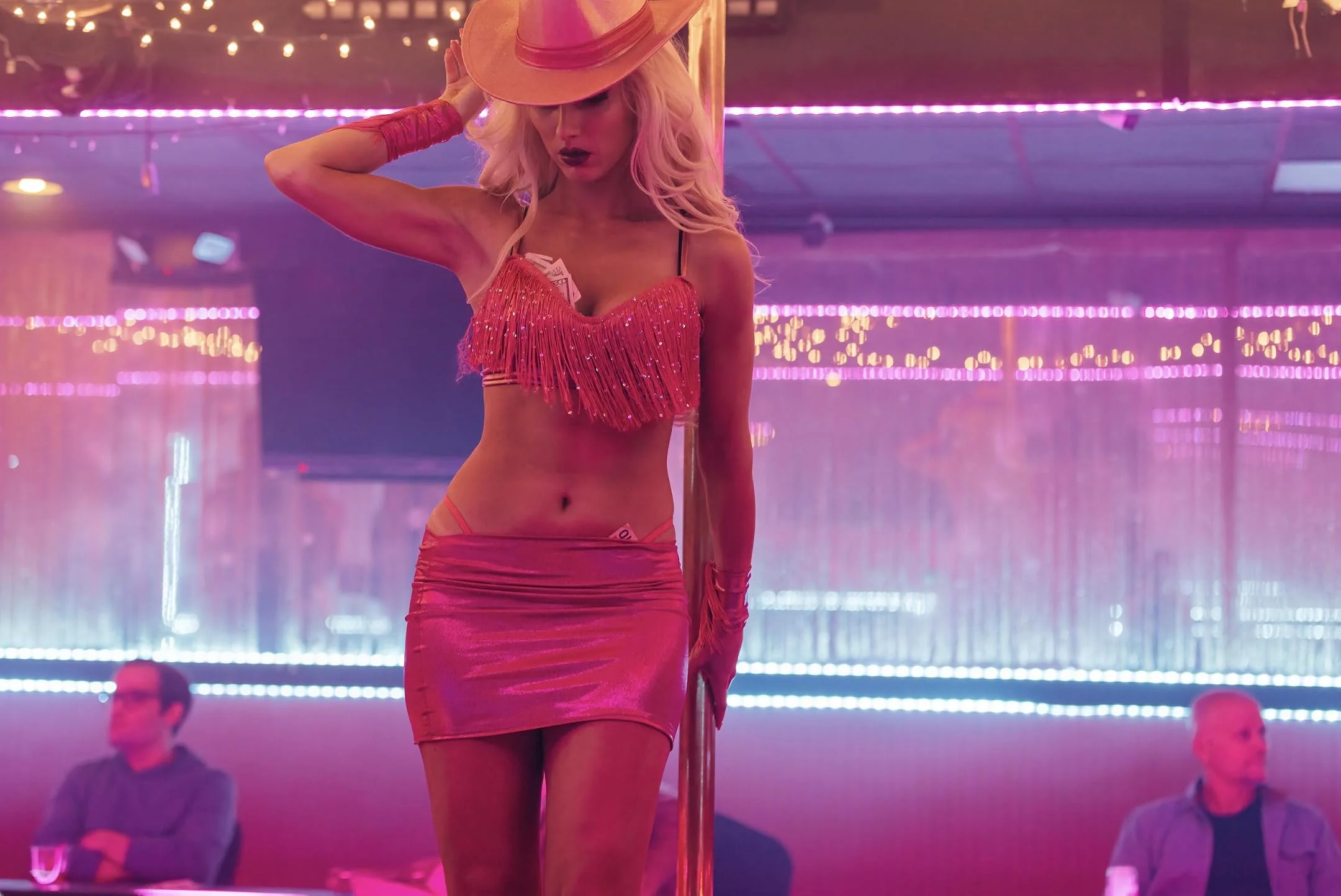
Earlier, the club’s customers barely look up from their phones while Bailey dances. Removing her top purchases their attention; expressive movement does not. This is a small, ugly transaction, and Duke lets it explain the workplace before anyone attempts to rob it. Bailey is visible on terms established by the people paying her. When she returns with a weapon, she tries to dictate those terms herself. The subsequent shouting match subjects that attempted reversal to ridicule, but the original humiliation remains lodged beneath the joke.
Ashley Benson plays Bailey, a stripper in small-town Arkansas whose infant daughter needs expensive medicine and whose trailer threatens to fill with sewage. Christmas approaches with its customary insistence that a household demonstrate happiness through purchases.
Bailey’s phone offers another display she cannot afford: influencers presenting their lives as uninterrupted prosperity. Duke puts these competing demands within reach of the same character, allowing the fantasy of wealth to rub against the immediate necessity of caring for a child. Her interest in the club’s private party, where criminal guests will bring substantial money, grows from circumstances the film has made tangible.
Her husband Tim is a less reassuring resource. Jake Lacy gives this military veteran an abrasive comic presence built around drinking, conspiracy talk, and the refusal of ordinary responsibility. Tim loses his store-greeter job after resisting its rules, neglects his parental duties, and owns enough guns to make a desperate plan seem actionable. His car requires a breathalyzer before it will start. The machine has developed a firmer position on his judgment than his household has. Turning to him for assistance gives Bailey access to weapons while tying her escape to a man already struggling with the obligations of staying put.
Lacy’s later dramatic seriousness complicates the temptation to dismiss Tim as an assortment of bad habits. It does not repair the choices that placed his family in greater difficulty. Benson supplies a different continuity: Bailey’s frustrated efforts to earn money remain connected to the determination she brings into the robbery. Her performance keeps practical need legible amid the grotesques. That connection is essential to the film’s moral interest. We can understand why she acts without assuming that understanding makes her plan sound. The noir inheritance sits here, in the protagonist who recognizes a trap accurately and chooses an exit capable of closing around her.
Hawg Heaven has already blurred the distinction between lawful work and criminal extraction. Junior, played with enjoyable nastiness by Justin Long, shortchanges and humiliates the women whose labor supports the club. His father Roger runs the enterprise, and the private celebration is linked to money laundering.
Bailey’s robbery threatens people who have their own methods of taking money. Duke avoids giving the crime a reassuringly innocent target, yet the arrangement creates another risk: the audience can begin to treat her violence as an overdue correction to the payroll. Junior’s behavior earns contempt easily. It cannot make every consequence of attacking his workplace harmless.
The initial operation has a brisk, intelligible progression: Bailey and Tim subdue the guests and reach the money, then a silent alarm summons an armed response. Chandler Duke’s security character arrives after arguing with his partner on the drive over, carrying domestic friction into a situation demanding coordinated action.
The expanding confrontation draws its comedy from people trying to exercise authority they cannot reliably sustain. The club gathers employer, worker, criminal patriarch, and would-be rescuers into the same crisis. Its social hierarchy remains recognizable after the guns scramble its practical arrangements, which gives the ensemble’s disorder a useful shape.
The music-and-subtitles device is less elastic than Duke needs it to be. Initially, the split between audible obstruction and readable speech makes the aggression absurd without rendering the exchange incomprehensible. Continued shouting then keeps returning us to an established joke.
The characters struggle to communicate, we understand the struggle, and the siege waits for the next exchange. Extended banter compounds the loss of urgency. The issue is accumulation rather than simple confusion: we can follow the confrontation while feeling too little change in its pressure. Increasing the bloodshed cannot, by itself, recover the uncertainty spent on repetition.
Roger offers the film its most concentrated visual contradiction. Ron Perlman’s criminal patriarch wears a Santa suit while being held captive, turning a familiar image of generosity into the costume of a man whose business exploits need. His defense of rugged individualism arrives from someone with a criminal income and a son installed in management.
Perlman gives that authority weight, making the contradiction worth examining rather than merely spotting. Roger can diagnose the younger men’s grievance and still remain an interested party. The suit allows benevolence to remain visible while the enterprise behind it supplies an entirely different account of how people obtain money.
The political dialogue becomes less effective when it explains pressures already enacted through Junior’s wage theft, Tim’s irresponsibility, and Bailey’s deteriorating home. Those details have given the satire specific objects; extended explanation pauses the danger to identify them again.
The increasingly bloody finish also changes the terms of our attention, inviting pleasure in violent consequences while Bailey tries to contain the peril she helped create. Her effort to return to her daughter keeps an obligation alive that neither Roger’s lecture nor the gunmen’s posturing can discharge. Leaving the club is now a physical problem, measured against the same child’s needs that made its cash seem worth taking.
Stranglehold released on digital and on demand platforms on October 2, 2026, courtesy of Quiver Distribution. The crime comedy follows a small-town stripper and her Army veteran husband who hatch a desperate plan to rob the strip club where she works.
Where to Watch Stranglehold (2026) Online






Full Credits
Title: Stranglehold
Distributor: Quiver Distribution
Release date: October 2, 2026
Rating: R
Running time: 1 hour 30 minutes (90 minutes)
Director: Clark Duke
Writers: Chandler Duke, Clark Duke, Billington Garrett
Producers and Executive Producers: Jordan Yale Levine, Jordan Beckerman, Michael Day, Clark Duke
Cast: Ashley Benson, Jake Lacy, Justin Long, Chandler Duke, Ron Perlman, Elle King, David Arquette, Brian Posehn
The Review
Stranglehold
Stranglehold gives its Christmas heist a persuasive moral trap: Bailey attempts to escape exploitation by seizing control of the place exploiting her. Ashley Benson sustains that tension, while Ron Perlman’s captive Santa makes criminal authority look absurdly benevolent. Duke’s comedy loses pressure through repeated subtitled shouting and extended banter, and the political speeches explain contradictions the action has already exposed. The performances keep the film engaging, but its siege needs sharper escalation to match the force of its setup.
PROS
- Ashley Benson preserves Bailey’s sympathetic, compromised agency.
- Lively comic performances give the ensemble definition.
- The workplace supplies a convincing motive and moral trap.
- Roger’s Santa costume sharpens the satire of paternal authority.
CONS
- The subtitled shouting gag outlasts its comic usefulness.
- Extended banter weakens the siege’s urgency.
- Political speeches repeat ideas already established through behavior.