

























After surviving a car accident, Alex Serian wants to know what happened to his cello. His own body has escaped injury, but he speaks as if the instrument were the vulnerable party, the one whose condition requires an account. Pedro Pascal gives this displacement the ordinary shape of a practical concern. Alex knows how to worry about something he can inspect. The prospect of his own disappearance seems harder to approach.
Among musicians, that narrowing of attention becomes a source of pleasure. Tony Gilroy’s Behemoth! watches Alex enter a recording studio where colleagues welcome him, rehearsal language passes between players, and the demands of the score give everyone something to attend to together.
He belongs here. The warmth of these exchanges complicates any easy reading of him as a man sealed against human contact. Playing allows him to respond to others with precision, without having to explain himself. Gilroy makes that responsiveness palpable in the sessions, where individual skill takes its place inside a collective sound.
A celebrated cellist who has spent roughly twenty years moving between orchestras and cities, Alex returns to Los Angeles as his mother’s health fails. Session work brings him into the machinery of film scoring, and the music recorded there follows him beyond the studio.
A passage performed for a fictional production becomes the accompaniment to an encounter or a memory. The transition can feel almost involuntary, as if Alex has carried a sound away without noticing how much of his life it has begun to occupy. The nine composers credited as the Behemoth! Collective supply an abundance of musical voices for a man whose spoken responses remain carefully rationed.
That fluency has a long history. Television footage shows Alex playing Bach on Johnny Carson’s show at six, already capable of giving an audience something extraordinary. His father, Peter, an accomplished composer and musician, pushed the boy’s talent; the adult Alex retains the competence without appearing comfortable inside its public history. The footage leaves a peculiar ache.
A childhood survives as a performance available for replay, while the person who lived it offers little explanation of what it cost. Pascal’s restraint is persuasive here because the archive itself supplies the pressure. The child can still be watched. The man cannot easily be reached.
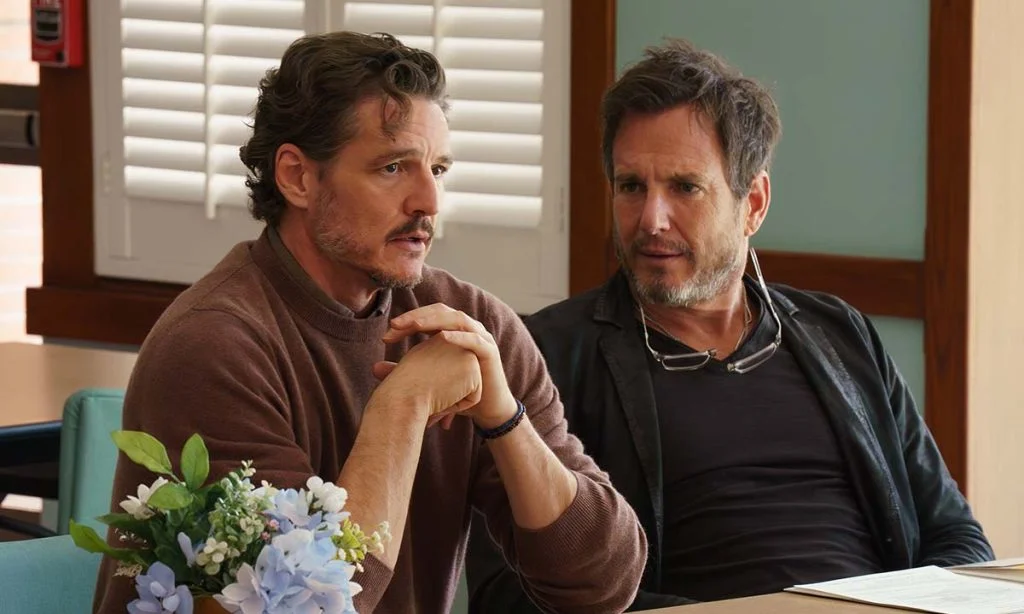
His brother Andy has found another way to live with that inheritance. Played by Will Arnett with resentment beneath an informal manner, Andy now hosts a podcast devoted to their father’s film and television music, after leaving classical viola for a rock career. Alex departed; Andy keeps returning to the recordings.
Their mother, once a renowned harpist, is losing her memory to dementia. Family achievement remains available in broadcasts and musical cues while the people who might explain the household become inaccessible. The brothers’ conversations offer fragments of recognition, though they do not always develop enough friction to make their shared childhood feel inhabited.
A more disturbing fragment arrives when Alex casually recalls an early sexual experience with an adult woman. His laughter makes the recollection difficult to absorb. The film leaves a possible wound inside an anecdote he has learned to tell lightly, and wisely supplies no diagnosis.
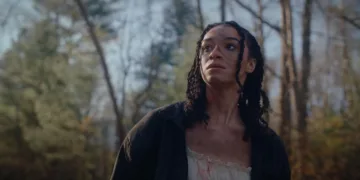
Yet this trust in implication has limits. Nadia, the musician played by Eva Victor with an anger sharp enough to disturb Alex’s composure, confronts his apparent indifference. Her frustration gives his remoteness a human cost. Too often, however, Pascal’s calm remains the same surface before and after such encounters. The feelings around Alex accumulate faster than the film develops his response to them.
Gilroy’s fractured chronology intensifies that problem. Musical passages draw earlier experiences into the present, giving memory the persistence of something still being heard. But the shifts between cities and relationships depend on scattered references, with little visible alteration in the actors.
During the Dallas romance with Nadia and its later aftermath, attention can drift toward reconstructing the interval between events. Loss needs duration: time spent together, time apart, the years in which an encounter might have become something else. When those distances are difficult to establish, the music carries sorrow whose human dimensions remain indistinct.
The same music can be wonderfully mischievous. Alex watches Andy arguing with his wife through a large window while their father’s cartoon score plays through the podcast. Domestic hostility acquires the absurd motion of animation, and the dead father’s work accompanies a household he never enters.
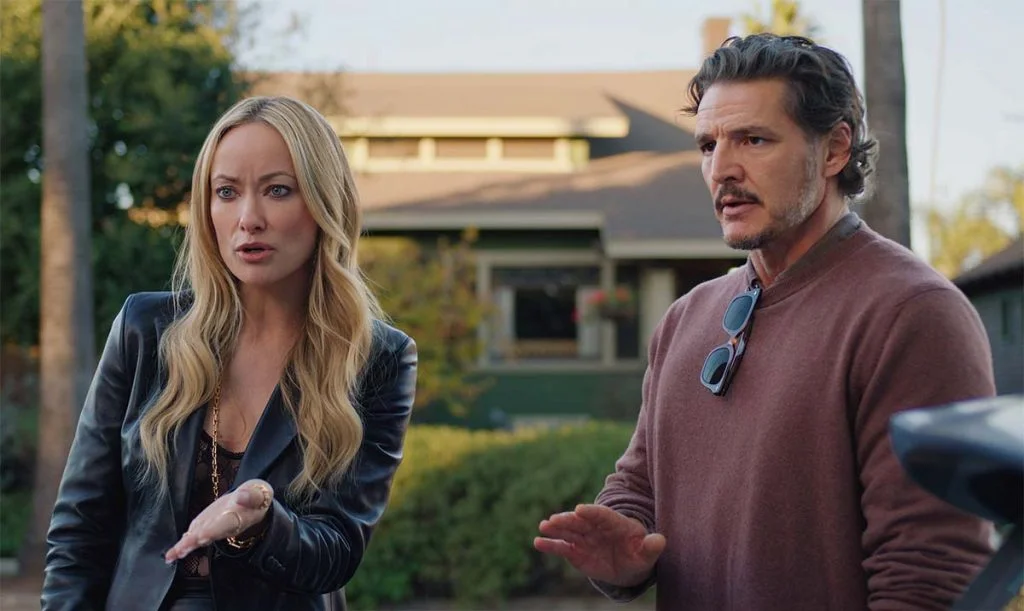
Suspenseful strings similarly turn Alex’s escape from Carol, the wealthy patron played by Olivia Wilde, into a pursuit. These passages loosen the film’s melancholy. They can also protect Alex from scrutiny: Carol’s exaggerated ferocity makes his withdrawal seem sensible before the relationship has received much examination. Her anger becomes entertainment, with its causes left at a distance.
The film grows emotionally clearer when Alex begins attending to younger musicians. Coaching Bronte, played by Kaya Ralls, for a San Francisco Symphony audition gives his expertise a use directed toward someone else’s opportunity. At Nadia’s funeral, her daughter’s original piano composition produces a quieter change. A slow zoom approaches Pascal’s face; small contractions around his eyes register absorption. There is no need for a speech about awakened feeling. For once, the camera catches him receiving something he cannot control, and his concentration becomes an event.
His interest in possible paternity brings urgency, including a mansion infiltration under cover as a caterer’s assistant, inflated into a comic caper by an enormous suspense score. Alex finally acts, though the desire to discover a child of his own sits uneasily beside his family’s investment in inherited brilliance.
The question follows him into the later professional encounter with Nadia’s daughter, when she takes over a major film’s scoring duties. That setting gives the connection its most persuasive terms. She has work to do and musical decisions to make. Alex’s attention must find a place within an achievement already taking shape without him.
Behemoth! had its world premiere as the Centerpiece selection at the 64th New York Film Festival on October 2, 2026, ahead of its wide theatrical release by Searchlight Pictures on December 4, 2026. The musical drama follows a renowned cellist returning to Los Angeles to compose film scores, where he confronts unresolved past choices and reconnects with family.
Where to Watch (2026) Online
Full Credits
Title: Behemoth!
Distributor: Searchlight Pictures
Release date: October 2, 2026 (New York Film Festival) / December 4, 2026 (United States)
Rating: R
Running time: 2 hours 4 minutes (124 minutes)
Director: Tony Gilroy
Writers: Tony Gilroy
Producers and Executive Producers: Tony Gilroy, John Gilroy, Sanne Wohlenberg
Cast: Pedro Pascal, Olivia Wilde, Eva Victor, Will Arnett, Alexa Swinton, Margarita Levieva, Hank Azaria
Director of Photography (Cinematographer): Damián García
Editors: John Gilroy
Composer: Michael Abels, James Newton Howard, Michael Giacchino, Henry Jackman, Alan Silvestri, Emily Bear, Lukas Frank, Nami Melumad, Brandon Roberts
The Review
Behemoth!
Behemoth! is most affecting when listening becomes an act of care. Its recording sessions give loneliness a temporary place among others, and Pascal’s quiet absorption makes the late movement toward connection credible. Gilroy’s fractured chronology sometimes obscures the losses it wants us to feel, while Alex’s composure leaves several relationships insufficiently explored. The music reaches emotional depths the drama only intermittently sustains.
PROS
- Recording sessions convey the pleasure of collective musicianship.
- Music passes expressively between work, memory, and daily life.
- Pascal’s attentive listening gives the funeral scene emotional weight.
- Mentorship brings clearer purpose to Alex’s expertise.
CONS
- Temporal ambiguity weakens the emotional scale of Nadia’s loss.
- Alex’s restrained responses limit the development of key relationships.
- Carol’s exaggerated pursuit overshadows her relationship’s underlying tensions.