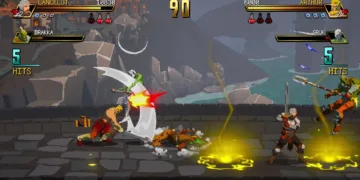

















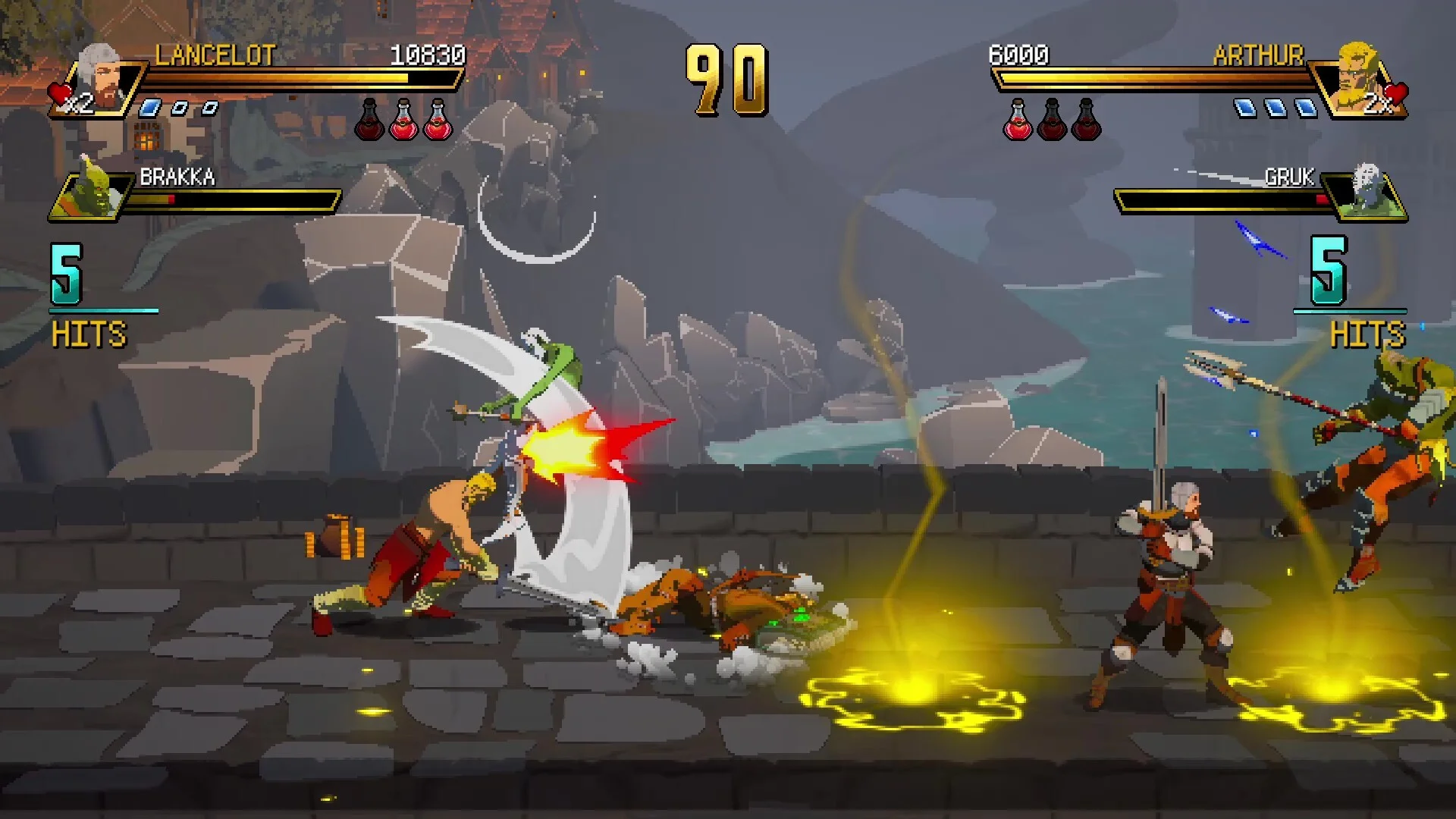

Arthur can send an enemy across the screen, catch it after a rebound, and continue hitting it before it reaches the ground. Blades & Battles makes that sequence surprisingly approachable. Basic attacks feed into launchers and aerial follow-ups, while the tutorial explains how to connect airborne punishment with attacks on the ground. The immediate pleasure comes from understanding a few inputs and discovering how much action they can sustain. You get to experiment with a combo while the unfortunate creature receiving it has very little say in proceedings.
Keeping that sequence going becomes a different problem when other enemies close in. Jumping, dodging, and movement across the fighting area give you ways to reposition, while crowd-clearing powers and emergency knockback offer space when ordinary attacks stop being safe.
Health and mana management put some restraint on that freedom. Breaking containers for restorative pickups becomes part of maintaining your options, particularly when a cooked chicken can repair the consequences of an overambitious assault. The useful decision is often how long to keep attacking before making room to breathe.
QUByte Interactive places this combat in an extravagantly loose version of Arthurian legend. Morgana has kidnapped Merlin, monsters threaten Camelot, and Arthur and Lancelot respond by cutting their way through the problem. Golden Axe provides the recognizable foundation: sword-wielding heroes, fantasy creatures, restorative food, and stages that carry the action toward a boss. The rescue plot supplies sufficient direction without interrupting the fighting with elaborate explanations. Shirtless Arthur and his oversized sword establish the register quickly. Historical dignity has evidently been left with the missing wizard.
The game’s generosity toward offensive juggling becomes less agreeable when enemies return the favor. Two large skeletons can repeatedly launch the player after respawn protection expires, removing a substantial amount of health during a sequence that offers little opportunity to intervene.
That exposes the importance of the recovery and knockback tools. A dangerous crowd can make resource management meaningful, but repeated interruption also needs a readable opening for escape. When the player spends much of an exchange being bounced between attackers, the system’s capacity for extravagant combos starts working against its own accessibility.
Positioning introduces a separate uncertainty. This is a 2.5D brawler, with movement into the foreground and background affecting which attacks connect. Understanding an attack’s range therefore requires judging depth alongside horizontal distance.
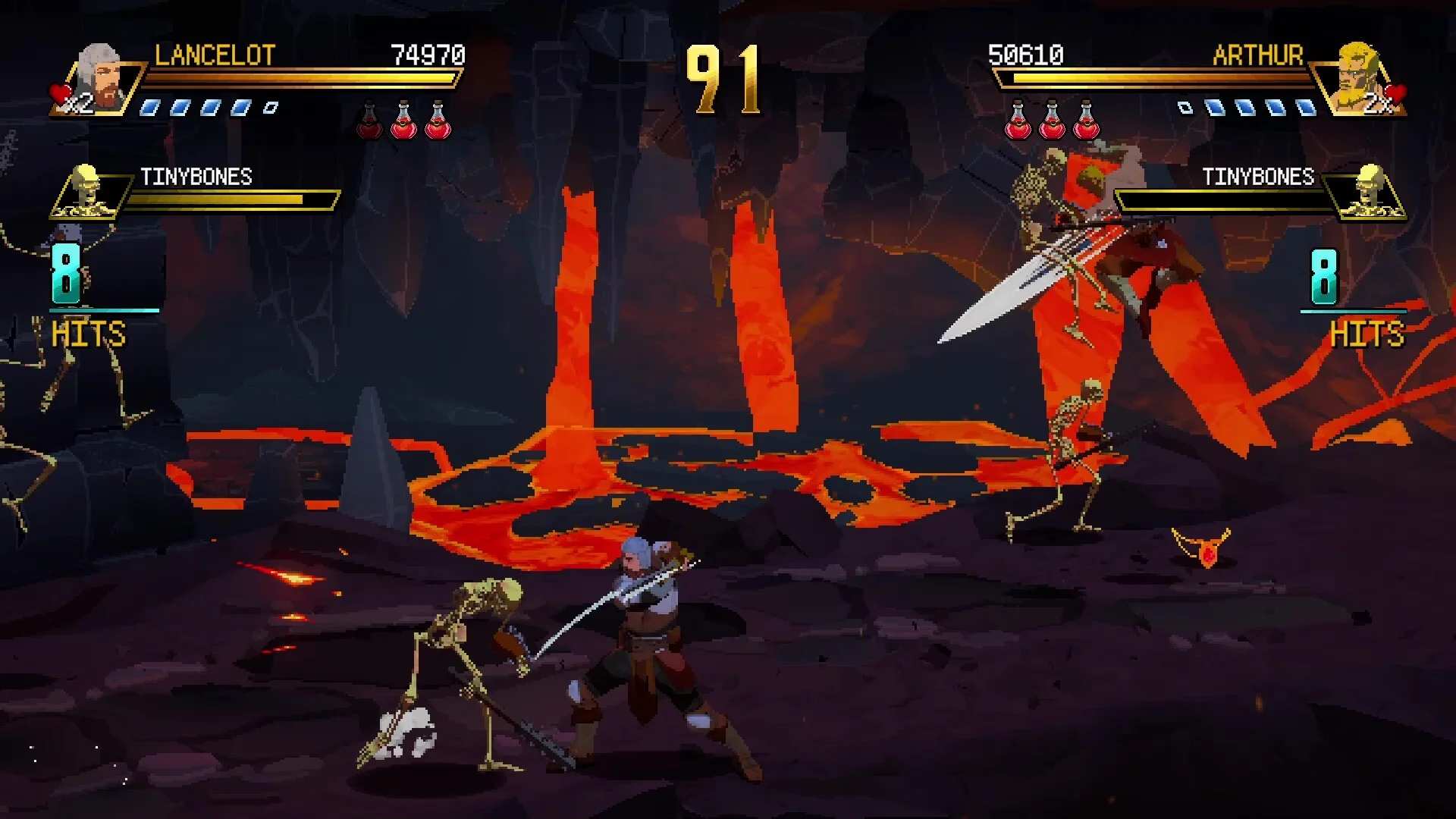
That is a legitimate demand, but hit registration can make the lesson difficult to learn. A sword swing that appears aligned may miss, while an incoming blow can connect across spacing that looks safe. Missing should help you adjust the next attempt. Here, the visible information does not always give a dependable explanation of what went wrong.
The visual treatment adds pressure to that reading process. Characters and environments are rendered in 3D beneath a chunky pixelated finish, producing an unusual approximation of older arcade graphics. The ruined village, forest, and Bone Castle give the campaign changes of scenery, and the portraits and map make room for its exaggerated fantasy personality.
During combat, however, heavy pixelation can muddy the moving figures you need to track. The filter and uncertain contact are separate issues, but both can weaken confidence in positioning. A style that looks distinctive while stationary has another job to perform once several creatures start moving across different depths.
Arthur and Lancelot give that style two recognizable expressions. Arthur’s large sword emphasizes physical force; Lancelot’s lightning and earth-moving attacks give the same rescue mission a magical vocabulary. Their abilities fit the game’s playful treatment of the legends, translating familiar names into immediate combat identities. The practical differences are less substantial than the spectacle suggests. Both rely on much of the same basic structure of attacks, launches, and follow-ups. Changing heroes alters the presentation and some available moves without requiring a thorough reconsideration of how to approach a fight.
That limited distinction matters because the campaign does not expand either character through upgrades, new skills, or equipment. Your starting tools remain your tools. There is nothing inherently deficient about that arrangement. A fixed move set lets players concentrate on timing, spacing, and efficient use of abilities instead of waiting for an unlock to make combat interesting. It also places the burden of development on encounters. Once the inputs are familiar, enemy behavior and combinations must give those inputs fresh problems to solve.
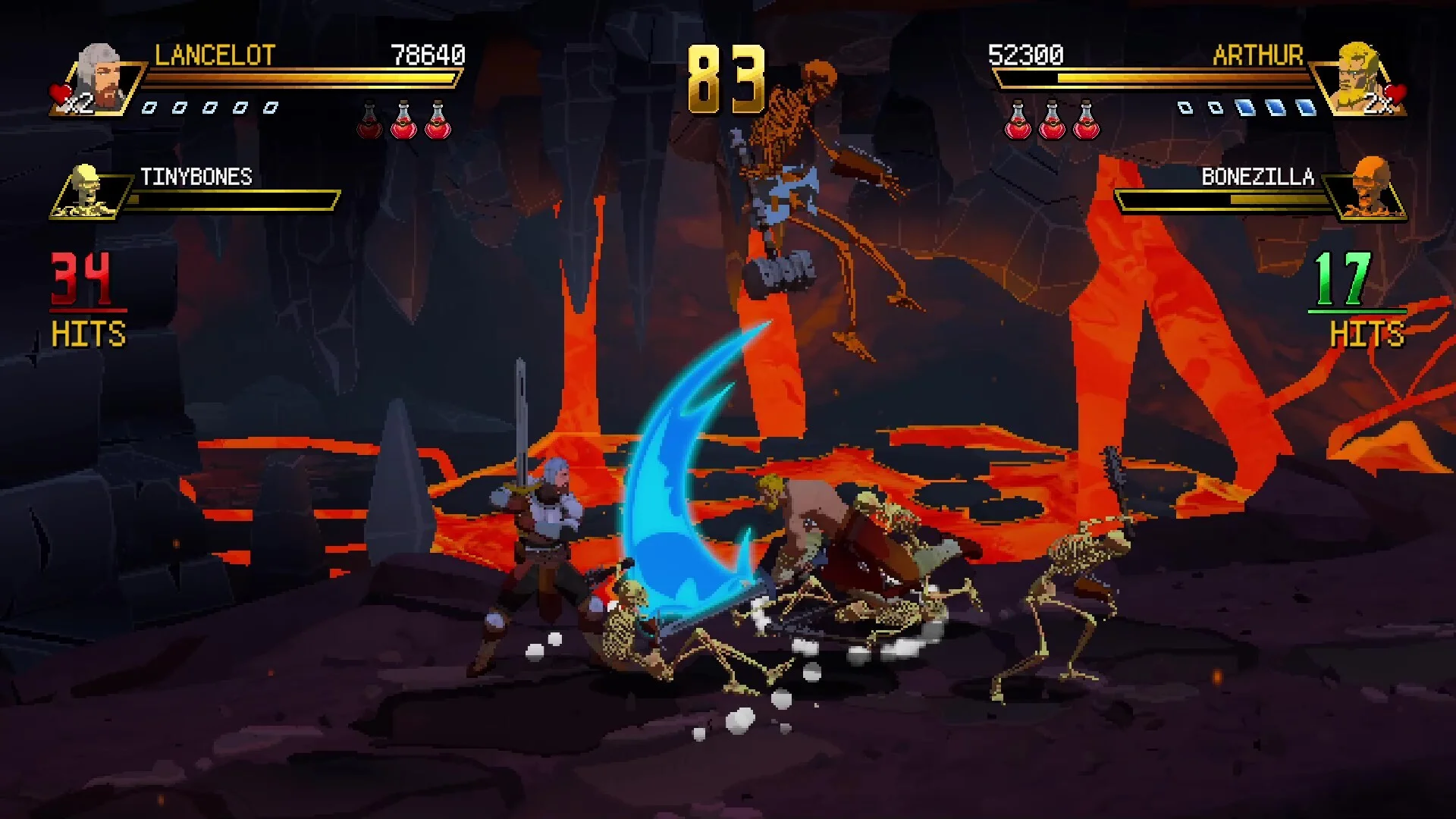
Bow-wielding bird creatures provide a different demand from nearby skeletons, while groups of enemies make positioning and emergency attacks matter. Goblins, imps, and floating heads broaden the fantasy roster, and bosses punctuate the stages. Yet the action has a limited capacity to keep changing the questions it asks.
Extended juggling remains enjoyable, but discovering another way to continue a combo cannot indefinitely substitute for encountering a situation that requires a different response. Across a campaign lasting a few hours, the complete starting toolkit becomes familiar quickly, and the modest differences between the heroes offer little incentive to repeat everything immediately.
Two-player local co-op gives the same material a stronger practical use. Combining attacks against a wave of creatures makes the accessible move set easy to share, and a second player brings another set of decisions into crowded encounters. The game’s straightforward rescue mission suits that arrangement: both players understand the objective and can spend their attention on the fighting.
Difficulty settings, score, and built-in achievements offer further reasons to revisit the campaign, though they leave its core possibilities intact. A return trip with a friend has a clearer appeal than another solo run undertaken to discover what Lancelot changes. The interesting adjustment becomes coordinating two players’ attacks with a toolkit that both can learn quickly.
The Review
Blades & Battles
Blades & Battles makes launching enemies and extending combos easy to enjoy, with emergency abilities adding useful decisions about survival and resources. Its fixed toolkit needs stronger encounter variety to sustain that pleasure. Uncertain hit registration and muddy combat visuals weaken the positioning game, while Arthur and Lancelot offer limited incentive for repeat solo runs. Local co-op gives the accessible action its strongest purpose: a brief, lively campaign to share with a friend.
PROS
- Accessible launchers and satisfying extended combos
- Emergency abilities give resource management practical value
- Two-player local co-op suits the straightforward action
CONS
- Inconsistent hit registration undermines positioning
- Heavy pixelation obscures crowded fights
- Limited encounter evolution and character differences restrict replay appeal