



























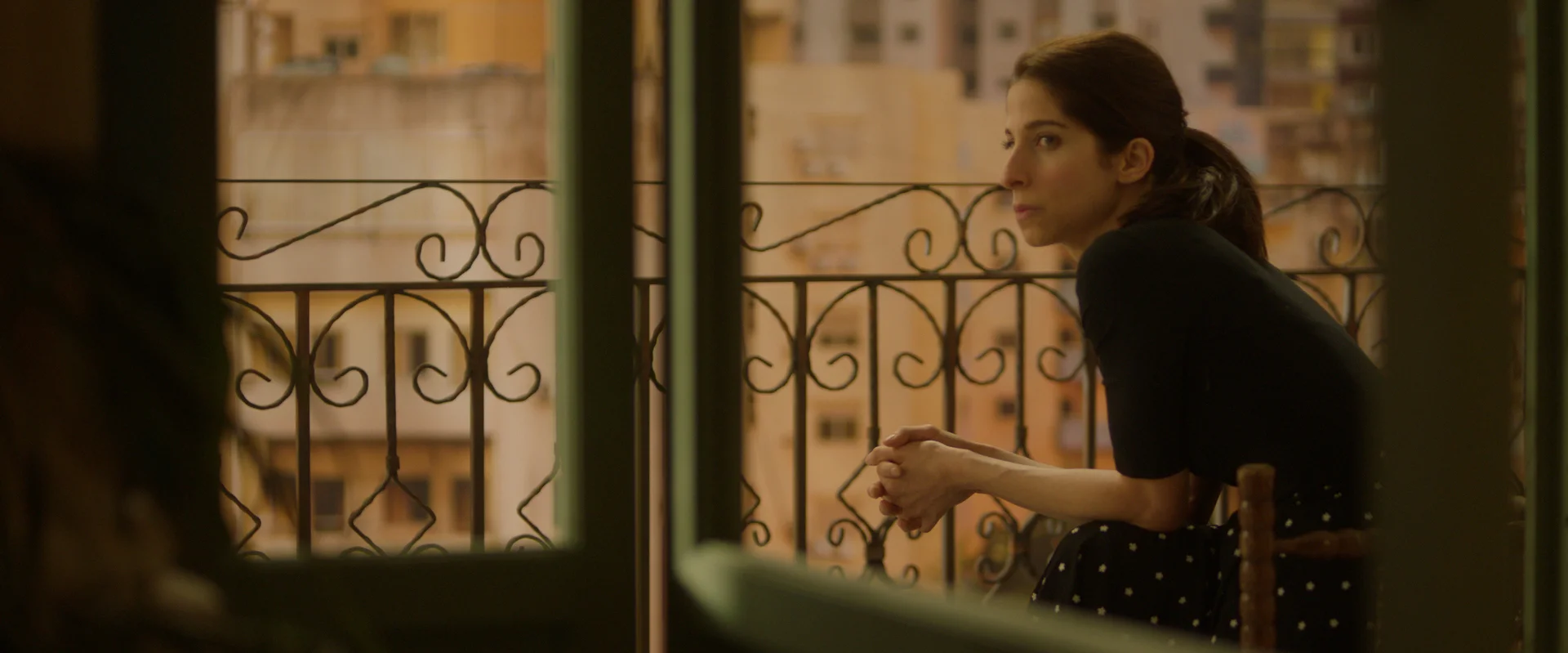

Lana understands Arabic and refuses to speak it. That refusal gives her return to Beirut a particular discomfort: she can follow the conversations around her while withholding the response that would place her inside them. Twenty-five years after leaving, she has come back because her estranged father is dying, yet familiarity offers little reassurance. In Tina Gharavi’s Shadows of Beirut, language survives the separation that Lana has tried to impose on her life. Her silence allows her to keep participating on restricted terms, hearing a world she remains reluctant to acknowledge as her own.
The same selective disclosure governs her relationship in London. Lana tells her partner Ben that she is visiting an uncle, concealing the father associated with her memories of alcoholism and violence. The lie creates an intimate version of the distance she maintains from Lebanon: Ben knows where she has gone without knowing what the place contains for her. Gharavi and co-writer Tala Calil, who also plays Lana, locate displacement within this unfinished conversation. The familiar homecoming narrative acquires an uncomfortable question about ownership. How much of a past must someone share before another person can understand the life built after it?
The pandemic makes Lana’s resistance to contact physically visible. Masks, gloves, and sanitiser occupy the image alongside her contamination fears, giving ordinary encounters a demanding set of precautions. Their legitimate protective purpose complicates their use as signs of withdrawal; the world really does contain dangers, even when Lana’s response becomes overwhelming.
Calil makes the hospital panic especially important because it interrupts an action that the plot seems ready to deliver. Arriving in Beirut and reaching the hospital cannot carry her across the remaining distance to her father. Fragmented childhood recollections keep that distance attached to remembered violence rather than vague unease.
Sirine enters through care during this failed encounter. Played by Flavia Bechara, the healthcare worker becomes a companion whose ease allows Lana to experience the city outside the obligations of reunion. Their outings, including a visit to the beach, give the relationship room to develop through shared time rather than repeated explanation of Lana’s condition.
Calil’s guardedness becomes less dominant beside Bechara’s directness, and their rapport supplies a persuasive basis for change. Sirine’s openness about her sexuality and her willingness to ask personal questions also complicate the visitor’s apparent access to freedom. Lana’s life abroad has left some subjects painfully difficult to discuss.
The Beirut Sirine helps her discover contains people whose concerns briefly displace Lana’s own. In a damaged building, men gathered around a fire offer biscuits and ask about Bitcoin. The combination is wonderfully specific. Cryptocurrency belongs to the same present as the broken architecture, preventing the place from becoming a timeless picture of suffering.
Elsewhere, tea, piano music, and efforts to make ruined rooms habitable establish forms of ordinary occupation. These encounters give the city interests and habits that continue beyond the protagonist’s arrival. For an audience encountering Beirut largely through images of destruction, such details change what deserves attention within the frame.
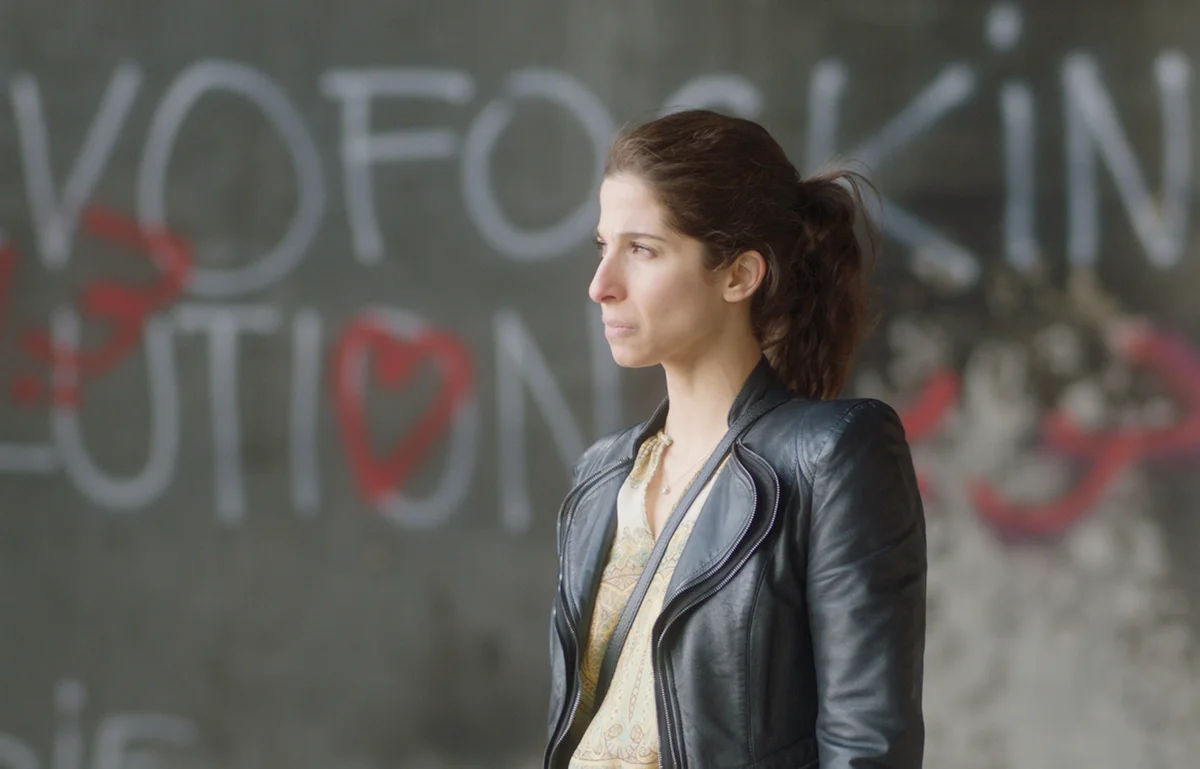
The glamorous family party introduces another Beirut within the same film. Wealth and social display coexist with the damaged spaces Lana has visited, while hospitality within the family carries its own risks. Rami, played by Assaad Bouab, initially offers reassuring companionship, but his wife Gloria’s public attack exposes the instability beneath their polished household.
The scene makes Lana’s cousin harder to read and prevents welcome from becoming proof of domestic security. His quick return to nightlife after the humiliation weakens its consequences, however. What could deepen our understanding of his habitual evasions passes rapidly into the next stage of Lana’s emotional release.
Other family encounters resist easy reconciliation. Her father’s second wife meets Lana with hostility, reminding us that the returning daughter enters relationships that have continued without her. Sirine’s willingness to explain restrictive male attitudes through the society that shaped them introduces a different difficulty.
Cultural understanding can clarify conduct while leaving the injured person with the burden of accommodating it. The late revelation concerning Lana and Sirine sharpens this pressure by giving their different experiences a shared family connection. Its explanatory neatness is less persuasive than the friendship preceding it, where their closeness grows through attention and choice.
Gharavi’s visual and sonic treatment of Beirut is strongest when it follows that gradual change in attention. Early constriction in framing and sound makes Lana’s surroundings feel difficult to tolerate; warmer passages and greater openness accompany her growing receptiveness.
At the nightclub, music accumulates in layers as she begins to give herself to dancing. The sequence provides an experience of participation that conversation alone has failed to produce. A club reached through a mechanic’s shop also extends the film’s interest in a city whose uses exceed its visible surfaces. Lana has to be introduced to ways of inhabiting places she might otherwise pass without understanding.
This subjective approach has a limit. The port explosion, damaged streets, pandemic precautions, and Lana’s private history can begin to look like corresponding images of injury. The men discussing Bitcoin help resist that reduction because their concerns belong to a life outside her emotional progress.
Repeated passages of Lana contemplating destruction are less productive: they return the city to the role of expressing her distress. A personal drama needs no comprehensive account of Lebanese politics, but its setting becomes thinner whenever collective damage serves mainly to make an individual recovery appear larger.
The renewed intimacy with Ben carries warmth, and Lana’s emotional message after the night out follows a release the sound design has made credible. The eventual confrontation with her father gives that openness a harder test.
Yet the warmly lit romantic reunion asks restored desire to carry much of the weight of recovery, drawing the film toward a familiar, widely legible resolution. Sirine’s care and the city’s unexpected encounters have offered Lana several ways to belong. When the ending concentrates their value in the repaired couple, it leaves less room for what those relationships might demand of her beyond making a return to intimacy possible.
Shadows of Beirut released in UK and Irish cinemas on September 25, 2026. The drama follows a young woman who returns to Beirut after 25 years to visit her estranged, dying father, ultimately discovering the profound heart of her homeland through the people she encounters.
Full Credits
Title: Shadows of Beirut
Distributor: BUFF Studios, Independent Cinema Releases
Release date: September 25, 2026 (United Kingdom)
Rating: 15
Running time: 1 hour 27 minutes (87 minutes)
Director: Tina Gharavi
Writers: Tala Calil, Tina Gharavi
Cast: Tala Calil, Assaad Bouab, Flavia Bechara, Michael E. Rodgers, Thuraya Baghdadi
The Review
Shadows of Beirut
Shadows of Beirut finds its strongest cultural insight in Lana’s reluctant participation: understanding Arabic, accepting hospitality, and discovering relationships her life in London has kept distant. Calil and Bechara give that reconnection warmth, while the city’s informal gathering places resist familiar images of devastation. Some family conflicts lose momentum, and Beirut occasionally becomes a reflection of Lana’s distress. The romantic resolution compresses the recovery, but the encounters preceding it make renewed belonging feel credible.
PROS
- Calil and Bechara’s persuasive rapport.
- Specific, lived-in encounters across Beirut.
- Language and secrecy deepen the treatment of displacement.
- Layered nightclub sound makes emotional release tangible.
CONS
- Rami’s marital conflict loses consequence too quickly.
- Collective destruction sometimes becomes shorthand for personal distress.
- Romantic closure compresses a difficult recovery.