


















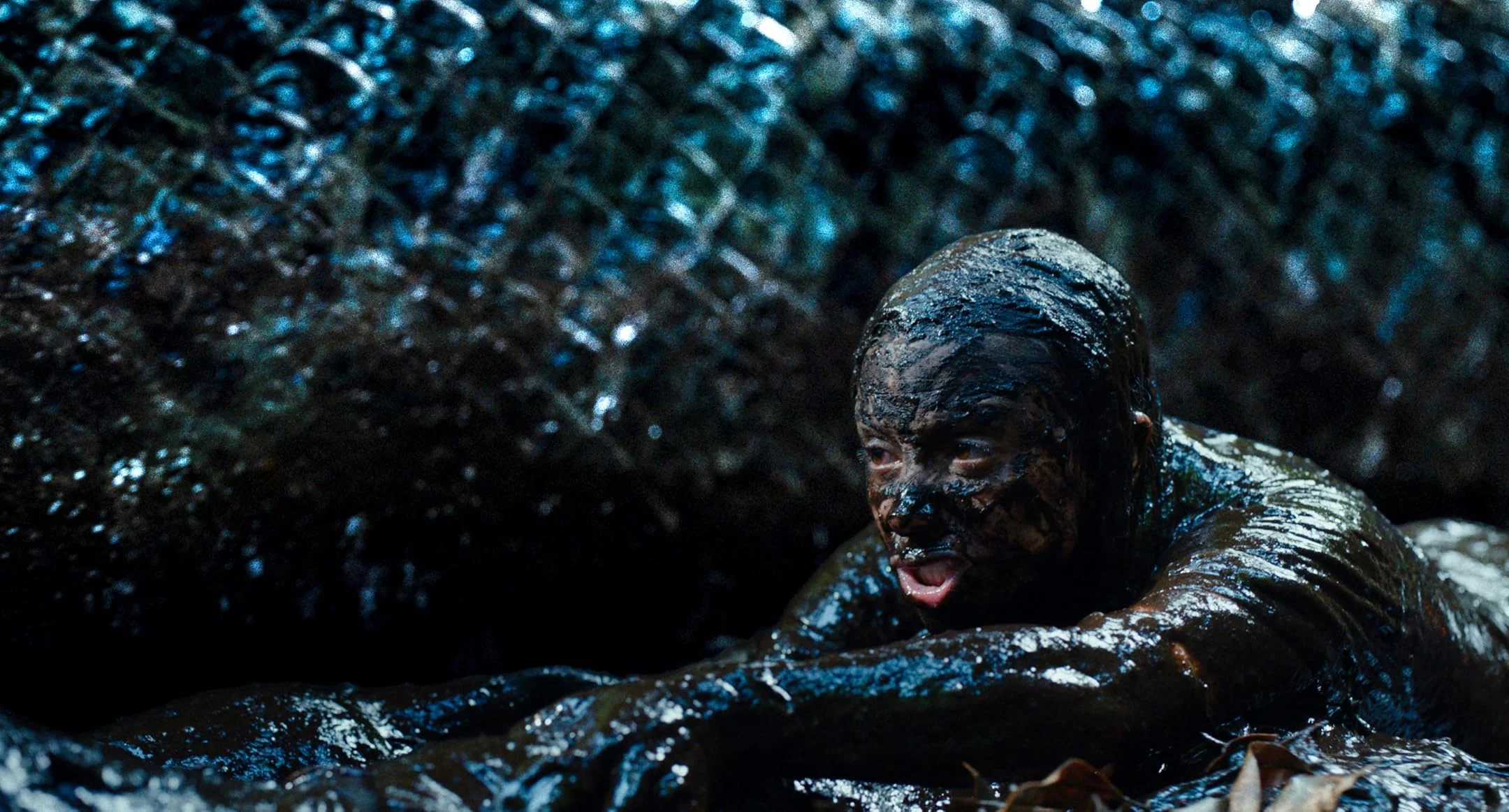

Boiúna becomes most frightening when a human body gives her a scale. A survivor watches the serpent moving nearby, and the disparity does the work: flesh that can be torn apart beside an animal whose full extent escapes the frame. Director Mike P. Nelson does not need to show the whole creature for that encounter to register. The visible portion establishes a relationship between predator and potential victim, while the unseen remainder enlarges it. For a moment, the frame feels inadequate to the thing occupying it.
Elsewhere, Beware Boiúna makes that inadequacy considerably less productive. Darkness, vegetation, and shaky camerawork conceal attacks whose physical details would give them force. The distinction matters. Suspense can survive an incomplete view of the predator; it struggles when the viewer cannot follow the predicament of the prey. Nelson demonstrates the value of controlled perception with a jump scare prepared through blurriness. There, obscurity has a dramatic function and a payoff. Several deaths pass too quickly, with too little visible information, to acquire a similarly distinct shape.
This becomes an ethical problem because Boiúna has been assigned an ethical role. The gigantic serpent inhabits protected Amazon territory and is described as a guardian capable of deciding who lives and dies. Her destructive power is easy to establish. Boats and mining infrastructure supply convenient measurements. Her judgment is harder to discern.
A creature can remain inscrutable without becoming dramatically empty, but the film often leaves the relationship between territorial defense and individual slaughter underdeveloped. Its lore gives the snake authority that its images do not consistently make intelligible.
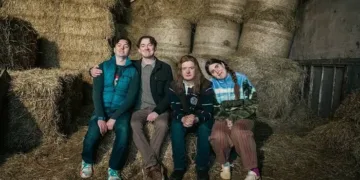
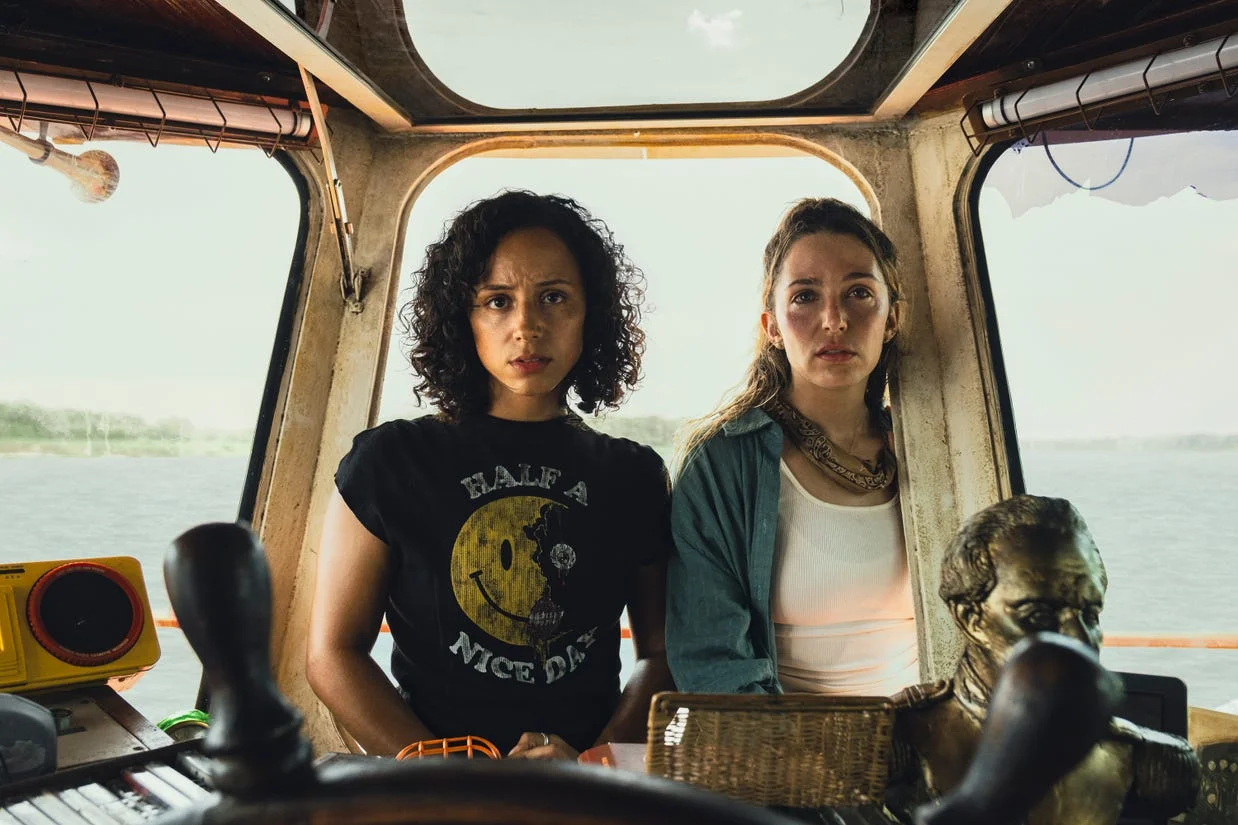
The human conflict offers a firmer account of responsibility. Alli, a medical student played by Jessica Rothe, travels with a humanitarian team administering aid along the river. Kiana Madeira’s Lena is the boat’s mechanic, searching for her missing brother. Their expedition encounters contractors exploiting the rainforest, including Brennan Malloy and his brother Shawn.
After Shawn attempts to assault Alli, the women accidentally kill him while resisting. Brennan’s retaliatory pursuit drives the expedition toward the serpent’s domain. The route into creature horror runs through a man’s decision to punish women for surviving another man’s violence.
Brennan’s grief does not erase that sequence of choices. Logan Marshall-Green’s character can possess a personal motive without receiving moral equivalence with the women he hunts. The objection of one member of his party is useful here: participation in revenge remains voluntary, even within the group pursuing it. The screenplay briefly makes refusal imaginable.
That is a stronger expression of moral complexity than simply giving a villain a bereavement. The resource exploitation surrounding these men also gives their pursuit a territorial dimension. They enter the rainforest expecting it, and the people within it, to accommodate their purposes.
Nelson spends a considerable stretch establishing the expedition, Lena’s search, and the pursuit before the serpent becomes the dominant threat. That delay could earn its place if these strands accumulated pressure that the encounters with Boiúna then released.
Too often, the setup supplies motivations that the survival action has limited room to develop. Lena’s missing brother gives her a reason to be there, while Alli’s desire to help establishes sympathetic intent, but the later danger does not consistently deepen those starting positions. The film changes its immediate threat faster than it develops the people exposed to it.
Rothe and Madeira help bridge that gap through credible resourcefulness. Their commitment makes the women’s defensive actions and subsequent struggle feel like responses to danger rather than obligations imposed by a monster screenplay. The seriousness is valuable.
A giant snake does not require every human encounter to become a joke. Will Close’s Callum provides enough comic relief to suggest a workable alternative to unbroken severity; his discomfort starts before Boiúna intervenes, which seems a reasonable assessment of the working conditions. The problem lies in dramatic accumulation, rather than a shortage of permission to laugh.
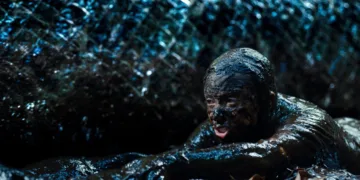
When Nelson gives an encounter a sustained physical constraint, the film tightens. Lena struggling in a sinking pit while the serpent moves around her is an effective arrangement of unequal freedoms: the creature controls the surrounding space while her own movement becomes increasingly restricted.
The body and the terrain communicate the danger together. Trapping characters aboard a boat offers a related pressure, turning the expedition’s means of passage into a place of confinement. These situations give the viewer something to apprehend beyond the arrival of the next attack. Escape has conditions, and those conditions make fear specific.
The construction battleground extends that physical logic into the film’s ecological argument. A grapple truck, a chainsaw, and the serpent’s collision with machinery bring the instruments of extraction into contact with the force defending the territory.
The connection is concrete enough to carry meaning without an explanatory speech. Yet the dim staging compromises the confrontation’s force. Equipment can provide an excellent scale reference for Boiúna, as the nearby human body does earlier, but that comparison requires readable space. The thematic relevance of the machinery cannot supply the visual information the action withholds.
The most disturbing survival maneuver works on a smaller scale. A character uses a dead friend’s body to escape, making personal attachment collide with immediate physical necessity. The early close views of parasites being removed from skin acquire an uncomfortable echo: bodies introduced as objects of care can become resources for staying alive.
Here the film finds a moral pressure that belongs to the action itself. The flashbacks immediately afterward weaken it by reminding us of the relationship we already understand. They steer the response toward remembered affection before the act’s discomfort has had room to settle, reducing the audience’s freedom to sit with what survival has required.
Beware Boiúna arrives in US theaters on October 2, 2026, following its festival premiere. The survival horror film follows a routine medical mission deep in the Amazon rainforest that turns into a desperate struggle for survival when the group awakens an ancient mythical serpent.
Where to Watch Beware Boiúna (2026) Online
Full Credits
Title: Beware Boiúna
Distributor: Lionsgate Films
Release date: September 17, 2026 (Fantastic Fest) / October 2, 2026 (United States)
Rating: R
Running time: 1 hour 44 minutes (104 minutes)
Director: Mike P. Nelson
Writers: Alan B. McElroy, Tony Giglio
Producers and Executive Producers: Robert Kulzer, Martin Moszkowicz
Cast: Jessica Rothe, Kiana Madeira, Logan Marshall-Green, Jackson Bews, Juan Pablo Shuk, Will Close
Director of Photography (Cinematographer): Nick Matthews
Editors: Tom Elkins
Composer: Steve Mazzaro
The Review
Beware Boiúna
Beware Boiúna finds genuine terror when the serpent’s scale meets a clearly staged human predicament. Rothe and Madeira give its survival struggle credibility, and the ecological argument gains force through the machinery of extraction. Yet murky attacks, a prolonged setup, and intrusive flashbacks weaken both suspense and moral inquiry. The film understands that survival can disturb our loyalties; it too often obscures the action or explains the feeling before that disturbance can settle.
PROS
- Credible resourcefulness from Rothe and Madeira.
- Effective suspense in physically constrained encounters.
- - Ecological themes grounded in destructive machinery.
CONS
- Dim, unstable staging obscures several attacks.
- Extended setup yields limited character development.
- - Redundant flashbacks blunt a powerful survival scene.