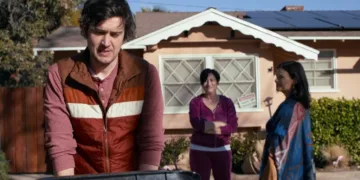
























Jacob keeps restarting the song he has chosen for his final moments because a bird will not stop making noise. The repetition is funny, and Mike Castle plays it with the irritation of someone watching another carefully arranged plan fall apart. J. Davis’s I Hate Myself and Want to Die establishes its comic rhythm through these small disruptions. Jacob wants to withdraw from the world; the world keeps interfering. Castle gives the frustration enough weight that the laughter leaves his distress intact. Even his struggle with a seatbelt feels like an exhausting negotiation with something that should be simple.
His mother’s request for a ride expands that rhythm into the film’s structure. A pharmacy errand leads to a family visit, which brings his teenage cousin Hayley into the car, which produces another set of demands. Davis connects these developments through ordinary obligations. Jacob has reasons to go from one place to the next, even as he retains a private objective that makes every detour unwelcome. The chain gives the film an accessible, almost farcical momentum. It also establishes a useful tension: the people delaying him do not necessarily understand what they are delaying.
Jacob’s return home follows the failure of his comic-book career and his fiancée’s infidelity. At thirty, he is living with his mother and treating those disappointments as an assessment of his entire existence. The screenplay supplies enough background to make his humiliation intelligible without spending much time outside the day’s events. That economy places considerable responsibility on Castle.
His subdued annoyance carries across encounters that could otherwise seem disconnected, and the flashes of engagement beneath it suggest a personality that has survived his own harsh account of himself. The film’s immediate problem is keeping him occupied. Its larger dramatic problem is helping him reconsider that account.
Hayley gives those two tasks their strongest connection. She secretly joins Jacob after conflict with her mother, wanting to see Tyler, an older boyfriend whose name she has tattooed on her shoulder at his encouragement. Her arrival introduces a problem Jacob cannot handle simply by completing an errand.
She needs attention, judgment, and eventually protection. His involvement starts to reveal capacities that his description of himself has excluded. Davis makes this development through a change in Jacob’s responsibilities, allowing the character to demonstrate something before the screenplay asks him to understand it.
Ali Gallo helps keep the relationship from becoming an obvious exercise in mutual healing. Hayley’s agitation is outward and immediate; Jacob’s frustration has settled into reserve. Their mismatched responses create awkwardness between relatives who share affection without much common ground.
Both have experienced romantic disappointment, but Hayley’s age and vulnerability give Jacob a responsibility that complicates the resemblance. Gallo allows her upset to be messy without making every exchange a contest for attention. Castle, in turn, can remain impatient while still responding to what she needs. Their scenes make care look effortful, which gives it credibility.
When they discover Tyler with another woman, Jacob confronts him, and the encounter develops into a chase. The escalation serves the comedy, but the confrontation matters before the pursuit begins. Jacob chooses to act on Hayley’s behalf and exposes himself to consequences.

His day has acquired a purpose that requires his participation. This is the screenplay’s most productive use of its detours: the incident changes what Jacob does, rather than merely changing where he goes. The audience can recognize value in his conduct, even while his willingness to recognize it remains uncertain.
His aunt’s criticism makes that uncertainty sharper. She attacks his judgment concerning Hayley, and Jacob defends himself by pointing to the greater danger his cousin might have faced with someone else. He has an argument because his actions have given him one.
The scene avoids an easy arrangement in which every supporting character exists to reassure him. Here, another person’s disapproval draws a response from someone who has largely accepted his own inadequacy. He can defend a particular decision without suddenly acquiring confidence in his whole life. That limited shift is plausible, and it supplies meaningful movement within the character’s distress.
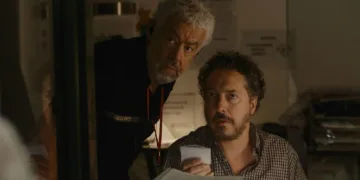
The later prominence of Russell, Jacob’s stoner friend, changes the film’s energy without producing an equally clear development. Andre Hyland brings a looser, more excitable presence, and the friendship lets Jacob exist outside the family roles that have occupied much of the story. Russell also has an early connection to the central crisis as the recipient of Jacob’s farewell email.
Yet his late arrival shifts attention away from the responsibility established through Hayley toward another stretch of companionship. The screenplay has found a new passenger; its next dramatic destination is less certain. Hyland’s liveliness helps individual scenes while the accumulating pressure of the earlier encounters begins to loosen.
This is where the film’s brevity can be deceptive. Events continue, and the change in company refreshes the tone, but Jacob’s decision receives less development than his busy itinerary suggests. His protective behavior and his defense against his aunt’s criticism have already complicated his self-image.
The later movement needs to carry those changes forward. Instead, the screenplay keeps his suicidal objective available while leaving the effect of his experiences difficult to measure. Emotional inconsistency is credible here. The weakness lies in how little the story clarifies the relationship between his moments of engagement and his continuing intention.
The final movement returns to another suicide attempt before an affirmative turn and coda. That renewed danger preserves uncertainty, but it places heavy emphasis on a late change of heart after the middle has offered quieter, more persuasive developments. Jacob’s decision to remain alive can be provisional; a hopeful ending does not need to certify recovery.
The film does, however, need to make that decision feel connected to the person who confronted Tyler and defended his care for Hayley. Those actions have already shown him accepting a place in someone else’s life. The last turn arrives quickly enough that his acceptance of a place in his own remains less clearly developed.
I Hate Myself and Want to Die released via digital platforms on October 6, 2026, courtesy of Freestyle Digital Media. The dark comedy follows a despondent man whose plans to end his life are continually upended by his clueless friends and family dragging him into their personal crises.
Where to Watch I Hate Myself and Want to Die (2026) Online


Full Credits
Title: I Hate Myself and Want to Die
Distributor: Freestyle Digital Media
Release date: October 6, 2026
Running time: 1 hour 25 minutes (85 minutes)
Director: J. Davis
Writers: J. Davis
Producers and Executive Producers: Not publicly specified
Cast: Mike Castle, Ali Gallo, Andre Hyland, Meredith Salenger, Leonora Pitts
Director of Photography (Cinematographer): Evan Papageorgiou
The Review
I Hate Myself and Want to Die
I Hate Myself and Want to Die builds sharp comedy from ordinary interruptions, with Mike Castle keeping Jacob’s distress credible beneath the irritation. His scenes with Ali Gallo give the story its strongest development, turning reluctant involvement into protective action. The later shift toward Russell loosens that momentum, and the ending asks a sudden reversal to complete an emotional change the middle has only partly developed. The hope is welcome; the route to it needs firmer connections.
PROS
- Castle’s restrained, emotionally credible performance.
- Opening disruptions build an effective comic rhythm.
- Gallo gives Hayley vulnerability without caricature.
- Jacob’s protective choices develop character through action.
CONS
- Russell’s late prominence loosens narrative momentum.
- The encounters’ effect on Jacob’s self-perception remains unclear.
- The ending relies heavily on a rapid change of heart.