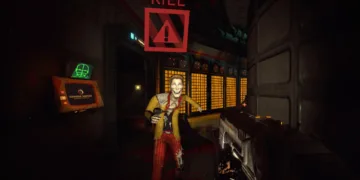































Cleaning blood off a wall in Retrospace can reveal a code. The Universe Cleaner makes the janitor’s work useful to the player: removing a stain recovers information, and that information opens access to the station. It is a small interaction with a substantial effect on how you inspect rooms. Blood becomes something to investigate, alongside notes, terminals, and suspiciously accessible ventilation shafts. Your occupation gives you a reason to notice what the people running Aurora 5 might overlook.
The same attention pays off when a turret guards a doorway. You can spend ammunition destroying it, recover a password and disable it through a security terminal, or find a vent that bypasses its line of fire. Each solution spends something different: supplies, investigative effort, or time spent searching the architecture. Stacking boxes to reach a passage adds another possibility. These are the decisions that make the station satisfying to explore. A room becomes a problem you can understand, with several answers whose costs you can weigh.
Aurora 5 is a research vessel caught in a black hole that disrupts time and transforms its inhabitants. The surviving janitor moves between interconnected sectors, helping scientists restore facilities while investigating their own identity. Janitors Haven provides a hub and fast-travel connections, giving those excursions a place to return to. Objectives establish a direction, but individual rooms often leave the method open. Janitorial access reinforces that arrangement: the employee tasked with maintaining the vessel can reach spaces closed to some of its supposedly essential personnel.
Combat gives those alternative routes an immediate value. Early pistol ammunition is limited, and wrench attacks require getting close enough to make saving bullets a risky proposition. The expanding arsenal gradually changes that calculation. Revolvers, shotguns, automatic weapons, and a ray gun offer different responses, while scanning enemies supplies information about their weaknesses. Flower-headed mutants take two or three ray-gun shots, making identification useful before you start firing. Acquiring a weapon can therefore change your reading of an encounter, turning a previously expensive threat into something manageable.
Resource pressure leaves room for experimentation. On Normal difficulty, supplies can become plentiful enough to try new equipment without treating every shot as an irreversible mistake, while healing limits still encourage caution. Explosive barrels can be thrown, oil can be spread and ignited, and water near a transformer can become an electrical trap. These interactions invite you to work with the room rather than rely entirely on the gun in your hands. They also create expectations about how objects should respond, and the game sometimes struggles to meet them.
A server-destruction objective exposes that inconsistency. Water, nearby transformers, and burning oil suggest several plausible ways to damage the equipment, yet those experiments fail to complete the task. Shooting the connected computer succeeds immediately. The problem is the mismatch between the available tools and the objective’s accepted solution. After encouraging players to combine environmental elements, the game asks them to recognize an exception without giving them a useful reason for it. Successful improvisation elsewhere makes this restriction harder to read.
Enemy behavior creates a different weakness in the same freedom. Vents and rooms with two entrances can confuse pursuit enough to let you attack safely from positions enemies struggle to contest. Avoiding a fight through a hidden route rewards observation; repeatedly shooting a creature unable to negotiate a doorway removes the tactical pressure that its attacks were meant to provide. This weakness also affects the final boss, whose encounter fails to make effective use of the player’s accumulated tools. A flexible layout needs opponents capable of responding to it, or the quickest solution becomes exploiting their movement.
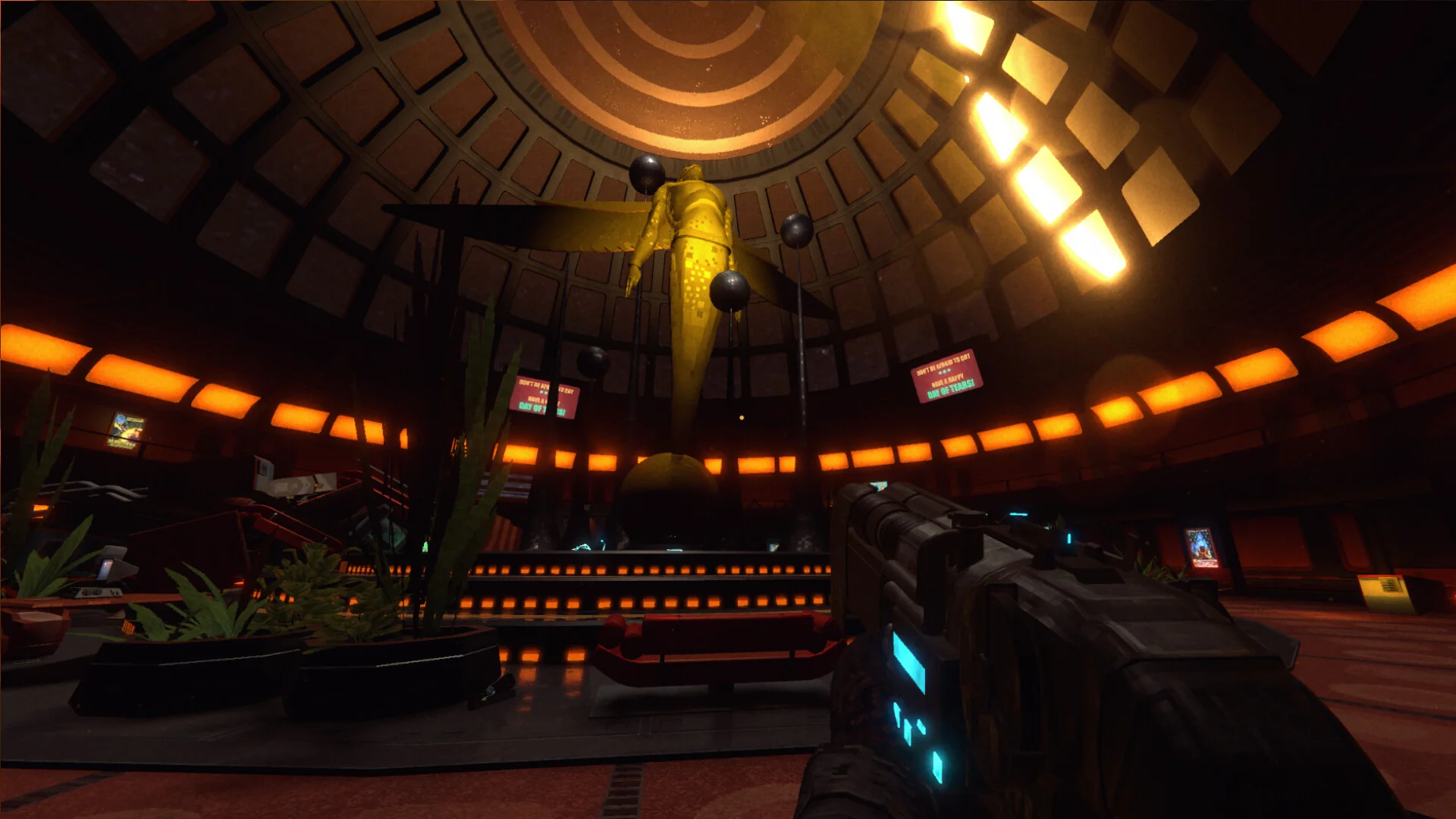
Exploration retains its appeal because Aurora 5 changes as your knowledge grows. New passwords and access items reopen earlier spaces, including the grotesquely practical use of severed heads on retinal scanners. Temporal shifts go further: the vessel’s two timelines, separated by 37 years, alter familiar locations with new objects and traversal demands. Returning means checking what your previous understanding still explains. Borealis Gardens, with its planted spaces and experimental chambers, gives the mutated plant life a setting that connects enemy design to the research conducted aboard the ship.
The map makes that process unnecessarily difficult. Its vague floor plan and cumbersome controls provide little help when several corridors and vents fold back into each other. Janitors Haven’s fast travel reduces the distance to a destination, but finding the relevant passage can still become a prolonged search. Early uncertainty encourages inspection because almost every discovery is new. Later uncertainty can mean failing to locate a route you already know exists. Optional objectives suffer particularly from that distinction: their extra information and rewards have to compete with the effort of finding the way back.
Narrative information is sensibly placed within that exploration. Text and audio logs fill quieter stretches between objectives, while figures such as MI-A and Dr Nebula give the player people and intelligences to question. The janitor’s identity search adds a personal reason to keep investigating the vessel.
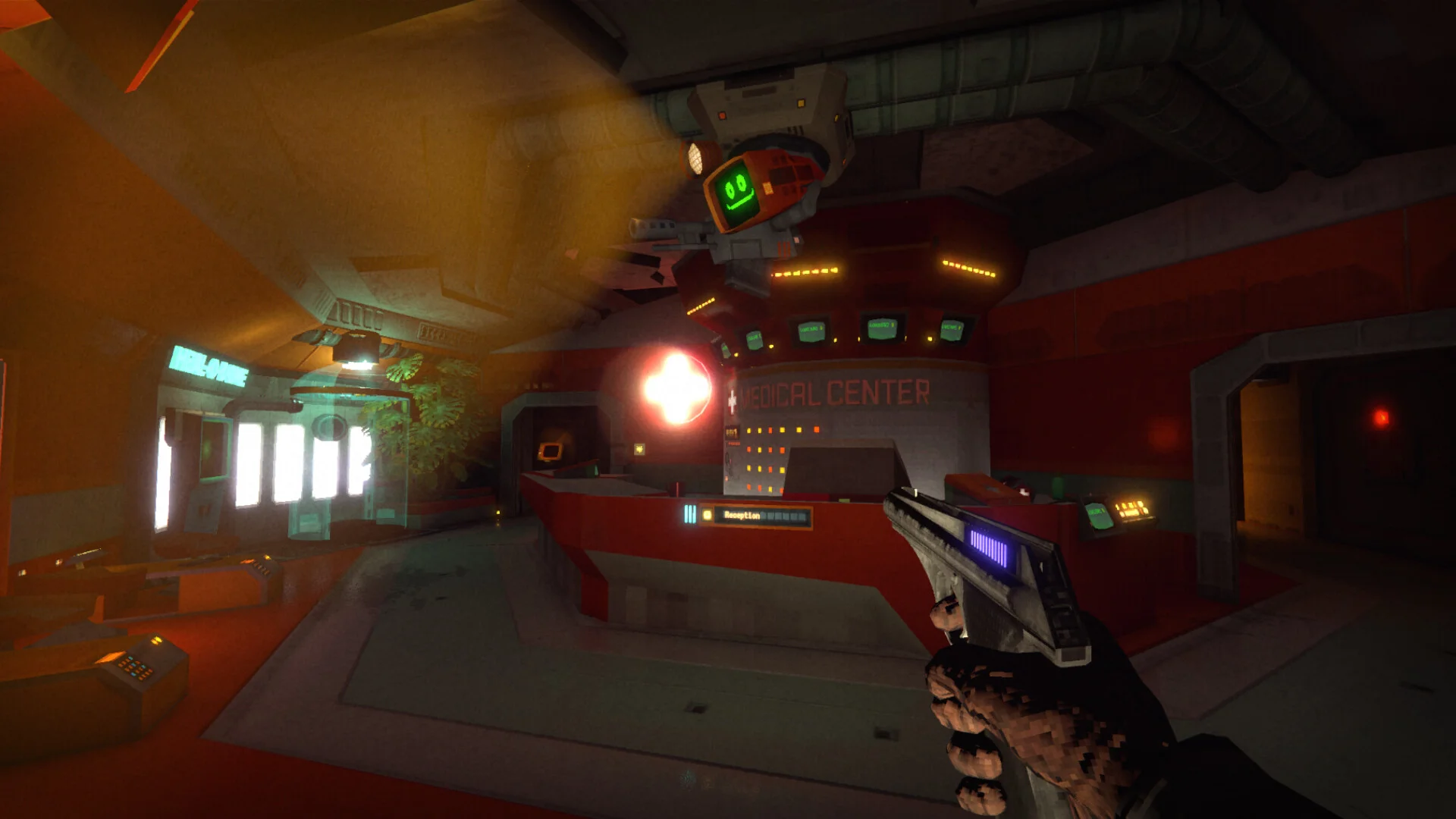
The setting supplies a less verbal kind of history through disco furnishings, cheerful institutional videos, and facilities occupied by the consequences of scientific experiments. A weak flashlight limits how much of that environment you can assess at once. Insectoid creatures make the unseen portion of a passage a practical concern, even when the furniture suggests someone once expected life aboard to be pleasant.
The PS5 version adds friction that has little connection to those intended pressures. Uneven performance and difficulty maintaining 60fps interrupt aiming and movement, particularly during combat. Inventory and storage interactions also need better controller shortcuts. Choosing equipment is part of the resource game; laboriously moving items between menus delays putting that choice into practice. These problems repeatedly interrupt the transition from inspecting a situation to acting on it.
Progression and rendering bugs can cause deeper damage. Missing keycards and ammunition have required a restart to restore the absent objects, leaving searches without a possible reward until the failure is recognized. Doors can appear closed when open, and portions of the vessel can fail to appear until approached. Damaging fires have also failed to render. A visible flame lets you judge a crossing against your remaining health and healing supplies. When the flame is absent but the damage remains, the player receives the information only after spending the health needed to discover it.
The Review
RetroSpace
Retrospace makes observation useful: cleaning reveals codes, alternate routes conserve ammunition, and enemy scans inform weapon choices. Aurora 5 rewards learning its spaces, especially when temporal changes reshape familiar routes. Its flexibility is less dependable during combat and scripted objectives, while poor mapping and serious bugs can make careful investigation fruitless. There is real satisfaction in solving this station, but missing progression items and invisible hazards undermine the trust its design needs.
PROS
- Alternative routes reward observation and conserve resources.
- Janitorial tools give the protagonist’s role practical meaning.
- Enemy scanning supports informed weapon choices.
- Temporal changes make familiar areas worth revisiting.
CONS
- Some objectives reject plausible environmental solutions.
- Weak enemy pursuit undermines combat and the final boss.
- An unclear map makes later backtracking frustrating.
- Uneven PS5 performance disrupts aiming and movement.
- Missing items and invisible hazards obstruct informed play.