















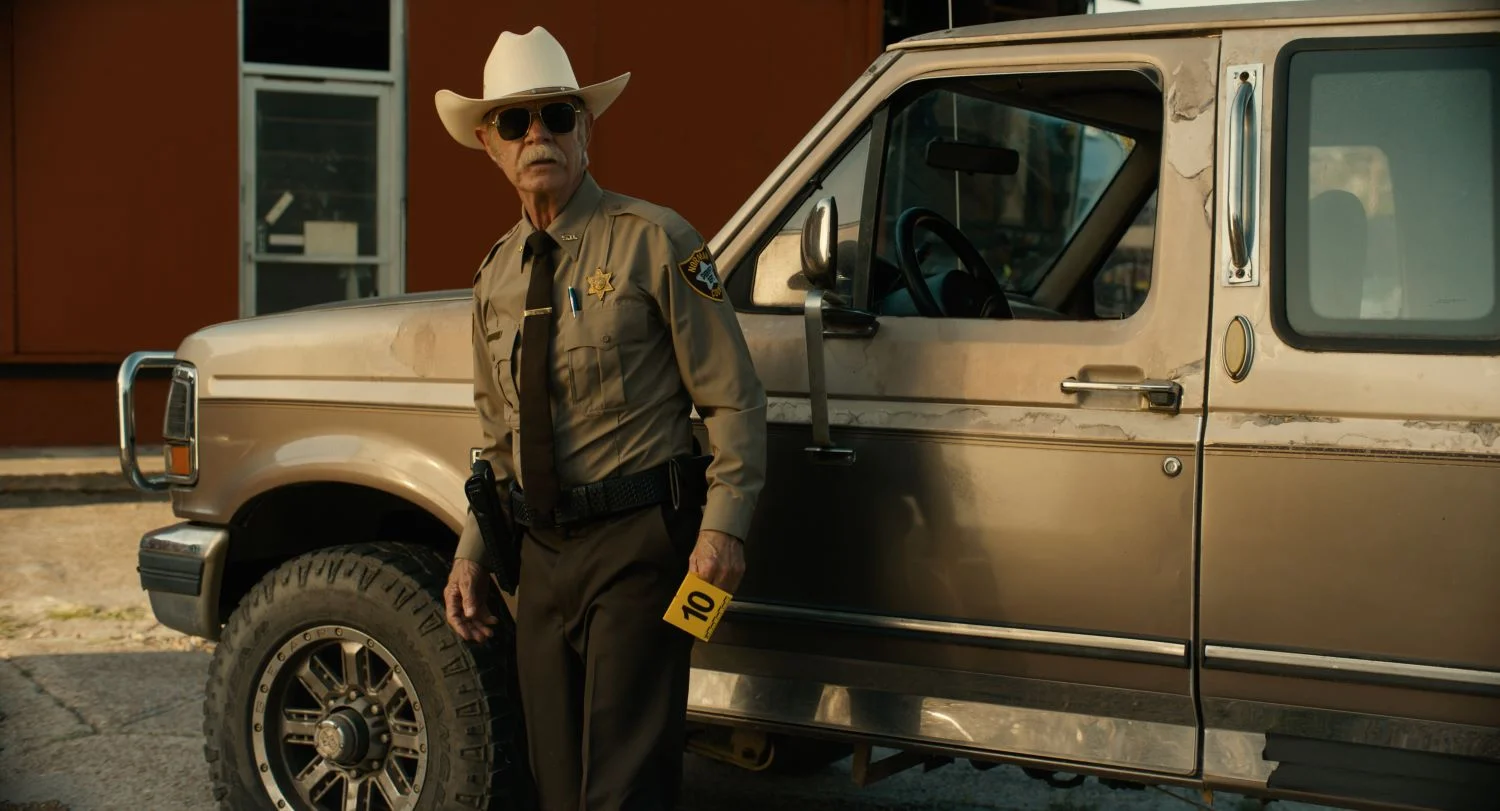

Toby Sawyer leaves a corpse unattended because he would rather visit his mistress. Until then, his assignment in The Deputy has required very little: stay beside Luke Jordan’s body and wait for someone to collect it. The sheriff has gone to notify the family, and Toby has arrived with his badge attached to a torn shirt. When he returns from seeing Molly, the body is gone. Matt Sukkar’s debut feature gives its investigator a mystery created by his own negligence, with an awkward personal stake in finding the answer.
Toby’s next act of disobedience complicates that introduction. Ordered to remain at the office by fellow deputy Billy Banks, he wanders off and discovers a truck containing people being smuggled. After speaking with a boy named Oscar, he lets them go. There is compassion in that decision, along with the same casual disregard for consequences that cost him the corpse.
The distinction matters because Carlo Bernard’s screenplay, adapted from Victor Gischler’s novel, needs us to follow a man whose instincts can be decent while his conduct remains irresponsible. Helping these strangers gives us a reason to reconsider him without settling the question.
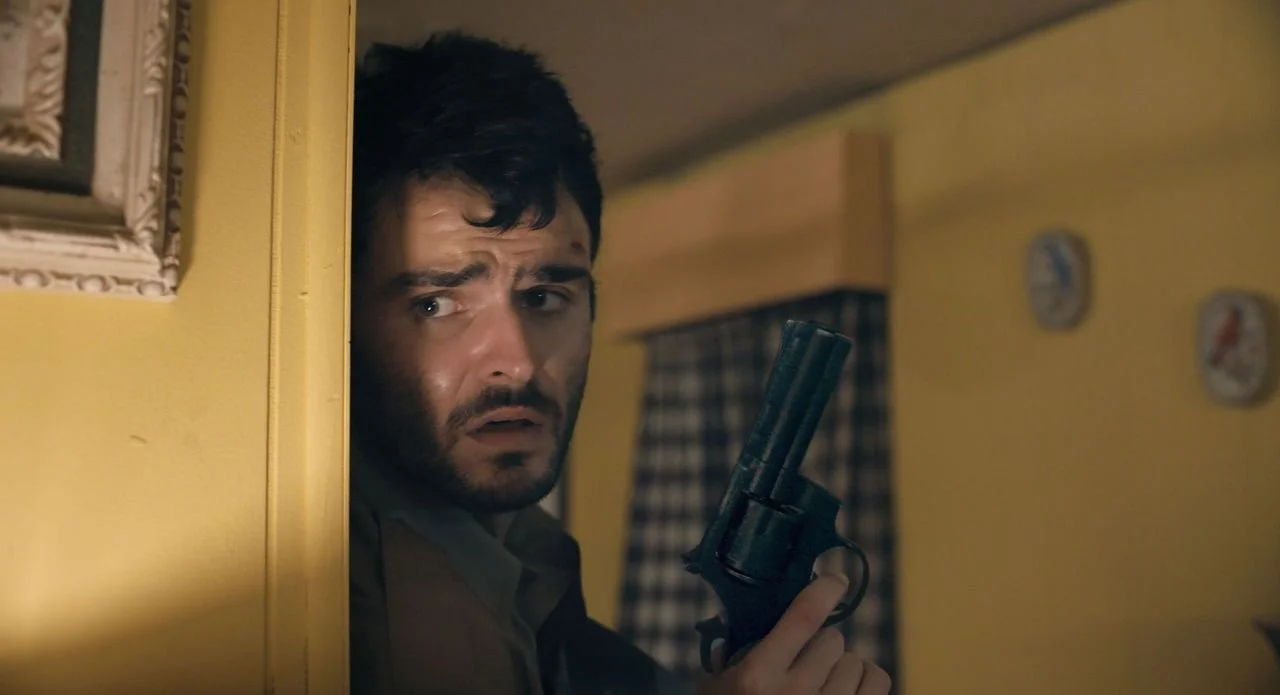
Duke Nicholson makes Toby’s inertia easy to understand. His sleepy manner and dishevelled appearance suggest someone accustomed to doing the minimum, and his hesitation around violence preserves that characterization once the danger escalates. Using a coffee carafe as a weapon suits a deputy improvising well outside his abilities.
The performance becomes less persuasive when the investigation requires growing initiative. Encounters with criminals, Luke’s brothers, and a kidnapped woman at a motel expand the trouble around him, but too much information seems to arrive through his presence rather than his reasoning. We accompany Toby from discovery to discovery without consistently seeing him learn how to investigate.
That is a limitation of the film’s restricted viewpoint, which simply means that our access to the mystery largely follows Toby’s. His uncertainty can make an encounter tense because we lack the reassurance of knowing who is trustworthy. Yet withholding answers cannot carry every stretch between discoveries.
The garage and motel widen the missing-body puzzle into a trafficking conspiracy, while the small circle of law-enforcement figures leaves limited room for surprise. Sukkar spends considerable time moving Toby around town, and the eventual connections are less interesting than the immediate discomfort of watching him enter another situation he cannot control.
I found the nighttime sound particularly effective at maintaining that discomfort. Ambient sound, the environmental noise beneath the action, usually helps establish the ordinary life surrounding a scene. Here, persistent insects fill a space with very little reassuring human activity. Traffic is scarce, cell service is unreliable, and landlines offer no dependable connection.
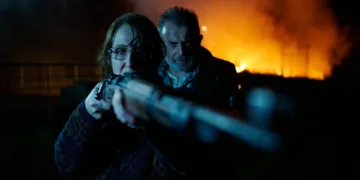
The crickets make the town feel inhabited by everything except someone Toby can ask for help. Deep blue-black photography strengthens that impression, with visible light sources picking faces and locations out of the darkness. The spaces remain readable, so their isolation registers without the action disappearing into murk.
Daniel Vildasola’s score works comfortably inside this environment. Guitar textures give the music a small, tactile quality, and rhythmic sounds produced by striking the instrument’s body build tension without introducing a conspicuous new sonic element.
Selective strings increase the emotional pressure while leaving room for the insects and empty surroundings. This restraint explains why some pauses work: the film gives us something uneasy to listen to while Toby waits or hesitates. Other passages simply prolong his movement between people and businesses. An expressive soundscape can sustain uncertainty, but it cannot supply the missing development of a clue.
The humor is most successful when it preserves ordinary irritations inside extraordinary trouble. Toby keeps smoking, and the sheriff, Banks, and Amanda Jackson keep telling him to stop. Their objections survive the bloodshed, giving these relationships a familiar workplace texture.
Nicholson’s subdued responses help the gag remain part of Toby’s behavior rather than a pause for a punch line. His physical ineptitude is riskier. Accidentally setting his foot on fire makes danger ridiculous, but each further blunder increases the screenplay’s burden of persuading us that this man can survive an armed conspiracy. The amusement and the credibility problem develop together.
Tiffany Haddish’s late arrival as Amanda gives the film a useful change in method. Faced with a bloodied deputy and an improbable explanation, she initially treats Toby as someone who might need arresting. Then she listens and revises her assessment as evidence emerges.
Haddish makes that adjustment legible without surrendering Amanda’s authority; she can take him seriously and still prohibit smoking in her station. After so much of Toby’s improvisation, the presence of someone evaluating a situation is welcome. Her arrival also exposes how long the film has depended on his bewilderment to keep its scenes moving.
His taste for Discharge’s “State Violence, State Control” suggests an uneasy fit between the badge and the person wearing it. The punk song accompanies a man whose humane response to the smuggled people sits awkwardly beside his neglect of work and family. That friction gives Toby some personality beyond the familiar bumbling deputy.
Later, his increasingly orderly appearance offers a visible sign of change. When his damaged uniform shirt needs covering, he wears a jacket and places the badge outside it. The gesture communicates a new willingness to identify with the job, but clothing supplies clearer evidence of intention than of competence.
The final turn toward fatherhood provides a stronger decision. Left responsible for his infant son by Doris, played by Billie Lourd, Toby accepts the child even after uncertainty arises about paternity. Here he commits himself to an obligation he could use that uncertainty to evade.
The transition from dark blues to the lighter blue and pink of dawn makes the emotional change immediately readable as he carries the baby into morning light. It is a tender image, and Nicholson’s quietness finally has a clear purpose within it. The film leaves him at the moment of accepting responsibility, before the daily work of keeping that promise begins.
The Deputy released in theaters and on digital platforms on September 25, 2026. The crime thriller follows a rookie deputy assigned to guard a corpse that suddenly vanishes, unearthing deep-seated small-town corruption.
Where to Watch The Deputy (2026) Online





Full Credits
Title: The Deputy
Distributor: Highland Film Group, VolgaFilm
Release date: September 25, 2026
Rating: R
Running time: 1 hour 32 minutes (92 minutes)
Director: Matt Sukkar
Writers: Matt Sukkar
Producers and Executive Producers: Hicham Benkirane
Cast: Duke Nicholson, William H. Macy, Tiffany Haddish, Stephen Dorff, Julia Fox, Billie Lourd, Colleen Camp
The Review
The Deputy
The Deputy builds an impressively uneasy night from insect noise, restrained guitar music, and blue-black photography. Its dark humor gives Toby’s incompetence personality, but the investigation too often delivers discoveries without showing him earn them. Nicholson’s quiet performance finds its clearest purpose in the final commitment to fatherhood, while Haddish supplies welcome authority late in the film. The atmosphere sustains interest through a familiar conspiracy that needs stronger momentum and a more active protagonist.
PROS
- Night photography and ambient sound create palpable isolation.
- Restrained guitar score supports tension without overwhelming scenes.
- Recurring cigarette gag keeps humor grounded in character.
- Haddish makes Amanda’s changing assessment of Toby convincing.
CONS
- Discoveries often arrive without meaningful investigative effort.
- Familiar conspiracy offers limited surprise.
- Movement between locations sometimes stalls narrative momentum.