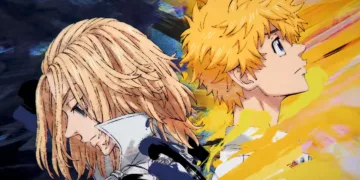























Takemichi tells Mikey about the futures he has witnessed, the lives he has tried to save, and the deaths he could not prevent. In “Break Up,” the premiere of Tokyo Revengers: War of the Three Titans Arc, that confession briefly makes their friendship less unequal. Mikey can finally understand the history behind Takemichi’s desperate interventions. He listens, refuses to blame him for Baji and Emma, and explains the faith he placed in him from their first meeting. The conversation gives Takemichi something his ability to revisit the past has failed to provide: permission to stop treating every loss as his personal failure.
Then the other members arrive, and Mikey disbands Toman. The placement matters. A scene built around sharing information leads directly into a decision made without collective discussion. Takemichi has explained himself; Mikey has offered reassurance, but little explanation of his own.
Calling forward the division captains and thanking them turns the announcement into a farewell ceremony before anyone has much opportunity to question it. The episode makes their affection unmistakable. It gives their acceptance less room to develop, leaving a consequential gap between understanding Mikey’s pain and understanding his choice.
The earlier funeral supplies a persuasive reason for that choice without entirely accounting for it. Following a recap of the Tenjiku conflict, Emma’s memorial forces the surviving characters to inhabit the aftermath of a victory that cannot restore her. Draken kneels before her grandfather and apologizes, receiving a response that preserves Emma’s affection for him.
That exchange locates the loss within a relationship rather than leaving it as another item in Takemichi’s growing inventory of failures. Draken’s loose hair, replacing his familiar tied-up appearance, quietly changes how we encounter him. The apology does the heavier dramatic work: he has survived, but survival has given him someone to answer to.
This is a useful function for the premiere’s restrained pace. The funeral does not need a new threat interrupting it to justify its place. It changes what the previous conflict’s outcome means. Kisaki is dead, yet the people gathered around Emma cannot experience his removal as an uncomplicated success. The recap establishes the events; the memorial establishes the cost. The episode is most assured when it allows those two tasks to remain distinct, rather than using grief merely to announce that another confrontation will be especially personal.
Takemichi’s conversation with Chifuyu makes that unsettled victory stranger. Learning that Kisaki had no time-travel ability leaves him admiring the intelligence of someone he cannot forgive. Kisaki accumulated influence through planning while Takemichi repeatedly returned to the past with information unavailable to everyone else.

His enemy’s ordinary limitations expose the limits of his own extraordinary advantage. Takemichi’s outburst and plunge into the river give this recognition an appropriately untidy expression. He wants to condemn Kisaki, understand him, and somehow recover the opportunity to settle things with him. Those desires do not fit neatly together.
The emotional response is convincing; the resolution that produces it remains less satisfying. Kisaki’s death beneath a truck in the previous arc terminated the pursuit before the rivalry could receive a sustained final exchange.
The clarification about his lack of powers now asks Takemichi, and the audience, to reinterpret the contest after its decisive participant has disappeared. There is value in making the survivor reconsider an enemy. There is also a difference between complicating a completed confrontation and compensating for an abruptly curtailed one. “Break Up” does effective work with Takemichi’s confusion, but cannot entirely repair the missing encounter.
Mikey’s dissolution of Toman offers a much larger change than replacing Kisaki with another opponent. The organization through which Takemichi has tried to alter history is being removed by the person whose future has repeatedly troubled him. After Emma’s funeral and Takemichi’s account of the casualties, ending the gang is a credible attempt to stop further harm. Mikey’s thanks also acknowledge that Toman has involved genuine loyalty, rather than allowing its violence to erase the relationships within it. The scene earns its sadness through that recognition.
Its weakness lies in how quickly shock becomes consent. Draken calls Mikey selfish, briefly putting the cost of unilateral leadership into words, but the objection receives little dramatic development. The captains have effectively been invited to attend the decision rather than participate in it. Their loyalty can explain a reluctance to challenge him; it cannot do all the work of showing what each is surrendering. This is how an episode with a leisurely succession of farewells can still feel hurried at its most important turn. Time spent marking a decision is different from time spent working through it.
Hakkai’s suggestion of a time capsule gives the dispersed group a concrete reason to meet again. Returning a week later with letters and meaningful possessions lets the members participate in shaping their farewell, something the dissolution largely denied them. The twelve-year interval connects this ordinary gesture to Takemichi’s movement through time, while the proposed reunion on Toman’s founding anniversary preserves a shared identity after the organization ends. It is an efficient piece of construction: affection becomes an appointment the future can either honor or fail.
That future remains withheld, so the capsule is a promise rather than evidence that anyone has been saved. On the motorcycle ride, Mikey encourages Takemichi to return to Hinata and assures him that he will protect everyone. His faltering smile gives us reason to hesitate without establishing what he intends.
The episode has supplied enough loss to make his reassurance understandable and enough secrecy to make it difficult to trust. Takemichi can inspect the future by leaving this moment behind, but doing so also removes him from the friend whose decisions he has only just begun to question.
Tokyo Revengers: War of the Three Titans Arc premiered on Disney+ and Hulu on October 2, 2026. The action anime series follows time-traveler Takemichi as he faces a dangerous new power vacuum in the underworld after the disbandment of the Tokyo Manji Gang.
Full Credits
Title: Tokyo Revengers: War of the Three Titans Arc
Distributor: Disney+, Hulu
Release date: October 2, 2026
Rating: TV-MA
Running time: 24 minutes per episode
Director: Maki Odaira
Writers: Yasuyuki Mutō
Producers and Executive Producers: Liden Films, Ken Wakui
Cast: Yuki Shin, Azumi Waki, Ryota Osaka, Yuu Hayashi, Masaya Fukunishi, Sho Karino, Yoshitsugu Matsuoka, Tasuku Hatanaka
Composer: Hiroaki Tsutsumi
The Review
Tokyo Revengers War of the Three Titans Arc
“Break Up” gives victory a credible emotional cost through Emma’s funeral and Takemichi’s unsettled response to Kisaki. Toman’s dissolution makes a substantial change, but the script spends longer commemorating the decision than examining it. Mikey’s reasoning and the captains’ acceptance need fuller development. The time capsule restores shared purpose, while the motorcycle farewell creates suspense through a promise whose reliability remains uncertain. An effective transition, with stronger emotional aftermath than dramatic resolution.
PROS
- Emma’s funeral grounds the casualties in personal relationships.
- Takemichi’s conflicted response gives Kisaki’s death emotional complexity.
- The time capsule connects friendship to a concrete future test.
- - Mikey’s farewell creates unease without revealing his intentions.
CONS
- Kisaki’s abrupt exit leaves the rivalry underresolved.
- Mikey’s decision to dissolve Toman receives limited explanation.
- - The captains’ acceptance lacks sufficient individual development.