



















Plankton can spoil a shot while sustaining almost everything worth filming. Its blooms feed the North Sea’s marine life and help cloud the water through which Peter van Rodijnen must photograph it. Cold, currents, and rough seas impose further restrictions; clear images are hard-won exceptions to difficult conditions. Mark Verkerk’s North Sea, Nature Untamed, filmed over seven years, makes this difficulty part of its ecological explanation. The water’s opacity has a function. What looks unpromising from the shore contains the food on which the film’s most spectacular subjects depend.
Van Rodijnen’s photography grants particular attention to a male shorthorn sculpin tending its eggs. He cleans them, circulates fresh water over them, and remains at his task until the young hatch. The pink eggs acquire eyes; small bodies emerge into dark water.
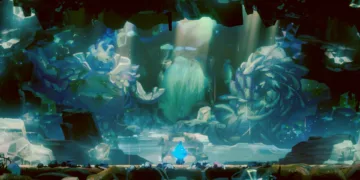
These details give the creature an existence independent of its usefulness to us. We watch labor, duration, and vulnerability. The underwater colors elsewhere can be startling, with blue bioluminescence and pinks, purples, and greens challenging the sea’s drab public image. Here, however, color helps us attend to a process. The eggs are beautiful, and they require care.
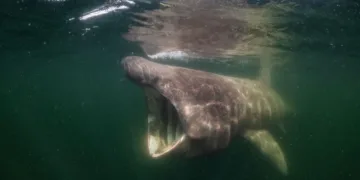
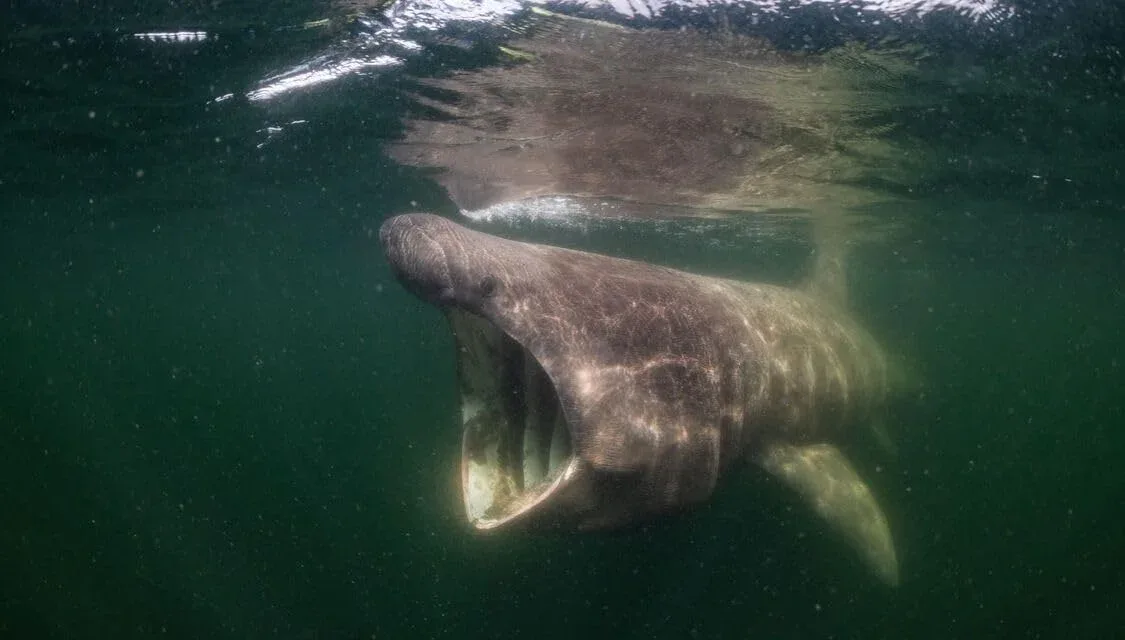
The basking shark supplies a different scale of attention. Its open mouth is an arresting sight, but its feeding brings the argument back to plankton. The large animal’s visual authority rests on tiny organisms that are difficult to see. This relationship gives the film a firmer organizing principle than its movement between species and locations might initially suggest.
From the Zeeland Delta to Scottish waters, encounters accumulate without one sustained dramatic trajectory. The construction sometimes feels loose, particularly as one animal episode gives way to another, but the food web supplies connections that geographical variety alone could not.
Van Rodijnen also narrates, and his voice makes the camera’s attachment explicit. His childhood admiration for Jacques Cousteau establishes a personal inheritance of curiosity, reinforced by Cousteau quotations throughout. The enthusiasm is credible because the footage demonstrates the patience behind it. His familiarity can nevertheless become a small act of interpretive coercion.
Wishing a departing gull “Good luck, little guy” is harmless enough; introducing cuttlefish courtship as romantic drama supplies a ready-made emotional category before the animals have much chance to establish their own strangeness. The basking shark becomes a friendly giant. Apparently even a plankton feeder needs a character reference. These gestures make the film approachable, but its strongest observations need less assistance.
That intimacy becomes substantially less comfortable aboard a Dutch fishing boat. The operation avoids bottom trawling, whose equipment damages the seabed, yet sharks and rays still appear among the discarded bycatch. Van Rodijnen recognizes these animals as the subjects of his photography.
The earlier attention to marine behavior now has a consequence: creatures we have learned to regard individually enter a process that classifies them as unwanted material. The images expose the limits of a reassuring description such as sustainable practice. Avoiding one destructive method leaves other harms visible. The boat’s conscientiousness and the animals’ vulnerability occupy the same account, without either being sufficient to explain away the other.
Off Shetland, the relationship between wildlife and industry becomes stranger. Orcas recognize the fishing vessel’s winch and take mackerel escaping its net. Human machinery has become part of their hunting environment. Then the scale of the commercial operation asserts itself, with thousands of fish drawn through enormous tubes into a steel vat.

The photographic question changes from how an animal moves to how a mass of animals can be transferred. Individual bodies become volume. Placing both kinds of feeding within the film permits comparison, but the differences in capacity remain immense. The orcas’ opportunism cannot make the machinery seem ecologically innocent.
Verkerk and Van Rodijnen resist turning the fishermen into convenient villains. The narrator’s time aboard gives him an understanding of their circumstances, and he judges the quotas in this particular mackerel fishery to be functioning. That qualification is useful precisely because the catch remains troubling to watch.
An image can establish the scale of extraction without settling every question about its acceptability. Here the commentary complicates the viewer’s response rather than naming the correct feeling. Sympathy for the fishermen coexists with the camera’s attention to the fish. The documentary allows that friction to persist, though the narrator’s assessment of one operation cannot serve as a certificate for fishing elsewhere.
Offshore wind construction introduces a pressure that the underwater colors cannot adequately describe. Pounding noise enters an environment where many organisms depend on sound, with potential effects extending to developing fish eggs. The acoustic disturbance changes the terms of our attention.
We have been admiring what human eyes can finally perceive; now the film asks us to register a form of intrusion that marine life encounters differently. The industrial presence reaches through water beyond the structure being built. Clean energy carries an ecological cost during construction, and the film’s willingness to examine that cost gives its environmental argument useful specificity.
The later prospect of refuge inside wind-farm areas complicates that damage without erasing it. Restrictions on fishing can protect portions of the seabed, while hard surfaces around foundations offer places for marine organisms to attach. Van Rodijnen’s dive to stone cargo lost decades earlier provides a tangible example of colonization: surfaces have acquired seaweed and animal life over time.
The image supports cautious optimism because it contains evidence of duration and changed habitat. It cannot promise the same outcome around every new development. Construction noise, protection from fishing, and the formation of reefs operate on different timescales. The organisms attached to those submerged stones have had decades; life exposed to the next construction site must survive the intervening disturbance.
North Sea, Nature Untamed arrived in UK cinemas on September 25, 2026, distributed by Dartmouth Films. The documentary follows experienced diver and underwater cameraman Peter van Rodijnen on a visual exploration of the rich, hidden marine ecosystem thriving beneath the waves of the North Sea.
Full Credits
Title: North Sea, Nature Untamed
Distributor: Dartmouth Films
Release date: September 25, 2026 (United Kingdom)
Rating: U
Running time: 1 hour 29 minutes (89 minutes)
Director: Mark Verkerk
Writers: Geert-Jan Roebers
Producers and Executive Producers: Klaudie Bertelink, Ignaś van Schaick
Cast: Peter van Rodijnen
Director of Photography (Cinematographer): Peter van Rodijnen, Dick Harrewijn
Editors: Helen Delachaux, Mark Verkerk, Sam Reitsma
Composer: Sven Figee
The Review
North Sea, Nature Untamed
Van Rodijnen’s camera makes marine life worth attending to before the fishing vessels turn it into catch. That change gives North Sea, Nature Untamed its ethical force. The photography rewards close observation, and the industrial sequences complicate sympathy without manufacturing villains. Familiar narration occasionally tells us how to feel, while the episodic structure can loosen the argument. Its optimism is strongest around the colonized stones, where recovery has taken decades and protection remains conditional.
PROS
- Patient photography captures intimate animal behavior.
- Concrete links between small organisms and large predators.
- Fishing footage sustains moral complexity.
- Wind-farm coverage gives recovery specific conditions.
CONS
- Overfamiliar commentary can narrow interpretation.
- Episodic construction occasionally feels loose.